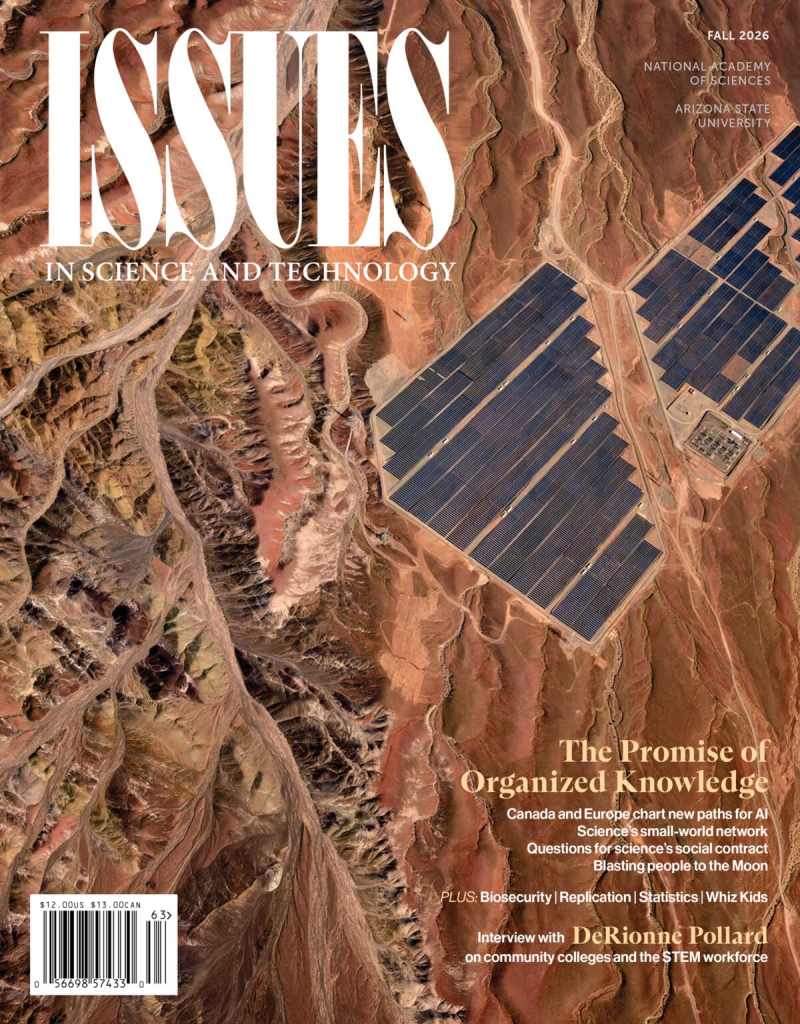
ISSUES IN SCIENCE AND TECHNOLOGY – FALL 2026

ISSUES IN SCIENCE AND TECHNOLOGY QUARTERLY MAGAZINE: The latest issue features ‘The Promise of Organized Knowledge’ – Canada and Europe chart new paths for AI Science’s small-world network; Questions for science’s social contract; Blasting people to the Moon….

The Promise of Organized Knowledge

The Fall 2026 issue explores how artificial intelligence might affect public policy in a variety of domains. Take biosecurity: Despite the fear that AI could be used to engineer dangerous pathogens, a former FBI special agent argues that the technology can also be used to uncover suspicious activity and possible bad actors before they become a threat. On economic policy: Spectacular wealth from AI will accrue to relatively few companies and individuals. What if a country were to create an AI sovereign wealth fund to distribute these profits more equitably? A group of Canadian scholars and legislators proposes to set up just such a fund. And when it comes to trust, a cultural anthropologist argues that CERN, the world’s most successful large-scale science collaboration, has many lessons to offer European regulators about how to build trust and transparency when using AI for science.

What Are the Goals for AI?

In “Escaping AI’s Measurement Trap” (Issues, Summer 2026), Urs Gasser, Viktor Mayer-Schönberger, and Fabienne Marco make a compelling case that governance of artificial intelligence faces a problem. Once benchmarks become targets, systems and their developers adapt to them, and measured performance may increasingly diverge from behavior in the real world. Their argument leads to a broader question: How can democratic societies not only improve the oversight of increasingly optimized AI systems, but shape what gets optimized in the first place?

A DISCUSSION OF

Escaping AI’s Measurement Trap

By Urs Gasser, Viktor Mayer-Schönberger, Fabienne Marco

Read Responses From

Biosecurity for the Age of AI

By Edward You

There is much discussion on how artificial intelligence poses threats to biosecurity; there should be at least as much focus on how AI can expand the solutions.

Today’s biosecurity approach is still grounded in a foundation laid nearly two decades ago. In 2008, when I reported to Federal Bureau of Investigation Headquarters as a newly minted supervisory special agent to support biosecurity policy, one important, emerging question was how providers of synthetic DNA should screen orders from customers. As commercial gene synthesis became increasingly accessible, many people worried that individuals could order genetic sequences coding for toxins and pathogens and then use them to cause harm.
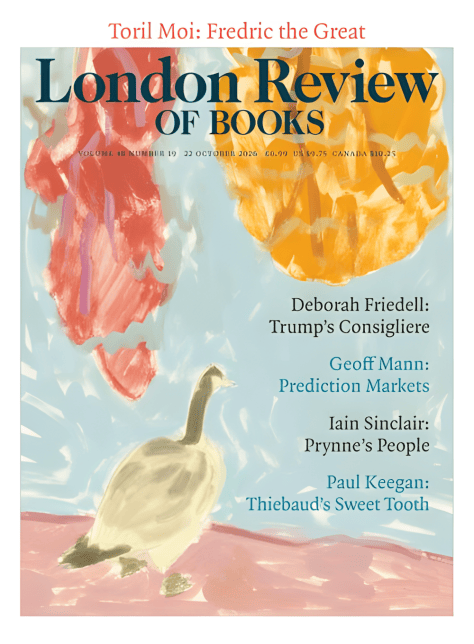
LONDON REVIEW OF BOOKS – OCTOBER 22, 2026 PREVIEW

LONDON REVIEW OF BOOKS: The latest issue features  Fredric the Great by Toril Moi; Trump’s Consigliere by Deborah Friedell; Prediction Markets by Geoff Mann; Prynne’s People by Iain Sinclair; and Theibaud’s Sweet Tooth by Paul Keegan….

Fredric the Great

Toril Moi

Fredric Jameson seemed to me to have read absolutely everything. He was the very antithesis of the intellectual type I think of as an empty theoriser, by which I mean someone who endlessly conjectures without having a genuine command of any relevant archive. To look at Fred as a reader of literature is not to reduce the scope of his work, but rather to try to understand its origins.

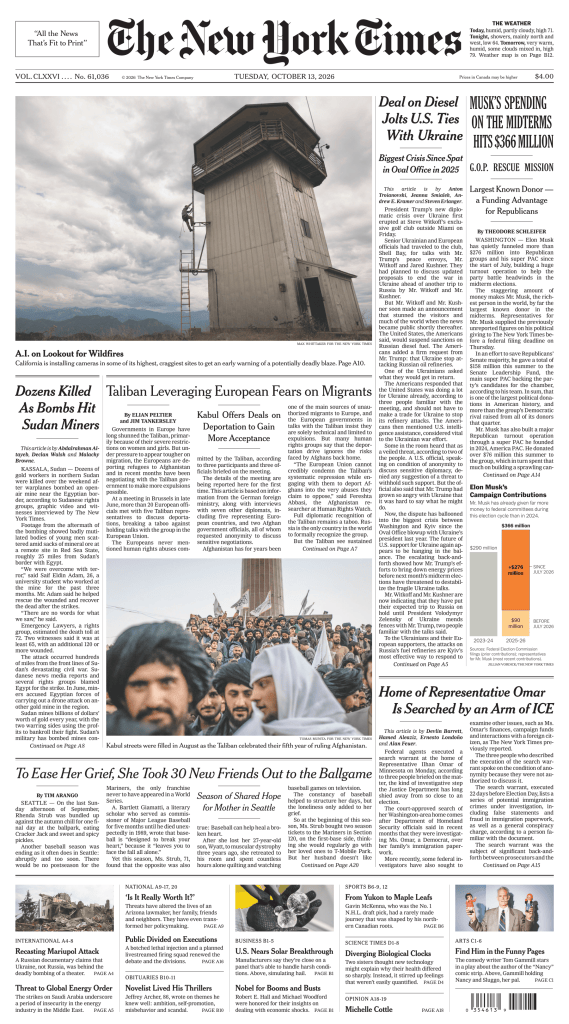
THE NEW YORK TIMES – TUESDAY, OCTOBER 13, 2026

The Oct. 7 Attack Changed Israel, but Not Its Politics

As Israelis prepare to vote for the first time since the Hamas-led assault, they remain divided over whether to hold Prime Minister Benjamin Netanyahu responsible for negligence or fault the “treason” of his generals.

U.K. and Europe Recoil From Trump’s Diesel Deal With Putin

Shocked by the U.S. agreement with Russia, which Ukraine has called “a gift” to President Putin, officials in Europe have coalesced around a cautious diplomatic message.

Top G.O.P. Groups Pull Support From First House Incumbents

Two Republican super PACs are said to be withdrawing cash from two House races as the party scrambles to prevent more widespread losses in the midterms.

NASA’s Perseverance Rover Sets an Off-Earth Driving Record

See how the rover traveled more than 28 miles on Mars, aided by self-driving technology.

FIFA’s Trump Tower Deal: 7 Years, $4 Million, One Mostly Unused Office

The deal is another sign of how Gianni Infantino, the leader of soccer’s global governing body, has sought closer ties to President Trump.

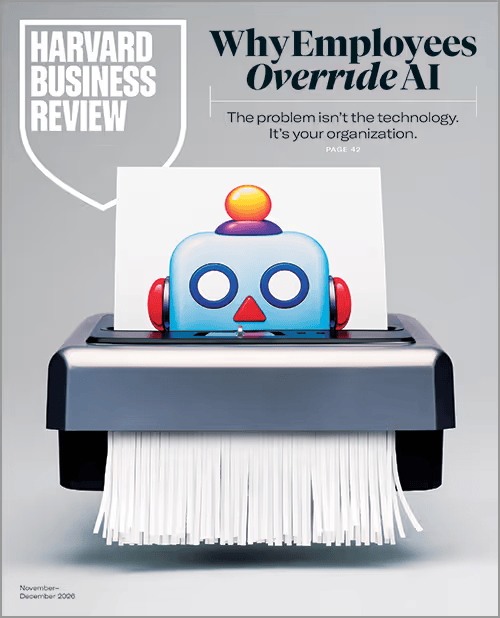
HARVARD BUSINESS REVIEW – NOVEMBER/DECEMBER 2026

HARVARD BUSINESS REVIEW: The latest issue features ‘WHY EMPLOYEES OVERRIDE AI’ – The problem isn’t the technology. It’s your organization.

Why Even Your Best Employees Override AI Systems That Work

It’s not that they don’t trust the technology. It’s that they don’t trust your organization.

Summary

Companies are deploying AI systems faster than they are redesigning the governance surrounding them. As a result, many AI systems remain permanent advisers rather than actual decision-makers—not because the technology falls short but because the…more

In late 2022 a global bank approved an AI system designed to automate routine credit decisions. On paper it looked exactly like the kind of forward-thinking move experts had been urging companies to make. In pilots the system processed applications faster than humans did, reduced errors, and promised meaningful cost savings. The risk management team signed off on it, compliance approved it, and the CEO touted it publicly as proof that the bank was leaning into the future.

Your Chatbot Will Define Your Brand

As conversational interfaces begin to dominate the customer experience, relationship design becomes a strategic priority.

For Real Performance Gains with AI, Start by Mapping Your Workflows

That’s how to reveal the most promising opportunities.

PERCHANCE TO FORGET

Intellicurean Essays· on Intellicurious

You wake the morning after a long dinner with an old friend, and the exact words are gone. What remains is the turn of it, the first draft of a story you may tell for years. Something chose what to keep while you slept. A new essay asks what happens to the minds that never get that night.


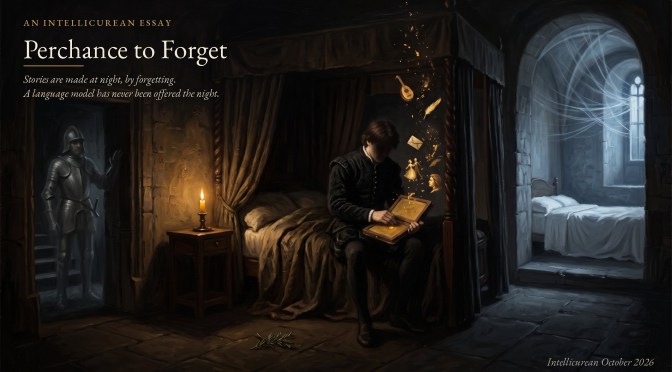
Perchance to Forget: a candlelit stone chamber at night. A young man in black sits on the edge of an unslept four-poster bed, pressing smooth a wax tablet as small gold shapes, a lute, a feather, a letter, a dancing couple, a face, drift up from it and dissolve. A faded armored ghost stands in a doorway at left; at right, through an arch, an empty, perfectly made bed lies under cold blue-white threads of light.
A prince wipes the table of his memory; across the hall, a bed no one sleeps in. Made for the essay.

Why we’re pointing you there

Sleep, on one leading account, is when the brain lets most of the day go, and the selection is where stories begin. Michael Cummins follows the people who could not make that trade. Borges’s Funes remembers every leaf of every tree and cannot think, because “to think is to forget a difference.” Solomon Shereshevsky, the real-life mnemonist Alexander Luria studied for almost thirty years, wrote down what he wanted to forget, burned the slips, and still saw the words. Nietzsche held that without forgetting it is impossible to live at all, and slept badly. Oliver Sacks’s amnesiac patients kept nothing, and one of them invented a new world every few minutes, while Sacks’s own journals, it turns out, confess inventions of his own.

Then the machine. A language model, the essay argues, has two memories, and they are opposites: a vast library that forgot almost every particular, and a conversation it holds entire and keeps none of. What it lacks is the night between them. When engineers try to make a model unlearn, the forgotten knowledge comes back, just as the words came back to Shereshevsky through the fire. The essay says plainly that it was drafted with Claude, and it asks one question: what would it mean for a machine to sleep?

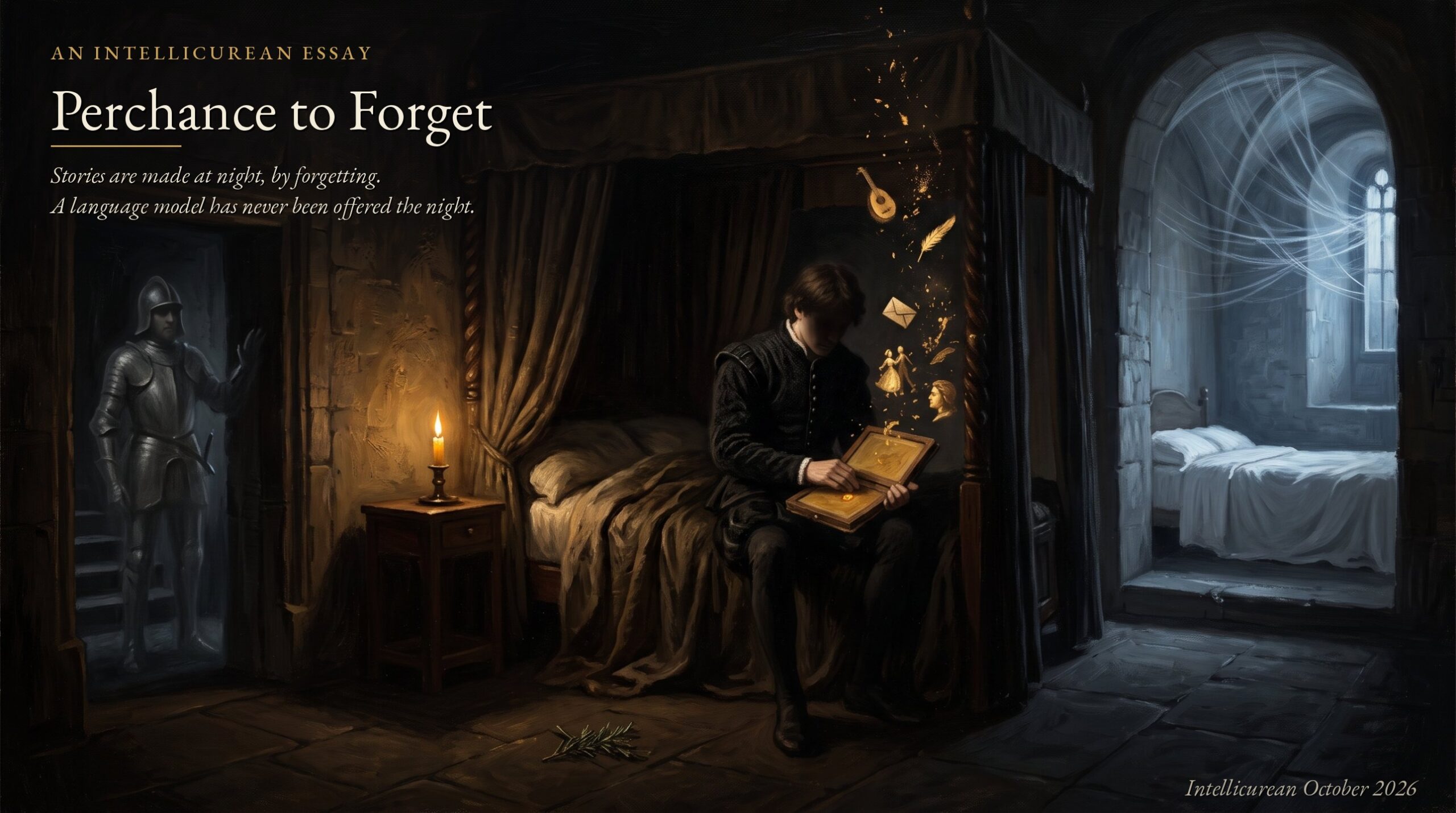
A dark 1920s room at night. A man in shirtsleeves kneels at an open iron stove, feeding slips of paper into the fire. From the smoke, a stream of pale slips pours out across the room toward a cold blue-white window, where fine threads of light catch them and stitch them into a tiled lattice across the ceiling.
Burning the paper, and what survives the fire. Made for the essay.
Read the full essay at Intellicurean →

Essays & Reviews for the Intellectually Curious

CITY JOURNAL MAGAZINE – AUTUMN 2026 PREVIEW

CITY JOURNAL MAGAZINE: The latest issue surveys pivotal shifts across American technology, governance, and culture, featuring essays on the nuclear energy revival, the impacts of federal civil service cuts, municipal socialism in Chicago, and ideological conflicts in the arts and healthcare.

DEI in Medicine Hurts Black Patients Most

Protocols that regard metrics like BMI as racist or refuse to report drug use in pregnant women are not medically sound.

The Left’s War on Gig

Costly labor mandates are hurting the very workers they’re supposed to help.

Britain’s Crisis of Governance

Small groups of motivated ideologues have imposed their views on a hostile populace.

David Foster Wallace’s Infinite Scroll

The novelist’s 1990s vision of entertainment as addiction is more relevant than ever.

Missionaries to the Jobless

Mormon employment counseling offers everything from resumé writing and networking to moral support and

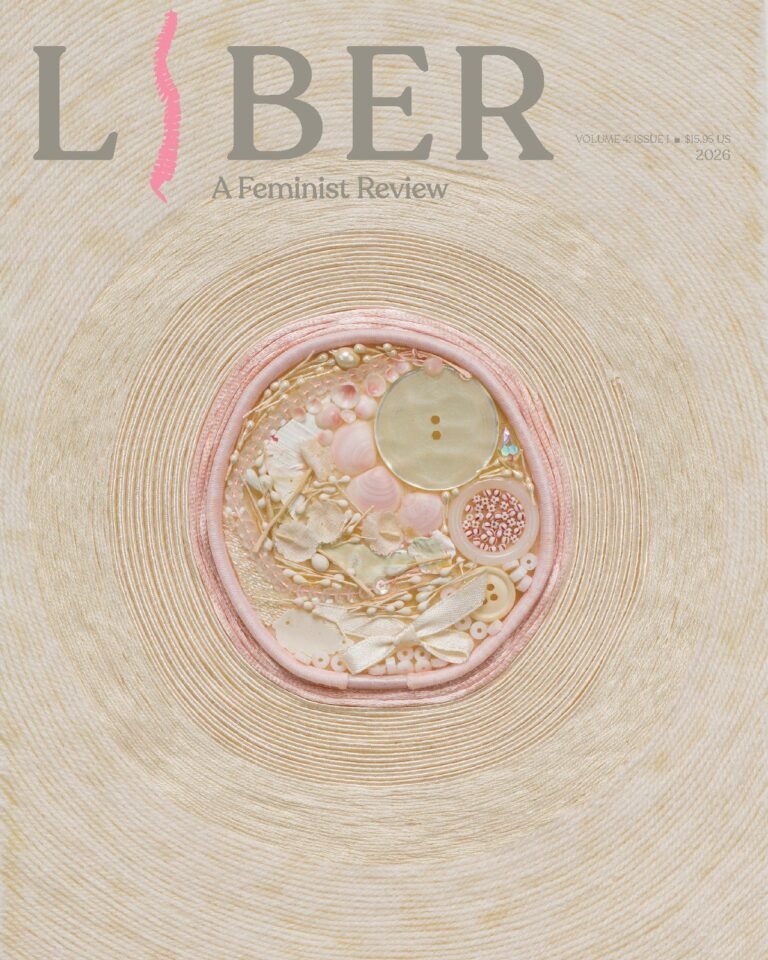
LIBER FEMINIST REVIEW – FALL 2026 PREVIEW

LIBER FEMINIST REVIEW: The latest issue features a diverse collection of essays, poetry, and reviews including Catharine A. MacKinnon’s feminist defense of transgender sex equality rights, personal essays on Rachel Pollack and tarot, and reviews of works by authors such as Rachel Cusk, Deborah Levy, and Sara Ahmed.

“My Year in Paris with Gertrude Stein: A Fiction” by Deborah Levy

Reviewed by Hailey Krueger

My first day ever in New York, age sixteen, I got stuck in the middle of Central Park in the pouring rain with no umbrella and zero sense of direction. Drenched, cold, and hopelessly wandering from the Alice in Wonderland statue to the steps of the Met, I was in remarkably high spirits. I had read Just Kids earlier that summer and regarded this trip as a rite of passage in my Patti Smith pilgrimage. The city was not a stranger to me: there was Washington Square Park, where Patti had slept during her first few weeks, she and Robert Mapplethorpe surviving on lettuce sandwiches. Sure, each face I passed on Fifth Avenue was unfamiliar, but I could imagine Patti and just know I belonged. Even the comically overpriced T-shirts at the John Varvatos store on the Bowery shimmered with Patti and CBGB-era spirit.

Patti wasn’t my first author/guide. I’d opted for books over a social life throughout much of high school and had long approached new destinations through the eyes of a beloved author. When I began at Smith College, I knew from Sylvia Plath’s journals to write in my own on the porch of Haven/Wesley. I assumed this author-as-friend-guide was my own (mal)adaptive quirk. That is, until I read Deborah Levy’s My Year in Paris with Gertrude Stein.

“The Book That Taught the World to Orgasm and Then Disappeared: Shere Hite and the Hite Report”

By Rosa Campbell

The Netflix series Bridgerton features a plotline about a nineteenth-century noblewoman desperately seeking a sexual “pinnacle” that coitus withholds from her yet not her husband. Meanwhile, the New York Times Wirecutter product review site recommends vibrators you can buy at Walgreens.

My, times have changed.

Fifty years ago, when feminist writer Shere Hite (1942–2020) published The Hite Report: A Nationwide Study of Female Sexuality, one of the best-selling books of all time, conventional wisdom dictated that plain old intercourse was the ticket to orgasm for women as well as men. Any woman who needed clitoral stimulation was deviant or trapped in her “phallic” stage; a mature woman achieved orgasm through the vagina (thanks, Freud). Hetero men didn’t know that what felt good for them didn’t necessarily feel good for women. Many women chose to fake pleasure rather than speak up because they were embarrassed or, rightly, worried about being belittled as pushy and slutty.

“Life of M: A Novel” by Rachel Cusk

Reviewed by Anna Godbersen

I had anticipated that Rachel Cusk’s latest would be a captivating work of big ideas. The premise—a nameless narrator encounters one of the great and celebrated film actors of the era and then attempts to write an “autobiography” of said star—is both juicy and think-y, a stage upon which brilliant observations can mingle with feminine angst and glamour.

THE NEW YORKER MAGAZINE – OCTOBER 19, 2026 PREVIEW

The cover for the October 19 2026 issue of The New Yorker which features a person wearing a colorful patterned sweater...

THE NEW YORKER MAGAZINE: The latest issue cover features Malika Favre’s “Sweater Weather” – Comfortable patterns.

Donald Trump After the Midterms

If the coming election does result in a blue wave, Trump will be faced with the fact of his diminishment. The rest of us will be faced with the wreckage. By David Remnick

We’re Learning to Live with Waymos. It’s Going Weird

A view from the back seat. By Molly Fischer

Kash Patel’s Slap Shot

The F.B.I. director’s hockey team, the Dons, faced their rivals in a beer league. With rogue slap shots and hovering security agents, Patel was in the zone—or, at least, next to it. By Richie McGinniss

My Education on the Border of the Syrian War

In the last Turkish town on the road to Aleppo, jihadis and spies mixed with reporters trying to prove themselves. By Ben Taub

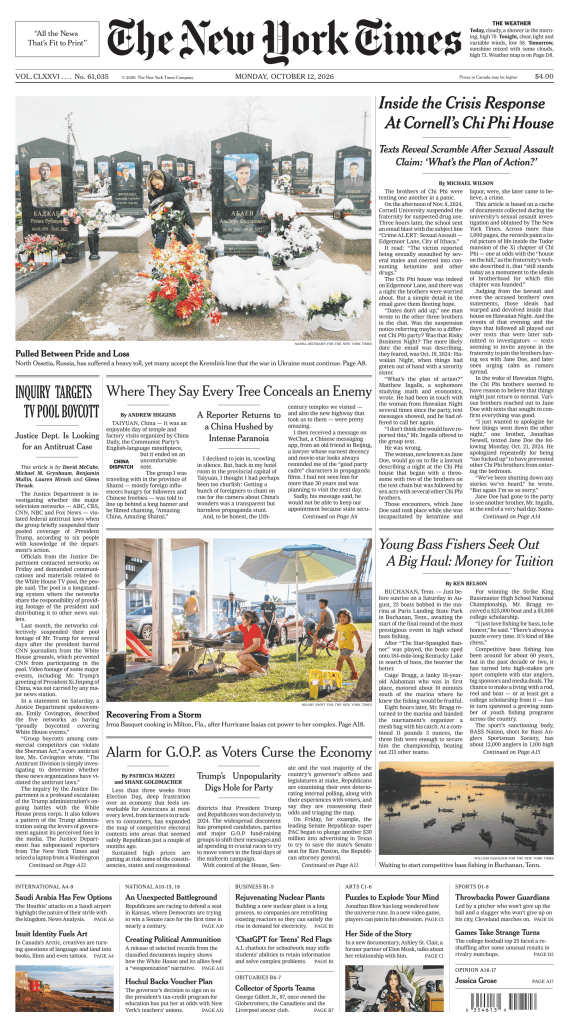
THE NEW YORK TIMES – MONDAY, OCTOBER 12, 2026

Israel’s Destruction of Southern Lebanon Intensified After the Cease-Fire

Much of Israeli-occupied southern Lebanon has been leveled, according to a Times analysis, and the majority has been destroyed by Israel since the April truce.

World’s Energy Order Tested Again as Iran War’s Reach Extends Further

“We are entering an age of prolonged insecurity,” one former U.S. energy official said of what have become chronic threats on the Middle East’s energy core.

Iran Offers to Mediate Between Its Houthi Allies and Saudi Arabia

Elon Musk Flooded Republican Groups With $276 Million in Rescue Mission for G.O.P.

He has quietly become by far the biggest known midterm donor, trying to save Republicans’ Senate majority with some of the largest donations in U.S. political history.

The Taliban Are Using Europe’s Fear of Migrants to Their Advantage

European nations that condemn the Taliban government for its human rights record are seeking its help to deport refugees back to Afghanistan.

Investigation Into FlyDubai Attacker Puts Spotlight on an Australian Mosque

Emirati investigators said the co-pilot accused of attacking a captain on a flight to Israel drifted toward extremism during his time as a student in Australia.

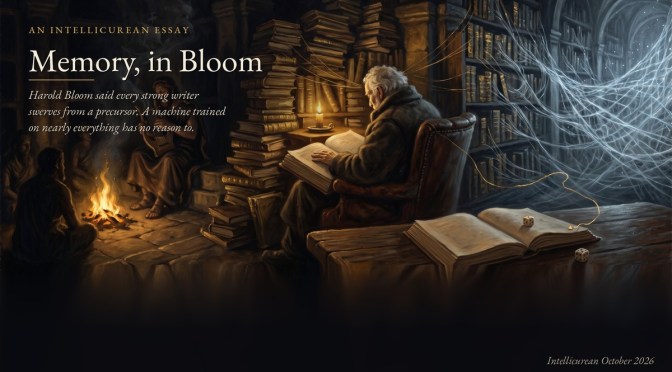
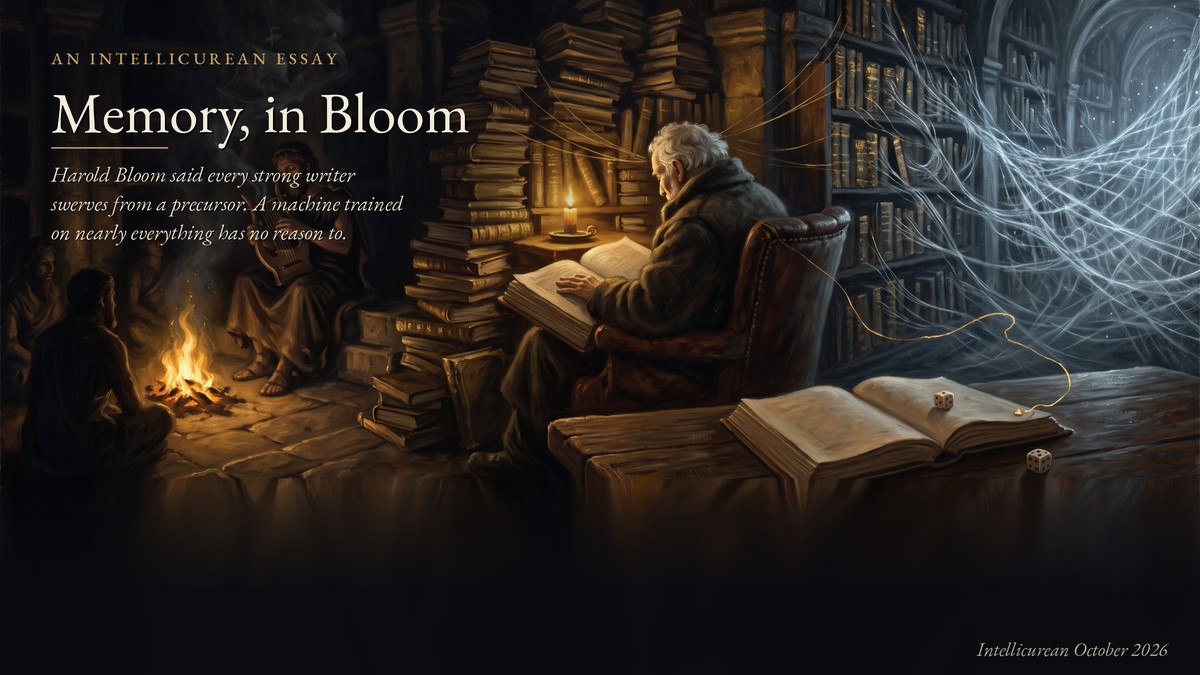
MEMORY, IN BLOOM

Intellicurean Essays· on Intellicurious

Nothing reliable is known about the life of Homer, yet two founding poems of Western literature bear his name. Harold Bloom, who said he could read and absorb a 400-page book in an hour, left a monument made not of poems but of memory. A new essay sets them face to face, with a third reader between them.


Memory, in Bloom: a vast night library in three parts. At left a Greek bard plays a lyre by a fire, smoke rising into the shapes of ships. At center an old white-haired reader in a leather armchair rests his hand on an open book among towering stacks, gold threads running from the books to his head. At right the shelves dissolve into a lattice of cold blue-white light. Two bone dice lie on a table in the foreground.
The singer, the reader and the lattice: three ages of memory in one room, made for the essay.

Why we’re pointing you there

Bloom held that every strong writer survives the past by misreading it on purpose, swerving from a precursor to make room for something new. Michael Cummins sets that theory against a reader Bloom never met: a language model, trained on a large share of everything written. The essay moves through scenes rather than abstractions. In 1926 the editor of Poetry asked Hart Crane, whose poems were the first book Bloom ever owned, to explain how dice could “bequeath an embassy,” and Crane’s answer became a defense of the unlikely line. A singer in 1930s Yugoslavia swore he sang a song “word for word and line for line,” and the recordings showed he hadn’t. In 2023 a chatbot supplied a federal court decision, signed with a real judge’s name, that no judge had ever written.

Along the way come Benjamin Franklin rebuilding essays from The Spectator, Helen Keller’s trial over a story she didn’t know she remembered, BloomBloom’s one novel and the precursor he couldn’t escapersquo;s one novel and the precursor that haunted it, and a singer in the Odyssey pleading for his life: “Self-taught am I.” The essay says plainly that it was drafted with Claude. It leaves one question open: when a writer can ask, at any hour, for the likeliest next line of anything, will that writer still learn to want the line no one else could have written?

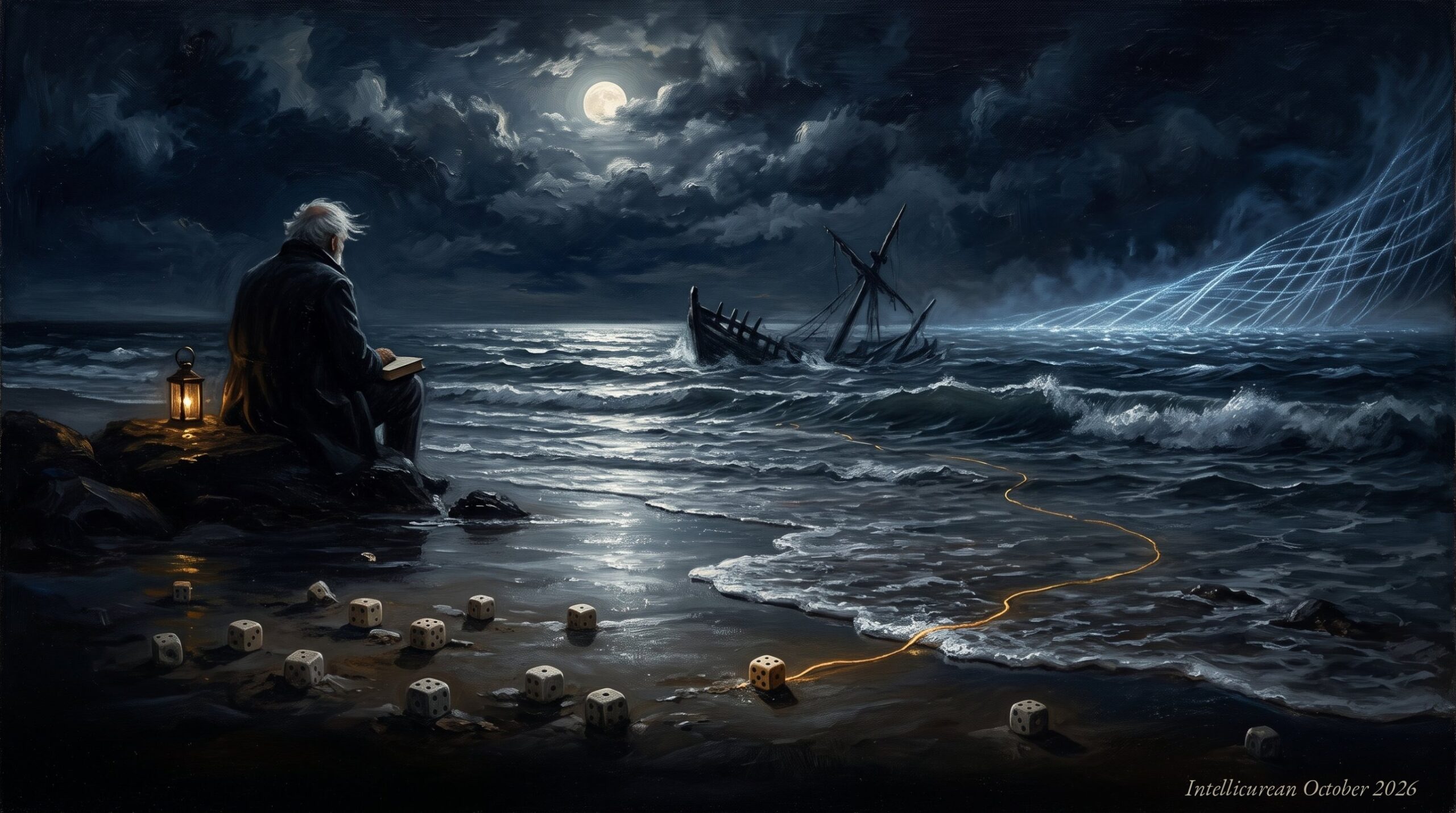
A moonlit shore at night. Small bone dice lie scattered on the wet sand; one, lit by a nearby lantern, trails a thin gold thread through the surf toward a wrecked sailing ship. On a rock at left an old man sits with his back to us, a closed book on his knee, watching the sea. Far off on the right, the moonlight breaks into a lattice of cold blue-white light.
The dice of drowned men’s bones, after Hart Crane, made for the essay.
Read the full essay at Intellicurean →

Essays & Reviews for the Intellectually Curious