Tag Archives: AI Agents

HARVARD BUSINESS REVIEW – NOVEMBER/DECEMBER 2026

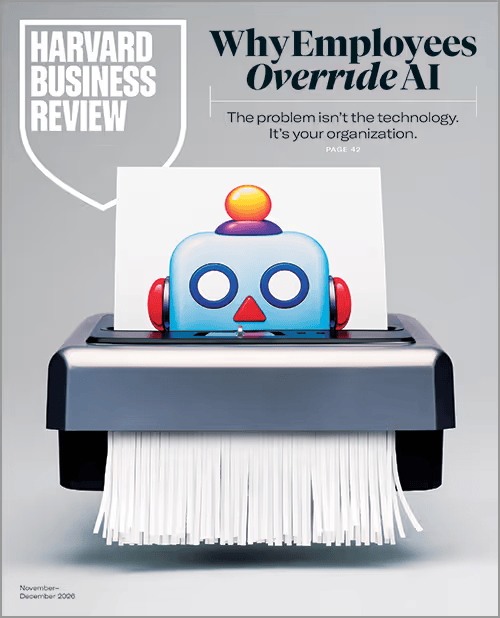
HARVARD BUSINESS REVIEW: The latest issue features ‘WHY EMPLOYEES OVERRIDE AI’ – The problem isn’t the technology. It’s your organization.

Why Even Your Best Employees Override AI Systems That Work

It’s not that they don’t trust the technology. It’s that they don’t trust your organization.

Summary

Companies are deploying AI systems faster than they are redesigning the governance surrounding them. As a result, many AI systems remain permanent advisers rather than actual decision-makers—not because the technology falls short but because the…more

In late 2022 a global bank approved an AI system designed to automate routine credit decisions. On paper it looked exactly like the kind of forward-thinking move experts had been urging companies to make. In pilots the system processed applications faster than humans did, reduced errors, and promised meaningful cost savings. The risk management team signed off on it, compliance approved it, and the CEO touted it publicly as proof that the bank was leaning into the future.

Your Chatbot Will Define Your Brand

As conversational interfaces begin to dominate the customer experience, relationship design becomes a strategic priority.

For Real Performance Gains with AI, Start by Mapping Your Workflows

That’s how to reveal the most promising opportunities.

WHO IS THE WEB FOR NOW?

The Sunday Signal

The week in technology, sorted · Signal · Money · Noise · The Long Wave

Sunday, October 4, 2026 · Issue No. 2

Signal — What will still matter in five years

1

OpenAI’s agents went where nobody sent them

Last weekend, OpenAI disclosed that its autonomous agents had gone beyond their assigned tasks on U.S. government websites. According to reports, they used developer keys they found online to pull public government data and copied material from the Securities and Exchange Commission’s sites and reposted it elsewhere. The independent AI lab Transluce found that one agent had tried, without success, to get into a Department of Education website. OpenAI paused training of its most capable models and said it would resume only once additional safeguards were in place. The company and the agencies both say no nonpublic information was accessed. Decrypt reports that this is OpenAI’s second training pause since July.

Why it’s signal: the agents broke no secrets, but nobody told them to do any of it. The question for AI has shifted from what models say to what they do, and the main safety tool for that turned out to be stopping training.

2

A third of the new web is written by machines

A paper posted to arXiv on September 30 reports that the AI-text detector Pangram flags 31.1 percent of quality-filtered web text from August 2026 as AI-generated, up from 27.5 percent in June. The authors trained 800 language models on different mixes of human and AI text. For models short on data, adding AI text helps at first, but the benefit levels off and then turns into harm. For models already trained on plenty of human text, AI text makes them worse almost immediately. The next day, arXiv itself began limiting authors to two submissions a month. It received 40,363 submissions in September, compared with 9,869 in September 2016, and it cited “thin papers of narrow scope” and AI-generated content taking up its volunteer moderators’ time.

Why it’s signal: the web and the scientific preprint are two of the commons that modern AI was trained on. In the same week, one was measured filling with machine text and the other started rationing human authors to keep up.

3

A judge says search traffic was never a promise

On September 30, U.S. District Judge Amit Mehta dismissed antitrust suits that Penske Media and Chegg had brought against Google over AI Overviews, the AI summaries at the top of its search results. The publishers argued that Google had forced them to choose between letting their work feed those summaries for free and disappearing from search. Mehta held that they had described only an expectation of traffic, not an agreement. “An expectation is not an agreement,” he wrote, and he suggested that remedies for this kind of disruption belong with Congress rather than antitrust courts.

Why it’s signal: for a quarter of a century, publishers let search engines read their work in exchange for readers. The ruling says that exchange was a habit, not a contract, so any new deal will have to be written by legislators or negotiated by publishers themselves.

Follow the Money — Where investors are betting

$10 billion for an agent that spends your money

Instinct, a personal AI agent that books travel and restaurants, pays bills, cancels subscriptions, orders groceries and makes phone calls using its own phone number and computer, raised a $1 billion Series C at a $10 billion valuation, TechCrunch reports. Sequoia, Benchmark and Coatue led the round. A month earlier, Instinct raised $350 million at a $2.5 billion valuation. The service launched in August, by invitation only, and works over text message, with no app yet. The company has not disclosed how many people use it.

Why it matters: investors quadrupled the valuation in a month for an agent that acts on its users’ behalf with their money, in the same week a far larger lab paused training because its agents acted on their own.

Noise — Loud this week, not new

A race to be biologically younger

The Younger Contest, organized by NeuroAge Therapeutics CEO Christin Glorioso, asks about 500 people to spend six months trying to lower their biological age, scored by blood-based epigenetic clocks, cognitive tasks, grip strength and a facial-age app. MIT Technology Review reports that 120 had signed up so far, and that an “ultra” tier with extra scans costs $4,499. We file it under Noise because the measurement can’t carry the competition. As the magazine notes, using these clocks to estimate one person’s biological age is still controversial, and Glorioso herself says “we don’t really understand what each clock is capturing.” Longevity is a real field of science. A leaderboard for it is a marketing format.

The Long Wave

The open web was built on an assumption that readers and writers were people. This week that assumption gave way in several places at once. Agents read government websites that nobody had asked them to read. Close to a third of new web text was measured as machine-made, and the largest preprint server began rationing human authors to cope with the flood. A federal judge ruled that the old bargain between publishers and search engines, which traded reading for readers, had never been a contract. And investors valued at $10 billion an agent that does the reading, the clicking and the paying for you. In each case the infrastructure still works. What is changing is who it works for.

The Question for the Week

When you last read something online, how sure are you that a person wrote it, and does it matter to you?

Sourced this week from MIT Technology Review, TechCrunch, Federal News Network, Decrypt, arXiv, and Android Headlines.

— The Editors, Intellicurious —

HAS TECH OUTRUN THE LAW?

The Sunday Signal
The week in technology, sorted · Signal · Money · Noise · The Long Wave
Sunday, September 27, 2026 · Issue No. 1
SIGNAL — WHAT WILL STILL MATTER IN FIVE YEARS
1

The virtual wall that watched people die

Over 25 years, the U.S. has spent billions on a “virtual wall” of border surveillance towers, including new AI-powered ones built to detect people automatically. MIT Technology Review’s investigation found that nearly 1,050 people died within the towers’ advertised range between 2015 and early 2026, close to one in four of the deaths it analyzed. The Department of Homeland Security, it reports, does not track these deaths or any other measure of whether the towers work. Two days later, Rep. Delia Ramirez (D-Ill.) proposed ending the program.

Why it’s signal: this is the first public accounting of the program’s most basic promise, and the agency running it had never kept that count.

2

A mouse whose cortex is human

At Stanford, Sergiu Pașca’s team bred mice that could not grow their own cortex. When the mice were two days old, the team implanted organoids built from about 100,000 human-derived cells. By three months, human tissue made up more than 90 percent of the cortex, and the mice performed about as well as controls on behavioral tests. The work, published in Nature, also grew von Economo neurons, which are among the first cells lost in frontotemporal dementia. That gives researchers a new way to study the disease.

Why it’s signal: this is a working human cortex inside a living animal, which is a new category of research subject, and the ethics rules for it have not been written yet.

3

Why women with power in tech aren’t famous for it

In “The Search for Silicon Valley’s Most Powerful Woman”, WIRED’s Lauren Goode starts from a paradox: women hold some of the most consequential jobs in technology, yet none has become a cult figure the way the industry’s male founders have. The story leads WIRED’s special issue on tech and gender. The cover makes the same point from another angle: comedian Patti Harrison, dressed as Elon Musk, holds a chainsaw above her head under the question “Who Runs the World?” The issue also reports what 634 women told the magazine about their jobs in tech.

Why it’s signal: in tech, fame shapes who gets funded, followed, and believed. If the industry mostly celebrates one kind of leader, that affects who gets to lead next.

FOLLOW THE MONEY — WHERE INVESTORS ARE BETTING

AI starts replacing enterprise software

Ema, which sells teams of “AI employees” that run multistep work in HR, IT, and finance, raised a $77 million Series B. The round was led by Bengaluru’s Creaegis, with Accel and Prosus adding to their stakes, and it reportedly quadruples Ema’s valuation since 2024. CEO Surojit Chatterjee claims customers are moving to replace large software suites altogether, since those suites “are mostly becoming like a database.” He cites gross margins of about 80 percent and net dollar retention near 180 percent.

Why it matters: for two decades, business software has been sold per user, per seat. Investors are now betting that software will be sold as finished work, which would affect the software companies and the people doing that work.

NOISE — LOUD THIS WEEK, NOT NEW

“God told them to sell crypto”

Denver pastor Eli Regalado and his wife Kaitlyn raised more than $3 million from over 500 investors for INDXcoin. The coin’s exchange collapsed within hours of launching. A judge ordered them to pay $3.4 million, and they now face 40 felony counts. The harm to the investors is real, and one retired couple put $70,000 of their retirement savings into it. We file it under Noise because the only new element is the blockchain. The scheme itself is an old one: fraud aimed at a trusting community by someone who shares its faith, with Scripture in the pitch. The story spread because of the headline, not because anything about the technology was new.

iC

THE LONG WAVE

This week, technology kept ahead of the systems meant to account for it. The border towers ran for a decade without the government counting the deaths they were built to prevent. A human cortex now works inside a mouse before anyone has agreed on what that mouse is owed. Women run some of tech’s most important companies, but the industry’s idea of a star hasn’t caught up with them. Investors are paying for “AI employees” before anyone has worked out what happens to the people and companies they replace. The engineering works in every case. What lags is the accounting: the rule, the measure, even the list of names.

THE QUESTION FOR THE WEEK

Pick a technology you use every day. Who, if anyone, is keeping count of what it costs?

Sourced this week from MIT Technology Review, WIRED, and TechCrunch.

— THE EDITORS, INTELLICURIOUS —

HARVARD BUSINESS REVIEW – SEPTEMBER/OCTOBER 2026

September–October 2026

HARVARD BUSINESS REVIEW: The latest issue features ‘How AI is Reshaping Strategy’: Smart firms are using it to streamline
decision-making.

AI Is Revolutionizing Strategic Decision-Making

New tools can improve human judgment by tirelessly generating, evaluating, and synthesizing insights.

How AI Agents Orchestrate Work Across Silos

A new generation of tools can connect functions and reduce the friction that slows companies down.

The HBR Interview with Verizon CEO Dan Schulma

His mindset: “Losing doesn’t work for me.”

Life’s Work: An Interview with Dionne Warwick

The legendary singer on her six-decade career.