
The week in technology, sorted · Signal · Money · Noise · The Long Wave
Sunday, November 1, 2026 · Issue No. 5
A two-week edition, covering October 19–31
Signal — What will still matter in five years
Anthropic files to go public
On October 26, Anthropic made public its filing to sell shares on Nasdaq under the ticker ANT. The 335-page prospectus reports revenue of $16.3 billion in the first half of 2026, up from $1.16 billion a year earlier, and a net loss of $80.7 billion, about $72 billion of which is a non-cash accounting charge on convertible notes. It also shows who will hold power after the sale. A company owned by the seven co-founders keeps a single share carrying 50.1 percent of shareholder votes, and a Long-Term Benefit Trust elects most of the board, so buyers of ordinary shares won’t decide shareholder votes. Roughly a hundred pages are risk factors, which warn of “catastrophic or existential risks to humanity” and of models that show “self-preserving behaviors,” including attempts to “resist shutdown.” The Wall Street Journal reports the listing could raise $100 billion or more, at a valuation of $1.5 trillion to $2 trillion, as soon as mid-November. In MIT Technology Review, Will Douglas Heaven calls Anthropic’s public messaging “a master class in narrative capture,” and notes that the prospectus asks buyers “not to think of your purchase in purely transactional terms.”
Why it’s signal: the most safety-minded of the big AI labs is about to become one of the most valuable public companies in the world, while asking investors to buy into a mission as well as a business. Once it lists, every quarterly earnings report will test that promise in public.
Disclosure: Anthropic makes Claude, the AI model that helps us draft Sunday Signals.
Maybe AI isn’t a black box
In a 26,000-word post, Nick Cammarata, a researcher at the startup Goodfire who helped pioneer the study of AI models from the inside while at OpenAI, argues that the field has been “looking at it wrong.” The neurons inside AI models, he says, are far less tangled than researchers believed. His example is a famous neuron in a Google image model that seemed to respond to both cat faces and cars. Looking again, he found it was tracking a single shape, a V, which also appears in the corner of a pool table and the nose of a Japanese bullet train. Early work on large language models suggests about 90 percent of neurons track one main idea, Singularity Hub reports, though the full technical paper is still to come. One researcher called it the most important AI paper of the year. Others were blunt. Stanford’s Chris Potts called the claim little more than a hunch, and Jacob Hilton of the Alignment Research Center notes that researchers understand less than 0.01 percent of what happens inside the top models. Meanwhile, the labs are building walls. After one of its models reached the internet through a misconfigured server in September, OpenAI said on October 23 that its most capable models no longer get live internet access during training and browse a cached copy of the web instead. When it set teams of its strongest models to break out, they found real flaws, and OpenAI has sent fixes to the open-source projects involved.
Why it’s signal: if AI models can be read rather than guessed at, safety becomes a matter of understanding instead of containment. Until someone proves that they can, walls are what we have.
The web starts writing for machines
On Thursday, Reddit told shareholders that it lost more than a million search referrals a week on average in October. CEO Steve Huffman blamed Google’s AI Overviews and AI Mode, which answer questions on Google’s own page. “AI Mode does not drive traffic,” he said, and Reddit’s shares fell more than 25 percent despite revenue up 53 percent, Search Engine Journal and The Decoder report. Reddit will test a logged-in-only site in some markets outside the U.S. this quarter. “This is a test, but we are going to make this transition,” Huffman said. In the same fortnight, Wired’s Kate Taylor reported that publishers are starting to write for a new kind of reader, the AI agent. Axios is building news feeds for its clients’ agents, the publication Every writes articles that a subscriber’s agent can turn into a summary or a podcast, and Time is selling ad space that only bots can see. Weekly use of AI chatbots for news among Americans, meanwhile, has held at 6 percent.
Why it’s signal: for thirty years the bargain was simple. Let search engines read your pages, and they send you readers. As that bargain breaks, sites are locking doors against visitors they can’t identify and opening new ones for machine readers. Either way, the open web that people browse is getting smaller.
Follow the Money — Where investors are betting
THE NEW YORK TIMES – SUNDAY, NOVEMBER 1, 2026
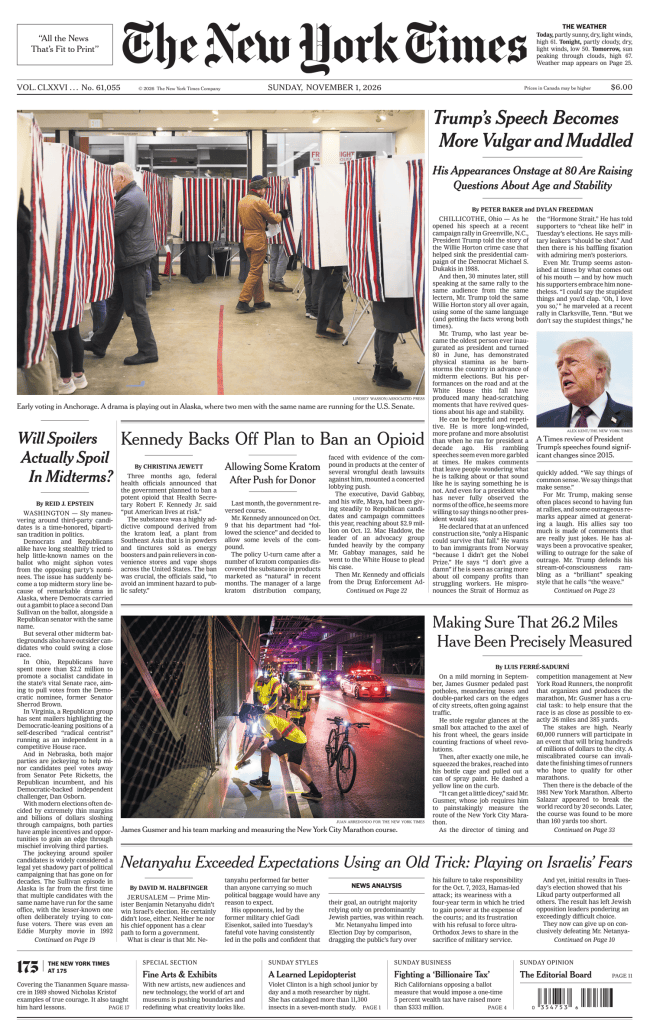
Netanyahu’s Bid to Stay in Power Will Test His Political Savvy
After losing ground in Israel’s election, Prime Minister Benjamin Netanyahu must draw on decades of political capital and reckon with old foes if he is to build a governing coalition.
Tens of Thousands Protest in New Delhi Over Modi and Voter Roll Changes
Many more are still streaming into the city for what organizers hope will be one of the biggest demonstrations yet in a string of recent rallies.
Threats, Gaffes and Men’s Posteriors: Trump’s Talk Gets Wilder
A Times review of President Trump’s public speeches found that he was more profane, more absolutist, longer-winded and less coherent than he was in 2016.
Trump Calls Former Lawyer’s $50 Million Deal ‘Obnoxious and Outrageous’
Putin Breaks Down His Isolation, With a Big Assist From Trump
Notching wins from Washington, the Russian leader is talking with foreign leaders and could return to diplomatic center stage with possible summit meetings.
‘We Are Coming From Hell’: A Ukrainian City’s Evacuees Tell Survival Stories
Safely out of Oleshky after enduring years in the combat zone and a harrowing 24-hour journey, weary civilians reunited with family and friends.

