
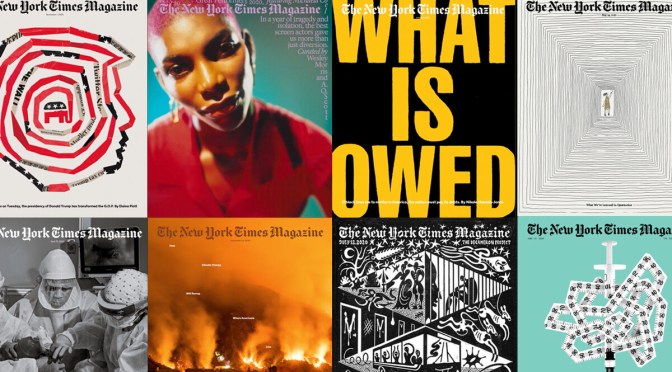

THE NEW YORK TIMES MAGAZINE: The 11.1.26 Issue features Marcela Valdes on the actor Penélope Cruz; Francesca D’annunzio McKenzie Funk and Kirsten Luce on a small town in Texas and a local deputy who became the face of deportation; Sophie Haigney on dark nutrition; Lisa Lerer on OB-GYNs in Idaho; and more.
How Silicon Valley Stole the Future
A.I. will reshape our world. But does that mean the people who make the technology get to control our imagination, too? By Linda Kinstler
These days, the leading tech companies are not primarily fighting one another for market share or talent or computing power. The bigger battle is over who can claim to know the future.
In August, Meta’s chief executive, Mark Zuckerberg, published a manifesto titled “The Future Is for Everyone,” in which he argued that artificial intelligence will bring about “an abundance of personal agency” and other riches — but only if Meta is in charge. “If our beliefs and principles lead,” he wrote of his company, “then the balance of power will favor individuals and a better future for everyone.” In September, Sam Altman of OpenAI told the United Nations Security Council that A.I. could lead to either a society in which “more people can participate in the future” or one in which humans have lost “control of the future.” And in his recent call for the voluntary slowdown of A.I. development, Dario Amodei of Anthropic claimed it was imperative to stave off the future we are headed toward, if only for an “extra year or two.”
Martin McDonagh Says Art Can Change the World. Just Not as Much as Murder
The writer-director Martin McDonagh has carved out a highly esteemed cinematic career as a chronicler of extreme, and often extremely bloody, behavior carried out on a relatively intimate scale. “The Banshees of Inisherin” (2022), to pick one of his films, was about two friends on a remote Irish island descending into a feud. “Three Billboards Outside Ebbing, Missouri” (2017), to pick another, looked at a mother’s attempt to get justice for her murdered daughter. That those movies, despite their dark setups, are often as vulgarly funny as they are emotionally affecting is evidence of McDonagh’s originality — and his skill too. (McDonagh was an enfant terrible of the British theatrical world before he turned to filmmaking.) The 56-year-old’s films have earned a cumulative 18 Academy Award nominations, and “Six Shooter” (2004) earned him an Oscar for best live-action short. By David Marchese
The Vibe Is Dissatisfaction. The Result Is Endless Political Deadlock.
From France to Brazil, voters are railing against the status quo, even as the politics of disenchantment make lasting change nearly impossible. By David Wallace-Wells
She Was Racked With Anxiety and Crushed by Insomnia. Finally She Understood Why.
The woman’s symptoms were common, but the cause was not. By Lisa Sanders, M.D.

