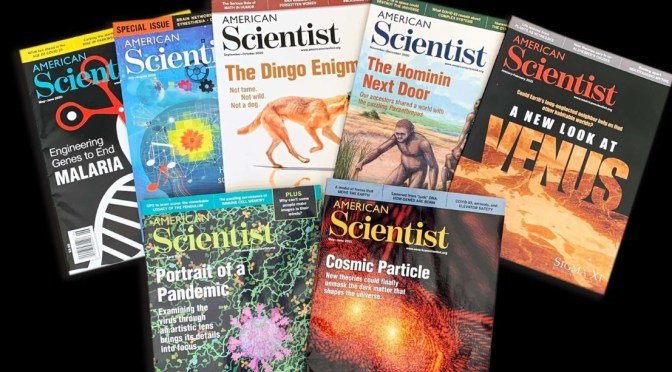

AMERICAN SCIENTIST – NOVEMBER/DECEMBER 2026

American Scientist Magazine: The latest issue features ‘Cellular Portraits’ – Detailed sketches helped reveal the function of chromosomes.

The Gene That Changed Cholesterol Treatment

Studies of rare mutations revealed a new way to lower LDL cholesterol—and led to an entirely new class of drugs.

By Philip A. Rea

In the early 2000s, geneticists Helen Hobbs and Jonathan Cohen at the University of Texas Southwestern Medical Center launched an ambitious effort to investigate cardiovascular health in Dallas County. Their study was unusual for the time. Rather than largely focusing on people of European ancestry, the Dallas Heart Study deliberately recruited a diverse population that reflected the region’s demographics.

QUICK TAKE
  • Rare genetic changes in a gene called PCSK9 help control low-density lipoprotein (LDL) cholesterol, the “bad” cholesterol linked to heart disease.
  • People who naturally make less of the PCSK9 protein have much lower LDL levels, pointing researchers toward new possibilities for lowering cholesterol.
  • That insight led to a new class of cholesterol-lowering drugs and showed how studying diverse populations can uncover important clues about disease.

Redrawing the Plague Maps

Ancient genomes are rewriting the history of Yersinia pestis infections across time and space.

By Monica H. Green

I spent much of my childhood in Colorado, which means that I, like millions of others living in the American West, grew up hearing warnings about the dangers of plague. People often find it shocking to learn that Yersinia pestis, the bacterium discovered in 1894 that is believed to have caused the mid-14th-century Black Death and other plague pandemics, is still around and dangerous, but that is one of many misperceptions about plague that need correcting. Plague’s multiple pandemics were not limited to the Black Death nor to Europe. And it is not a disease that disappears simply because no human cases are being reported at epidemic levels. Plague is not a thing of the past, and infections most definitely occur to this day.

QUICK TAKE

For centuries, our understanding of plague was riddled with assumptions based on a few historical accounts and data from modern plague victims.

Advances in genomics and bioarcheology now allow us to tie historical plague pandemics to human remains and even reconstruct the full plague family tree.

These data tell a new, broader story in which plague arrives earlier, stays later, and lurks in rural animal reservoirs before spilling over into human populations.

How Explanation Unlocks Deeper Understanding

The human drive to ask “why” can prompt abstract thinking and aid comprehension.

By Tania Lombrozo

Seeking and evaluating explanations can shape the very process of learning. Just like tasting the soup as you’re cooking can shift the final product toward a closer approximation of soupy perfection, explaining as you learn can change the course of learning itself, pushing you to find a closer approximation of a truly great explanation: one that covers all the relevant observations in the simplest way possible. But how does that work?

QUICK TAKE

The process of explaining is a powerful learning tool.From a young age, humans ask “why”; answering that question can reveal deeper meanings and reveal hidden patterns.

Explaining can unlock abstraction, a complex thought process that allows people to generalize from specific examples to identify common themes.

The need to know why can unlock learning, but it can also drive some people to latch on to patterns that do not exist, such as conspiracy theories.

THE ATLANTIC MAGAZINE – NOVEMBER 2026 PREVIEW

cover of the November 2026 Atlantic

THE ATLANTIC MAGAZINE: The latest issue features “BATTLE OF THE GALACTIC OVERLORDS’….

Choose Your Overlord

Musk vs. Bezos

By Josh Tyrangiel

The Adriatic has been crossed by Odysseus and Caesar, by Venetian fleets and Napoleon’s navy, by countless men bent on dominating the world. It has seen its share of courage and folly. But one day in June 2025, off the island of Cres, it witnessed something genuinely new: a man worth $240 billion standing waist-deep in bubbles on the deck of a $500 million yacht, wearing a white bucket hat.

The Great Data-Center Rebellion

Could a new populist movement help save American democracy?

By George Packer

Clinton, Iowa, is topographically flat and economically declining. The sawmills that made the city rich in the late 19th century have been repurposed as a museum. One of the Victorian mansions long since abandoned by the old lumber barons is open for tours, but tourists are scarce. Clinton has shrunk to about 24,000 people, and the town center, along the Mississippi River, feels nearly empty. On the west side, miles of deep-green corn and soy fields are crisscrossed with transmission wires and zoned for heavy industrial use. The city’s economic activity includes corn processing, pet-food production, and methamphetamines. With available land and a dire need for investment, Clinton seems like the perfect place for a gigantic data center.

The Baltic States Prepare for War

Lithuania, Latvia, and Estonia are readying themselves to fend off a Russian attack—with the help of the United States, or without it.

By Isaac Stanley-Becker

ne evening this summer, in the village of Bezdonys, in eastern Lithuania, I watched as a platoon of riflemen arrived at a train station occupied by enemy forces. Some of the Lithuanians let out a burst of gunfire from across the tracks, pinning the adversary in place as the rest of the unit advanced on the station. As the firefight intensified, wounded riflemen were evacuated to makeshift medical tents. An enemy soldier lay slumped against the station’s yellow clapboard siding.

THE NATION MAGAZINE – NOVEMBER 2026 PREVIEW

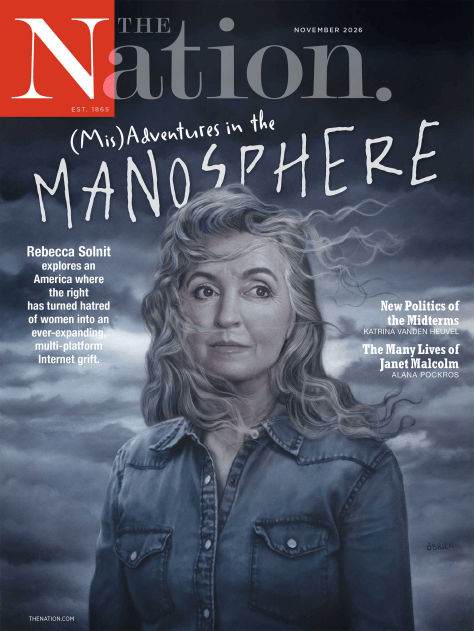
THE NATION MAGAZINE: The latest issue features ‘(Mis)Adventures in the MANOSPHERE’ – Rebecca Solnit explores an America where the right has turned hatred of women into an ever-expanding multi-platform internet grift.

Rebecca Solnit’s (Mis)Adventures in the Manosphere

Rebecca Solnit explores an America where the right has turned hatred of women into an ever-expanding, multi-platform Internet grift. Rebecca Solnit

The People vs. the Supreme Court

This term the Supreme Court has plans to trample even more of our rights. But we, the people, are not powerless in the face of their power grab. Elie Mystal

Why Democratic Leaders Keep Waging War on the Young

The party’s silver-haired establishment is caught up in an existential culture war. Elizabeth Spiers

ISSUES IN SCIENCE AND TECHNOLOGY – FALL 2026

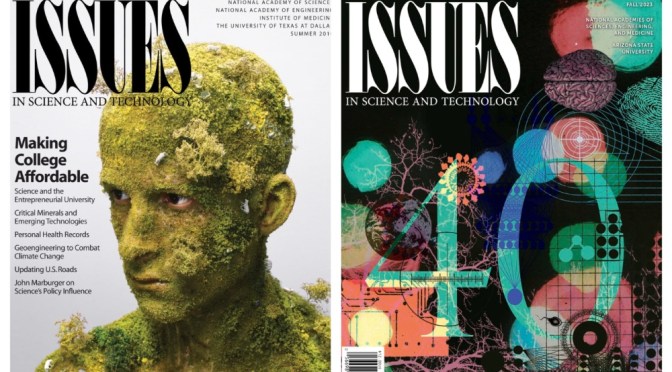
ISSUES IN SCIENCE AND TECHNOLOGY QUARTERLY MAGAZINE: The latest issue features ‘The Promise of Organized Knowledge’ – Canada and Europe chart new paths for AI Science’s small-world network; Questions for science’s social contract; Blasting people to the Moon….

The Promise of Organized Knowledge

The Fall 2026 issue explores how artificial intelligence might affect public policy in a variety of domains. Take biosecurity: Despite the fear that AI could be used to engineer dangerous pathogens, a former FBI special agent argues that the technology can also be used to uncover suspicious activity and possible bad actors before they become a threat. On economic policy: Spectacular wealth from AI will accrue to relatively few companies and individuals. What if a country were to create an AI sovereign wealth fund to distribute these profits more equitably? A group of Canadian scholars and legislators proposes to set up just such a fund. And when it comes to trust, a cultural anthropologist argues that CERN, the world’s most successful large-scale science collaboration, has many lessons to offer European regulators about how to build trust and transparency when using AI for science.

What Are the Goals for AI?

In “Escaping AI’s Measurement Trap” (Issues, Summer 2026), Urs Gasser, Viktor Mayer-Schönberger, and Fabienne Marco make a compelling case that governance of artificial intelligence faces a problem. Once benchmarks become targets, systems and their developers adapt to them, and measured performance may increasingly diverge from behavior in the real world. Their argument leads to a broader question: How can democratic societies not only improve the oversight of increasingly optimized AI systems, but shape what gets optimized in the first place?

A DISCUSSION OF

Escaping AI’s Measurement Trap

By Urs Gasser, Viktor Mayer-Schönberger, Fabienne Marco

Read Responses From

Biosecurity for the Age of AI

By Edward You

There is much discussion on how artificial intelligence poses threats to biosecurity; there should be at least as much focus on how AI can expand the solutions.

Today’s biosecurity approach is still grounded in a foundation laid nearly two decades ago. In 2008, when I reported to Federal Bureau of Investigation Headquarters as a newly minted supervisory special agent to support biosecurity policy, one important, emerging question was how providers of synthetic DNA should screen orders from customers. As commercial gene synthesis became increasingly accessible, many people worried that individuals could order genetic sequences coding for toxins and pathogens and then use them to cause harm.

LONDON REVIEW OF BOOKS – OCTOBER 22, 2026 PREVIEW

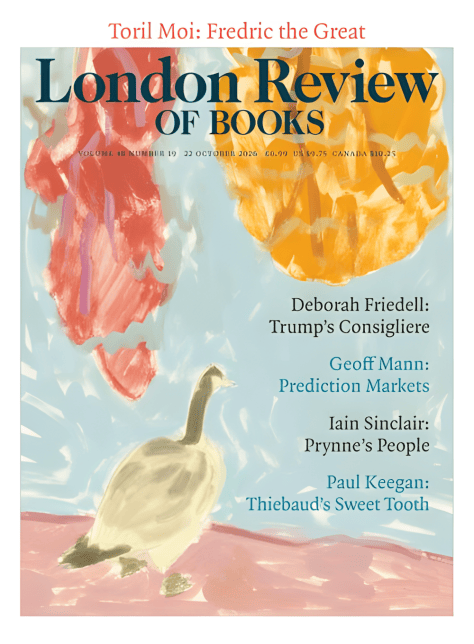
LONDON REVIEW OF BOOKS: The latest issue features  Fredric the Great by Toril Moi; Trump’s Consigliere by Deborah Friedell; Prediction Markets by Geoff Mann; Prynne’s People by Iain Sinclair; and Theibaud’s Sweet Tooth by Paul Keegan….

Fredric the Great

Toril Moi

Fredric Jameson seemed to me to have read absolutely everything. He was the very antithesis of the intellectual type I think of as an empty theoriser, by which I mean someone who endlessly conjectures without having a genuine command of any relevant archive. To look at Fred as a reader of literature is not to reduce the scope of his work, but rather to try to understand its origins.

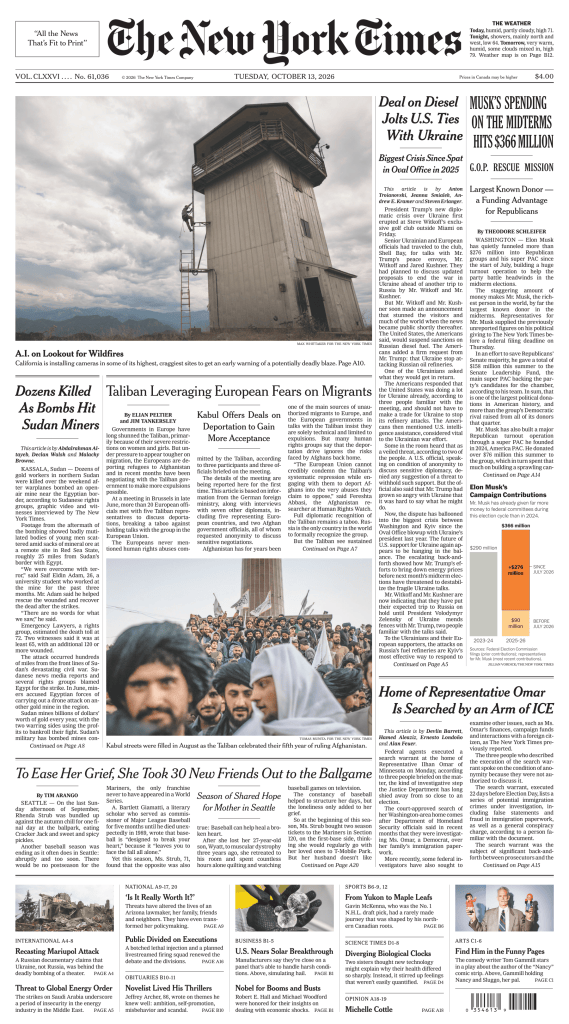
THE NEW YORK TIMES – TUESDAY, OCTOBER 13, 2026

The Oct. 7 Attack Changed Israel, but Not Its Politics

As Israelis prepare to vote for the first time since the Hamas-led assault, they remain divided over whether to hold Prime Minister Benjamin Netanyahu responsible for negligence or fault the “treason” of his generals.

U.K. and Europe Recoil From Trump’s Diesel Deal With Putin

Shocked by the U.S. agreement with Russia, which Ukraine has called “a gift” to President Putin, officials in Europe have coalesced around a cautious diplomatic message.

Top G.O.P. Groups Pull Support From First House Incumbents

Two Republican super PACs are said to be withdrawing cash from two House races as the party scrambles to prevent more widespread losses in the midterms.

NASA’s Perseverance Rover Sets an Off-Earth Driving Record

See how the rover traveled more than 28 miles on Mars, aided by self-driving technology.

FIFA’s Trump Tower Deal: 7 Years, $4 Million, One Mostly Unused Office

The deal is another sign of how Gianni Infantino, the leader of soccer’s global governing body, has sought closer ties to President Trump.