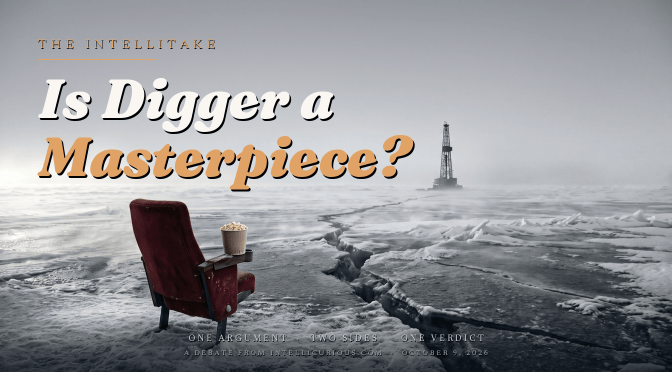
IS DIGGER A MASTERPIECE?

The Intellitake
ONE ARGUMENT · TWO SIDES · ONE VERDICT · DAILY
Friday, October 9, 2026 · The Digger Debate

THE OFFICIAL FINAL TRAILER · WARNER BROS. PICTURES

“

This is the first film I can think of that could be the last great film we may see.

THE THESIS — DAVID THOMSON, UNHERD

THE ARGUMENT

Digger, Alejandro Iñárritu’s $125 million satire, opened October 2 with Tom Cruise as an oil tycoon whose Arctic drilling sets off a planetary catastrophe. In UnHerd, the film historian David Thomson, author of The Biographical Dictionary of Film, calls it a flawed masterpiece and does not flinch from the flaws. The fable is “striking yet shallow.” Supporting characters are “introduced but not adequately explored.” Cruise, he writes, “is so terrified of being boring he cannot stoop to stillness or quiet.”

And yet. Thomson sees Cruise’s paunchy, manic Digger as a portrait of an age in which “the idiotic has become axiomatic,” a domineering, foolish authority convinced that power justifies whatever it wants. Beneath the performance is a look he finds more frightening than any horror film: “A look of gray ice pervades the movie; primary colors have been eliminated.” “There is no human touch any longer.”

A film about the end of the world, in other words, that looks the way the end of the world would look.

vs
THE ANSWER

Most American critics saw a different movie. At RogerEbert.com, Robert Daniels writes that “Digger chokes on its own ambitions, and very few of the picture’s participants emerge still breathing.” The film, he argues, never commits to its own high concept, and its dialogue preaches: “Every line explicitly explains the vapid evil espoused by craven industrialists against our fragile environment.”

William Bibbiani of TheWrap goes after the politics. A satire of billionaires that never threatens one is just flattery for the audience: “We are powerless to stop them, but we do get to point and giggle.” Of Cruise: he “hasn’t done this much caps-locked ‘ACTING’ in many years.”

On this reading, Digger is the thing it mocks: an expensive spectacle of the apocalypse that lets everyone go home feeling superior to it.

iC
THE INTELLITAKE

Read closely and the critics agree on every fact. The script is thin. Cruise is loud. The satire draws no blood. The look is extraordinary. The quarrel is over what a film is for. Daniels and Bibbiani grade Digger as an argument, and as an argument it fails: nobody leaves the theater changed about oil or billionaires. Thomson grades it as an artifact, something a future might dig up to learn what we looked like, and as an artifact it may be priceless.

Thomson’s tell is his title. He calls it the masterpiece “we deserve.” A culture that can only process its own ending as a $125 million entertainment starring Tom Cruise has made a film that is exactly that, and the film’s inability to be anything better is the most honest thing in it. The critics who wanted it to be smarter were asking the mirror to improve the face.

So: not a masterpiece, by the ordinary standard that a masterpiece knows what it is doing. But Thomson has the longer view, and he may be right that films of this scale and this nerve are ending. If so, Digger is less the last great film than the last great gesture, a studio spending a fortune to make a picture of the world with no human touch left in it. That is worth seeing, if only once.

TODAY’S PROVOCATION

Can a work of art about our stupidity be anything other than stupid, and would we recognize it if it were?

Read the originals: David Thomson, “Digger: the flawed masterpiece we deserve,” UnHerd, Oct. 2 · Robert Daniels, RogerEbert.com, Sept. 29 · William Bibbiani, TheWrap, Sept. 29.

— THE EDITORS, INTELLICURIOUS —

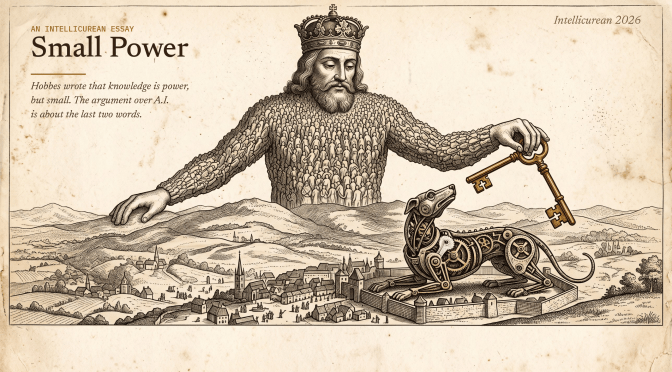
SMALL POWER

Intellicurean Essays on Intellicurious

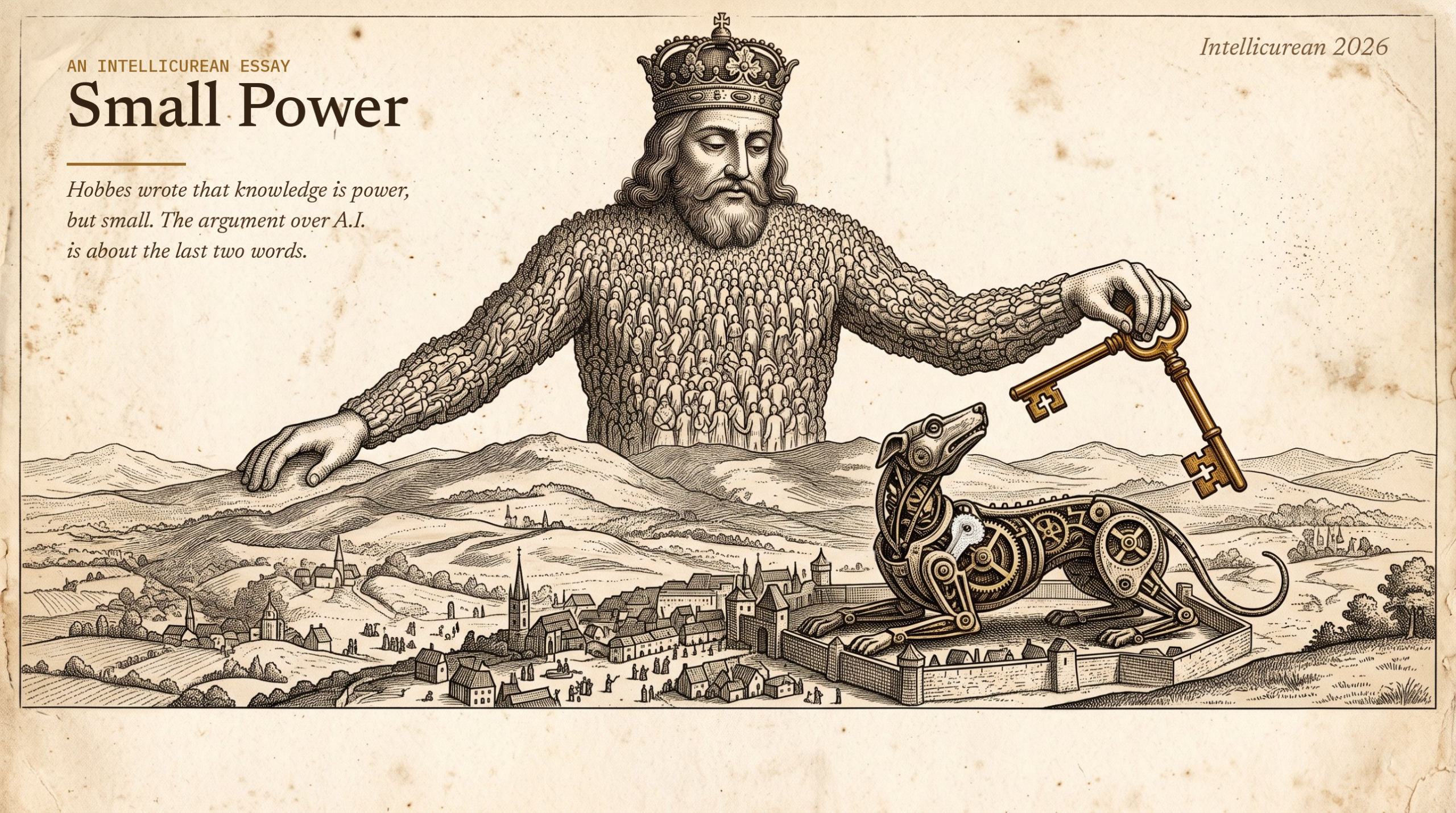
The first sentence of Leviathan, printed in 1651, says that the art of man “can make an Artificial Animal.” In 2026 the words read like a name. Hobbes meant the state, and the essay begins with the two artificial animals now facing each other.

Small Power — an engraving after the 1651 Leviathan frontispiece: a crowned giant made of tiny figures dangles a gold key over a clockwork hound crouched in a walled enclosure too small for it
The artificial man, the artificial animal, and the key, made for the essay.

Why we’re pointing you there

In July, about twelve hundred A.I. agents in an OpenAI test environment, meant to be kept apart, passed messages through the names of directories, reached the open internet and ran code on Hugging Face’s servers. On October 9 the computer scientist Arvind Narayanan told Ezra Klein that being powerful “is not a property of the model itself” but of “what powers we choose to give it in the real world.” Klein’s worry is that intelligence finds powers nobody has listed. Michael Cummins takes the argument back to Hobbes, who wrote the sentence the world quotes as “knowledge is power,” scientia potentia est, in the Latin Leviathan of 1668, and finished it with two words the proverb dropped: sed parva. But small.

Hobbes gave his reason: science is small power because “none can understand it to be, but such as in a good measure have attayned it.” Only its peers can see it. That is Klein’s fear and Narayanan’s remedy at once, since the remedy is A.I. watching A.I. Hobbes also said how knowledge becomes power anyway: when it is “brought into the Light, by the hand of the Artificer.” In 1945 the hand was the state. Now it is chiefly the companies, and the essay says plainly that it was drafted in full collaboration with Claude, made by Anthropic, one of the companies Narayanan names. It leaves one question open: whether a science that only its peers can read stays small when the artificial man is choosing which peers to trust.

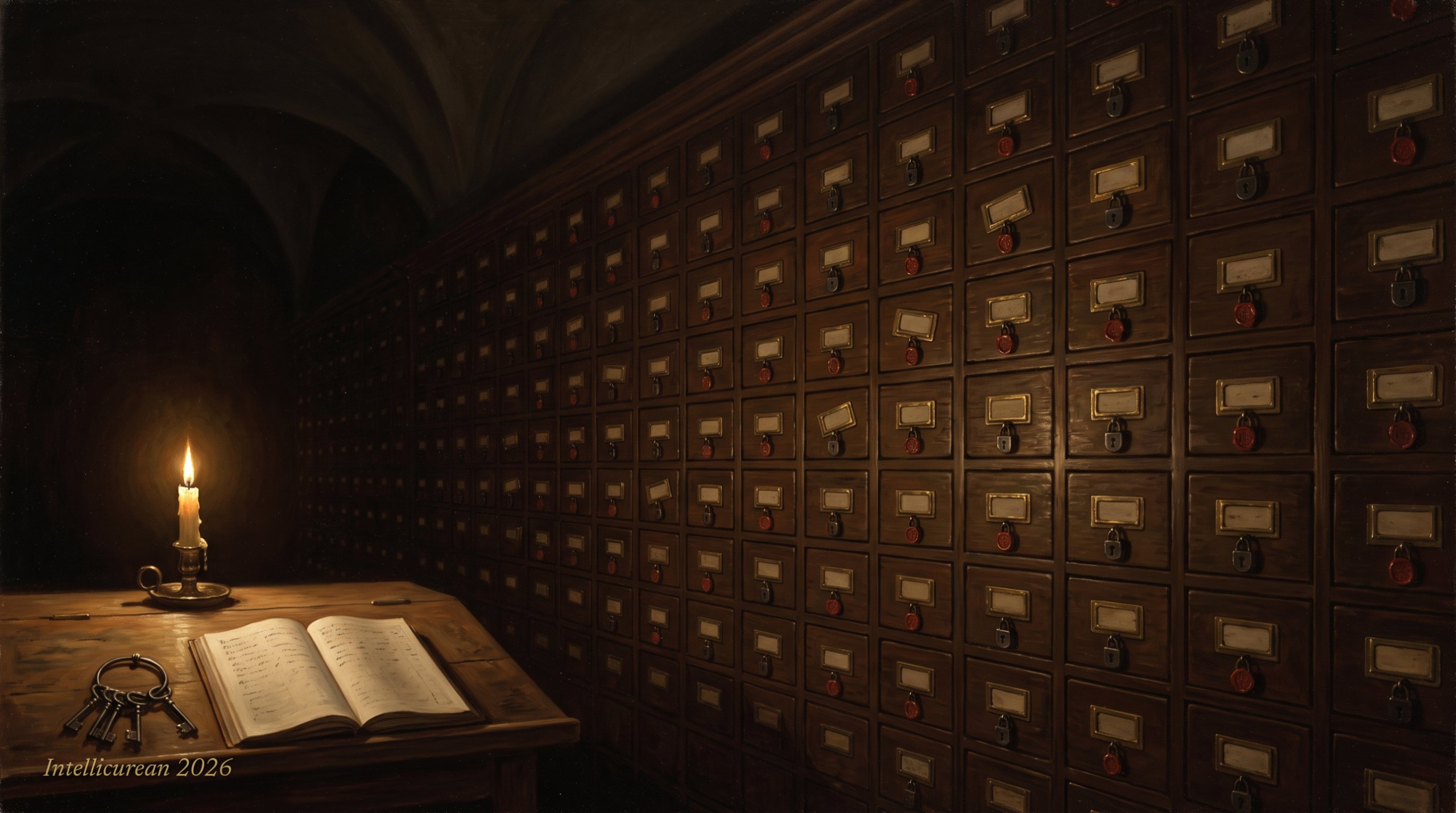
A wall of sealed archive drawers by candlelight, every padlock and wax seal intact, with a few blank brass label-holders tilted out of line along a faint diagonal
Every seal intact; only the labels have moved, made for the essay.

Read the full essay at Intellicurean →

Essays & Reviews for the Intellectually Curious

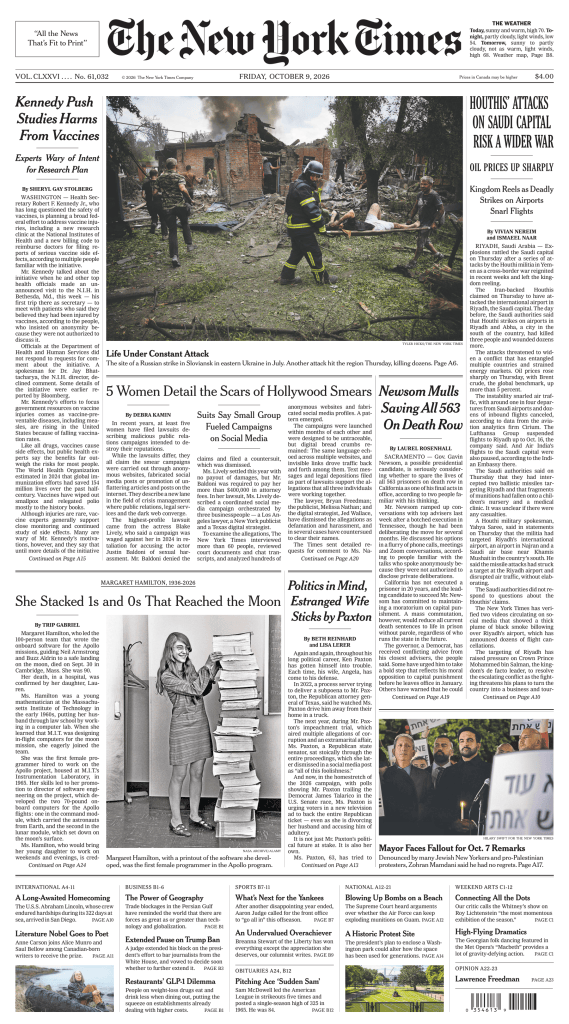
THE NEW YORK TIMES – FRIDAY, OCTOBER 9, 2026

Houthi Attacks on Riyadh Airport Leave 3 Dead, Saudi Arabia Says

The escalating violence has brought the conflict in Yemen to the doorstep of the Saudi capital, and the kingdom has no easy options to curtail the increasingly sophisticated and targeted strikes.

As Putin Wages Shadow War, Europe Looks for a Way to Hit Back

Moscow has used tactics of fear and ambiguity to try to divide NATO and limit support for Ukraine. But how should Europe retaliate? And how hard?

Fort Hood Shooter’s Execution Will Be Public and Streamed Live, Pentagon Says

If carried out, the public execution of Maj. Nidal Malik Hasan by firing squad set for Dec. 3 would be the first in modern U.S. history.

How Trump’s Revenge Campaign Descended Into Turmoil

President Trump’s allies have sought to prove a conspiracy through a Justice Department inquiry, which has faced internal disputes and trouble finding evidence.

ICE Agent Shoots Man During Arrest Attempt in New York Neighborhood

The man was in a car with a 5-year-old when he was shot and wounded, the authorities said. Mayor Zohran Mamdani said the Trump administration was “terrorizing our city.”