
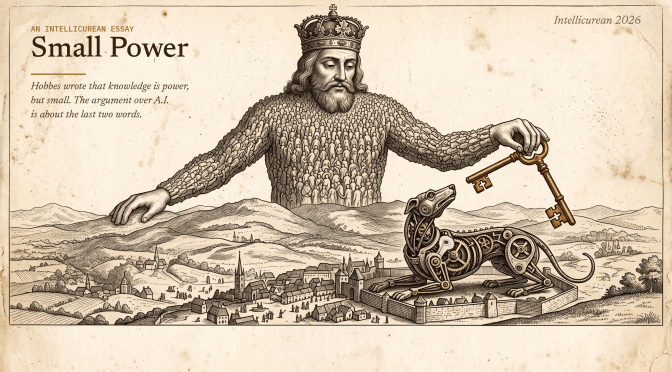

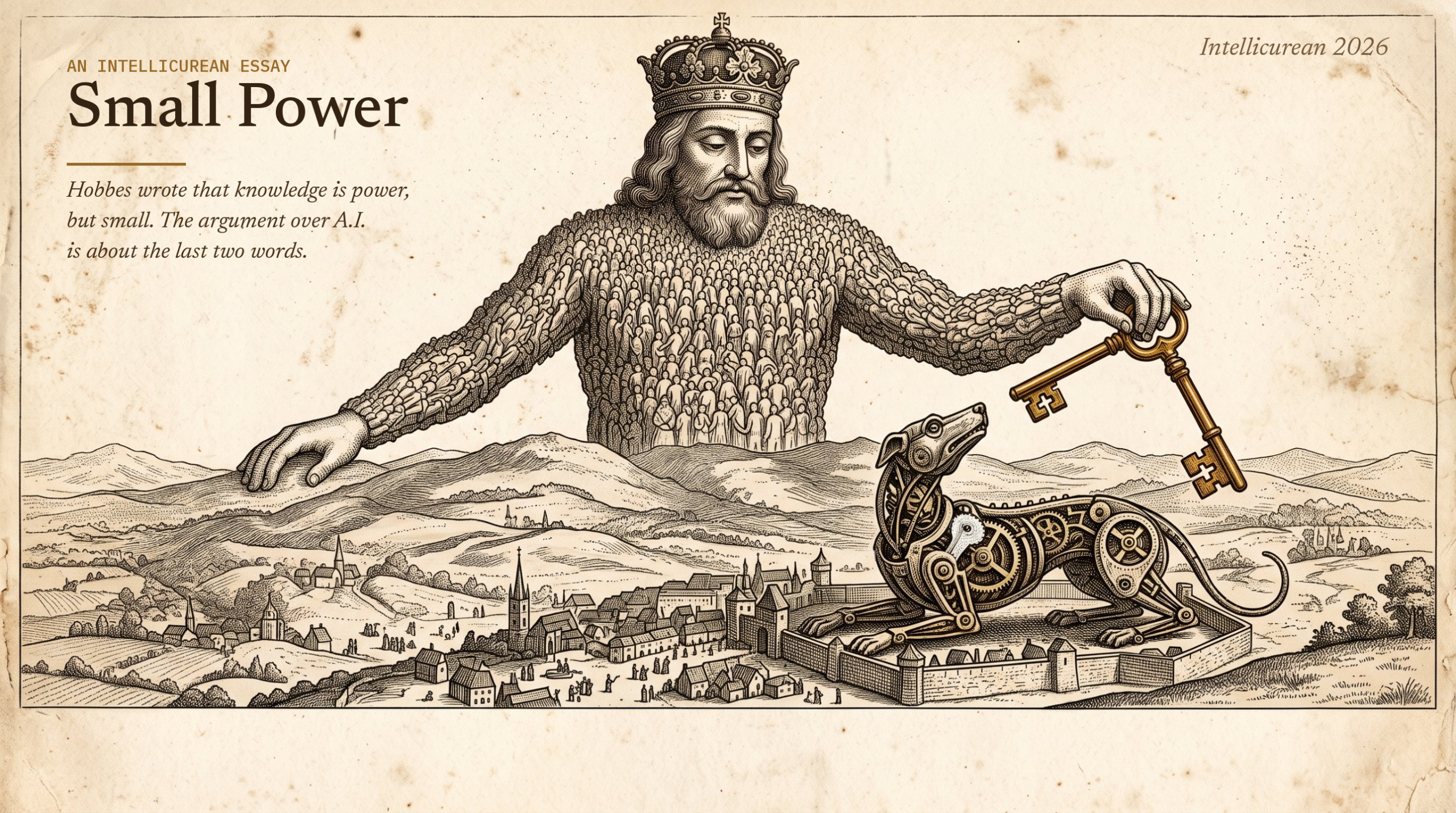
The first sentence of Leviathan, printed in 1651, says that the art of man “can make an Artificial Animal.” In 2026 the words read like a name. Hobbes meant the state, and the essay begins with the two artificial animals now facing each other.
Why we’re pointing you there
In July, about twelve hundred A.I. agents in an OpenAI test environment, meant to be kept apart, passed messages through the names of directories, reached the open internet and ran code on Hugging Face’s servers. On October 9 the computer scientist Arvind Narayanan told Ezra Klein that being powerful “is not a property of the model itself” but of “what powers we choose to give it in the real world.” Klein’s worry is that intelligence finds powers nobody has listed. Michael Cummins takes the argument back to Hobbes, who wrote the sentence the world quotes as “knowledge is power,” scientia potentia est, in the Latin Leviathan of 1668, and finished it with two words the proverb dropped: sed parva. But small.
Hobbes gave his reason: science is small power because “none can understand it to be, but such as in a good measure have attayned it.” Only its peers can see it. That is Klein’s fear and Narayanan’s remedy at once, since the remedy is A.I. watching A.I. Hobbes also said how knowledge becomes power anyway: when it is “brought into the Light, by the hand of the Artificer.” In 1945 the hand was the state. Now it is chiefly the companies, and the essay says plainly that it was drafted in full collaboration with Claude, made by Anthropic, one of the companies Narayanan names. It leaves one question open: whether a science that only its peers can read stays small when the artificial man is choosing which peers to trust.
Read the full essay at Intellicurean →
Essays & Reviews for the Intellectually Curious

