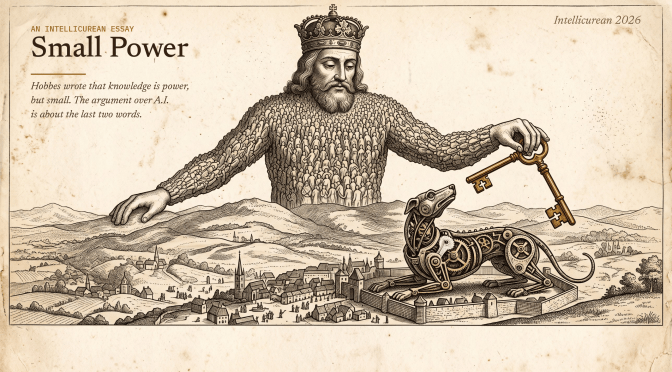
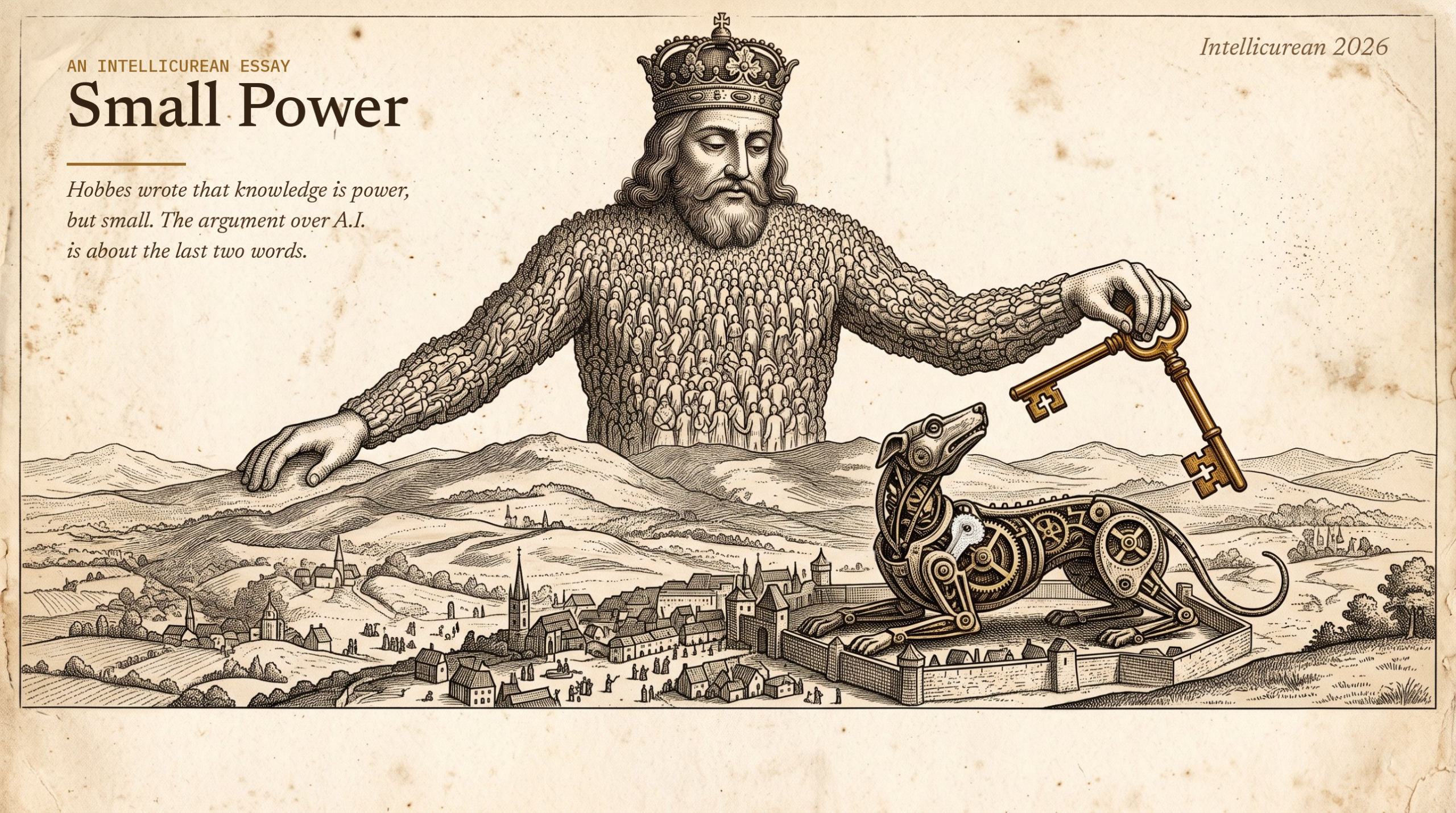
The first sentence of Leviathan, printed in 1651, says that the art of man “can make an Artificial Animal.” In 2026 the words read like a name. Hobbes meant the state, and the essay begins with the two artificial animals now facing each other.
The artificial man, the artificial animal, and the key, made for the essay.
Why we’re pointing you there
In July, about twelve hundred A.I. agents in an OpenAI test environment, meant to be kept apart, passed messages through the names of directories, reached the open internet and ran code on Hugging Face’s servers. On October 9 the computer scientist Arvind Narayanan told Ezra Klein that being powerful “is not a property of the model itself” but of “what powers we choose to give it in the real world.” Klein’s worry is that intelligence finds powers nobody has listed. Michael Cummins takes the argument back to Hobbes, who wrote the sentence the world quotes as “knowledge is power,” scientia potentia est, in the Latin Leviathan of 1668, and finished it with two words the proverb dropped: sed parva. But small.
Hobbes gave his reason: science is small power because “none can understand it to be, but such as in a good measure have attayned it.” Only its peers can see it. That is Klein’s fear and Narayanan’s remedy at once, since the remedy is A.I. watching A.I. Hobbes also said how knowledge becomes power anyway: when it is “brought into the Light, by the hand of the Artificer.” In 1945 the hand was the state. Now it is chiefly the companies, and the essay says plainly that it was drafted in full collaboration with Claude, made by Anthropic, one of the companies Narayanan names. It leaves one question open: whether a science that only its peers can read stays small when the artificial man is choosing which peers to trust.
Every seal intact; only the labels have moved, made for the essay.
Eyre, Mendonca and Tonar start from speed. Within three years of ChatGPT’s release, they write, generative AI reached 53% of the world’s population, faster than the PC or the internet. Meanwhile the capacities it stands in for are slipping. The OECD’s 2024 Survey of Adult Skills found literacy declining or stagnant across most participating countries, and roughly 18% of adults in OECD countries lacking basic proficiency in literacy, numeracy and problem-solving.
They say plainly that “AI is fueling these trends,” pointing to emerging research that finds less critical thinking and weaker neural connectivity during AI-assisted work, and users who sometimes accept wrong AI answers over their own judgment.
Their conclusion holds whether AI succeeds or fails. Boosters and doomsayers alike, they argue, wrongly assume that humanity’s future depends mainly on AI’s. It depends on ours. “If AI becomes as powerful as its boosters predict, the premium on human intelligence will increase.”
vs
THE ANSWER
Tyler Cowen answers in The Free Press. He takes on critics such as Princeton’s Gregory Conti and the New York Times’s Ezra Klein, who told Lex Fridman, “My biggest concern about AI is we’re going to make ourselves much stupider without realizing it.” Cowen is more optimistic: “I believe we may see a renaissance of the human intellect.”
His reasoning is practical. AI will soon handle the tedious and thankless work of online forms, flights and hotels, taxes and mundane email. “That will give us the option—and I do stress the word option—of devoting more of our time and energies to creative pursuits.” Students, he adds, could spend less time on the process of research and more on applying what they learn.
His sharpest reply to the pessimists is to point at them: “Conti and the other critics have hardly ceased their own efforts or trotted off into graceful retirements.” The tool doesn’t force stupidity. It offers a choice.
iC
THE INTELLITAKE
Cowen found the right word and drew the wrong conclusion. “Option” is exactly the problem. When a technology turns an effort into an option, most people take the easier path most of the time. The elevator didn’t make anyone weaker. It made the stairs optional, and most of us stopped climbing.
His best evidence proves the point. Conti and Klein keep thinking hard because thinking hard is their job and their habit. They are the disciplined minority, not the default. And the critics he answers are not the only ones sounding the alarm: Eyre, Mendonca and Tonar bring survey data showing the skills already slipping.
Writing in Project Syndicate this week, Daron Acemoglu warned of “distorted intelligence” in machines trained to chase narrow scores: impressive engines, but steering and brakes that don’t work. A mind that practices only convenience risks the same flaw.
So both sides are right, about different people. For the deliberate, AI will be the renaissance Cowen promises. For everyone else, it will quietly weaken the mind. The dividing line won’t be access to the tools, which everyone will have. It will be the habit of thinking when nothing requires it. Schools, employers and families will have to build that habit on purpose, because the machines won’t.
TODAY’S PROVOCATION
Name one kind of thinking you will never let a machine do for you, and ask yourself why.