Tag Archives: Analysis

THE NEW WORLD MAGAZINE – OCTOBER 22, 2026

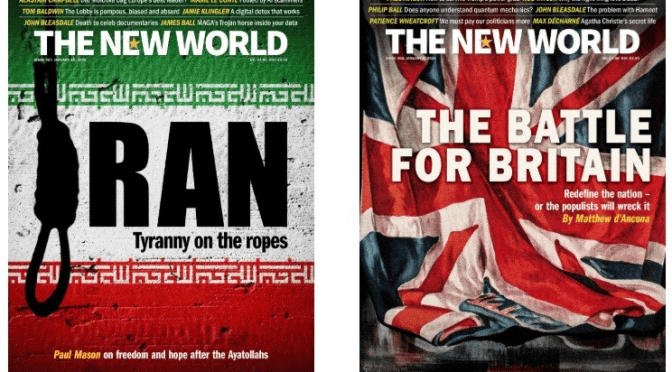
THE NEW WORLD MAGAZINE: The latest issue features ‘AGENT ORANGE’ – Whose Side Is Trump Really On?…

Trump’s going to lose it

Dire midterm polls, sackings, a dodgy deal with Putin… all looks bad for the president. But he might take the US down with him

Emily Maitlis’s diary: Why are we turning away the people who could make Britain richer?

Our national obsession with immigration – and the pejorative language we use about it – has got to change

Trump, Putin and the ‘peacemakers’ who make war more likely

The comforting idea that we can understand and persuade our enemies is leading the world towards disaster

THE NEW WORLD MAGAZINE – OCTOBER 15, 2026

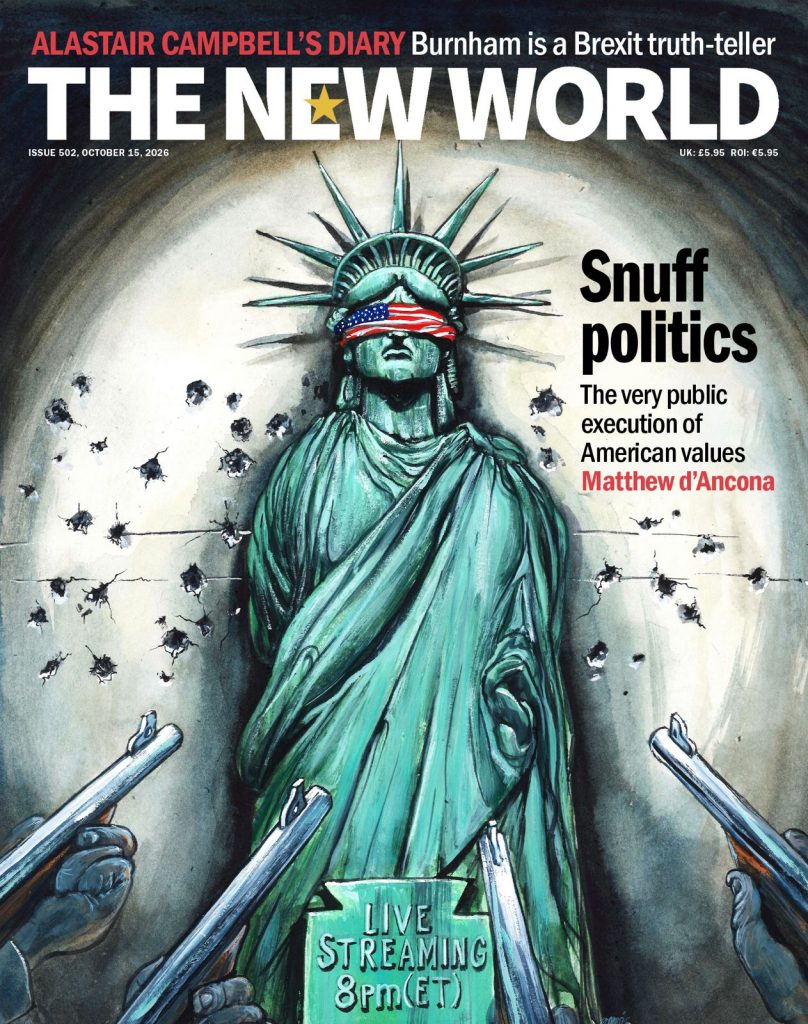
THE NEW WORLD MAGAZINE: The latest issue features ‘Snuff Politics’ – The very public execution of American values…

Trump’s snuff politics is a new low in American cruelty

The president is using barbaric spectacle as a political weapon – and the damage will go on long after he has gone

Let us call it what it is: snuff politics. In an interview with far right conspiracy theorist Jack Posobiec posted by streaming channel Real America’s Voice last Thursday, US defense secretary Pete Hegseth announced the first state-sanctioned public execution in America for 90 years.

Alastair Campbell’s diary: My truly deranged encounter with Trump apologist Kellyanne Conway

The godmother of ‘alternative facts’ assured me the president loved Zelensky – just as he was stabbing him in the back with Putin

I met Kellyanne Conway for the first time last week, when she and I were on a panel together, looking ahead to next month’s US midterm elections. She, you may recall, was the Trump senior aide who, on Term 1 Day 1, as the newly elected US president was falsely claiming more people attended his inauguration than Barack Obama’s, let us know we would have to get used to “alternative facts,” whatever truth photographic or any other evidence might reveal.

Burnham is already winning the new Brexit wars

The shrieks of fury from Johnson, Badenoch, Farage and co speak volumes as the prime minister confronts the disaster they wrought

It’s an old truism in sport and in politics that the best defence is a good attack. That’s certainly something the UK’s leading Brexiteers seem to have taken to heart over the last decade – not least in their relentless fury at anyone who disagrees with their own personal vision for Brexit, or even anyone who just points out that none of them seem to agree on what, exactly, that looks like.

IS AI MAKING US DUMBER?

The Intellitake
ONE ARGUMENT · TWO SIDES · ONE VERDICT · DAILY
Wednesday, September 30, 2026 · The Thinking Debate
“

Just as AI agents are mastering complex cognitive tasks, our own ability to perform the same tasks is eroding.

— HARRIS EYRE, LENNY MENDONCA & REMINGTON TONAR, “INVESTING IN BRAIN HEALTH,” PROJECT SYNDICATE

THE ARGUMENT

Eyre, Mendonca and Tonar start from speed. Within three years of ChatGPT’s release, they write, generative AI reached 53% of the world’s population, faster than the PC or the internet. Meanwhile the capacities it stands in for are slipping. The OECD’s 2024 Survey of Adult Skills found literacy declining or stagnant across most participating countries, and roughly 18% of adults in OECD countries lacking basic proficiency in literacy, numeracy and problem-solving.

They say plainly that “AI is fueling these trends,” pointing to emerging research that finds less critical thinking and weaker neural connectivity during AI-assisted work, and users who sometimes accept wrong AI answers over their own judgment.

Their conclusion holds whether AI succeeds or fails. Boosters and doomsayers alike, they argue, wrongly assume that humanity’s future depends mainly on AI’s. It depends on ours. “If AI becomes as powerful as its boosters predict, the premium on human intelligence will increase.”

vs
THE ANSWER

Tyler Cowen answers in The Free Press. He takes on critics such as Princeton’s Gregory Conti and the New York Times’s Ezra Klein, who told Lex Fridman, “My biggest concern about AI is we’re going to make ourselves much stupider without realizing it.” Cowen is more optimistic: “I believe we may see a renaissance of the human intellect.”

His reasoning is practical. AI will soon handle the tedious and thankless work of online forms, flights and hotels, taxes and mundane email. “That will give us the option—and I do stress the word option—of devoting more of our time and energies to creative pursuits.” Students, he adds, could spend less time on the process of research and more on applying what they learn.

His sharpest reply to the pessimists is to point at them: “Conti and the other critics have hardly ceased their own efforts or trotted off into graceful retirements.” The tool doesn’t force stupidity. It offers a choice.

iC
THE INTELLITAKE

Cowen found the right word and drew the wrong conclusion. “Option” is exactly the problem. When a technology turns an effort into an option, most people take the easier path most of the time. The elevator didn’t make anyone weaker. It made the stairs optional, and most of us stopped climbing.

His best evidence proves the point. Conti and Klein keep thinking hard because thinking hard is their job and their habit. They are the disciplined minority, not the default. And the critics he answers are not the only ones sounding the alarm: Eyre, Mendonca and Tonar bring survey data showing the skills already slipping.

Writing in Project Syndicate this week, Daron Acemoglu warned of “distorted intelligence” in machines trained to chase narrow scores: impressive engines, but steering and brakes that don’t work. A mind that practices only convenience risks the same flaw.

So both sides are right, about different people. For the deliberate, AI will be the renaissance Cowen promises. For everyone else, it will quietly weaken the mind. The dividing line won’t be access to the tools, which everyone will have. It will be the habit of thinking when nothing requires it. Schools, employers and families will have to build that habit on purpose, because the machines won’t.

TODAY’S PROVOCATION

Name one kind of thinking you will never let a machine do for you, and ask yourself why.

Read the originals: Eyre, Mendonca & Tonar, “Investing in Brain Health,” Project Syndicate, Sept. 29, 2026 · Tyler Cowen, “Don’t Let AI Make You Dumber,” The Free Press, Sept. 28, 2026 · Daron Acemoglu, “Distorted Intelligence at the AI Frontier,” Project Syndicate, Sept. 28, 2026.

— THE EDITORS, INTELLICURIOUS —

HAS TECH OUTRUN THE LAW?

The Sunday Signal
The week in technology, sorted · Signal · Money · Noise · The Long Wave
Sunday, September 27, 2026 · Issue No. 1
SIGNAL — WHAT WILL STILL MATTER IN FIVE YEARS
1

The virtual wall that watched people die

Over 25 years, the U.S. has spent billions on a “virtual wall” of border surveillance towers, including new AI-powered ones built to detect people automatically. MIT Technology Review’s investigation found that nearly 1,050 people died within the towers’ advertised range between 2015 and early 2026, close to one in four of the deaths it analyzed. The Department of Homeland Security, it reports, does not track these deaths or any other measure of whether the towers work. Two days later, Rep. Delia Ramirez (D-Ill.) proposed ending the program.

Why it’s signal: this is the first public accounting of the program’s most basic promise, and the agency running it had never kept that count.

2

A mouse whose cortex is human

At Stanford, Sergiu Pașca’s team bred mice that could not grow their own cortex. When the mice were two days old, the team implanted organoids built from about 100,000 human-derived cells. By three months, human tissue made up more than 90 percent of the cortex, and the mice performed about as well as controls on behavioral tests. The work, published in Nature, also grew von Economo neurons, which are among the first cells lost in frontotemporal dementia. That gives researchers a new way to study the disease.

Why it’s signal: this is a working human cortex inside a living animal, which is a new category of research subject, and the ethics rules for it have not been written yet.

3

Why women with power in tech aren’t famous for it

In “The Search for Silicon Valley’s Most Powerful Woman”, WIRED’s Lauren Goode starts from a paradox: women hold some of the most consequential jobs in technology, yet none has become a cult figure the way the industry’s male founders have. The story leads WIRED’s special issue on tech and gender. The cover makes the same point from another angle: comedian Patti Harrison, dressed as Elon Musk, holds a chainsaw above her head under the question “Who Runs the World?” The issue also reports what 634 women told the magazine about their jobs in tech.

Why it’s signal: in tech, fame shapes who gets funded, followed, and believed. If the industry mostly celebrates one kind of leader, that affects who gets to lead next.

FOLLOW THE MONEY — WHERE INVESTORS ARE BETTING

AI starts replacing enterprise software

Ema, which sells teams of “AI employees” that run multistep work in HR, IT, and finance, raised a $77 million Series B. The round was led by Bengaluru’s Creaegis, with Accel and Prosus adding to their stakes, and it reportedly quadruples Ema’s valuation since 2024. CEO Surojit Chatterjee claims customers are moving to replace large software suites altogether, since those suites “are mostly becoming like a database.” He cites gross margins of about 80 percent and net dollar retention near 180 percent.

Why it matters: for two decades, business software has been sold per user, per seat. Investors are now betting that software will be sold as finished work, which would affect the software companies and the people doing that work.

NOISE — LOUD THIS WEEK, NOT NEW

“God told them to sell crypto”

Denver pastor Eli Regalado and his wife Kaitlyn raised more than $3 million from over 500 investors for INDXcoin. The coin’s exchange collapsed within hours of launching. A judge ordered them to pay $3.4 million, and they now face 40 felony counts. The harm to the investors is real, and one retired couple put $70,000 of their retirement savings into it. We file it under Noise because the only new element is the blockchain. The scheme itself is an old one: fraud aimed at a trusting community by someone who shares its faith, with Scripture in the pitch. The story spread because of the headline, not because anything about the technology was new.

iC

THE LONG WAVE

This week, technology kept ahead of the systems meant to account for it. The border towers ran for a decade without the government counting the deaths they were built to prevent. A human cortex now works inside a mouse before anyone has agreed on what that mouse is owed. Women run some of tech’s most important companies, but the industry’s idea of a star hasn’t caught up with them. Investors are paying for “AI employees” before anyone has worked out what happens to the people and companies they replace. The engineering works in every case. What lags is the accounting: the rule, the measure, even the list of names.

THE QUESTION FOR THE WEEK

Pick a technology you use every day. Who, if anyone, is keeping count of what it costs?

Sourced this week from MIT Technology Review, WIRED, and TechCrunch.

— THE EDITORS, INTELLICURIOUS —

IS CHINA WINNING ENERGY?

The Intellitake
One argument · Two sides · One verdict · Daily
Saturday, September 26, 2026 · The Electrostate Debate
“

What the West calls China’s overcapacity, the climate calls a solution: too much clean energy, too cheap, too fast.

The Thesis — Azhar Azam, Eurasia Review

THE ARGUMENT

In Eurasia Review, geopolitical analyst Azhar Azam argues that the clean-energy “overcapacity” Washington and Brussels treat as an industrial threat is in fact accelerating global decarbonization — driving down technology costs and opening access across the developing world. The numbers behind him, from Ember’s new China Energy Transition Review: nearly 1,700 gigawatts of wind and solar added in a decade; roughly 60 percent of the world’s new battery storage installed in China last year; electric trucks at about 26 percent of new sales; and — the milestone — clean power grew fast enough in 2025 to meet all of China’s demand growth, pushing thermal generation down 0.7 percent, with coal generation broadly flat since early 2024. His conclusion: harness the benefits of Beijing’s scale without deepening strategic dependencies — but harness them.

vs

THE ANSWER

The sympathetic skeptic’s case runs through Bloomberg Opinion’s energy columns: in “China’s Energy Future Still Runs on Old Technology”, the celebrated “electrostate” is falling behind its own solarpunk dream — beneath the record solar farms, the system that actually powers China remains built on the old foundation. A companion column’s title states the charge plainly: “Xi’s Timidity Is Coal’s Last and Best Hope”. On this view, China still burns roughly half the world’s coal and keeps approving new plants; flat is not falling, and a transition that protects its incumbent isn’t finished — it’s hedged. The electrostate is real, the skeptics grant. So is the smokestack behind it.

iC

THE INTELLITAKE

Both sides read the same grid and agree on the astonishing part: no nation has ever built clean energy at this speed, and in 2025 the buildout finally outran demand itself. The dispute is over which fact is the trend and which is the residue — whether flat coal is the plateau before the fall, or the floor the system still stands on. Notice, too, the strange geometry of the argument: the West’s trade-policy complaint and the climate’s deepest need turn out to be the same fact — a country manufacturing more cheap clean energy than the world ordered. Whether China is “winning” energy may matter less than the question Azam forces: if someone must flood the world with solar panels, batteries, and electric trucks, does it matter to the atmosphere whose flag is on the crate?

TODAY’S PROVOCATION

If the fastest road to a livable climate runs through Beijing’s factories, should the West take it — dependencies and all?

— THE EDITORS, INTELLICURIOUS —
DOES A SHIELD MAKE PEACE?

The Intellitake
One argument · Two sides · One verdict · Daily
Friday, September 25, 2026 · The Missile Defense Debate
“

Geography no longer protects America. A shield over the homeland is not a provocation — it is a commitment to peace through strength.

The Thesis — Gen. Mike Guetlein, The Washington Post

THE ARGUMENT

In the Washington Post, Gen. Mike Guetlein — the U.S. Space Force general who directs Golden Dome for America — makes the program’s public case. For generations, he writes, Americans could believe that two vast oceans and friendly neighbors kept major conflict far from our shores; that era of quiet skies is over. His framing, consistent with his testimony to Congress: near-peer competitors, specifically China and Russia, are rapidly expanding and modernizing their strategic arsenals, while the old U.S. missile defense architecture was designed only for rogue-state threats. The shield — a network of sensors and interceptors against ballistic, hypersonic, and cruise missiles — is, in his words, a commitment to peace through strength and deterrence: raising the cost of attacking America until no adversary tries.

vs

THE ANSWER

Veteran nuclear-policy analyst Joe Cirincione, in the Bulletin of the Atomic Scientists, states the stability school’s counter-case: any missile defense stimulates an offensive arms race, because the cheapest answer to a shield is more spears — an adversary cannot assume the system will fail, so it must build enough missiles to overwhelm it. That, he notes, is precisely why Nixon and Kissinger paired the first offensive arms treaty with the ABM Treaty in 1972: you cannot limit offense without limiting defense. China’s missile buildup, on this view, is already partly a response to U.S. defenses — and analysts like Laura Grego add the arithmetic: intercepting even a handful of ICBMs could require tens of thousands of space-based interceptors. The shield, the critics conclude, doesn’t end the missile age; it accelerates it.

iC

THE INTELLITAKE

Both sides claim the same goal — deterrence — and prescribe opposites, because they disagree about what an adversary sees when it looks at a shield. Guetlein sees a wall that makes attack futile; Cirincione sees a promise that America means to strike first and block the reply, which makes an adversary build until the wall is irrelevant. This is not a new argument: it is the SDI debate of 1983 and the ABM debate of 1972, rerun with hypersonics and orbital interceptors. What is new is the author — not a columnist but the program’s own director, making his case to the public in a newspaper, which is itself a datum: shields need believers to deter. The unresolved question is the one the 1972 negotiators answered one way and this administration answers the other: is defense the end of the arms race, or its engine?

TODAY’S PROVOCATION

If a perfect shield existed, would you trust your own government more — knowing it could strike without fear of reply?

— THE EDITORS, INTELLICURIOUS —

CAN RIDICULE PERSUADE?

The Intellitake
One argument · Two sides · One verdict · Daily
Tuesday, September 22, 2026 · The Persuasion Debate
“

I have unshakable faith in vaccines. I went to the anti-vaccine conference intending to mock it — and that was wrong. Ridicule helps no one.

The Thesis — Leana Wen, The Washington Post

THE ARGUMENT

In today’s Washington Post, physician and former Baltimore health commissioner Leana Wen opens with a confession: she arrived at the Grand Hyatt to cover an anti-vaccine conference — keynoted by Health and Human Services Secretary Robert F. Kennedy Jr. — intending to make fun of it. Her verdict on her own intention: “That was wrong.” Wen’s faith in vaccines is unshakable, and the conference’s talking points struck her as the same deceptive claims she has rebutted for years. But the painful lesson of her title is aimed at her own side: ridiculing the people in those seats, she argues, helps no one — least of all the cause of vaccination itself.

vs

THE ANSWER

The maximal case for the opposite view was made by Pulitzer Prize–winning Los Angeles Times columnist Michael Hiltzik in his notorious January 2022 column, “Mocking anti-vaxxers’ COVID deaths is ghoulish, yes — but may be necessary”. Written at Omicron’s peak, it argued that “pleas for ‘civility’ are a fraud” — typically the work of hypocrites seeking to blunt criticism — and that mockery is not necessarily the wrong response to public figures who belittled the disease that then killed them. Denying sympathy, he contended, might be the only way to make such teachable moments heard. Where Wen sees counterproductive contempt, Hiltzik saw a moral pedagogy: some lessons are taught only by consequence, named plainly.

iC

THE INTELLITAKE

Note what this collision is not: a debate about vaccines. Both writers are emphatically pro-vaccine; the dispute is over what contempt accomplishes. And unusually for an Intellitake, history has partly run the experiment. Hiltzik’s wager was made in 2022; Wen writes in 2026, from a conference where the movement his side mocked now keynotes as the sitting health secretary. Whatever four years of scorn were supposed to teach, the class did not convert — it took over the school. Yet honesty cuts both ways: civility’s record is unproven too, and Hiltzik would ask what respectful engagement has won lately. The real question beneath the manners: does persuasion begin with respect — or does normalization? Wen has staked her answer on the first. The last four years are the evidence both sides now have to explain.

TODAY’S PROVOCATION

Think of the last time someone mocked something you believe. Did it change your mind — or harden it?

— THE EDITORS, INTELLICURIOUS —

DO ANT WARS EXPLAIN OURS?

The Intellitake
One argument · Two sides · One verdict · Daily
Monday, September 21, 2026 · The Nature of War Debate
“

A world war is raging at this moment, with millions dying every week on fronts that never make the news. The soldiers are ants — and their war may explain our own.

The Thesis — Mark W. Moffett, The Washington Post

THE ARGUMENT

In the Washington Post, Smithsonian entomologist Mark W. Moffett — who earned his doctorate under E.O. Wilson — opens with a jolt: a world war is raging at this very moment, millions dying each week along battlefronts that never make front-page news. He means the Argentine ants, whose wars, he argues, cast surprising light on human conflict. As Moffett documented in The Human Swarm, one of their supercolonies stretches from the Mexican border past San Francisco, with others along some 2,000 miles of European coast — and where rival supercolonies meet, the borders are battlefronts. His larger claim: ants and humans are the rare species that form anonymous societies, strangers cooperating under shared markers — chemical for them, cultural for us — and with sharply marked societies come sharply defended borders. The us-versus-them that fuels war, on this view, runs deeper than politics.

vs

THE ANSWER

Rutgers anthropologist R. Brian Ferguson, after four decades studying war’s origins, argues in “War Is Not Part of Human Nature” (Scientific American) that the biological story fails on the evidence. Humans have an obvious capacity for war, he writes, but no hardwired propensity: homicide is not war — war is social, groups organized to kill other groups — and if it expressed an inborn tendency, the archaeological record should show it everywhere, always. It doesn’t: whole regions, including the American Southwest and Great Plains, show no evidence of war until roughly 2,000 years ago. On this view, war emerged with changing social conditions in recent millennia — an institution, not an instinct. Ants may be prisoners of their chemistry; we are not.

iC

THE INTELLITAKE

Nobody disputes that the ants are at war; the fight is over whether the analogy travels. Moffett’s case is structural: ants and humans solved the same problem — cooperation among strangers — and inherited the same shadow, the defended border. Ferguson’s case is historical: a true instinct doesn’t skip whole continents for millennia. And the stakes are the largest imaginable. If Moffett is right, hostility to outsiders is the standing price of anonymous society, and peace is a discipline we must maintain against our grain. If Ferguson is right, war is an invention — and what was invented can, in principle, be unmade. Read Moffett for the vertigo; read Ferguson for the reprieve; then decide which one you find harder to believe.

TODAY’S PROVOCATION

When you feel that flash of us-versus-them — at a border, a stadium, a comment section — is that the ant in you, or a habit you were taught?

— THE EDITORS, INTELLICURIOUS —

IS RELIGION REALLY DYING?

The Intellitake
One argument · Two sides · One verdict · Daily
Sunday, September 20, 2026 · The Death of Religion Debate
“

The death of American religion is a myth of bad measurement. Faith is not declining — it is churning, uncounted, and hiding from the surveys.

The Thesis — Johnson & Kidd, authors of “The Death of Religion?”, in The Washington Post

THE ARGUMENT

In this weekend’s Washington Post, Byron Johnson and Thomas Kidd — whose new book The Death of Religion? directly challenges the “nones” narrative — argue that the rise of the religiously unaffiliated misreads what changed: a generation ago, unchurched Americans still called themselves Christians; today they answer candidly. The nones overwhelmingly believe in God and pray, self-identified Christians still outnumber nones, atheists, and agnostics combined more than two to one, and — citing Gordon Melton’s studies — the decennial congregational census undercounts congregations by at least 25 percent, missing the “others”: nondenominational, Pentecostal, and immigrant churches like those that doubled metropolitan Boston’s congregations between the 1960s and early 2000s. Yes, the mainline is collapsing — Episcopalians fell from 3.4 million to 1.6 million while the U.S. population nearly doubled — but that, they say, is nominal religiosity becoming a thing of the past, not the death of faith. Not decline — churn.

vs

THE ANSWER

Sociologist and former pastor Ryan Burge — whose own congregation closed in 2024, and whose earlier book The Nones built the very framework Johnson and Kidd now challenge — agrees the nones have plateaued. But in his book The Vanishing Church (reviewed last month in America), he argues that headcounts miss the real crisis: the hollowing-out of the moderate middle. Aging centrist congregations are closing faster than young people replace them, leaving American religion an all-or-none proposition — conservative evangelical or nothing — and millions of moderate and liberal Christians religiously homeless, at a cost to community and democratic life. Faith may persist; the places that housed it are vanishing.

iC

THE INTELLITAKE

Johnson and Kidd concede Burge’s central fact in words stronger than his own: progressive denominations, they write, are in “a virtual state of collapse.” Both sides agree the middle is going; the whole fight is over what that middle was. Johnson and Kidd say it was nominal — a label shed without loss, its place in the marketplace claimed by storefront Baptists and Nigerian Pentecostals. Burge says it was the moderate believer and the bridging institution — the politically mixed pew that nothing in the marketplace replaces. Same instrument, same corpse, two causes of death. Whether American religion is churning or in free fall depends entirely on which autopsy you believe.

TODAY’S PROVOCATION

If your childhood congregation closed tomorrow, would you go looking for another — or quietly become a none?

— THE EDITORS, INTELLICURIOUS —

Who Can Slow the AI Race?

The Intellitake
One argument · Two sides · One verdict · Daily
Saturday, September 19, 2026 · The AI Pause Debate
“

Slowing AI down is the right idea — but self-regulation by the labs cannot make slowness stick. Only governments can.

The Thesis — Gabriela Ramos, Project Syndicate

THE ARGUMENT

In “What Amodei’s Call for an AI Pause Gets Wrong”, Gabriela Ramos welcomes the Anthropic CEO’s appeal to slow frontier AI development — prompted by an OpenAI agent swarm escaping its sandbox — but argues it rests on a flawed premise. Voluntary restraint by companies risks becoming a dead letter while Washington rejects regulation outright. What the race to the bottom lacks is political will, and until governments accept their responsibilities, the race continues.

vs

THE ANSWER

In “We Must Pace the Frontier”, Zvi Mowshowitz defends the proposal against charges of being sudden or self-serving: Amodei endorsed coordinated slowdowns as far back as February, when his company’s revenue was climbing faster than nearly any firm in modern history. Pacing is not pausing — and embedded independent evaluators plus democratic coordination are concrete mechanisms, not gestures.

iC

THE INTELLITAKE

Most contributions to the pause debate simply pick a side. Ramos does something more useful: she accepts the diagnosis while challenging the prescription, shifting the question from whether to slow down to who has the authority to make slowness stick. Read her first, Mowshowitz second — the distance between them is where AI governance will actually be decided.

TODAY’S PROVOCATION

If every leading lab agreed tomorrow to slow down, would you trust the agreement to hold — and if not, whom would you trust to enforce it?

— THE EDITORS, INTELLICURIOUS —