Tag Archives: Ants

DO ANT WARS EXPLAIN OURS?

The Intellitake
One argument · Two sides · One verdict · Daily
Monday, September 21, 2026 · The Nature of War Debate
“

A world war is raging at this moment, with millions dying every week on fronts that never make the news. The soldiers are ants — and their war may explain our own.

The Thesis — Mark W. Moffett, The Washington Post

THE ARGUMENT

In the Washington Post, Smithsonian entomologist Mark W. Moffett — who earned his doctorate under E.O. Wilson — opens with a jolt: a world war is raging at this very moment, millions dying each week along battlefronts that never make front-page news. He means the Argentine ants, whose wars, he argues, cast surprising light on human conflict. As Moffett documented in The Human Swarm, one of their supercolonies stretches from the Mexican border past San Francisco, with others along some 2,000 miles of European coast — and where rival supercolonies meet, the borders are battlefronts. His larger claim: ants and humans are the rare species that form anonymous societies, strangers cooperating under shared markers — chemical for them, cultural for us — and with sharply marked societies come sharply defended borders. The us-versus-them that fuels war, on this view, runs deeper than politics.

vs

THE ANSWER

Rutgers anthropologist R. Brian Ferguson, after four decades studying war’s origins, argues in “War Is Not Part of Human Nature” (Scientific American) that the biological story fails on the evidence. Humans have an obvious capacity for war, he writes, but no hardwired propensity: homicide is not war — war is social, groups organized to kill other groups — and if it expressed an inborn tendency, the archaeological record should show it everywhere, always. It doesn’t: whole regions, including the American Southwest and Great Plains, show no evidence of war until roughly 2,000 years ago. On this view, war emerged with changing social conditions in recent millennia — an institution, not an instinct. Ants may be prisoners of their chemistry; we are not.

iC

THE INTELLITAKE

Nobody disputes that the ants are at war; the fight is over whether the analogy travels. Moffett’s case is structural: ants and humans solved the same problem — cooperation among strangers — and inherited the same shadow, the defended border. Ferguson’s case is historical: a true instinct doesn’t skip whole continents for millennia. And the stakes are the largest imaginable. If Moffett is right, hostility to outsiders is the standing price of anonymous society, and peace is a discipline we must maintain against our grain. If Ferguson is right, war is an invention — and what was invented can, in principle, be unmade. Read Moffett for the vertigo; read Ferguson for the reprieve; then decide which one you find harder to believe.

TODAY’S PROVOCATION

When you feel that flash of us-versus-them — at a border, a stadium, a comment section — is that the ant in you, or a habit you were taught?

— THE EDITORS, INTELLICURIOUS —
Research Preview: Nature Magazine – June 15, 2023

Image

nature Magazine – June 15, 2023 issue: In this week’s issue, Abhinav Kandala and his colleagues show that it is still possible for a quantum computer to outperform a classical computer, by mitigating, rather  than correcting, the errors. 

DeepMind AI creates algorithms that sort data faster than those built by people

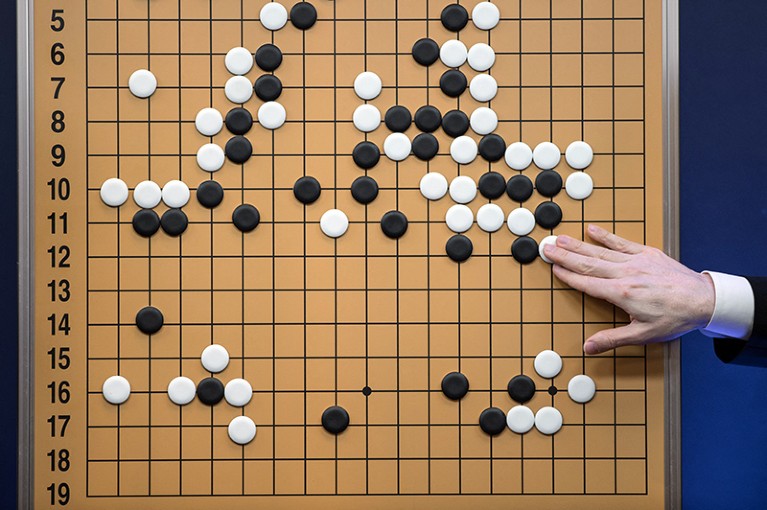
A replica of a game between 'Go' player Lee Se-Dol and a Google-developed super-computer, in Seoul, Korea, 2016.

The technology developed by DeepMind that plays Go and chess can also help to write code.

An artificial intelligence (AI) system based on Google DeepMind’s AlphaZero AI created algorithms that, when translated into the standard programming language C++, can sort data up to three times as fast as human-generated versions.

“We were a bit shocked,” said Daniel Mankowitz, a computer scientist at DeepMind who led the work. “We didn’t believe it at first.”

Ukraine dam collapse: what scientists are watching

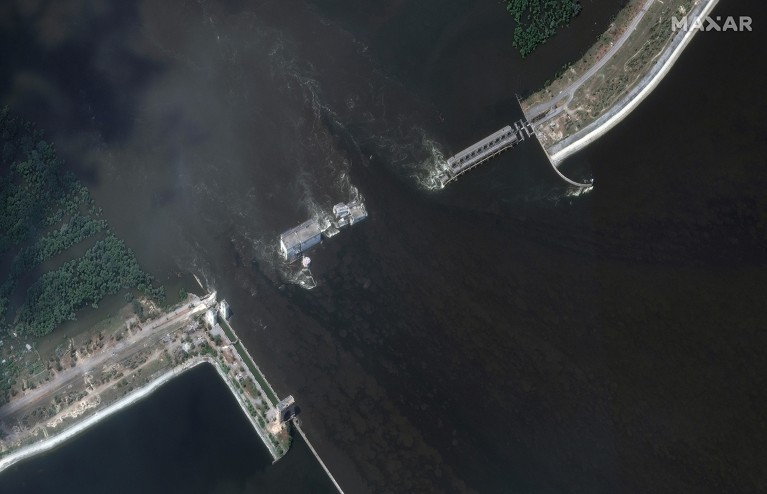
Maxar satellite imagery of the destruction of the Nova Kakhovka dam and hydroelectric power facility.
Large sections of the Kakhovka dam have collapsed, unleashing catastrophic floods. Credit: Satellite image (c) 2023 Maxar Technologies via Getty

Extensive flooding could have severe consequences for farming, health and the environment.

The 66-year-old Kakhovka dam on the Dnieper River in south Ukraine collapsed on the morning of 6 June after a suspected explosion, triggering a catastrophic humanitarian and environmental crisis.

Research Preview: Nature Magazine – June 8, 2023

Image

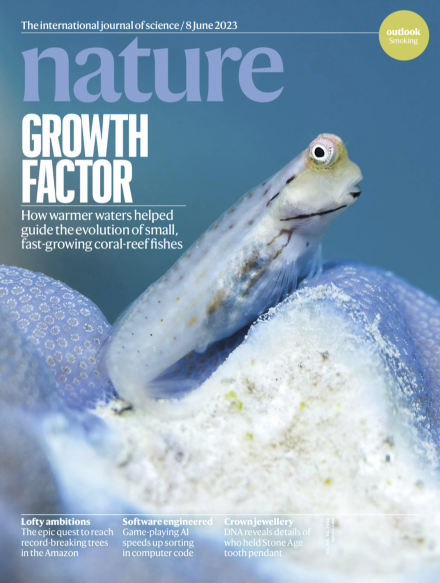
nature Magazine – June 8, 2023 issue:  Coral reef fishes, such as the blenny Ecsenius stictus pictured on the cover, are diverse, abundant and grow quickly. In this week’s issue, Alexandre Siqueira and his colleagues investigate the evolutionary history of these fishes to find out how growth has shaped life on coral reefs. 

Camera that could fit on a penny captures vivid colour photos

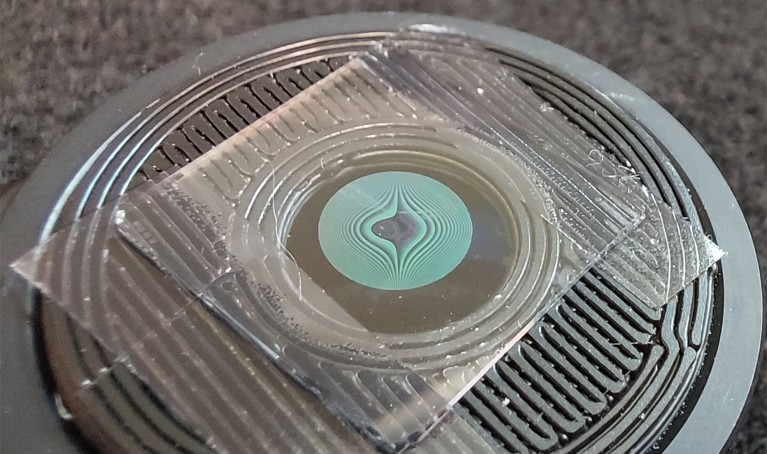
Optimized phase mask of five-millimetre diameter fabricated using a nanofabrication approach.

A ‘meta-lens’ and corrective algorithms allow a tiny device to produce high-resolution images.

A computational-imaging technique paves the way for ultra-small cameras that could be used in various portable devices.

These hardy ants build their own landmarks in the desert

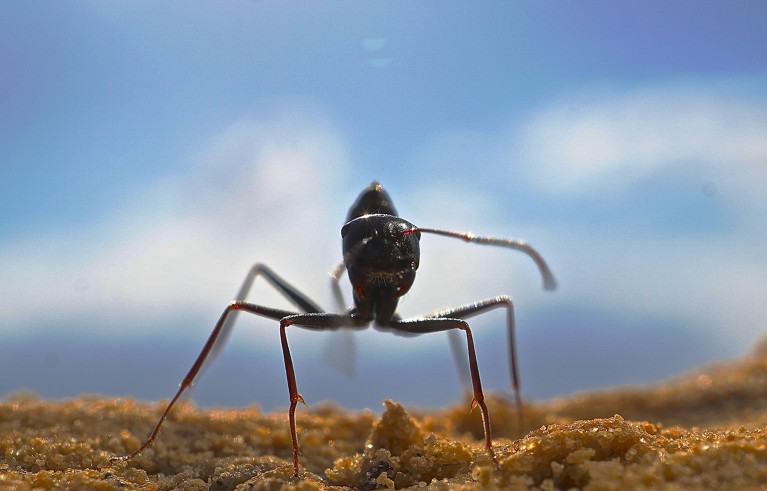
Tunisian desert ant Cataglyphis fortis.

Ants living on the sprawling salt pans of Tunisia use DIY markers to find their way home.

The desert ant Cataglyphis fortis lives in Tunisia’s arid salt flats, and can travel more than a kilometre from its underground nest in search of food. Now scientists have found that these ants build tall hills on top of their nests that help the insects to find their way home across the vast, featureless landscape1.

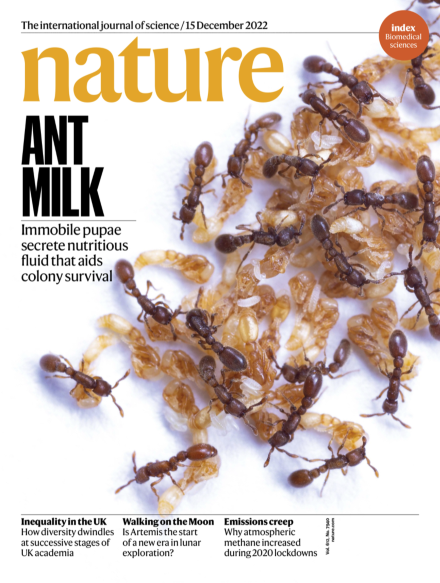
Research Preview: Nature Magazine – Dec 15, 2022

Volume 612 Issue 7940
Cover image: Daniel Kronauer

nature – December 15, 2022 issue:

Sharp laser beam reveals internal organs in stunning 3D

Scientists refine a technology that peers through bone to image sub-surface body parts.

Prehistoric carvings are oldest known story sequence

Two carved panels discovered in what is now Turkey illustrate a tale involving leopards and a bull.

Deadly skin cancer can shrink or vanish after T cells join the fray

Immune-cell-based therapy quashed tumour growth in some people with treatment-resistant melanoma.

A city’s sprawl triggers ominous changes underground

Rapid growth in a city in Central Africa is causing a landslide to speed up.

Science: ‘Insane Biology Of Ant Colonies’ (4K Video)

Ants are social insects which form small to large colonies. A typical colony contains an egg-laying queen and many adult workers together with their brood (eggs, larvae and pupae). Workers are by far the most numerous individuals in the nest. They are responsible for nest construction and maintenance, foraging, tending the brood and queen, and nest defence.

While all workers are female, they are sterile and do not lay eggs. Winged queens and males are present in the nest for only a short period. Soon after emerging they leave the nest to mate and establish new nests. Queens are generally similar to the workers, differing primarily in having larger bodies. In some species, fully winged queens are lacking and egg-laying is undertaken either by typical workers or by individuals which are morphologically intermediate between typical queens and workers (these are called ergatoid queens). Males are generally about the same size as the workers or smaller, and have smaller heads with large ocelli, very short scapes and small mandibles. In many cases males look more like wasps than ants.