With Sudan still in the midst of conflict and the largest humanitarian and displacement crisis in the world, this magazine shows the complexity of the crisis and the political dynamics behind the headlines. In collaboration with independent Sudanese media platform Ayin Network, the Big Story explores the impact of the war on civilians, from the interruption of education to how displacement is changing the face of the country. We hear from revolutionaries turned fighters, and activists in exile who can’t escape the war, even outside Sudan’s borders. How does the revolutionary dream continue and what does it mean for the goal of civilian rule?
Also in this edition, a report from Syria on attacks against the Alawite minority, a long read exploring how Palestine became a focus of international anti-colonial solidarity, and is the AI apocalypse really on its way?
TAKE BACK THE LAND
The land beneath our feet is what sustains us – from it we can produce food, construct shelter and build livelihoods. But, it’s also a cultural marker and a source of identity. Its control has been a long-favoured tool of colonizers, wealth hoarders and polluters, while its fiercest protectors – often Indigenous peoples – are criminalized, violated and dispossessed. This edition hears from struggles to take back the land in Brazil, Bangladesh, Kenya and North America. We also launch our new series ‘Decolonize how?’ which will explore what people are doing to dismantle the impacts – and current realities – of British-linked colonialism.
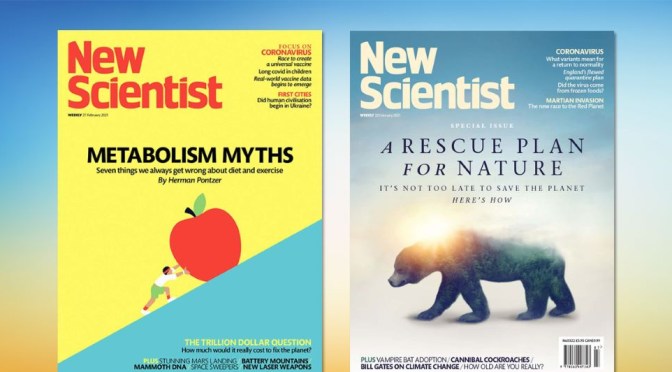
The controversial discovery that our brains can generate new neurons surprisingly late in life is now prompting a rethink of adult brain health, pointing the way to better treatments for stroke, dementia and depression By Jamie Ducharme
Often described as a genius, physicist Sabrina Pasterski built and flew her own plane by the age of 16 and is now developing a mind-bending idea that could finally unify gravity and quantum theory By Miriam Frankel
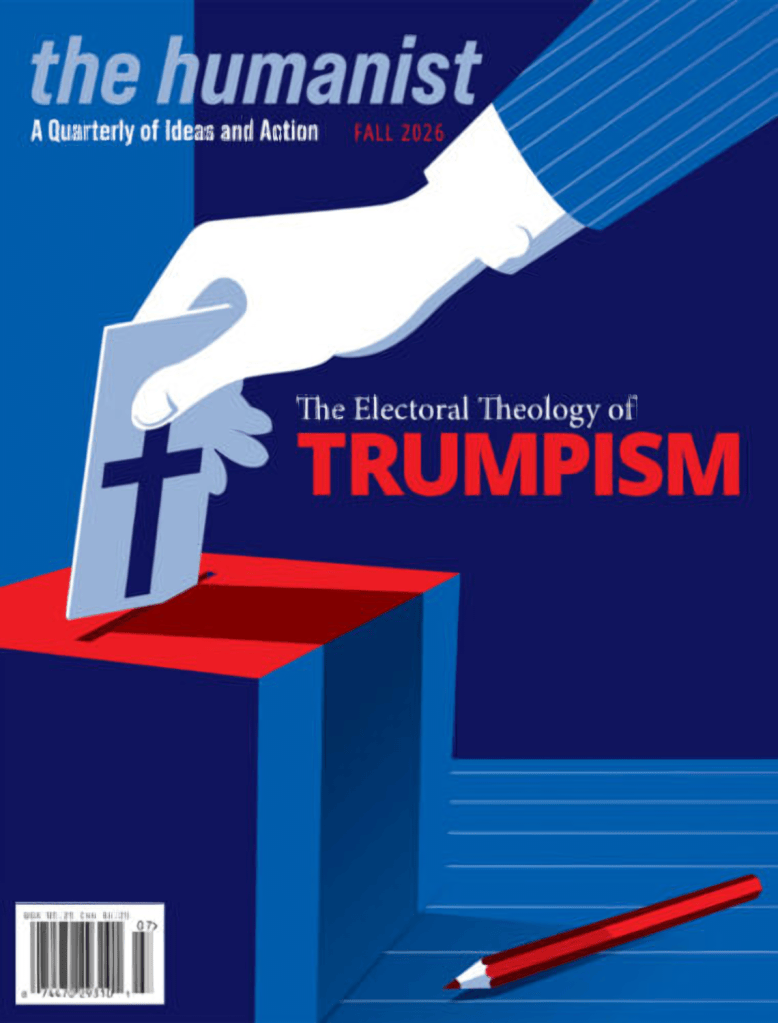
How White Evangelical Voters Made Trump’s Victory Possible—and Helped Legitimize Government by Certainty by Gordon Gamm
Donald Trump’s 2024 victory depended heavily on White evangelical or born-again Christian voters. National exit polling estimated that they constituted approximately 23 percent of voters and supported Trump over Kamala Harris by 82 percent to 17 percent.¹ Trump won the national popular vote by only about 1.5 percentage points—49.81 percent to Harris’s 48.34 percent.²
At the foot of burning Mount Doom, Samwise the gardener kneels beside his friend, Frodo, who can no longer walk. Frodo has been carrying a great weight– the One Ruling Ring, which grows heavier with every step. As Sam watches his friend press onward at a crawl, he knows he…
This piece was awarded first place in the Humanists of Greater Portland’s annual essay contest for high school seniors seeking funding for post-high school education. Every day reminds me how much we rely on tiny lines…
An Intimate Look at the Life of Thomas Jefferson in This Anniversary Year
“Being Thomas Jefferson: An Intimate History”by Andrew Burstein
Over a long life encompassed by countless books while a student, professor or a researcher, it is only “once in a blue moon,” this reviewer encountered a magnificent book. One such is Andrew Burstein’s latest, “Being Thomas Jefferson: An Intimate History.” I can only sing praises of this monograph. I had difficulty putting it down. This poignant book is a must read for those wishing to learn more about the author of several significant achievements that still ring the cause of freedom in the United States of America. Particularly in this 250th anniversary year of Jefferson’s Declaration of Independence, “well-armed with pulsating phrases,” one should spend time getting reacquainted with this man of particular talent and devotion to the cause of liberty. It is also the 200th anniversary of Jefferson’s death. Between these two anniversaries lie a testament to greatness, and devotion to his country. There are numerous history book offerings in this anniversary year, but surely this book stands apart from many others.
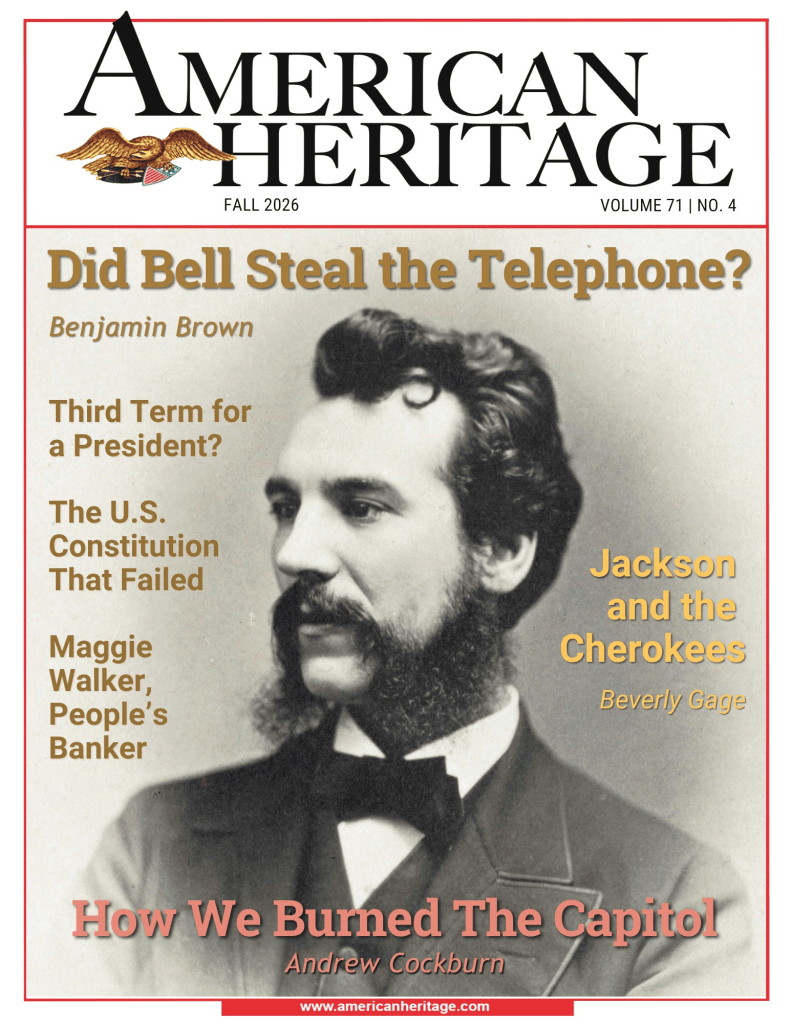
AMERICAN HERITAGE MAGAZINE: The Fall 2026 issue of American Heritage magazine features articles that address historic debates and legacies, including new evidence regarding whether Alexander Graham Bell stole the telephone patent from Elisha Gray, an ancestor’s account of Admiral Cockburn burning Washington while freeing 6,000 slaves, a guide to Southeast historic sites evaluating the complex democratic and brutal legacy of Andrew Jackson, an analysis of perceived ambiguities in the 22nd Amendment regarding presidential term limits, and the story of Maggie Walker, the first Black woman to open a bank to help underserved individuals.
New evidence finally settles the 150-year-old debate as to whether Alexander Graham Bell or Elisha Gray first invented the telephone. Benjamin Lathrop Brown
Museums and historic sites across the Southeast help us better understand Andrew Jackson, who helped define American democracy but also championed the brutal treatment of indigenous peoples. Beverly Gage
Maggie Walker, the first Black woman to open a bank, helped thousands of individuals who could not borrow from traditional lenders. Norah O’Donnell, Kate Brower Andersen
We know that this monster El Niño will bring floods, droughts, cyclones and wildfires, but some governments aren’t putting in the necessary resources to prepare for disaster
This El Niño is forecast to end around June next year after smashing all records, but its impacts could persist indefinitely in some parts of the world By Michael Le Page
My heart sank when I first saw the magazine’s thirtieth-anniversary issue on paper. My managing editor back then, Michael Strizic, and I had spent the morning pacing in our small, dark office — anxious to receive several heavy boxes from Ottawa. Eventually I couldn’t stand the anticipation, so I walked ten minutes or so to Harbord Bakery to distract myself. The magazines had arrived by the time I returned.
Thirty-five years ago, in the inaugural issue of this magazine, I reviewed the newly published diary of André Laurendeau, written from 1964 to 1967 during the Royal Commission on Bilingualism and Biculturalism. The timing was apt: politicians, scholars, and journalists were speculating heavily on how to fix the “Canadian crisis” following the collapse of the Meech Lake Accord the year before.
“By Authority of Parliament: The Constitutional Boundaries of Legislative Power in Canada” by Ryan Alford
In 2017, during the early days of Donald Trump’s first term, the world was riveted both by his reality TV presidency and by the salacious rumours about the way he had obtained it. Insistent tales circulated about how Vladimir Putin’s troll army had engineered the Republican candidate’s victory by hacking into the Democratic Party’s servers and then releasing thousands of embarrassing emails on the eve of Hillary Clinton’s nomination. What followed was a stormy season of investigations and counter-accusations about Trump’s Russian proclivities.
What is the largest art-history library in the world? The answer to this question depends of course on how you measure size, but an institution that might reasonably claim such a status is the RKD in The Hague. The RKD has for decades been a vast and invaluable library and archive, carefully nurtured by expert librarians and archivists (or ‘curators’ as they have long been described).
A new drawing by Édouard Manet
A newly identified drawing in a private collection of a crouching girl is a characteristic example of the red-chalk life studies that Édouard Manet made in the 1860s, influenced by his close study of Renaissance draughtsmanship in Florence. Although squared for transfer, the drawing has not yet been linked to any known composition by the artist.
Mistaken identities: Liotard’s 1762 portrait of Marie-Antoinette
A refined portrait by Jean-Étienne Liotard in the Musée d’art et d’histoire, Geneva, has long been identified as depicting Marie-Antoinette as a child. New research establishes, however, that it is a drawing of another member of the imperial Habsburg family and also reveals a hitherto unidentified likeness of Marie-Antoinette.
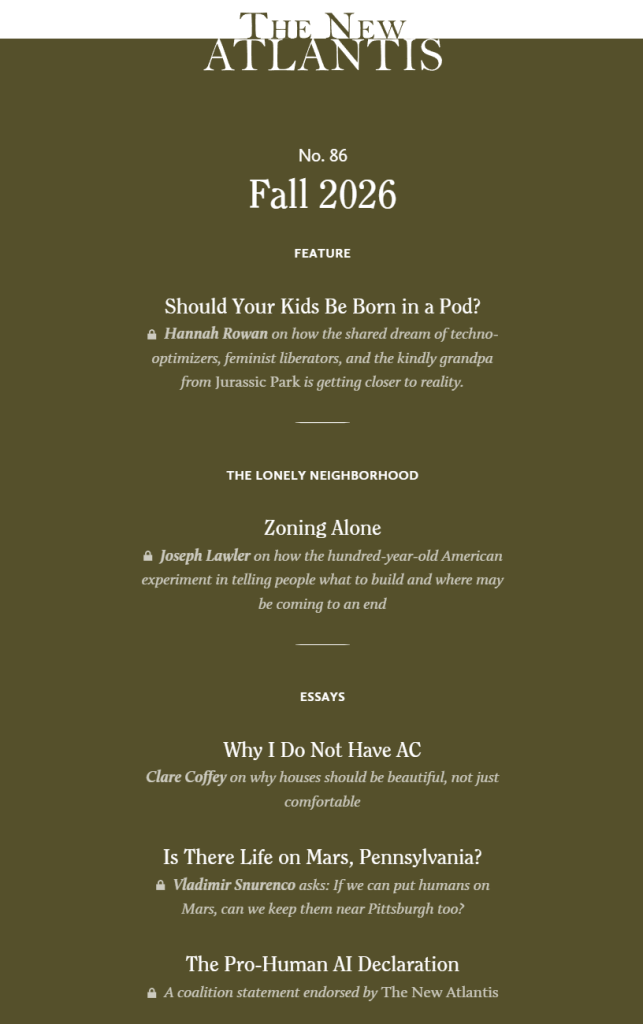
The shared dream of techno-optimizers, feminist liberators, and the kindly grandpa from Jurassic Park is getting closer to reality.
Zoning Alone
A hundred-year-old experiment in telling people what to build and where is part of why Americans have become so isolated. The Supreme Court may soon bring it to an end — and help bring back real neighborhoods.
The Pro-Human AI Declaration
A statement endorsed by The New Atlantis
In March 2026, a coalition of interest groups and individuals, organized by the Future of Life Institute, issued the following declaration at HumanStatement.org.
As companies race to develop and deploy AI systems, humanity faces a fork in the road. One path is a race to replace: humans replaced as creators, counselors, caregivers and companions, then in most jobs and decision-making roles, concentrating ever more power in unaccountable institutions and their machines. An influential fringe even advocates altering or replacing humanity itself. This race to replace poses risks to societal stability, national security, economic prosperity, civil liberties, privacy, and democratic governance. It also imperils the human experiences of childhood and family, faith, and community.
A remarkably broad coalition rejects this path, united by a simple conviction: artificial intelligence should serve humanity, not the reverse. There is a better path, where trustworthy and controllable AI tools amplify rather than diminish human potential, empower people, enhance human dignity, protect individual liberty, strengthen families and communities, preserve self-governance and help create unprecedented health and prosperity. This path demands that those who wield technological power be accountable to human values and needs, in support of human flourishing.
1. Keeping Humans in Charge
Human Control Is Non-Negotiable: Humanity must remain in control. Humans should choose how and whether to delegate decisions to AI systems.
Meaningful Human Control: Humans should have authority and capacity to understand, guide, proscribe, and override AI systems.
No Superintelligence Race: Development of superintelligence should be prohibited until there is broad scientific consensus that it can be done safely and controllably, and there is strong public buy-in.
Off-Switch: Powerful AI systems must have mechanisms that allow human operators to promptly shut them down.
No Reckless Architectures: AI systems must not be designed so that they can self-replicate, autonomously self-improve, resist shutdown, or control weapons of mass destruction.
Independent Oversight: Highly autonomous AI systems where controllability is not obvious require pre-development review and independent oversight: genuine authority to understand, prohibit, and override, not industry self-regulation.
Capability Honesty: AI companies must provide clear, accurate and honest representations of their systems’ capabilities and limitations.
2. Avoiding Concentration of Power
No AI Monopolies: AI monopolies that concentrate power, stifle innovation, and imperil entrepreneurship must be avoided.
Shared Prosperity: The benefits and economic prosperity created by AI should be shared broadly.
No Corporate Welfare: AI corporations should not be exempted from regulatory oversight or receive government bailouts.
Genuine Value Creation: AI development should prioritize solving real problems and creating authentic value.
Democratic Authority Over Major Transitions: Decisions about AI’s role in transforming work, society, and civic life require democratic support, not unilateral corporate or government decree.
Avoid Societal Lock-In: AI development must not severely limit humanity’s future options or irreversibly limit our agency over our future.
3. Protecting the Human Experience
Defense of Family and Community Bonds: AI should not supplant the foundational relationships that give life meaning — family, friendship, faith communities, and local connections.
Child Protection: Companies must not be allowed to exploit children or undermine their wellbeing with AI interactions creating emotional attachment or leverage.
Right to Grow: AI companies should not be allowed to stunt children’s physical, mental or social growth or deprive them of essential experiences for healthy development during critical periods.
Pre-Deployment Safety Testing: Like drugs, chatbots must undergo pre-deployment testing for increased suicidal ideation, exacerbation of mental health disorders, escalation of acute crisis situations, and other known harms.
Bot-or-Not Labeling: AI-generated content that could reasonably be mistaken for human-generated must be clearly labeled as such.
No Deceptive Identity: AI should clearly and correctly identify itself as artificial, nonhuman, and not a professional, and it should not claim experiences it lacks.
No Behavioral Addiction: AIs should not cause addiction or compulsive use through manipulation, sycophantic validation, or attachment formation.
4. Human Agency and Liberty
No AI Personhood: AI systems must not be granted legal personhood, and AI systems should not be designed such that they deserve personhood.
Trustworthiness: AI must be transparent, accountable, reliable, and free from perverse private or authoritarian interests.
Liberty: AI must not curtail individual liberty, freedom of speech, religious practice, or association.
Data Rights and Privacy: People should have power over their personal data, with rights to access, correct, and delete it from active systems, AI training sets, and derived inferences.
Psychological Privacy: AI should not be allowed to exploit data about the mental or emotional states of users.
Avoiding Enfeeblement: AI systems should be designed to empower, rather than enfeeble their users.
5. Responsibility and Accountability for AI Companies
No Liability Shield: AI must not be able to act as a liability shield, preventing those deploying it from being legally responsible for their actions.
Developer Liability: Developers and deployers bear legal liability for defects, misrepresentation of capabilities, and inadequate safety controls, with statutes of limitation that account for harms emerging over time.
Personal Liability: There should be criminal penalties for executives responsible for prohibited child-targeted systems or ones causing catastrophic harm.
Independent Safety Standards: AI development shall be governed by independent safety standards and rigorous oversight.
No Regulatory Capture: AI companies must not be allowed undue influence over rules that govern them.
Failure Transparency: If an AI system causes harm, it should be possible to ascertain why as well as who is responsible.
AI Loyalty: AI systems performing functions in professions with fiduciary duties, such as health, finance, law, or therapy, must fulfill all of those duties, including mandated reporting, duty of care, conflict of interest disclosure, and informed consent.