Tag Archives: United States

AMERICAN HERITAGE MAGAZINE – FALL 2026

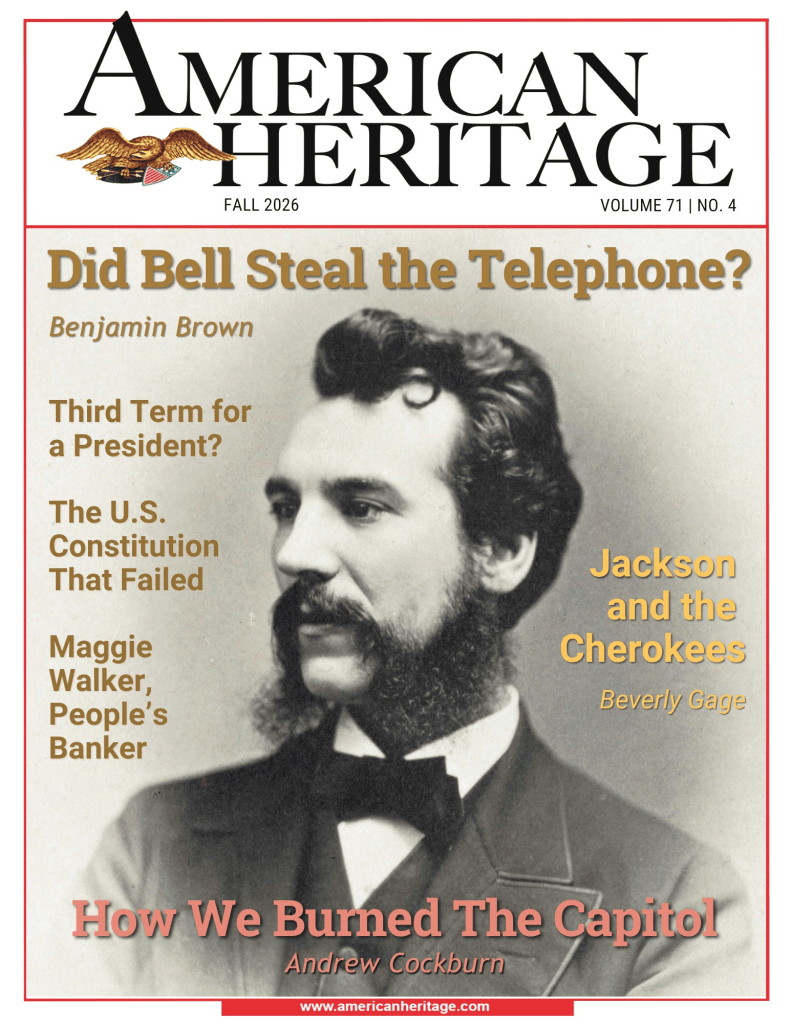
AMERICAN HERITAGE MAGAZINE: The Fall 2026 issue of American Heritage magazine features articles that address historic debates and legacies, including new evidence regarding whether Alexander Graham Bell stole the telephone patent from Elisha Gray, an ancestor’s account of Admiral Cockburn burning Washington while freeing 6,000 slaves, a guide to Southeast historic sites evaluating the complex democratic and brutal legacy of Andrew Jackson, an analysis of perceived ambiguities in the 22nd Amendment regarding presidential term limits, and the story of Maggie Walker, the first Black woman to open a bank to help underserved individuals.

Did Bell Steal the Telephone?

New evidence finally settles the 150-year-old debate as to whether Alexander Graham Bell or Elisha Gray first invented the telephone. Benjamin Lathrop Brown

The Truth About the Telephone Invention

Some writers ignore a mountain of evidence contrary to their theories about the telephone’s development. Edwin S. Grosvenor

How We Burned Washington

In 1814, my ancestor Admiral Cockburn destroyed the Nation’s Capital. He also freed some 6,000 slaves. Andrew Cockburn

Searching for Andrew Jackson

Museums and historic sites across the Southeast help us better understand Andrew Jackson, who helped define American democracy but also championed the brutal treatment of indigenous peoples. Beverly Gage

Third Term for a President?

Some observers see ambiguity in the 22nd Amendment. Joseph Connor

Maggie Walker, Banker to the People

Maggie Walker, the first Black woman to open a bank, helped thousands of individuals who could not borrow from traditional lenders. Norah O’Donnell, Kate Brower Andersen

DOES A SHIELD MAKE PEACE?

The Intellitake
One argument · Two sides · One verdict · Daily
Friday, September 25, 2026 · The Missile Defense Debate
“

Geography no longer protects America. A shield over the homeland is not a provocation — it is a commitment to peace through strength.

The Thesis — Gen. Mike Guetlein, The Washington Post

THE ARGUMENT

In the Washington Post, Gen. Mike Guetlein — the U.S. Space Force general who directs Golden Dome for America — makes the program’s public case. For generations, he writes, Americans could believe that two vast oceans and friendly neighbors kept major conflict far from our shores; that era of quiet skies is over. His framing, consistent with his testimony to Congress: near-peer competitors, specifically China and Russia, are rapidly expanding and modernizing their strategic arsenals, while the old U.S. missile defense architecture was designed only for rogue-state threats. The shield — a network of sensors and interceptors against ballistic, hypersonic, and cruise missiles — is, in his words, a commitment to peace through strength and deterrence: raising the cost of attacking America until no adversary tries.

vs

THE ANSWER

Veteran nuclear-policy analyst Joe Cirincione, in the Bulletin of the Atomic Scientists, states the stability school’s counter-case: any missile defense stimulates an offensive arms race, because the cheapest answer to a shield is more spears — an adversary cannot assume the system will fail, so it must build enough missiles to overwhelm it. That, he notes, is precisely why Nixon and Kissinger paired the first offensive arms treaty with the ABM Treaty in 1972: you cannot limit offense without limiting defense. China’s missile buildup, on this view, is already partly a response to U.S. defenses — and analysts like Laura Grego add the arithmetic: intercepting even a handful of ICBMs could require tens of thousands of space-based interceptors. The shield, the critics conclude, doesn’t end the missile age; it accelerates it.

iC

THE INTELLITAKE

Both sides claim the same goal — deterrence — and prescribe opposites, because they disagree about what an adversary sees when it looks at a shield. Guetlein sees a wall that makes attack futile; Cirincione sees a promise that America means to strike first and block the reply, which makes an adversary build until the wall is irrelevant. This is not a new argument: it is the SDI debate of 1983 and the ABM debate of 1972, rerun with hypersonics and orbital interceptors. What is new is the author — not a columnist but the program’s own director, making his case to the public in a newspaper, which is itself a datum: shields need believers to deter. The unresolved question is the one the 1972 negotiators answered one way and this administration answers the other: is defense the end of the arms race, or its engine?

TODAY’S PROVOCATION

If a perfect shield existed, would you trust your own government more — knowing it could strike without fear of reply?

— THE EDITORS, INTELLICURIOUS —

Preview: Foreign Policy Magazine – Fall 2024

2024 U.S. Election: The World's Advice to the Next White House

Foreign Policy Magazine – September 9, 2024: The new issue features 2024 U.S. Election: The World’s Advice to the Next White House…

Letters to the Next President

No matter who wins the White House, these nine thinkers from around the world would like a word. Catherine Ashton, Jason Bordoff, Arancha González, Martin Kimani, Mark Malloch-Brown, Joseph S. Nye Jr., Danny Quah, Nirupama Rao, Joseph E. Stiglitz

The Most Important Factor in Presidential Debates

A dramatic moment between Jimmy Carter and Gerald Ford showed the camera really is king.

Is 2024 Really the Most Important Election in History?

Democracy—and the global system—might not be so easily dismantled.

Preview: Foreign Policy Magazine – Summer 2024

Europe-issue-FP-Summer-2024

Foreign Policy Magazine – July 1, 2024: The new issue features ‘Europe Alone’ – Ten thinkers on a future without America’s embrace….

Europe Alone

Europe-EU-NATO-Donald-Trump-US-election-foreign-policy-illustration-doug-chayka-3-2

Nine thinkers on the continent’s future without America’s embrace.

By Mark Leonard, Constanze Stelzenmüller, Nathalie Tocci, Carl Bildt, Robin Niblett, Radoslaw Sikorski, Guntram Wolff, Bilahari Kausikan, Ivan Krastev, and Stefan Theil

No bloc of countries has, for the past 75 years, been as umbilically tied to the United States as Europe. First, its western half and, since the end of the Cold War, much of its eastern half have prospered under the world’s most extensive bonds in trade, finance, and investment. Europe could also depend on the U.S. military’s iron commitment—enshrined in the 75-year-old NATO alliance—to come to its defense. Together with a few other nations, the United States and Europe defined many of the institutions that comprise what we call the Western-led order. The U.S.-European alliance has arguably been the bedrock of the global system as we know it today.

Trump’s Return Would Transform Europe

Illustration of a torn map of Europe revealing Donald Trump

Without Washington’s embrace, the continent could revert to an anarchic and illiberal past. By HAL BRANDS

Which is the real Europe? The mostly peaceful, democratic, and united continent of the past few decades? Or the fragmented, volatile, and conflict-ridden Europe that existed for centuries before that? If Donald Trump wins the U.S. presidential election in November, we may soon find out.

Preview: Foreign Policy Magazine – Winter 2024

Image

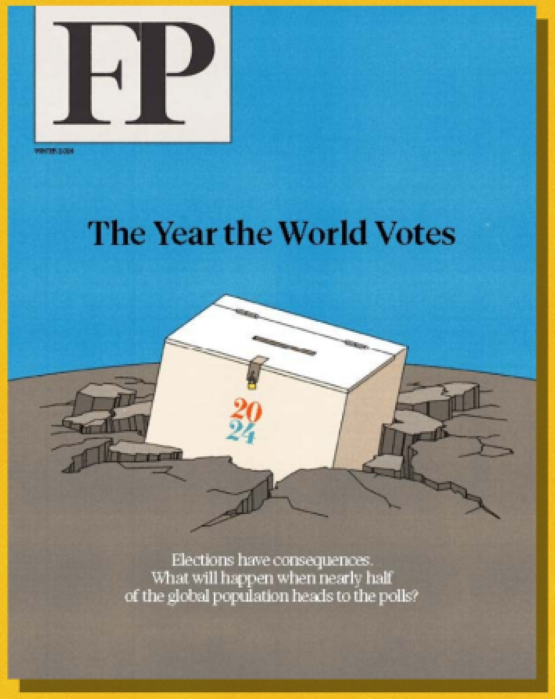
Foreign Policy Magazine – December 28, 2023: The new issue features ‘The Year The World Votes’ – Elections have consequences. What will happen when nearly half of the global population heads to the polls?

The Promise and Peril of Geopolitics

The world’s most dismal science could make Eurasia safe for illiberalism and predation—or protect it from those forces.

By Hal Brands, a professor of global affairs at the Johns Hopkins School of Advanced International Studies.

An illustration shows a stylized globe with a crack through it. A hand with a wrench tightens the screw atop the globe.

Alexander Dugin is a bit of a madman. The Russian intellectual made headlines in the West in 2022, when his daughter was killed, apparently by Ukrainian operatives, in a Moscow car bombing likely meant for Dugin himself. Dugin would have been targeted because of his unapologetic, yearslong advocacy for a genocidal war of conquest in Ukraine. “Kill! Kill! Kill!” he screeched after Russian President Vladimir Putin’s first invasion of that country in 2014, adding: “This is my opinion as a professor.” Even at his daughter’s funeral, Dugin stayed on message. Among her first words as an infant, he claimed, were “our empire.”

Travel: 50 Best Places To Visit In The United States

touropia Films (November 22, 2023) – A video tour of the 50 best places to visit in the United States. The top 15 include:

  1. The Grand Canyon – Arizona
  2. New York City
  3. Hawaii
  4. Yellowstone National Park – Wyoming
  5. Florida Keys
  6. San Francisco – California
  7. Zion National Park – Utah
  8. Las Vegas – Nevada
  9. Los Angeles – California
  10. Glacier National Park – Montana
  11. Washington D.C.
  12. Miami – Florida
  13. Seattle – Washington
  14. Rocky Mountain National Park – Colorado
  15. New Orleans – Louisiana

Clean Energy: The Global Race For Lithium Batteries

Financial Times (November 19, 2023) – Lithium is the ‘new oil’ of the clean energy era, crucial to the production of batteries for electric vehicles. The FT investigates this booming industry – and the controversies surrounding it – on a journey from Chile to Norway and the UK.

Video timeline: 00:00 Lithium and the energy transition 01:13 Global lithium reserves 01:33 The process 03:03 The communities 04:05 Water reserves 05:29 The investors 07:40 Lithium supply and China 08:41 The policymakers 09:35 Cornish mining revival 12:16 The markets 15:28 Chile’s lithium policy 18:02 Direct lithium extraction 19:54 The indigenous perspective 22:58 Recycling batteries 25:30 The future

#lithium #lithiumbattery #energy #electricvehicle #zerocarbon #emission

Moon Missions: Launch Of The New ‘Lunar Economy’

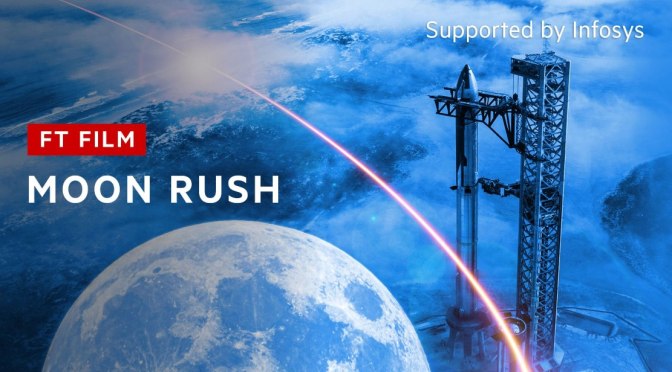
Financial Times (October 18, 2023) – The rush back to the Moon has begun. The US and China are planning permanently crewed bases on the lunar surface. Billions of dollars in contracts are up for grabs as companies are launching ambitious new support projects, from growing food in space to a new lunar internet.

The FT’s Peggy Hollinger asks if the next great leap forward in space is a lunar economy?

#space #moon #spaceexploration

Preview: Foreign Policy Magazine – Fall 2023

Image

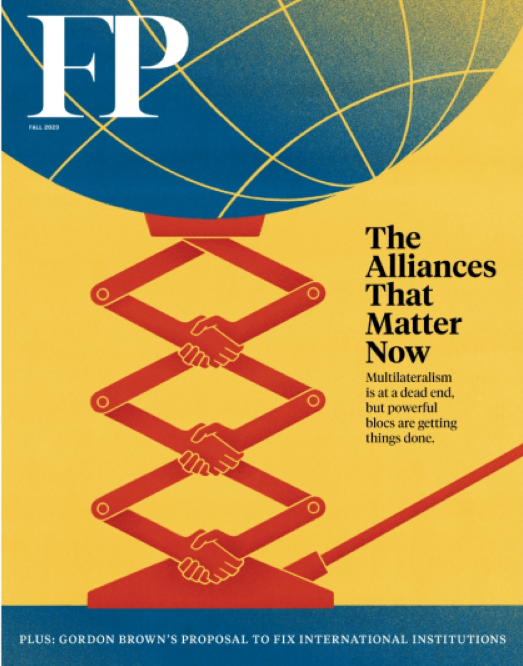
Foreign Policy Magazine – Fall 2023: The new issue features The G-7 Becomes a Power Player – Russia’s war and China’s rise are turning a talking shop into a fledgling alliance of democracies; Vivek Ramaswamy’s Foreign Policies Raise Eyebrows in Washington – The GOP’s rising star offers up a grab bag of ideas cribbed from Eminem to Richard Nixon and more…

The G-7 Becomes a Power Player

Foreign Policy – the Global Magazine of News and Ideas

Russia’s war and China’s rise are turning a talking shop into a fledgling alliance of democracies.

By G. John Ikenberry, a professor of politics and international affairs at Princeton University.

Time and again over the last century, the United States and the other liberal democracies in Europe, East Asia, and elsewhere have found themselves on the same side in grand struggles over the terms of the world order. This political grouping has been given various names: the West, the free world, the trilateral world, the community of democracies. In one sense, it is a geopolitical formation, uniting North America, Europe, and Japan, among others. It is an artifact of the Cold War and U.S. hegemony, anchored in NATO and Washington’s East Asian alliances.

Vivek Ramaswamy’s Foreign Policies Raise Eyebrows in Washington

Vivek Ramaswamy's Foreign Policies Raise Eyebrows in Washington – DNyuz

The GOP’s rising star offers up a grab bag of ideas cribbed from Eminem to Richard Nixon.

By Jack Detsch

End American dependence on Taiwan’s semiconductor factories. Declare economic independence from China. Give India an AUKUS-like submarine deal. And stage a dramatic visit to Moscow to broker a deal to end Russia’s full-scale invasion of Ukraine. 

Culture: France-Amérique Magazine – February 2023

February 2023 - France-Amérique

France-Amérique – February 2023 Issue:

W.E.B. DU BOIS IN PARIS – An Exhibition against Racist Clichés

In 1900, the prominent sociologist worked with the Paris Exposition Universelle to showcase the newfound freedom and rapid progress of Black Americans. But Belle Epoque France was more interested in colonial expansion than social emancipation – which is the focus of an exhibition currently on display at the Cooper Hewitt in New York City.

FRENCH FOUNDERS – A Revolutionary Entrepreneur Network

Founded in New York City in 2014 by two expats, FrenchFounders drew its inspiration from the start-up model and is now shaking up communities of entrepreneurs living abroad. This new approach has since won over more than 4,000 members across the world.

L’AMOUR À LA FRANÇAISE vs. American Romance

Do we seduce each other in the same ways on both sides of the Atlantic? Are Americans prudish? Are the French more unfaithful? And how easy is it to be in a binational relationship? For Valentine’s Day, these questions are all answered by Bérénice Boursier-Baudouin, a Florida-based French psychotherapist.

Table of contents

  • FROM THE NEWSDESK – Bis Repetita: Another Attempt at Pension Reform in France. By Anthony Bulger
  • COME ON OUT – French Cultural Events in North America. By Tracy Kendrick
  • EDITORIAL – Woke, a Fashionable Dance. By Guy Sorman
  • INTERVIEW – Olivier Zunz: “Tocqueville Believed That Democracy Is a Constant Struggle.” By Guy Sorman
  • THE OBSERVER – Celebrating 60 Years of the Barbie Doll in France. By Anthony Bulger