Tag Archives: Economics

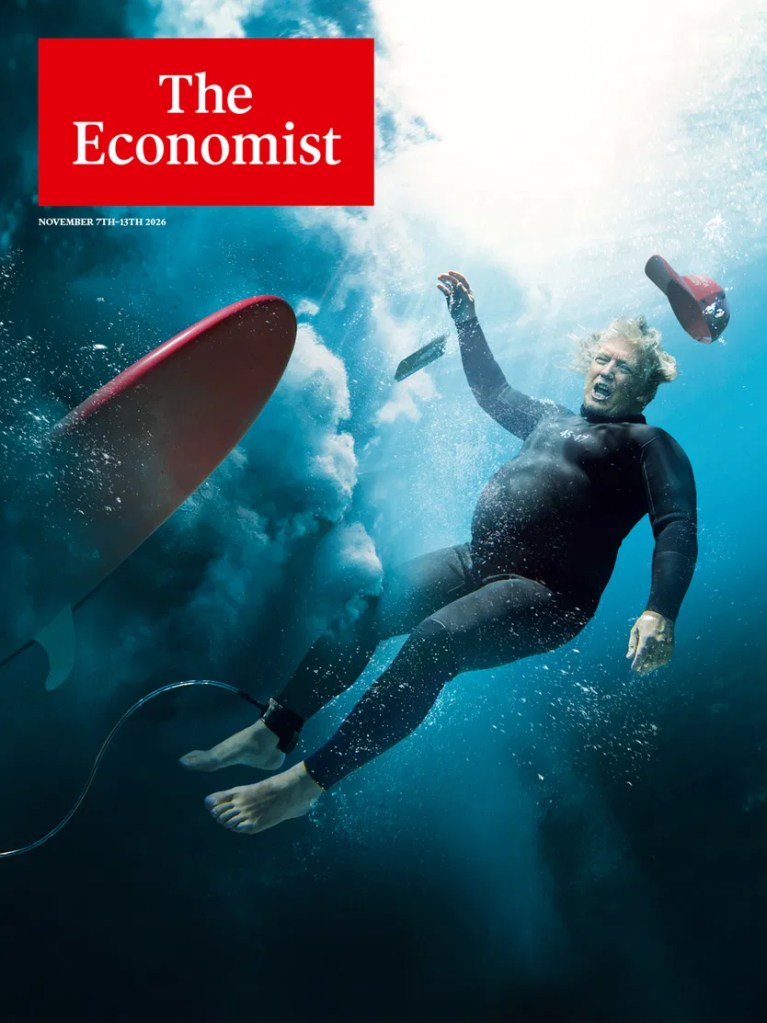
THE ECONOMIST MAGAZINE NOVEMBER 7, 2026

THE ECONOMIST MAGAZINE: The latest issue features ‘WIPEOUT’…

Donald Trump’s humiliation offers America an opportunity

Voters demand a new way of doing things in Washington. Let them have it

SURFERS CALL it the washing machine. When a giant wave throws you off your board and plunges you underwater, you lose all sense of where you are. That is what befell Donald Trump and his party on November 3rd, as they were slammed by tens of millions of American voters. They have still to grasp just how much their country has changed.

Already it is clear this was not a normal midterm swing against a sitting president, but the biggest wave-election since the aftermath of Watergate more than 50 years ago. Democrats won control of both chambers of Congress, flipping seats deep into once-safe red waters, from South Carolina to Texas.

El Salvador’s gangbuster tries his luck in Haiti

The status quo is so dire Nayib Bukele might improve it. But the risks are huge

The world must act to stop a cyber-disaster

Governments should make sure defenders have better models than attackers do

Patients are acting more like consumers. Good

Health care cannot be an ordinary market. But it could be much more like one

England’s new ban on kinky porn will misfire

Bans make moralists feel good, but will not work as planned
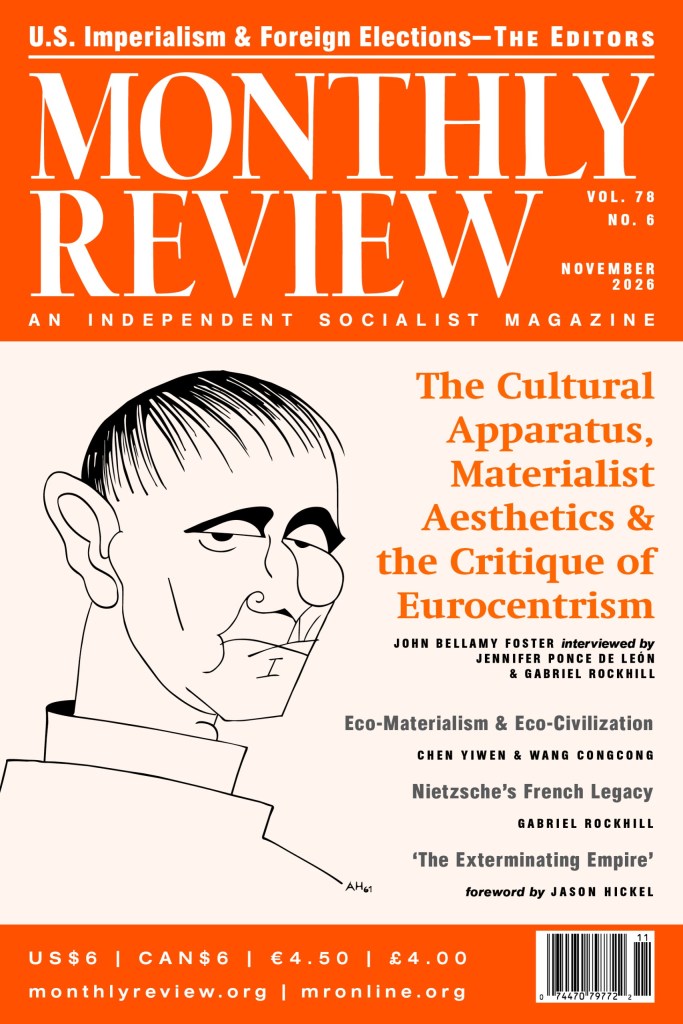
MONTHLY REVIEW MAGAZINE NOVEMBER 2026 PREVIEW

MONTHLY REVIEW MAGAZINE: The latest issue features the United States as the world’s chief enemy of sovereign elections.

Citing Dov Levin’s research, it counts 128 U.S. interventions in foreign elections from 1946 to 2014, rising after the Cold War, increasingly overt, and successful about 60 percent of the time before 2000. Methods include funding right-wing campaigns, dirty tricks, lawfare, social-media bots, aid threats, and CIA surrogates posing as “democracy assistance” groups. Recent examples include Venezuela, ending in Maduro’s abduction; $20 billion tied to electing Milei’s allies in Argentina; and Honduras, where Trump declared Asfura the winner. Leaked “Hondurasgate” tapes exposed regional manipulation schemes.

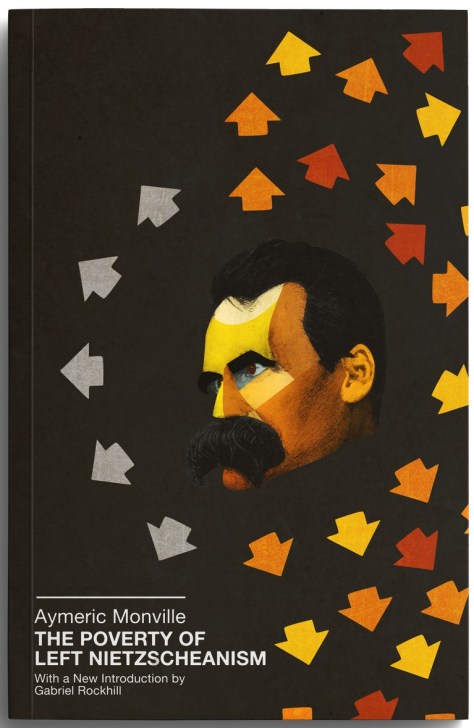
Nietzsche’s French Legacy

The Poverty of Left Nietzscheanism by Aymeric Monville

MR is pleased to be able to share with readers Gabriel Rockhill’s Introduction to The Poverty of Left Nietzscheanism by Aymeric Monville (Iskra Books, 2026). Rockhill provides readers with a thorough account of the rehabilitation of Nietzsche within French Theory and its consequences within the non-communist left. Fascism, Rockhill argues, “can only be understood and contested through materialist analysis and anticapitalist praxis”—a fitting preamble to a book that acts as “an insightful indictment of the dominant capitalist ideologies while clearly articulating the political path forward.”

THE ECONOMIST MAGAZINE OCTOBER 31, 2026

THE ECONOMIST MAGAZINE: The latest issue features ‘The Americans changing politics for the better’…

The Americans changing politics for the better

Hispanics and Asians have become their country’s most dynamic swing voters

Andy Burnham’s government talks of change, then does nothing

Britain’s unimpressive budget reveals a lack of ambition

Israel’s Jewish and Arab opposition parties should work together

If they want to dislodge Binyamin Netanyahu from office, they need to act fast

What to make of 25 years of Narendra Modi

He is learning that even rapid economic growth won’t placate voters if it fails to produce jobs

Markets are dismayed by Lula’s surprise win—and for good reason

The pressure is on Brazil’s re-elected president to avoid an economic slump

Let China copy American AI

Distillation annoys Anthropic and OpenAI. That is not reason enough to ban it

THE ECONOMIST MAGAZINE OCTOBER 24, 2026

THE ECONOMIST MAGAZINE: The latest issue features ‘The agony of liberal Europe‘…

The agony of liberal Europe

Centrist rulers have fallen dangerously short—and are now paying the price

“The first steps into the Unrest seem straightforward enough—anger at the fall of real wages, at capitalist aggression, at the unwillingness of Parliament; anger fomented by agitators…reason wars with instinct.” Few of those who mobbed French cities this week would recognise those words. But many would agree with George Dangerfield, the British-American journalist who wrote them. The demonstrators were consumed by rage. Rage at the failure of the state and against the floundering centrist politicians who govern. Rage at high prices and economic dysfunction. And for some, rage against the idea of centrist politics at all.

Will AI take over science?

Artificial intelligence will require scholars to reinvent their disciplines

Mysteries of the Musk Foundation

The world’s richest man disdains charity. His money is where his mouth is

How Britain’s lobbyists exploit suicide

Public policy is increasingly dictated by tragedy

Our interview with Alice Weidel

The populist-right politician says Ukraine has “already lost” against Russia and should sue for peace

THE ECONOMIST MAGAZINE – OCTOBER 17, 2026

THE ECONOMIST MAGAZINE: The latest issue features ‘NOT SORRY’ – What Carney and Canada can teach the world…

Mark Carney and the lessons for the middle powers

Canada demonstrates how to respond to a dangerous world

What if the machines take over science?

Artificial intelligence will require scholars to reinvent their disciplines

Hardly his finest hour

Donald Trump’s scheme to secure Russian diesel is scandalous

America makes waves in Cuba

But it shouldn’t undermine the growth of the island’s private sector

Millennials’ success deserves a toast (not the avocado sort)

How a “lost generation” found itself

A PROMISE, NOT A FORECAST

Intellicurean Essays· on Intellicurious

On a July morning in 2012, the head of the European Central Bank told a room in London that he would do whatever it took to save the euro, and then added two words: believe me. The program he went on to design was never used. A new essay asks how a sentence can do the work of a policy, and what it costs to keep one.


A Promise, Not a Forecast: a dark modern conference hall. A man in a dark suit stands at a slim lectern with his back to the viewer. A single ribbon of gold light runs from his hand up across a giant wall of falling red market data, and every red fragment stops above it. In the foreground, an audience in silhouette holds up phones and tablets whose screens show the gold line.
A line made of nothing, holding back the market, and a room recording it. Made for the essay.

Why we’re pointing you there

This week’s Nobel in economics went to Robert Hall and Michael Woodford, and Michael Cummins reads their theory as a theory of promising. Hall showed in 1978 that tomorrow is already inside today’s spending. For forty-six years he also chaired the committee that dates America’s recessions, the economy’s official narrator, always speaking after the fact. Woodford built the model central banks now use, and wrote that guidance must offer “a ‘promise’ and not merely a ‘forecast.’” Three years later Janet Yellen said of the Fed’s dot plot, “that’s not a promise.” Between those two sentences the essay sets the promises that held and the one that broke: the Swiss National Bank’s floor under the franc, called the cornerstone of its policy three days before it was abandoned, when the franc jumped almost 30 percent in minutes.

Then the turn. The fall in inflation after 2022 is being told as the theory’s triumph, but the economists who have studied it most closely disagree about why it happened, and the laureate himself spent the 2010s building a listener who believes less. Meanwhile the listener is changing: from a television anchor reading the thickness of Alan Greenspan’s briefcase to futures trading three milliseconds after a Fed release. The essay says plainly that it was drafted and edited with Claude, and it ends on one question: if the listener a central bank speaks to has read every promise it has ever made, what is a promise still worth?

A dark, steeply raked auditorium. On a distant stage a man at a lectern faces a large market screen. A gold ribbon of light bursts into hundreds of thin gold threads that fan out to cameras, tablets on tripods and server towers among mostly empty seats. In the front row, under a pool of warm light, an old leather briefcase sits alone; no thread reaches it.
A hall with no one in it, listening. Made for the essay.
Read the full essay at Intellicurean →

Essays & Reviews for the Intellectually Curious

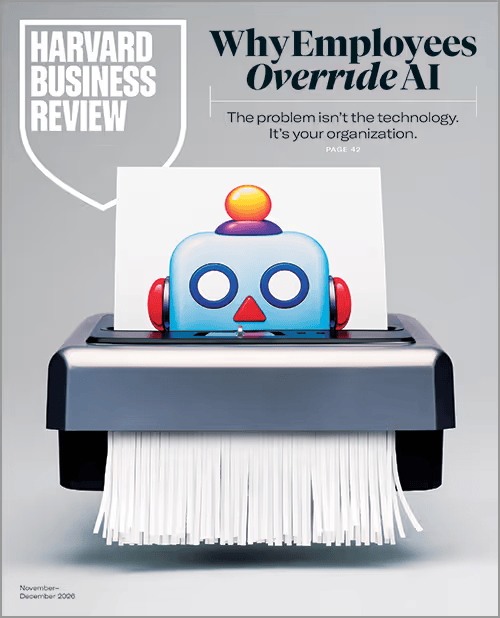
HARVARD BUSINESS REVIEW – NOVEMBER/DECEMBER 2026

HARVARD BUSINESS REVIEW: The latest issue features ‘WHY EMPLOYEES OVERRIDE AI’ – The problem isn’t the technology. It’s your organization.

Why Even Your Best Employees Override AI Systems That Work

It’s not that they don’t trust the technology. It’s that they don’t trust your organization.

Summary

Companies are deploying AI systems faster than they are redesigning the governance surrounding them. As a result, many AI systems remain permanent advisers rather than actual decision-makers—not because the technology falls short but because the…more

In late 2022 a global bank approved an AI system designed to automate routine credit decisions. On paper it looked exactly like the kind of forward-thinking move experts had been urging companies to make. In pilots the system processed applications faster than humans did, reduced errors, and promised meaningful cost savings. The risk management team signed off on it, compliance approved it, and the CEO touted it publicly as proof that the bank was leaning into the future.

Your Chatbot Will Define Your Brand

As conversational interfaces begin to dominate the customer experience, relationship design becomes a strategic priority.

For Real Performance Gains with AI, Start by Mapping Your Workflows

That’s how to reveal the most promising opportunities.

THE ECONOMIST MAGAZINE – OCTOBER 10, 2026

THE ECONOMIST MAGAZINE: The latest issue features ‘Will bonds blow up?’….

Will bonds blow up?

A government-debt crisis is looming

A selfish ploy to break up Pakistan

Its military chief wants lots of small provinces, to fragment the opposition

How Europe should deal with the new China shock

Amassing “second-strike” trade weapons is not enough

A no-rules approach to AI is mad politics and worse policy

Do not let it rip

Britain’s Greens have voted, shamefully, to say Zionism is racism

It is a damning moment for a political party with pretensions to power

Brazil is a right-wing country now

The Bolsonaro clan promises to align with Donald Trump, and to attack democratic institutions

THE ECONOMIST MAGAZINE – OCTOBER 3, 2026

THE ECONOMIST MAGAZINE: The latest issue features ‘The century’s biggest idea’ – Effective altruism and the battle over AI…

Effective altruism is this century’s biggest idea

The movement is admirable, but dangerous

A hurricane is coming to tax systems

Governments should be preparing, but most aren’t

Don’t put Donald Trump and Kim Jong Un in a room together

A summit between the two “friends” could go horribly wrong

China’s new infrastructure push will help itself and the world

But it must still do more to lift consumption

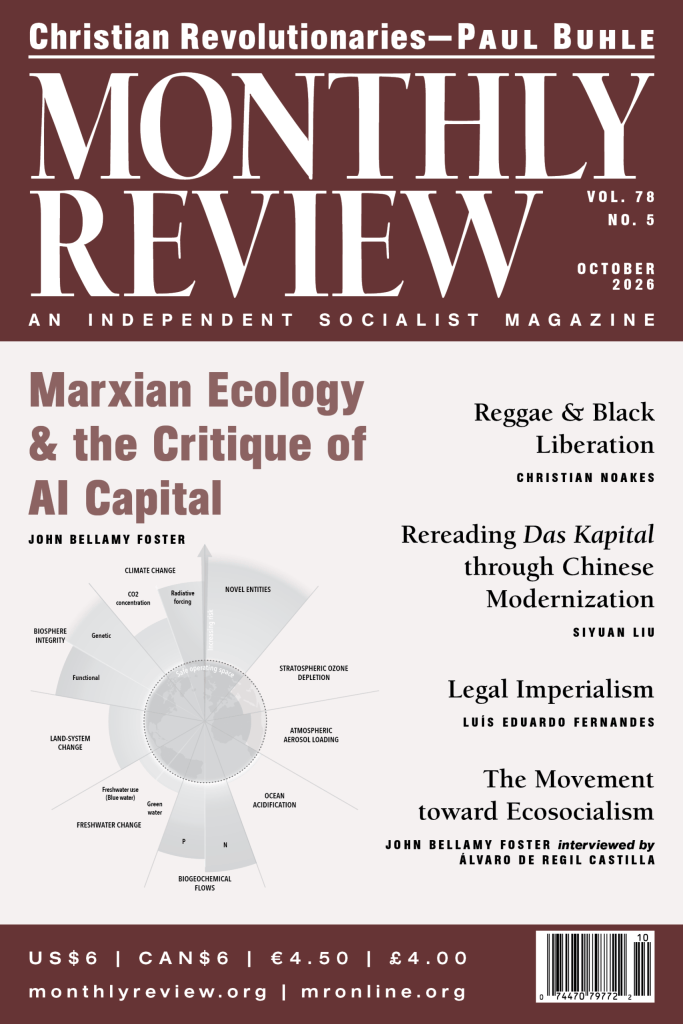
MONTHLY REVIEW MAGAZINE – OCTOBER 2026 PREVIEW

MONTHLY REVIEW MAGAZINE: The latest issue features ‘Marxian Ecology & the Critique of AI Capital’….

Marxian Ecology and the Critique of AI Capital

by John Bellamy Foster

What is the rise of AI capital, and what does it mean for contemporary work, culture, and the ecological state of our planet? John Bellamy Foster dispels the myth of a “hyperorganized AI capitalism.” As Foster writes: “We are not entering a stable new age…but rather a new, capitalist-engendered global disorder in which humanity, according to climate science, is headed ever more rapidly toward a planetary ‘point of no return.'” The only way out—the only way, that is, to ensure the survival of humanity—is a radical shift away from the catastrophically destructive regime of capital accumulation and toward sustainable human development through socialism.

Radical Jewish Tradition

by Paul Buhle

Paul Buhle reviews The Radical Jewish Tradition by Donny Glickstein and Janey Stone. The book, Buhle writes, is a window onto “the antinomies of nineteenth-century Jewish life”—including the growing movement against Zionism and for socialism among Eastern European Jews. This authors, Buhle notes, also tells the story of Jewish communists in Britain, the United States, and beyond, taking into account the wide sweep of Jewish left activity globally, situating the present struggles against genocide in Palestine squarely within the legacy of radical Jews everywhere.

Legal Imperialism: International Law and Dependency in Late Imperialism

by Luís Eduardo Fernandes

Today’s resurgence in U.S. imperialist interventions abroad and the concomitant so-called crisis of the “rules-based order” can be explained, Luís Eduardo Fernandes argues, through the category of “legal imperialism, which refers to how the international juridical form is internalized within societies and in the context of dependency, colonialism, unequal exchange, and monopoly capital. “International law and imperialism,” Fernandes writes, “do not stand as opposing poles. They are part of the same unity.… Violence is constitutive of the juridical form.”