Tag Archives: Russia

THE ECONOMIST MAGAZINE NOVEMBER 14, 2026

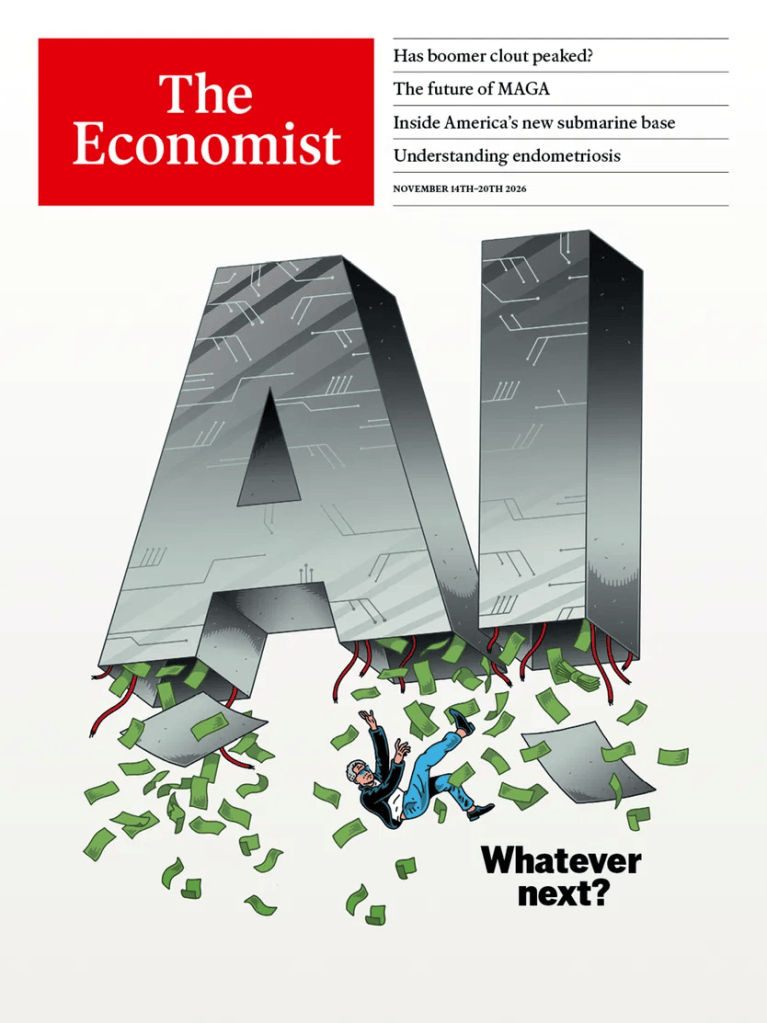
THE ECONOMIST MAGAZINE: The latest issue features ‘AI’ – Whatever next?

Why you should expect an AI crash

But not necessarily a financial cataclysm

Could the news be much more dramatic? Artificial-intelligence models keep growing more powerful, faster than almost anyone predicted. Next week Anthropic, a frontier model-maker, is expected to list its shares in what could be the biggest-ever IPO of an AI firm. Yet in some ways the AI boom is looking wobbly. A sex-and-spying scandal is rocking Nvidia, the top chipmaker. America’s Democratic Party, having won the midterms, is raring to go after data centres and Trump-adjacent tech titans. Some fear an almighty tech bust is coming. How worried should the world be?

History offers clues. Plenty of past technologies, from canals and railways to the internet, have brought market euphoria and then despair. Bets on them went wrong even though the underlying technologies proved revolutionary.

South Africans are giving up on Nelson Mandela’s party. Good

The decline of the African National Congress shows that democracy is working

Jensen Huang must go

His should not be the only head to roll

China’s emissions are falling. Thank self-interest

And its technology is helping others fight climate change, too

To triumph in show business, take a lo-fi or hi-fi approach

Skydance is stuck in the dangerous middle ground
THE ECONOMIST MAGAZINE NOVEMBER 7, 2026

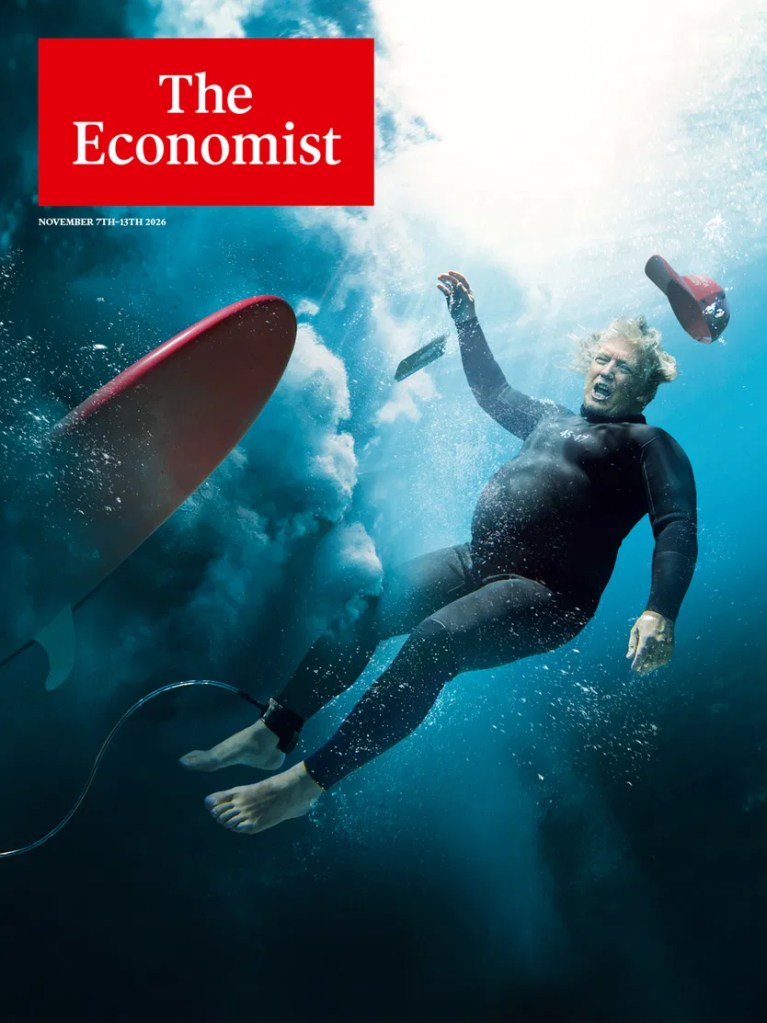
THE ECONOMIST MAGAZINE: The latest issue features ‘WIPEOUT’…

Donald Trump’s humiliation offers America an opportunity

Voters demand a new way of doing things in Washington. Let them have it

SURFERS CALL it the washing machine. When a giant wave throws you off your board and plunges you underwater, you lose all sense of where you are. That is what befell Donald Trump and his party on November 3rd, as they were slammed by tens of millions of American voters. They have still to grasp just how much their country has changed.

Already it is clear this was not a normal midterm swing against a sitting president, but the biggest wave-election since the aftermath of Watergate more than 50 years ago. Democrats won control of both chambers of Congress, flipping seats deep into once-safe red waters, from South Carolina to Texas.

El Salvador’s gangbuster tries his luck in Haiti

The status quo is so dire Nayib Bukele might improve it. But the risks are huge

The world must act to stop a cyber-disaster

Governments should make sure defenders have better models than attackers do

Patients are acting more like consumers. Good

Health care cannot be an ordinary market. But it could be much more like one

England’s new ban on kinky porn will misfire

Bans make moralists feel good, but will not work as planned

THE WEEK MAGAZINE NOVEMBER 6, 2026

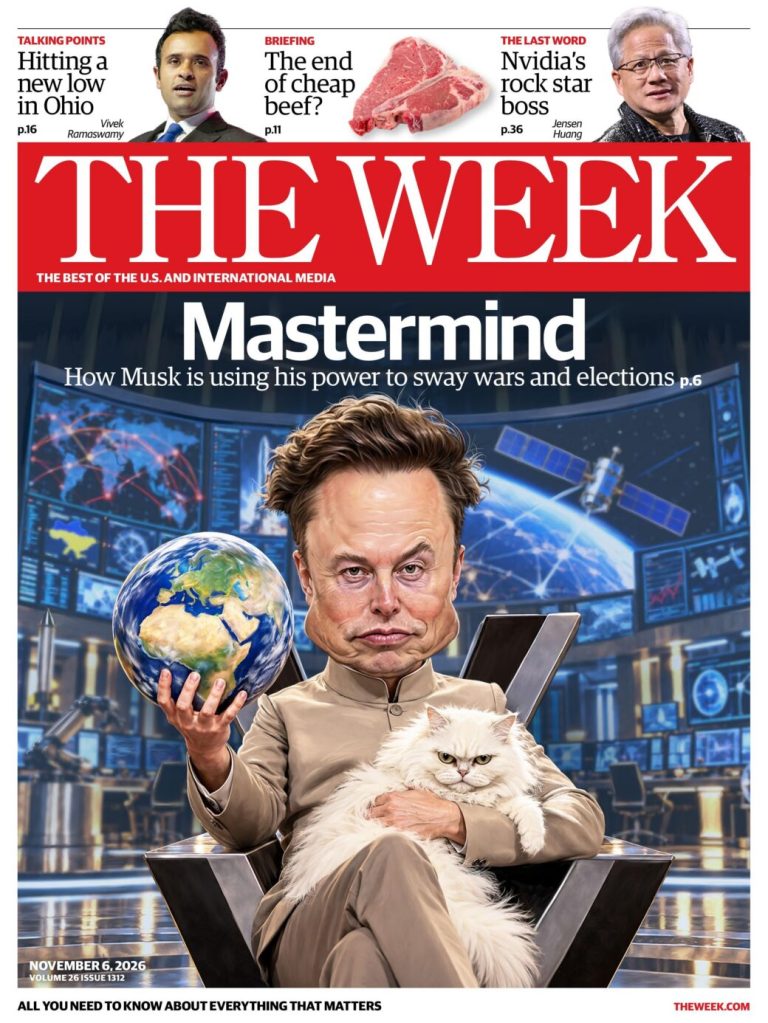
THE WEEK MAGAZINE: The latest issue features ‘MASTERMIND’ – How Musk is using his power to sway wars and elections….

Musk: Does he have too much power?

Elon Musk is trying to “make himself more powerful than the government,” said Michael A. Cohen in MS.now. The SpaceX founder and world’s wealthiest man announced last week that he was behind the decision to temporarily throttle Ukraine’s access to a crucial battlefield technology, claiming Kyiv had violated the “terms of service” of his commercial Starlink satellite network by using it for offensive operations against Russia. Kyiv said that explanation didn’t make sense, because the slowdown hit Starlink’s Pentagon-controlled military equivalent Starshield, which Ukraine uses to guide attack drones and defensive drone interceptors. Most likely, Musk was “working in concert” with President Trump, trying to pressure Ukrainian President Volodymyr Zelensky into accepting Russia’s terms for ending the war. Either way, it’s outrageous that Musk, “unelected and unaccountable,” should hold such sway over U.S. foreign policy—or domestic policy. The trillionaire has spent over $442 million helping Republicans in next week’s midterms. That’s more than any individual has ever spent on a congressional election cycle and “dwarfs” the $250 million he spent returning Trump to the White House in 2024. If Democrats can overcome Musk’s money and win at least the House next week, they need to find ways to stop this “menace” wielding “such influence in American elections and on American statecraft.”

In The Spotlight

Trumpland is already looking for midterm scapegoats

Some of the president’s closest allies are in the hot seat ahead of an expected electoral drubbing

After winning the streaming wars, has Netflix peaked?

Viewership has slowed, while YouTube attracts eyeballs

Is Viktor Orbán being primed for UN’s top job?

Hungary’s authoritarian former PM would be controversial choice as new secretary general

THE ECONOMIST MAGAZINE OCTOBER 31, 2026

THE ECONOMIST MAGAZINE: The latest issue features ‘The Americans changing politics for the better’…

The Americans changing politics for the better

Hispanics and Asians have become their country’s most dynamic swing voters

Andy Burnham’s government talks of change, then does nothing

Britain’s unimpressive budget reveals a lack of ambition

Israel’s Jewish and Arab opposition parties should work together

If they want to dislodge Binyamin Netanyahu from office, they need to act fast

What to make of 25 years of Narendra Modi

He is learning that even rapid economic growth won’t placate voters if it fails to produce jobs

Markets are dismayed by Lula’s surprise win—and for good reason

The pressure is on Brazil’s re-elected president to avoid an economic slump

Let China copy American AI

Distillation annoys Anthropic and OpenAI. That is not reason enough to ban it

THE GUARDIAN WEEKLY – OCTOBER 30, 2026

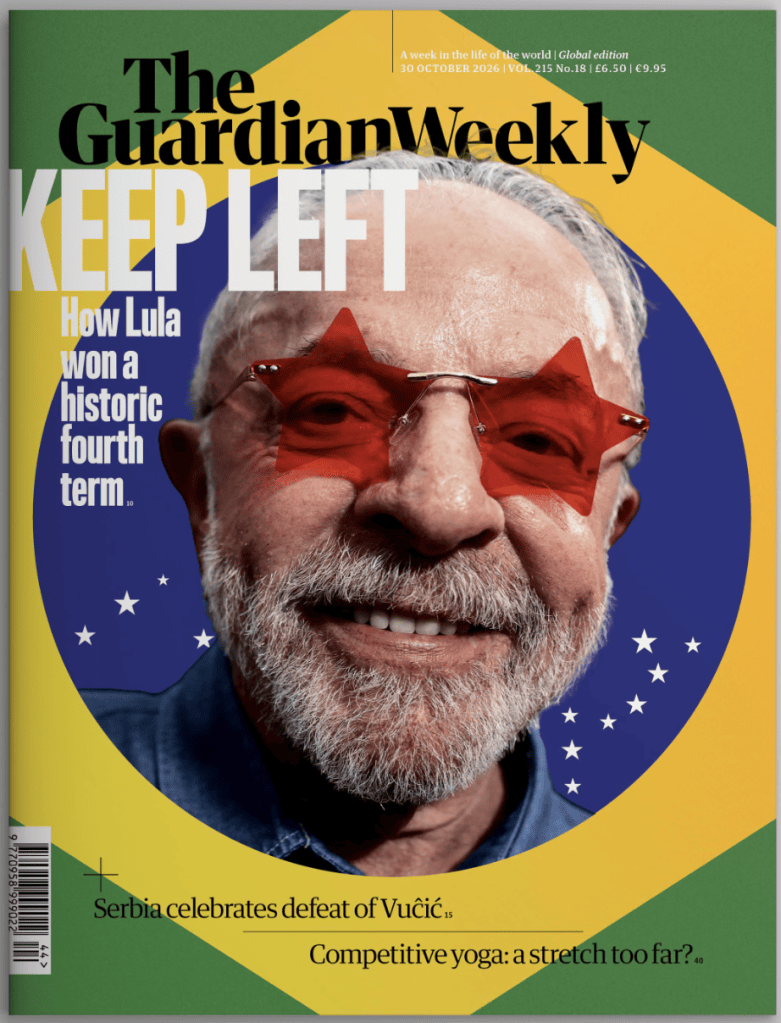
THE GUARDIAN WEEKLY: The latest issue features ‘KEEP LEFT’ – How Lula won a historic fourth term; Serbia celebrates defeat of Vučić; Competitive yoga – A stretch too far?

How many grinning faces, jubilant crowds and celebrating politicians can you fit into a single issue of the Guardian Weekly? That’s not a question that often troubles us, but the spectacular triumph of President Luiz Inácio Lula da Silva, winning a historic second-round vote after losing the first to rightwing opponent Flávio Bolsonaro, and the victory of the student-led campaign against autocrat Aleksandar Vučić in Serbia gave me a happy problem to solve this week. In an era when the right seems to be riding high in the world, popular pushbacks against strongmen politicians is something to celebrate.

For our Brazil cover story, Tom Phillips and Tiago Rogero report on the reaction to Lula’s victory and how he pulled eventual success from the jaws of what, until the first results came on Sunday evening, seemed a probable defeat. As government health minister Alexandre Padilha said that evening: “It’s a massive victory – not just for Brazil. It’s also an important signal to the rest of Latin America and to the world.” But, as commentator Jordana Timerman cautions, Brazil has been an exception in Latin America in successfully resisting Donald Trump’s attempt to achieve hegemony over the region.

Spotlight | ‘Pure arrogance’
Google has been in the dock in Finland over the illegal felling of hectares of woodland for its datacentres, reports Miranda Bryant

Science | Out of the blue
Why are more planes encountering invisible air turbulence, what can they do about it and what effect will more frequent incidents have on travellers, asks Patrick Keneally

Feature | Bent out of shape?
Competitive yoga may sound like anathema to some devotees of the ancient practice but, as Anita Chaudhuri discovers, there is a movement among some yogis to make it an Olympic sport

Opinion | Lame duck presidents can be dangerous beasts
If Democratic midterm gains hamper Donald Trump at home, we should be very worried about what he might do abroad when foreign policy is his last bastion of power, says Steve Bloomfield

Culture | Stay faithful
As the second series of Celebrity Traitors draws to its conclusion, Michael Hogan meets the people who made it the world’s biggest TV show and finds out why Claudia Winkleman never wants to leave the castle

THE ECONOMIST MAGAZINE OCTOBER 24, 2026

THE ECONOMIST MAGAZINE: The latest issue features ‘The agony of liberal Europe‘…

The agony of liberal Europe

Centrist rulers have fallen dangerously short—and are now paying the price

“The first steps into the Unrest seem straightforward enough—anger at the fall of real wages, at capitalist aggression, at the unwillingness of Parliament; anger fomented by agitators…reason wars with instinct.” Few of those who mobbed French cities this week would recognise those words. But many would agree with George Dangerfield, the British-American journalist who wrote them. The demonstrators were consumed by rage. Rage at the failure of the state and against the floundering centrist politicians who govern. Rage at high prices and economic dysfunction. And for some, rage against the idea of centrist politics at all.

Will AI take over science?

Artificial intelligence will require scholars to reinvent their disciplines

Mysteries of the Musk Foundation

The world’s richest man disdains charity. His money is where his mouth is

How Britain’s lobbyists exploit suicide

Public policy is increasingly dictated by tragedy

Our interview with Alice Weidel

The populist-right politician says Ukraine has “already lost” against Russia and should sue for peace

THE GUARDIAN WEEKLY – OCTOBER 23, 2026

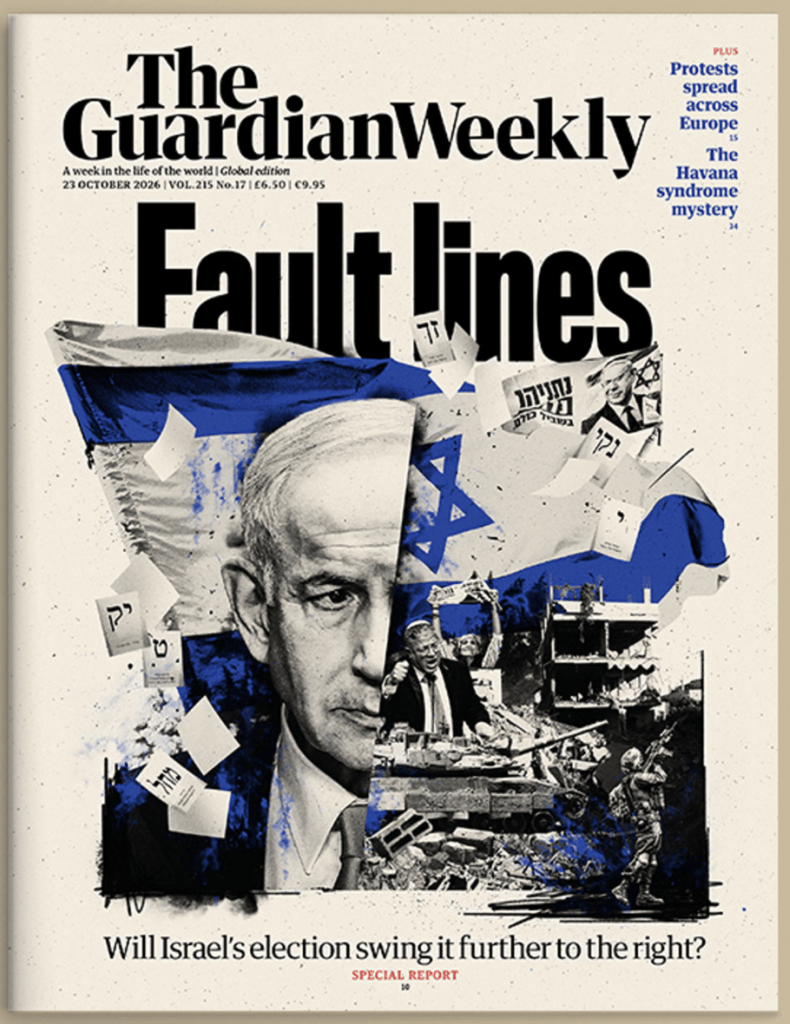
THE GUARDIAN WEEKLY: The latest issue features ‘FAULT LINES’ – Will Israel’s election swing it further to the right?…

Israel is holding national elections next week, giving its citizens their first chance to pass judgment on Benjamin Netanyahu and his coalition since the Hamas-led attacks of 7 October 2023.

For our big story this week, chief Middle East correspondent Emma Graham-Harrison says that whether or not the prime minister can hold on to power, a more rightwing Knesset is expected to be voted in. More than half a million Israelis have reached voting age since the last election in 2022 and, according to polls, three-quarters of first-time Jewish voters define themselves as right or centre-right.

Peter Beaumont profiles opposition candidate Gadi Eisenkot. The former general contrasts with Netanyahu when it comes to style and character, he writes, yet on key policy points retains a studied ambiguity.

Then Israeli pollster and political analyst Dahlia Scheindlin argues that after three disastrous years, Israel needs to rethink itself, but only a clear opposition victory would let the country begin to heal, strengthen democracy and establish Palestinian rights.

Spotlight | ‘We are suffocating’
As protests that have convulsed Spain and France in recent weeks spill over to Italy and Portugal, Sam Jones reports on the rising wave of anger over the housing crisis and cost of living

Science | Taking a shot
Could a drug to prevent shingles also protect our brains against dementia? The possibility, writes Ian Sample, is driving a boom in vaccinations

Feature | The Havana syndrome mystery
Dozens of CIA officers have been afflicted by debilitating symptoms over the past decade. Are they the result of “mass hysteria” or are they from attacks with an energy weapon, asks Shaun Walker

Opinion | Another EU referendum? Not just yet
The omertà on the UK rejoining has now been broken, but it would be folly to move too soon, says Polly Toynbee

Culture | Shygirl’s slog to the top
She has opened for Beyoncé, writhed in a cubicle for Madonna – and is poised to take over the mainstream with her new rock sound. The pop auteur talks to Simran Hans about cash, class – and finding true love

FOREIGN AFFAIRS MAGAZINE NOVEMBER/DECEMBER 2026

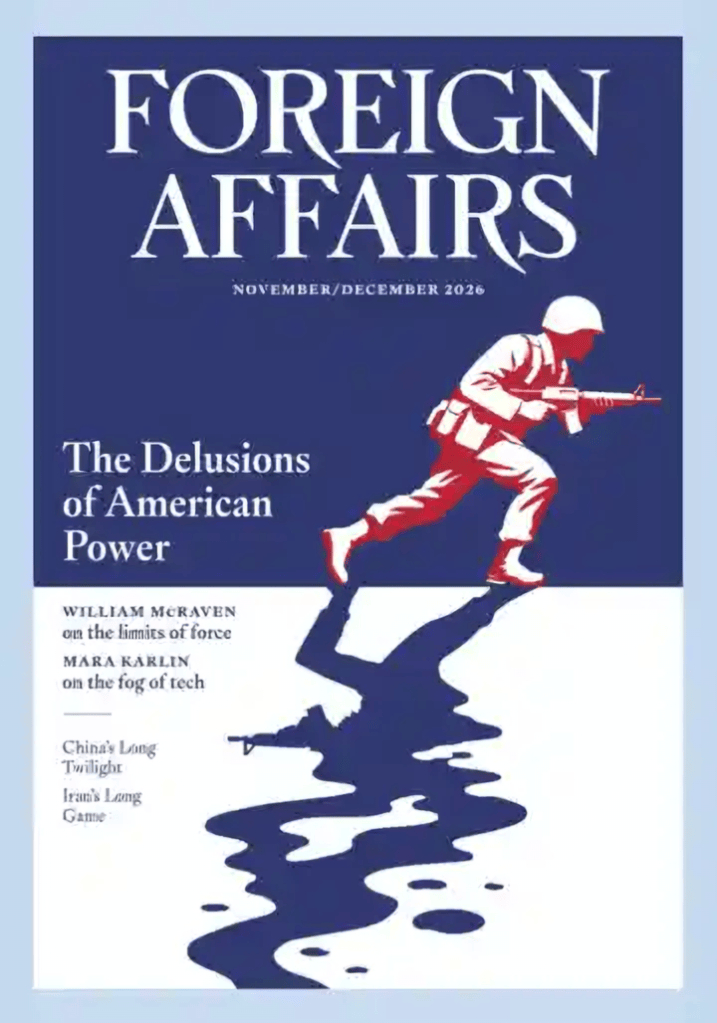
FOREIGN AFFAIRS MAGAZINE: The latest issue features ‘THE DELUSIONS OF AMERICAN POWER’….

The Limits of American Power

U.S. Strategy and the Delusion of Force By William H. McRaven

The war in Iran is far from the first time that U.S. policymakers have failed to appreciate the limits of American power. But the Trump administration’s use of military force against the Islamic Republic since February 28 offers a particularly glaring example of a mistake that has often characterized American strategy in recent decades. The war was launched without a clear rationale and with a constantly shifting set of objectives—from changing Tehran’s regime and squelching its nuclear ambitions to, more recently, reopening the Strait of Hormuz, which wasn’t closed until the war started. The results, not surprisingly, have been bad both for U.S. interests and for the Middle East.

The Fog of Tech

Why the Future of War Can’t Escape the Past By Mara Karlin

China’s Long Twilight

Demographic Decline, Political Paralysis, and the Fate of Great Powers By Carl Minzner

The Chokepoint Trap

How the Search for Economic Security Will End in Geopolitical Calamity By Henry Farrell, Abraham Newman, and Yeling Tan

The Case for Economic Espionage

America Should Spy On Foreign Companies to Help Its Own By David S. Cohen

Empires of AI

The Rise and Fall of a New Global Order By Niall Ferguson, Lisa Klaassen, and Eric Schmidt

THE ECONOMIST MAGAZINE – OCTOBER 17, 2026

THE ECONOMIST MAGAZINE: The latest issue features ‘NOT SORRY’ – What Carney and Canada can teach the world…

Mark Carney and the lessons for the middle powers

Canada demonstrates how to respond to a dangerous world

What if the machines take over science?

Artificial intelligence will require scholars to reinvent their disciplines

Hardly his finest hour

Donald Trump’s scheme to secure Russian diesel is scandalous

America makes waves in Cuba

But it shouldn’t undermine the growth of the island’s private sector

Millennials’ success deserves a toast (not the avocado sort)

How a “lost generation” found itself

THE GUARDIAN WEEKLY – OCTOBER 16, 2026

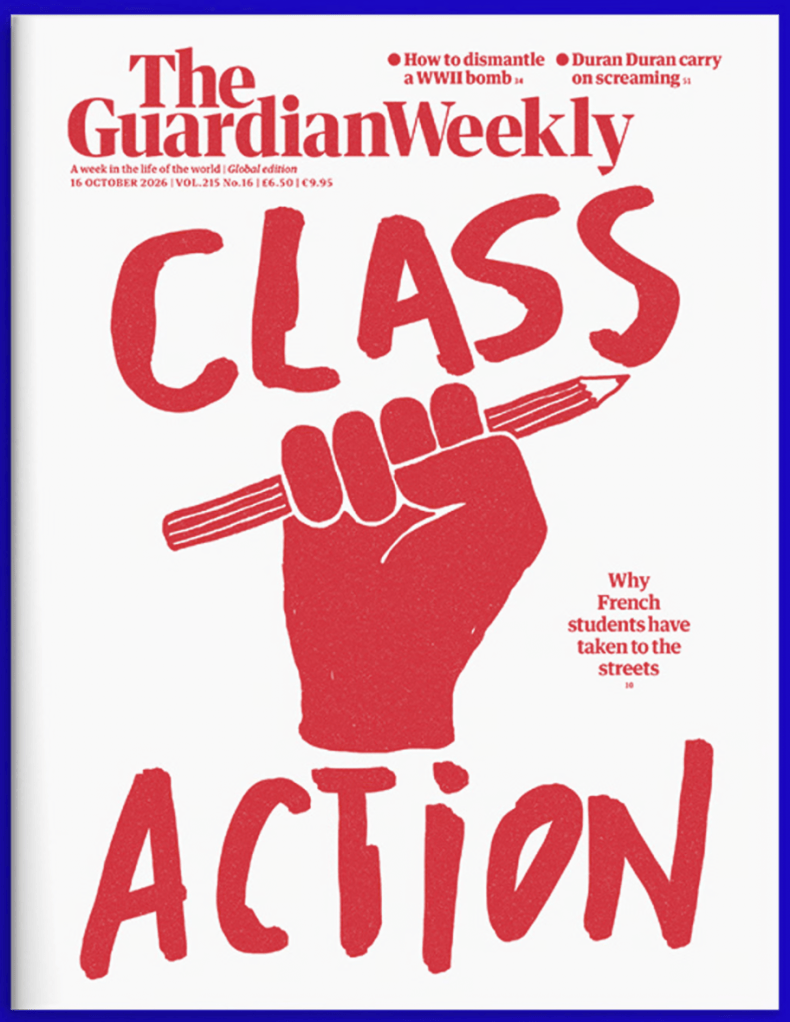
THE GUARDIAN WEEKLY: The latest issue features ‘CLASS ACTION’ – Why French students have taken to the streets…


France has been rocked by huge youth protests in recent weeks over the state of high school education, bringing tens of thousands of people on to the streets.

The movement began with outrage over shoddy school conditions in a Paris banlieue, but has spread across the country as pupils voice their anger about a system they say is failing them.

For this week’s big story, Paris correspondent Angelique Chrisafis hears from protesters who feel abandoned by the French state. Angelique also looks at the evidence on students’ complaints of dilapidated buildings, teacher shortages, inequality and low investment.

Then, Alexander Hurst says fixing the broken education system should be just the start for an aloof political class if it is to finally pay attention to a generation who feel neglected.

Spotlight | The future of the death penalty
Donald Trump has used the full might of the presidency to supercharge executions but, writes Ed Pilkington, an avalanche of mishaps has put the system’s flaws in the spotlight

Science | Sweet time
A flurry of recent studies suggests that spending the first 1,000 days of life under sugar rationing may have left traces on people’s health more than seven decades later. Linda Geddes reports

Feature | The art of dismantling a second world war bomb
British bomb disposal squads are being called to more unexploded devices than ever – and they risk their lives each time. Samira Shackle recounts the challenge they faced when two bombs were discovered on the same day

Opinion | A new era of instability
The latest attack by Houthi rebels on Saudi Arabia may prove to be more calamitous for the region than the world imagines, says Nesrine Malik

Culture | Hungry like the werewolf
Duran Duran talk to Alexis Petridis about 80s excess, tabloid scrutiny and their Halloween glow-up