
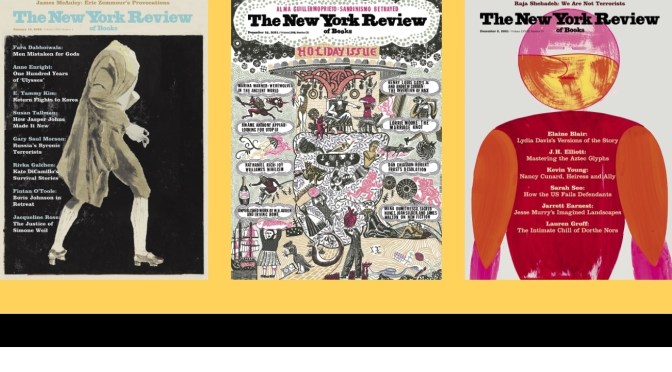
The left found its winning message.
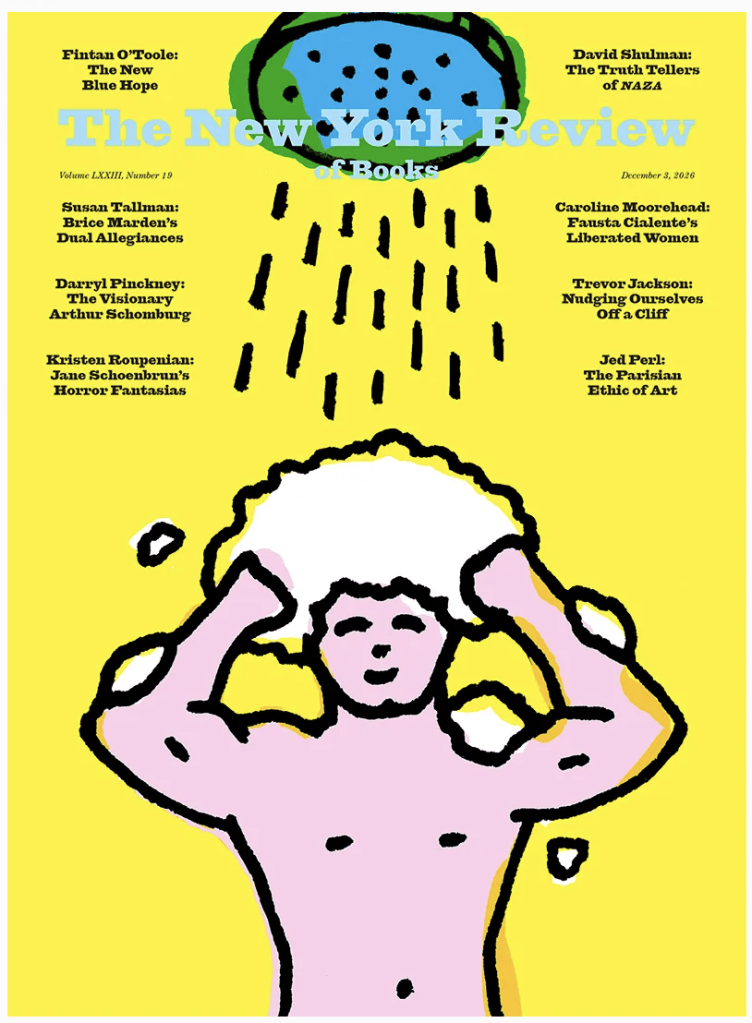
The December 3 issue opens with “The Next Generation” by Fintan O’Toole, the Review’s advising editor, who credits the American left with a historic election win achieved by tying the affordability crisis to Republican corruption. The whole Democratic Party, he argues, should learn from it. Later, Mark Danner‘s “The Tightrope Walker” asks how Trump turned a failed coup into a tale of his own martyrdom. He reviews Mary Clare Jalonick’s oral history of January 6th, Carol Leonnig and Aaron C. Davis’s account of a Justice Department cowed by politics and fear, and Michael Wolff’s All or Nothing.
Violence leaves lasting scars.
In “Collateral Damage,” David Shulman, a Hebrew University scholar and longtime activist with the Arab–Jewish group Ta’ayush, considers NAZA. In Yuval Abraham and Rachel Szor’s documentary, Israeli soldiers frankly voice remorse over their part in the Gaza war. Helen Epstein and Aminu Abubakar‘s “Interview with a Bandit” hears from one of the many Nigerians driven to violence by years of corrupt government. And in “The Executioner’s Song,” Piper French reviews Pamela Colloff’s To Catch the Devil. It is the Gulf Coast story of a notorious jailhouse informant whose lies sent an innocent man to death row, and of the officials and institutions that encouraged him.
Fiction crosses borders and centuries.
Caroline Moorehead‘s “Home and Away” introduces Fausta Cialente, an Italian émigré who lived much of her life in Egypt and wrote of restless women and girls drawn to flight. Her A Very Cold Winter appears in Julia Nelsen’s translation, introduced by Claudia Durastanti. Michael Gorra‘s “Nightmares of History” reviews The Newer World, which completes Sebastian Barry’s trilogy, begun with Days Without End, about Americans swept up in nineteenth-century violence. Kristen Roupenian‘s “We Tell Ourselves Stories in Order to Change” explores how Jane Schoenbrun’s book Public Access Afterworld and film Teenage Sex and Death at Camp Miasma blur reality and fantasy.
Art and archives take center stage.
Jed Perl‘s “Masters of Their Craft” tours shows at the Louvre, the Musée d’Orsay, the Grand Palais and the Fondation Louis Vuitton devoted to Michelangelo and Rodin, Renoir, late Matisse and Calder. For 150 years, he argues, Paris was modern art’s great workshop. Susan Tallman‘s “Seeing Through the Lightness” finds Brice Marden’s famous equanimity, in Gagosian’s survey I Am Plane Image, looking less inevitable and more like a hard-won balancing act. Darryl Pinckney‘s “Arthur Schomburg’s Legacy” marks the Schomburg Center’s centennial in Harlem, celebrating the collector whose books seeded one of the world’s foremost archives of Black history and literature.
Big ideas get a second look.
Trevor Jackson‘s “The Cost of Monetizing Everything” reviews Nick Chater and George Loewenstein’s It’s On You and The Price of Happiness by Cass R. Sunstein, co-author of Nudge. Behavioral economists promised rational policy, but Jackson finds a corporate push behind their nudges, which, as Chater and Loewenstein argue, shifted blame for systemic problems onto individuals. Clare Carlisle‘s “Reverence for All of It” takes up Steven Nadler’s Spinoza, Atheist. She asks whether a thinker branded a heretic in seventeenth-century Europe, for treating God and nature as interchangeable, should be called an atheist today.
Wild places and poems round it out.
In “‘Quest Without End’,” the Australian scientist Tim Flannery follows the Scottish journalist Cal Flyn, whose The Savage Landscape and Islands of Abandonment explore the emotions stirred by wild and deserted places, from wildernesses people helped create to landscapes nature has reclaimed. The issue also carries two poems: Susana Plotts-Pineda‘s “Our Lady of Beverly, TX” and Aaron Fagan‘s “Why I Go to the Movies Alone.” Browse the full table of contents for every review and poem.

