
Tag Archives: Book Review

LITERARY REVIEW MAGAZINE NOVEMBER 2026

LITERARY REVIEW : The latest issue features ‘SAKI’S SECRETIVE LIFE’…..

Laughter in the Margins

Super-Beast: The Mysterious Life of Saki By Oliver Soden

In some ways all you really need to know about Hector Hugh Munro (1870–1916) can be gleaned from the short story ‘Sredni Vashtar’, first published in the Westminster Gazette in the summer of 1910. Conradin – Munro’s heroes nearly always have these hifalutin names – is a sickly small boy quartered on a tyrannical guardian called Mrs de Ropp. Denied much in the way of freedom or material comfort, in particular the hot buttered toast he craves, Conradin makes a fetish out of a savage polecat-ferret hidden in the garden shed, worships it as a god and looks to it for vengeance.

Here in the World

Letters: 1944–1959 By Albert Camus & Maria Casarès (Edited by Béatrice Vaillant, translated from French by Sandra Smith & Cory Stockwell)

What an amazing behemoth of a book! I’ve been lugging it around for weeks. Nearly a thousand letters: the intimate correspondence of Albert Camus and Maria Casarès. When they first met in Paris – on D-Day, 1944 – Camus had already published L’Etranger (1942; The Outsider). Born and raised in Algeria, he was in Paris when the Second World War broke out, and later joined the French Resistance. Camus’s wife, Francine Faure, a mathematician and pianist, remained in Algeria. Maria Casarès was originally from Galicia, the daughter of an exiled former prime minister of Spain, Santiago Casares Quiroga. In 1944, Casarès was already known as an actress, having played the titular role in J M Synge’s Deirdre of the Sorrows. She later starred in Les Enfants du paradis (1945), Cocteau’s Orphée (1950) and La Lectrice (1988), among other films and plays.

Talk to the Animals

Minds I’ve Met: From Denying to Embracing the Inner Lives of Animals By Frans de Waal

Some years ago, a prominent animal-behaviour scientist hosted a colleague at his field station devoted to the study of chimpanzees. Talking together on top of the observation tower, the pair glanced at the apes but mostly stayed absorbed in conversation. Then a female chimpanzee named Thai began to scream and hit herself in dramatic fashion. In response to her outburst, other chimpanzees rushed to embrace, hold and kiss her.
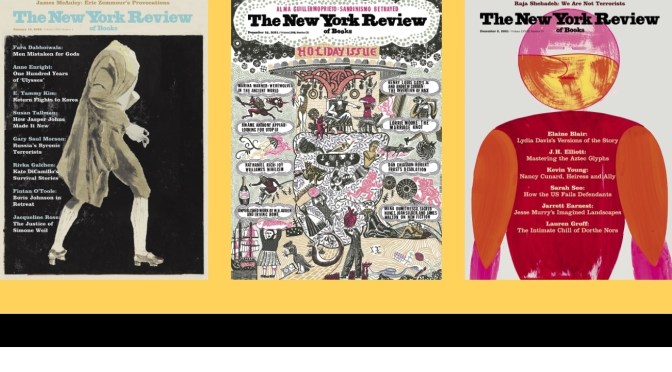
THE NEW YORK REVIEW OF BOOKS – NOVEMBER 19, 2026

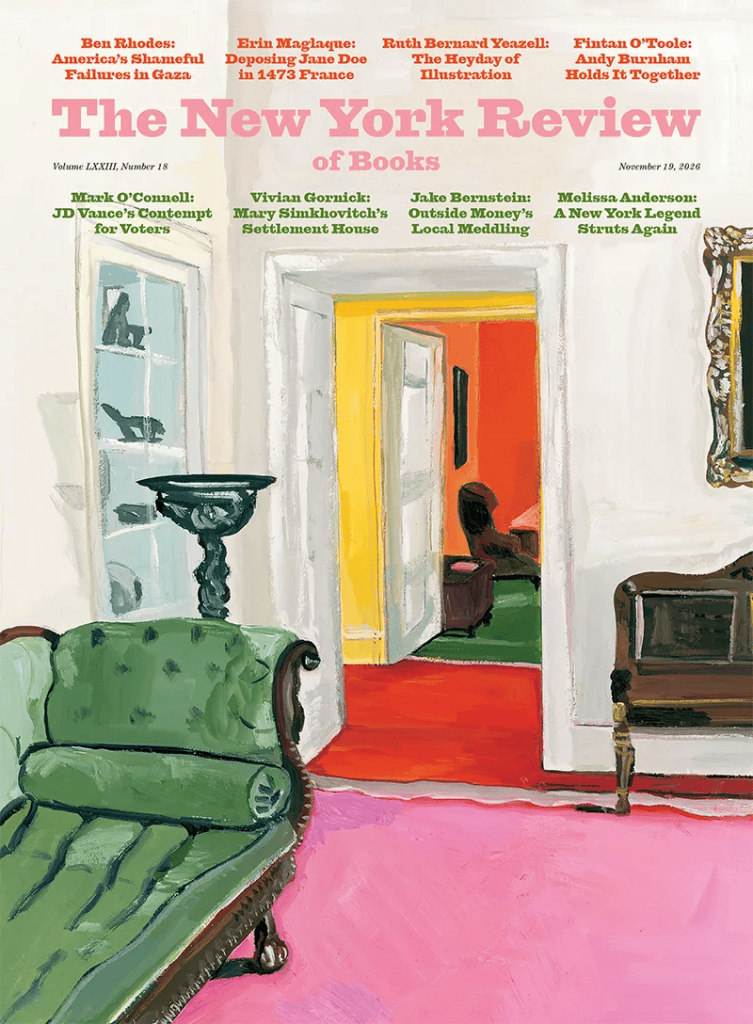
THE NEW YORK REVIEW OF BOOKS: The latest issue features Verlyn Klinkenborg on the rivers that you’re used to, Fintan O’Toole on Andy Burnham’s communion, Ruth Bernard Yeazell on illustrious illustration, Mark O’Connell on JD Vance’s overweening ambition, Melissa Anderson on Tally Brown’s underground, Jake Bernstein on the super PAC blitz, Erin Maglaque on a medieval Me Too moment, Vivian Gornick on the history of affordable housing, Ben Rhodes on Biden’s dereliction of Gaza, a poem by Jenny Grassl, and much more.


Biden’s Choice

As Israel’s assault on Gaza grew worse and worse, Joe Biden and his advisers acted as though they had no option but to offer their unconditional support. Why couldn’t they see the destruction they were enabling? By Ben Rhodes

Hull House on the Hudson

Mary K. Simkhovitch, the founder of Greenwich House, believed in the radical idea that housing should be made as livable for the working class as it was for the middle class. By Vivian Gornick

Me Too in the Middle Ages

A forensic study of a rape survivor from 1473 Dijon reveals a legal process surprisingly accepting of imperfect victims and contradictory testimony. By Erin Maglaque

The Flood of Life

Our desire to control a river’s course always conflicts with a river’s determination to shape its own. By Verlyn Klinkenborg

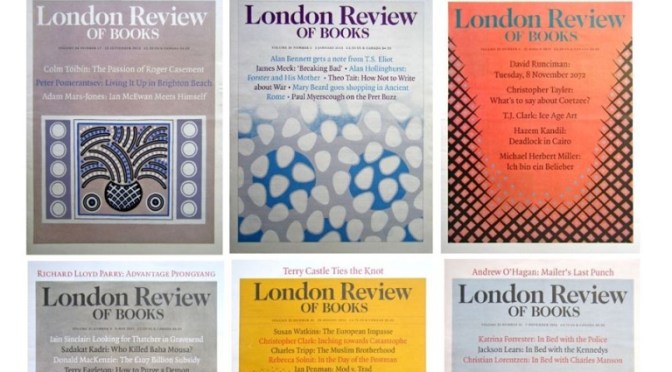
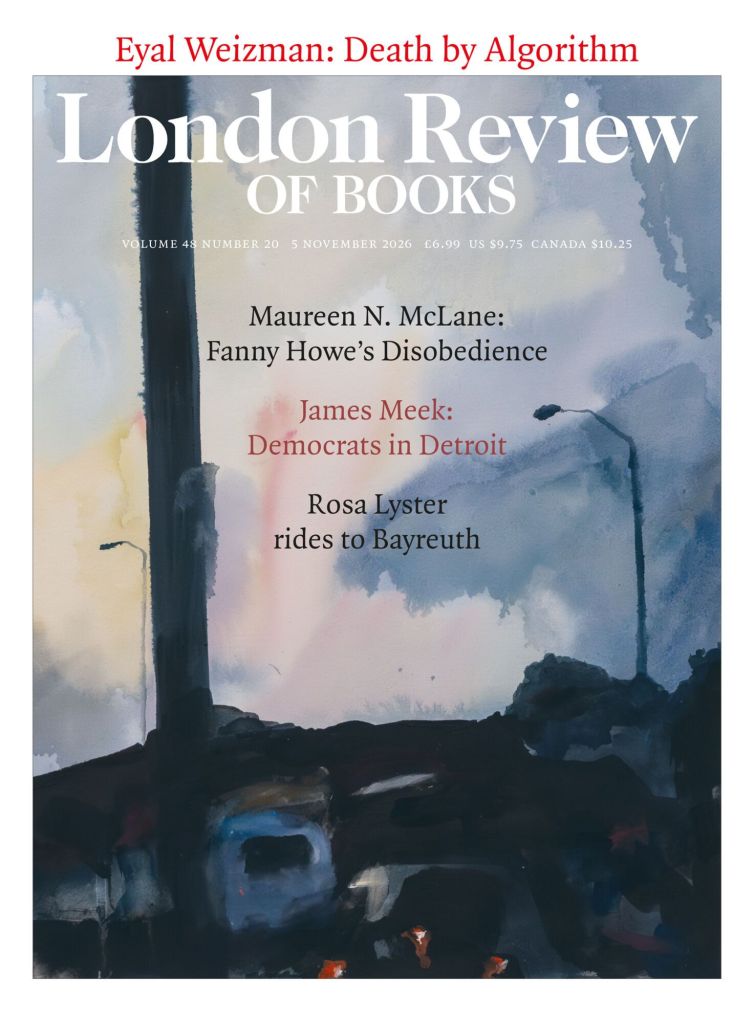
LONDON REVIEW OF BOOKS – NOVEMBER 5, 2026 PREVIEW

LONDON REVIEW OF BOOKS: The latest issue features  Fanny Howe’s Disobedience by Maureen N. McLane; Democrats in Detroit by James Meek; and Rosa Lyster rides to Bayreuth….

Democrats in Detroit

‘To win the Senate, the Democrats need to hold on to the one Michigan seat (out of two) that is up for grabs, and have chosen a new candidate, Abdul El-Sayed, a moderate leftist in European terms, a “communist loser who hates Jews and Israel” according to Trump, “very, very evil”, per J.D. Vance.’ By James Meek

Is curiosity good for us?

‘The superego – and its precursor, conscience – refers to the part of us that has no curiosity about ourselves. It’s the saboteur of curiosity about ourselves. And that part of us, like a narrow-minded fascist, has only one project: to destroy our pleasures in being alive by trying to kill our curiosity (or by making us frightened of our curiosity, which amounts to the same thing).’ By Adam Phillips

Death by Algorithm

Eyal Weizman on NAZA

‘Israel’s automated targeting system allows for the responsibility for “industrialised annihilation” to be shared between coders, operators, legal officers who pre-set the level of collateral damage, officers who approve the strike, officers who choose the bomb and the pilots or drone operators who launch it. “I am just a small screw in the system,” one of the interviewees says, quoting Eichmann’s defence during his trial in Jerusalem. The system that begins with a phone number being put into a computer system ends with an entire family crushed under the rubble.’

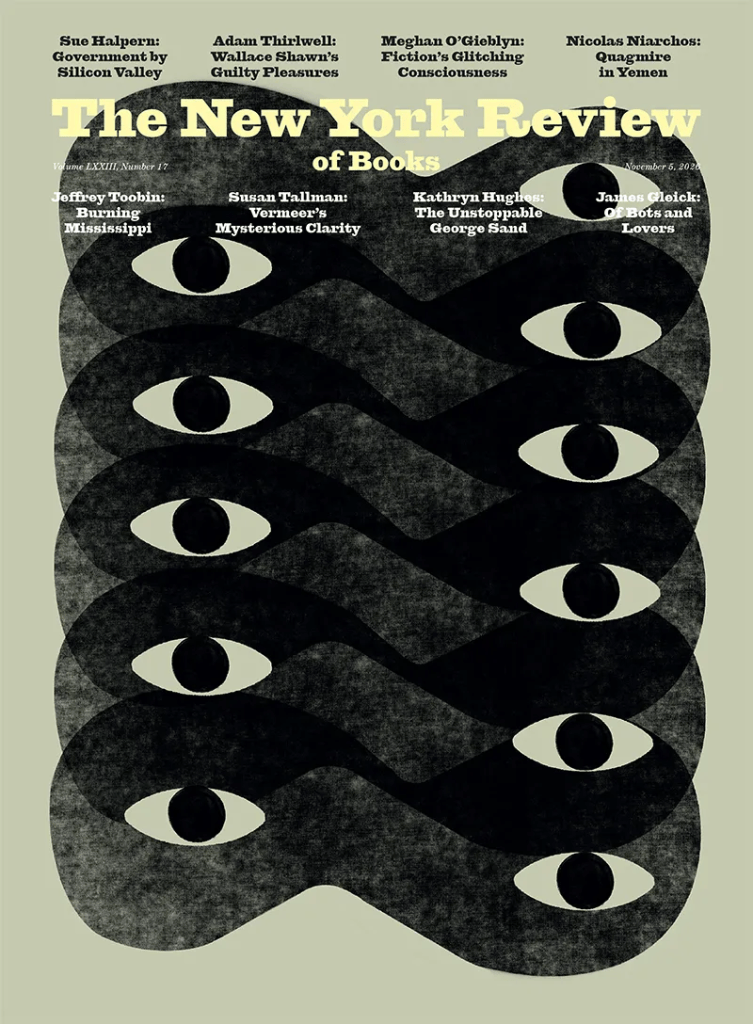
THE NEW YORK REVIEW OF BOOKS – NOVEMBER 5, 2026

THE NEW YORK REVIEW OF BOOKS: The latest issue features Sue Halpern on fascist dorks, Colm Tóibín on La Bola Negra, Kathryn Hughes on George Sand, Jeffrey Toobin on the fall of the Voting Rights Act, Colin Thubron on saving the great cats, Nicolas Niarchos on America’s disastrous Yemen policy, Julian Gewirtz on AI supremacists, Susan Tallman on the elusive Vermeer, James Gleick on the duplicitous chatbots, Adam Thirlwell on Wallace Shawn’s genius, poems by David Plante, Claire DeVoogd, and Shane McCrae, and much more.

The Plot to Delete Democracy

In The Nerd Reich Gil Durán shows how Silicon Valley billionaires have pushed a fringe ideology—what is popularly called techno-fascism but is closer in aspiration to straight-up totalitarianism—into the affairs of state.

The Nerd Reich: Silicon Valley Fascism and the War on Democracy by Gil Durán

Making Light of a Dark Past

La Bola Negra sidesteps the vicious politics of the Spanish Civil War to tell a story about gay sexual freedom.

La Bola Negra a film directed by Javier Calvo and Javier Ambrossi

Rebel Rebel

George Sand’s scandalous life, including a decade-long affair with Chopin, has obscured the influence of her many novels.

Becoming George: The Invention of George Sand by Fiona Sampson

Mapping Mississippi White

Bennie Thompson’s trailblazing career came after the success of the Voting Rights Act and could end with its fall.

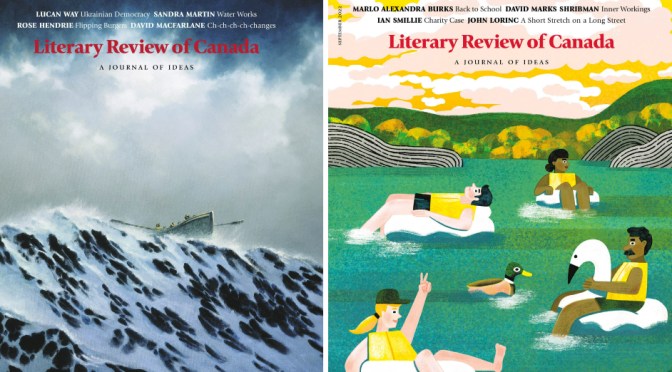
LITERARY REVIEW OF CANADA – NOVEMBER 2026 PREVIEW

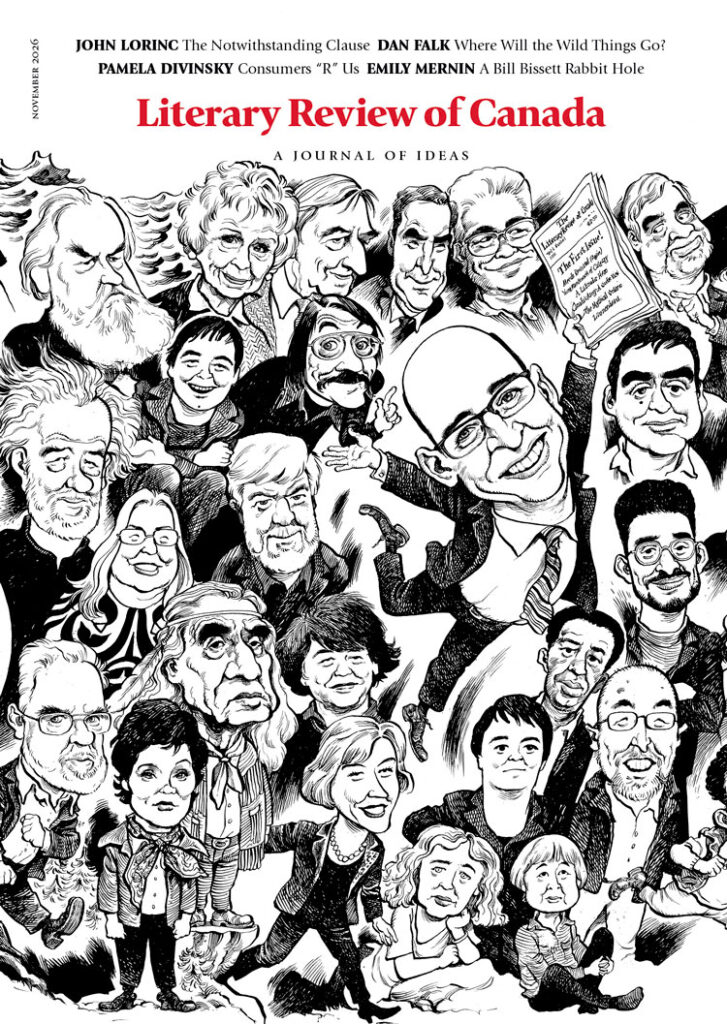
Front cover by David Parkins for November 2026.

LITERARY REVIEW OF CANADA: The latest features Canada’s political identity, constitutional tensions, and colorful parliamentary history while reflecting on the magazine’s own milestone anniversary.

A Coral Anniversary

A panoramic reflection

By Kyle Wyatt

My heart sank when I first saw the magazine’s thirtieth-anniversary issue on paper. My managing editor back then, Michael Strizic, and I had spent the morning pacing in our small, dark office — anxious to receive several heavy boxes from Ottawa. Eventually I couldn’t stand the anticipation, so I walked ten minutes or so to Harbord Bakery to distract myself. The magazines had arrived by the time I returned.

More Unbearable Lightness

Somewhere between patriotism and nationalism

By Patrice Dutil

Thirty-five years ago, in the inaugural issue of this magazine, I reviewed the newly published diary of André Laurendeau, written from 1964 to 1967 during the Royal Commission on Bilingualism and Biculturalism. The timing was apt: politicians, scholars, and journalists were speculating heavily on how to fix the “Canadian crisis” following the collapse of the Meech Lake Accord the year before.

Clause and Effect

How section 33 barrels along

By John Lorinc

“By Authority of Parliament: The Constitutional Boundaries of Legislative Power in Canada” by Ryan Alford

In 2017, during the early days of Donald Trump’s first term, the world was riveted both by his reality TV presidency and by the salacious rumours about the way he had obtained it. Insistent tales circulated about how Vladimir Putin’s troll army had engineered the Republican candidate’s victory by hacking into the Democratic Party’s servers and then releasing thousands of embarrassing emails on the eve of Hillary Clinton’s nomination. What followed was a stormy season of investigations and counter-accusations about Trump’s Russian proclivities.

LONDON REVIEW OF BOOKS – OCTOBER 22, 2026 PREVIEW

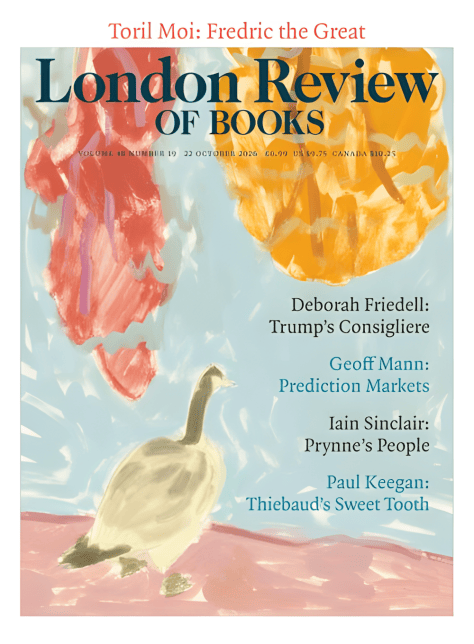
LONDON REVIEW OF BOOKS: The latest issue features  Fredric the Great by Toril Moi; Trump’s Consigliere by Deborah Friedell; Prediction Markets by Geoff Mann; Prynne’s People by Iain Sinclair; and Theibaud’s Sweet Tooth by Paul Keegan….

Fredric the Great

Toril Moi

Fredric Jameson seemed to me to have read absolutely everything. He was the very antithesis of the intellectual type I think of as an empty theoriser, by which I mean someone who endlessly conjectures without having a genuine command of any relevant archive. To look at Fred as a reader of literature is not to reduce the scope of his work, but rather to try to understand its origins.

LIBER FEMINIST REVIEW – FALL 2026 PREVIEW

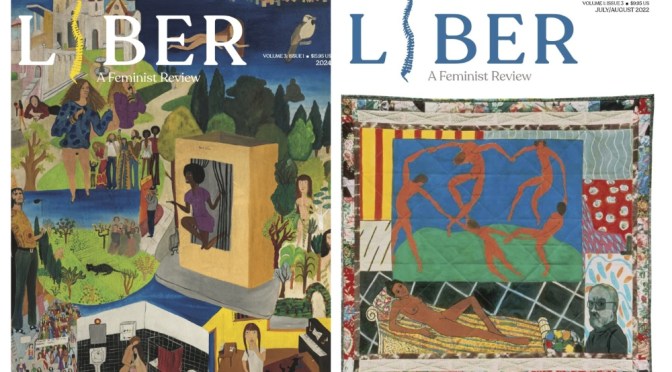
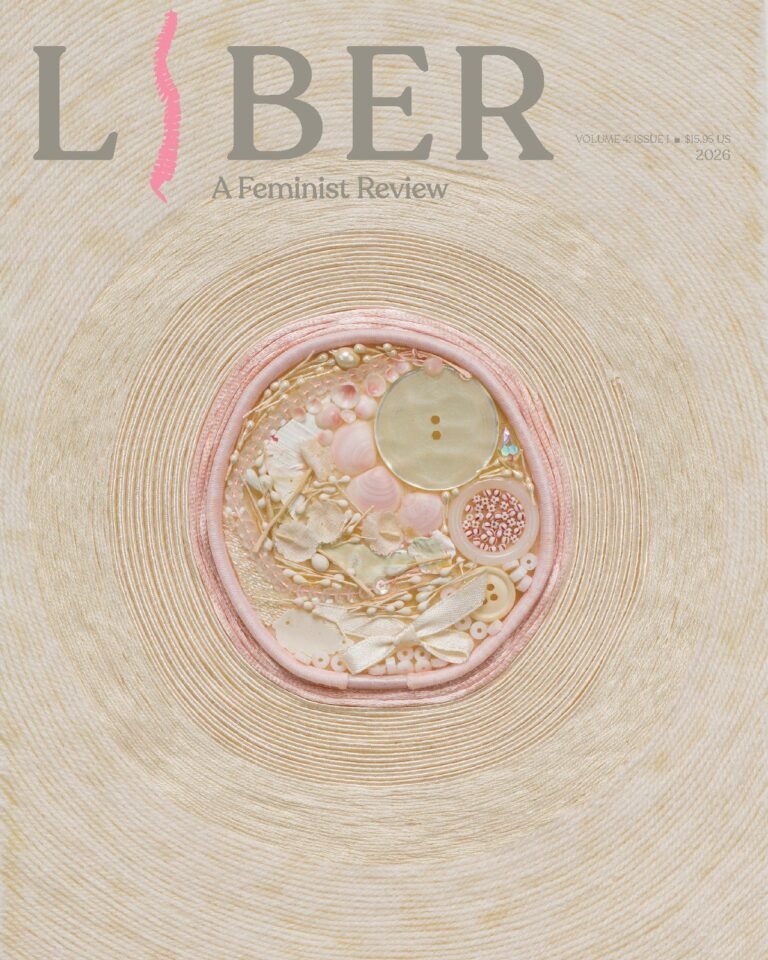
LIBER FEMINIST REVIEW: The latest issue features a diverse collection of essays, poetry, and reviews including Catharine A. MacKinnon’s feminist defense of transgender sex equality rights, personal essays on Rachel Pollack and tarot, and reviews of works by authors such as Rachel Cusk, Deborah Levy, and Sara Ahmed.

“My Year in Paris with Gertrude Stein: A Fiction” by Deborah Levy

Reviewed by Hailey Krueger

My first day ever in New York, age sixteen, I got stuck in the middle of Central Park in the pouring rain with no umbrella and zero sense of direction. Drenched, cold, and hopelessly wandering from the Alice in Wonderland statue to the steps of the Met, I was in remarkably high spirits. I had read Just Kids earlier that summer and regarded this trip as a rite of passage in my Patti Smith pilgrimage. The city was not a stranger to me: there was Washington Square Park, where Patti had slept during her first few weeks, she and Robert Mapplethorpe surviving on lettuce sandwiches. Sure, each face I passed on Fifth Avenue was unfamiliar, but I could imagine Patti and just know I belonged. Even the comically overpriced T-shirts at the John Varvatos store on the Bowery shimmered with Patti and CBGB-era spirit.

Patti wasn’t my first author/guide. I’d opted for books over a social life throughout much of high school and had long approached new destinations through the eyes of a beloved author. When I began at Smith College, I knew from Sylvia Plath’s journals to write in my own on the porch of Haven/Wesley. I assumed this author-as-friend-guide was my own (mal)adaptive quirk. That is, until I read Deborah Levy’s My Year in Paris with Gertrude Stein.

“The Book That Taught the World to Orgasm and Then Disappeared: Shere Hite and the Hite Report”

By Rosa Campbell

The Netflix series Bridgerton features a plotline about a nineteenth-century noblewoman desperately seeking a sexual “pinnacle” that coitus withholds from her yet not her husband. Meanwhile, the New York Times Wirecutter product review site recommends vibrators you can buy at Walgreens.

My, times have changed.

Fifty years ago, when feminist writer Shere Hite (1942–2020) published The Hite Report: A Nationwide Study of Female Sexuality, one of the best-selling books of all time, conventional wisdom dictated that plain old intercourse was the ticket to orgasm for women as well as men. Any woman who needed clitoral stimulation was deviant or trapped in her “phallic” stage; a mature woman achieved orgasm through the vagina (thanks, Freud). Hetero men didn’t know that what felt good for them didn’t necessarily feel good for women. Many women chose to fake pleasure rather than speak up because they were embarrassed or, rightly, worried about being belittled as pushy and slutty.

“Life of M: A Novel” by Rachel Cusk

Reviewed by Anna Godbersen

I had anticipated that Rachel Cusk’s latest would be a captivating work of big ideas. The premise—a nameless narrator encounters one of the great and celebrated film actors of the era and then attempts to write an “autobiography” of said star—is both juicy and think-y, a stage upon which brilliant observations can mingle with feminine angst and glamour.

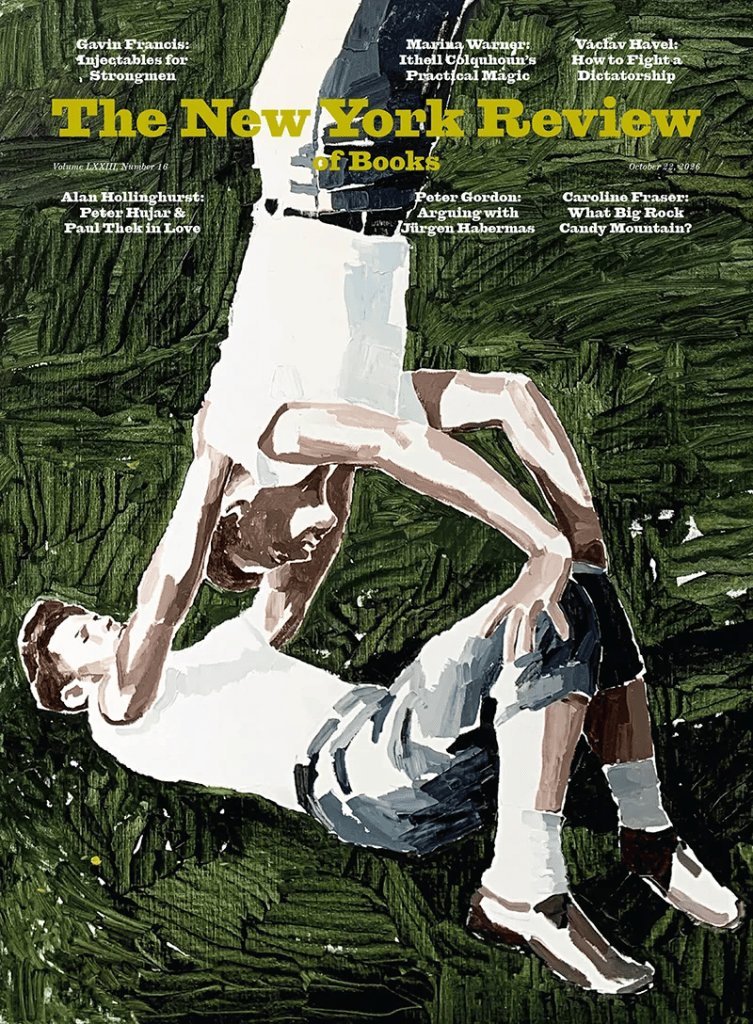
THE NEW YORK REVIEW OF BOOKS – OCTOBER 22, 2026

THE NEW YORK REVIEW OF BOOKS: The latest issue features Gavin Francis on musclemen, Caroline Fraser on hobos, Ben Tarnoff on our digital oligarchs, Alan Hollinghurst on Peter Hujar and Paul Thek, Howard W. French on the Chinese Internet, Matthew Aucoin on Philip Glass, Václav Havel on state repression, Jonathan Lethem on Wilfrid Sheed, Catherine Nicholson on ye olde VDs, Noah Feldman on the dangers of the unitary executive, Marina Warner on Ithell Colquhoun, Lola Seaton on Jonathan Buckley, poems by Ben Lerner and Elaine Equi, and much more.

Building a Real Man

From its origins in the classical physique and homoerotic spectacle, bodybuilding today often involves the use of steroids whose dangers are not properly understood.

When Fitness Went Global: The Rise of Physical Culture in the Nineteenth Century by Conor Heffernan

A Genealogy of Male Bodybuilding: From Classical to Freaky by Dimitris Liokaftos

Muscle Works: Physical Culture and the Performance of Masculinity by Broderick D.V. Chow

How Tech Rules

The AI boom is only the latest stage in Silicon Valley’s long history of creating and expanding intellectual monopolies.

The Rulers: Corporate Power in the Age of AI and the Cloud by Cecilia Rikap

Silicon Empires: The Fight for the Future of AI by Nick Srnicek

Let a Hundred Websites Bloom

The Internet and the smartphone have become formidable tools for the Chinese government to maintain tight control over society.

The Wall Dancers: Searching for Freedom and Connections on the Chinese Internet by Yi-Ling Liu

The Highest Exam: How the Gaokao Shapes China by Ruixue Jia and Hongbin Li with Claire Cousineau

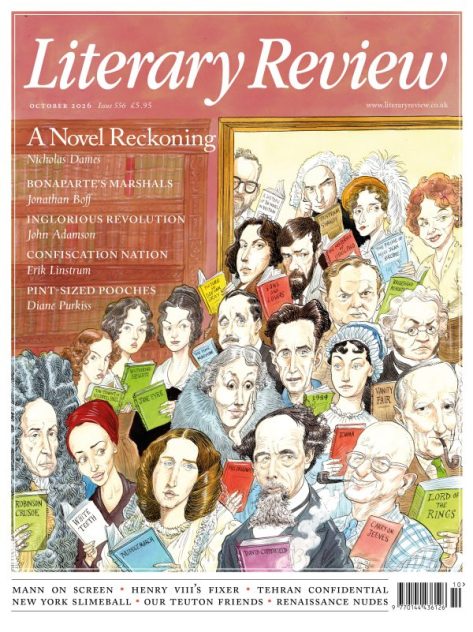
LITERARY REVIEW MAGAZINE – OCTOBER 2026 PREVIEW

LITERARY REVIEW : The latest issue features ‘A Novel Reckoning’…

Catchpole to the King

King’s Secretary: William Paget and the Last Years of the Reign of Henry VIII By Andrew Johnston

Tudor history buffs and attentive readers of Hilary Mantel’s Wolf Hall trilogy will recognise the name William Paget. Others will require some words of introduction. Paget (1505/6–63) was an able and influential diplomat and administrator who rose to become principal secretary to Henry VIII. ‘Rose’ is the operative word. Paget, like his predecessor and mentor Thomas Cromwell, was a self-made man, though his father, a sergeant serving the sheriff of London, was able to provide him with a grammar school and Cambridge education.

1688 and All That

The Last Invasion of England: 1688 and the Dutch Armada By Arthur der Weduwen

Much is exceptional about the Bayeux Tapestry currently on magnificent display in the British Museum, but nothing is quite so exceptional as the event itself. As the museum’s website reminds us, 1066 ‘was the last time England was successfully invaded’. Our sea-girt immunity from foreign invasion has been at the centre of ‘Our Island Story’ ever since, with the Channel confounding the hubris of Philip II in 1588 and 1596, of Napoleon in 1803 and of Hitler in 1940.

Scavenger Hunt

Imperial Predator: Britain and the Destruction of the Ottoman Empire By David S Tonge

In his survey of the collapse of the Ottoman Empire in the late 19th and early 20th centuries, David S Tonge sees Britain as an aggressive superpower, hence the title of his excellent book. My one quibble is zoological. ‘Predator’ may not be quite the right word. For in much of Tonge’s story Britain is less lion than vulture: what zoologists call an obligate scavenger – or a necrophagous power – feeding on carrion. The Ottoman carcass had already been wounded by Russian aggression, nationalist revolt, indebtedness and internal decay. There were exceptions, and Britain could be predatory when circumstances demanded, notably in Cyprus and Alexandria, but its more characteristic pose was to sniff the odour of mortality and arrive in time for lunch.

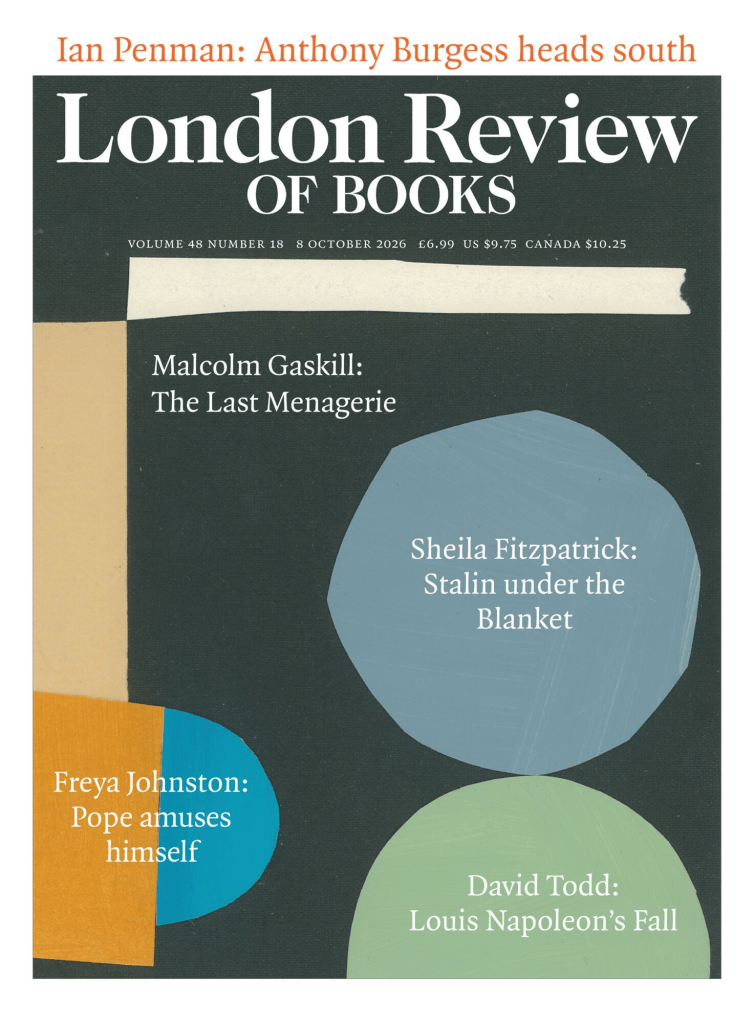
LONDON REVIEW OF BOOKS – OCTOBER 8, 2026 PREVIEW

LONDON REVIEW OF BOOKS: The latest issue features major critical reviews and essays spanning Soviet history, geopolitical war gaming, 20th-century literary figures, and avant-garde art.

History & Geopolitics

  • Sheila Fitzpatrick on Stalinism: Fitzpatrick examines Irina Paperno’s Always under Siege: Olga Freidenberg’s Diary-Theory and the Everyday Terror of Stalinism, analyzing how classicist Olga Freidenberg’s secret writings framed the Siege of Leningrad and Soviet surveillance as a totalizing domestic regime.
  • Tom Stevenson on NATO and Russia: Stevenson reviews Carlo Masala’s If Russia Wins: A Scenario and Thomas Newman and John Pierson’s Atlantic Resolve: The War for Estonia, analyzing contemporary Western military simulations and anxieties regarding Baltic security.

Literary Studies & Biography

  • Edmund Gordon on William Golding: Reviewing William Golding: The Faber Letters edited by Tim Kendall, Gordon details the editorial tensions between Golding and Charles Monteith, focusing on substantial cuts to the original draft of Lord of the Flies.
  • Freya Johnston on Alexander Pope: Johnston explores Henry Power’s edition of Alexander Pope: The Major Works, charting the Augustan poet’s biting satire, anxieties, and self-fashioning.
  • Ian Penman on Anthony Burgess: Penman re-evaluates Burgess’s 1966 espionage satire Tremor of Intent, dissecting its baroque style and its uneasy relationship with James Bond.

Art & Culture

Columns and Short Cuts: Additional pieces include Peter Geoghegan on democratic funding reform and Blake Morrison on Luke Kennard’s poetry collection Black Bag.

Em Hogan on Hujar and Thek: Hogan reviews Andrew Durbin’s dual biography The Wonderful World that Almost Was: A Life of Peter Hujar and Paul Thek, profiling the turbulent lives of the photographer and artist against 1960s–1980s New York and the onset of the AIDS crisis.

Dexter Dalwood on Jasper Johns: Dalwood contributes a review of Johns’s exhibition at the Guggenheim Bilbao, evaluating his enduring postwar artistic motifs and printmaking legacy.