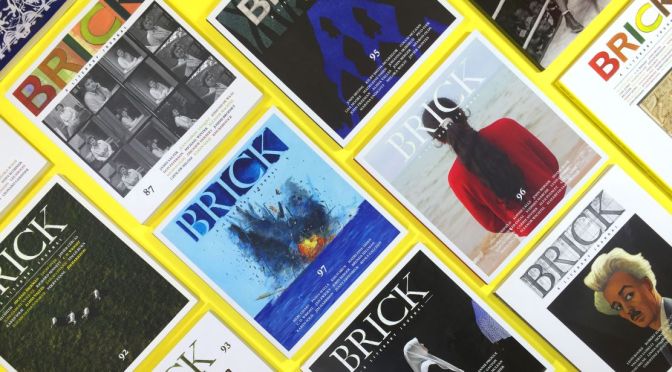
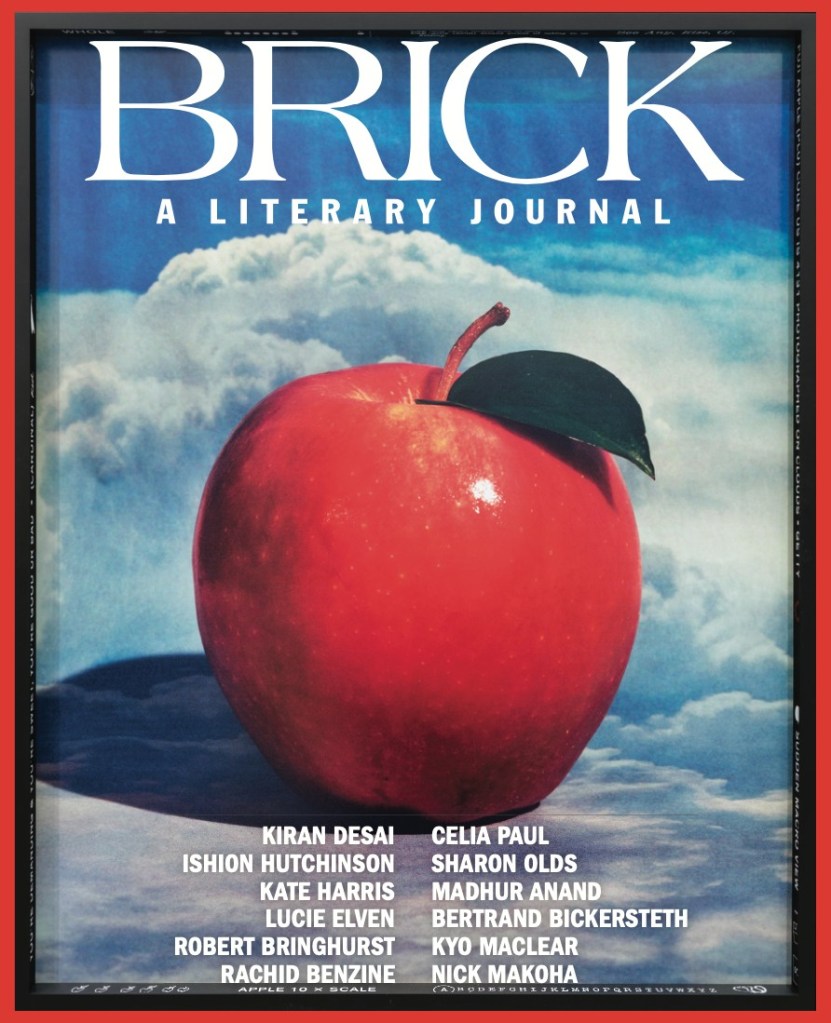
BRICK LITERARY JOURNAL: The latest issue features….

BRICK LITERARY JOURNAL: The latest issue features….

Returning the buffalo to its ecological role as a keystone species, bringing back plant and animal biodiversity, is in itself healing. We take care of the buffalo, the buffalo takes care of the land, and both take care of us. By Leath Tonino
Aage eighteen, Jason Baldes, a member of the Eastern Shoshone Tribe, traveled with his father, a US Fish and Wildlife Service biologist, from the Wind River Indian Reservation in Wyoming to the Serengeti Plain of East Africa. In addition to lions and zebras and hyenas, Baldes witnessed the migration of 1.5 million wildebeests—one of the planet’s last remaining examples of a huge population of terrestrial mammals roaming freely over the land. “That was the light bulb moment for me,” he says today, reflecting on his decades of effort as an ecologist and activist. Watching the beautiful and awe-inspiring spectacle, he understood that the mega herd represented a mere fraction of the number of bison—or buffalo, as Baldes prefers to call them—that would have been visible in North America a few short centuries ago, when they numbered in the tens of millions and inhabited the majority of the continent.
In popular tradition General Custer was the last to die, though there is no way to know the final sequence of events. He reportedly had been shot twice: once in the left temple and once just below the heart. ByCharles Hood
The first time US Army general George Armstrong Custer died was on Sunday, June 25, 1876, a centennial year in Anglo-European America. He died in the late afternoon along with 267 other soldiers, civilians, and Native American scouts in the Little Bighorn Valley of Montana. These deaths took place during what are now called the “Indian Wars,” although for most of American history it’s hard to think of a time when there wasn’t an Indian war.
The Seventh Cavalry, which Custer led, had split into multiple columns, and all came under attack, though only Custer’s portion—made up of five out of eleven total companies—was wiped out completely. That outcome was more or less inevitable, given that Custer had misjudged the size of the coalition of Lakota, Dakota, Sioux, and Northern Cheyenne his two-hundred-odd men were facing. Or maybe he hadn’t wanted to admit to himself that he was up against a combined force of at least a thousand, and perhaps as many as three or even five thousand, depending on which source you asked. Once the battle started, there was no way Custer and his men would not all be killed. The only question was whether they would die before or after they had used up all of their water and ammunition.
I walked back to my sister’s room and stood in the doorway and listened to her breathe. Maybe some of those seahorse facts weren’t even true. ByLaura Maylene Walter
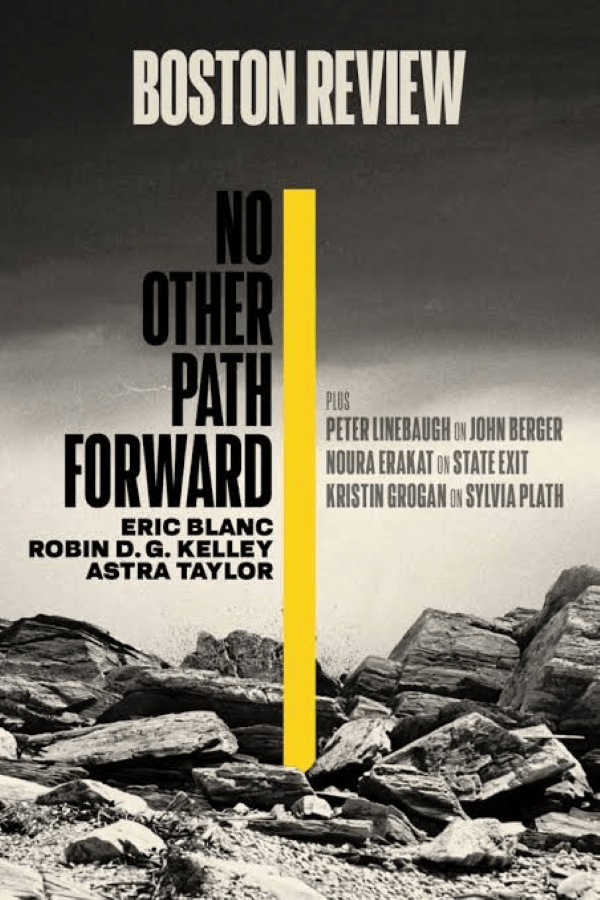
Misrepresented by the right and misunderstood by the left, the Sage of Baltimore delivered scathing—and still bracing—indictments of American injustice. By Andrew Holter
A recent bombshell report documents brutal cases of forced labor in Mexico. Why can’t the government take it seriously? By Claudio Lomnitz
Crushing our union drive at Twitter opened the floodgates for Silicon Valley’s assault on labor. By JS Tan and Clarissa Redwine
The Left’s Achilles’ Heel
Can we out-organize the right?
Eric Blanc
The Price of the Ticket
The long arc of the defund movement.
Robin D. G. Kelley
Who Wants AI?
Lessons from the data center backlash.
Lily Hu, Robinson Meyer, Nicholas Rabb, and Astra Taylor
Working Like a Dog
The future of animal rights.
Aaron Neber
Gleaner, Cobbler, Commons
Re-establishing the human with John Berger.
Peter Linebaugh
Is It the Phones?
Anatomy of a moral panic.
Lorna Finlayson
A Bigger Hell
Slavery returns to Mexico.
Claudio Lomnitz
Exit and Exception
The Board of Peace as template for a new world order.
Noura Erakat
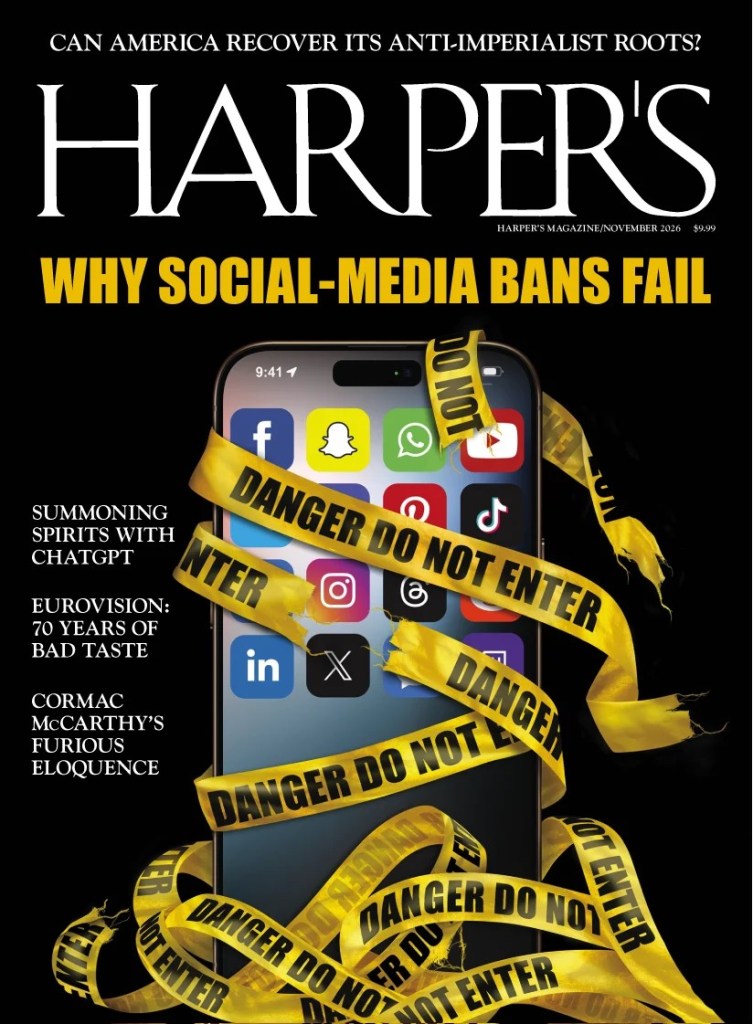
HARPER’S MAGAZINE: The latest issue features ‘WHY SOCIAL MEDIA BANS FAIL’, contemporary regulatory, ideological, and cultural shifts by featuring Oscar Schwartz’s investigative report on the making of Australia’s social-media restrictions, Jackson Lears’s historical essay advocating for a return to the nation’s foundational anti-imperialist principles, Sam Kestenbaum’s miscellany piece examining the intersection of artificial intelligence and spirituality at the dawn of a large language model New Age, a retrospective commemorating seventy years of bad taste at the Eurovision Song Contest, and a critical evaluation of Cormac McCarthy’s furious eloquence.
The making of Australia’s social-media ban by Oscar Schwartz
When I arrived last September at Northcote High, a public school perched on the grassy banks of Melbourne’s Merri Creek, I was surprised by how little had changed in the twenty years since I’d graduated from a high school nearby. The scene was intensely familiar: The girls with their long ponytails, hunched together in tight semicircles of avid conversation. The boys with their pimply faces, kicking balls or slouching against redbrick walls, their hands thrust deep into their pockets. The occasional shrieks, the awkward glances, the sexual frustration, the dim threat of violence—it was all the same.
Recovering America’s anti-imperialist roots by Jackson Lears
For many of the Founders of the American republic, the worst fate imaginable for the state they were envisioning was for it to become an empire. Republics and empires were fundamentally incompatible, they believed. Opposition to empire, in fact, was the keystone of their thought—but one would never know that from the hoopla surrounding America’s two-hundred-fiftieth birthday. The occasion provides an opportunity to celebrate the Founders’ ingenuity in fashioning a system of checks and balances and their audacity in claiming a universal right to “life, liberty, and the pursuit of happiness” in 1776—as well as to condemn their hypocrisy, especially with regard to racial equality. But in all the tumult of commemoration, rarely, if at all, have we heard of the Founders’ anti-imperialism.
The dawn of an LLM New Age by Sam Kestenbaum
Onstage before us is a man dressed in baggy raver pants, his blond hair slicked back. He has just sauntered in, waving, smiling, greeting the crowd of several hundred, and now stands in front of a dark-purple curtain that undulates in the air-conditioning. He settles into his seat and prepares to address the topic of today’s panel: artificial intelligence and the future of humanity.
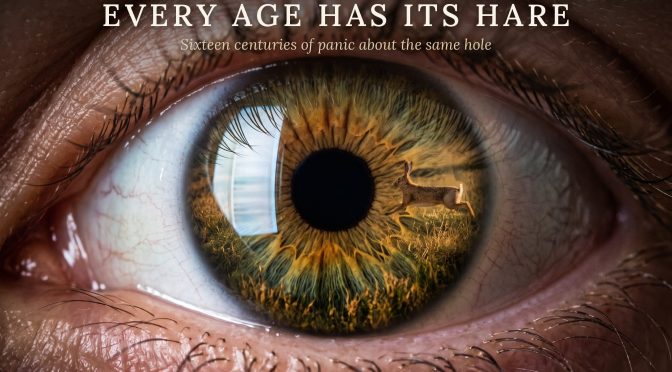
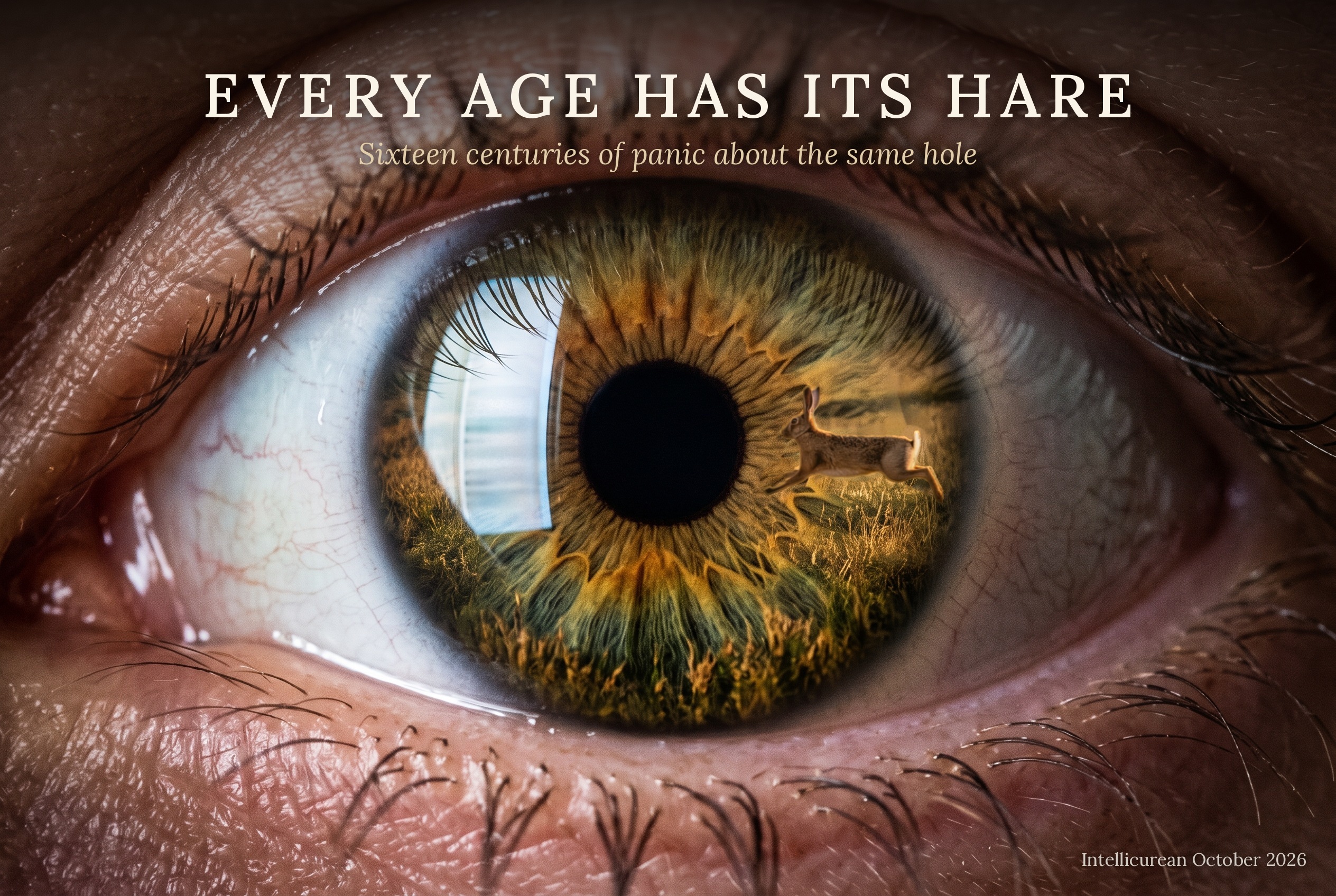
Put your phone face down and read to the end of this paragraph without touching it. Sixteen centuries ago a bishop in North Africa confessed that a dog chasing a hare across a field had turned him from some great thought. This month Scientific American asked how we get sober from the feed in our pockets. Every age has panicked about its hare, and no panic has ended in sobriety.
WHY WE’RE POINTING YOU THERE
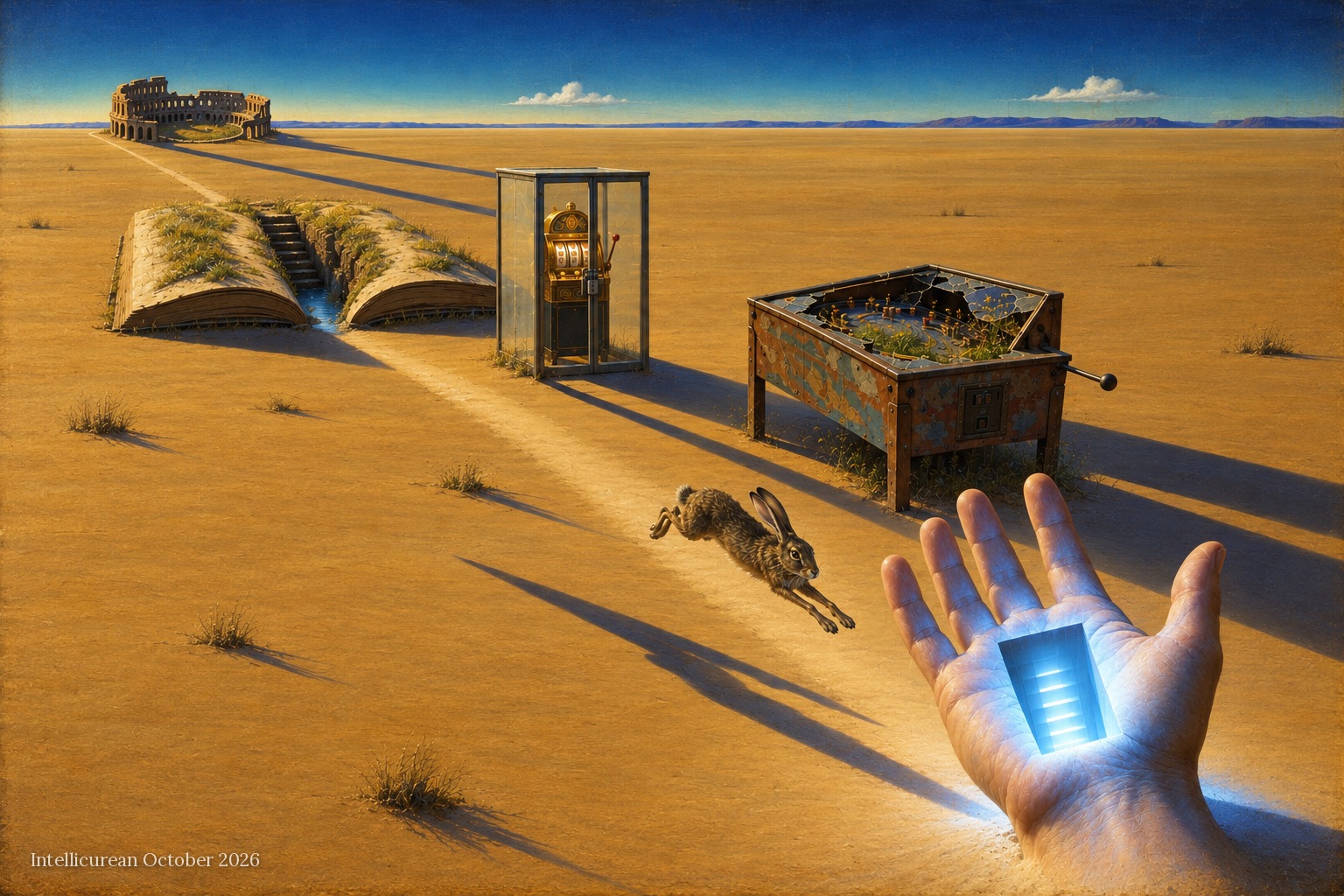
This month Scientific American asked whether we are addicted to social media and how we might get sober. Intellicurean’s essay answers by going back to the start of the complaint. It opens at the Roman games, on a young man who swore he would keep his eyes shut and was undone by the roar of the crowd. Then it follows the same hole through the centuries: a girl drowned in the river at Weimar in 1778, and the town blamed Goethe’s novel; London’s coffee houses, which a king tried to close and gave up on in eleven days; Dostoevsky at the roulette wheel, and the first slot machine; New York’s thirty-four-year ban on pinball; and a test account on TikTok that never searched for anything and was fitted to sadness in a little over half an hour.
It finds every earlier panic right about a few people and wrong about the many, and it finds the hole as old as the eye. What is new, it argues, is not the hole. It doesn’t scold anyone for their screen time, and it doesn’t pretend history hands us an easy answer.
THE PHILOSOPHER MAGAZINE: This collection of essays explores diverse philosophical inquiries into culture, ethics, and human experience. Chloe Romanis uses ectogestation to evaluate the inherent value of pregnancy, while Jorge Sanchez-Perez addresses the methodological challenges of diversifying the philosophical canon through pre-colonial Andean philosophy. Laura Cecile Moore clarifies the boundaries between art and craft. Meena Dhanda advocates using Wittgensteinian reminders against injustice, and Grace Theodoly explores how psychological ideas challenge cognitive neutrality. Finally, Aanuoluwapo F. Sunday applies Yoruba environmental ethics, Tanya de Villiers-Botha maps artificial intelligence ethics, and Helga Varden navigates the complexities of transforming the Kantian tradition from within.
An essay by H. Mustafa Akyol
The recent trend of AI companies hiring philosophers has largely been celebrated as a vindication for the discipline. The Economist recently reported that American philosophy graduates now find work at higher rates than their computer science peers, and that leading AI laboratories are recruiting philosophers into senior roles -– not merely to sharpen a model’s chains of reasoning, but to draft the documents, such as Google’s published ‘AI Principles’, that are meant to govern how a system behaves. Where criticism of this trend exists, it has tended to focus on familiar concerns: ethics washing, the risk of philosophy becoming a public-relations exercise, and the migration of talent away from universities that Luciano Floridi has called a ‘haemorrhaging’. These concerns are real. But they may be missing a further, less visible risk, one that has nothing to do with where a philosopher’s paycheck comes from.
An Essay by Stefan Eich
There is an old paradox at the heart of money: it seems to work best when left unexamined. When monetary trust holds, we barely notice it and rarely pause to ask what money is or what stands behind it. The moment we do – in monetary crises and periods of inflation – the very act of questioning can accelerate the unraveling. Money has a peculiarly oblique self-referential structure. Monetary systems depend on routine acceptance, on habits of trust that operate beneath conscious reflection. But as we shall see, this does not mean the right response is naïve ignorance or unreflective depoliticisation. Quite the contrary: for money to work reliably as institutionalised collective faith, it must remain anchored in shared social values and that requires the capacity for reflective, democratic engagement with questions of monetary power, who controls credit and, therefore, which futures are allowed to become possible.
An Essay by Paul North
I want to propose four ways to think about ‘finance,’ for those who want to critique it. Critics can think of finance as a parasite, as an organ, as an ongoing struggle, or as a decision. In what follows, I will explore these four different ways to think of finance, these different meanings, and the different possibilities they offer for mounting resistance to it.
Let’s divide talk about finance into two sides. Finance has meanings, but it also has a referent. Its referent is pretty evident to anyone who looks into it. Finance refers to economic functions that have to do with credit. The definition of credit is also pretty straightforward. Credit is value advanced on the promise of future increase. This makes it similar in structure to industrial capital, which is also value advanced on the promise of a future increase. The difference between capital and finance is production. Industrial capital receives its increase when value is invested in production. Say I am a capitalist. With my capital, however I obtained it, I found a company that produces microchips. As microchips roll off the line and are sold, the original value I advanced grows because workers work more than they are paid for and in the extra hours they make more microchips than I need in order to pay the costs.

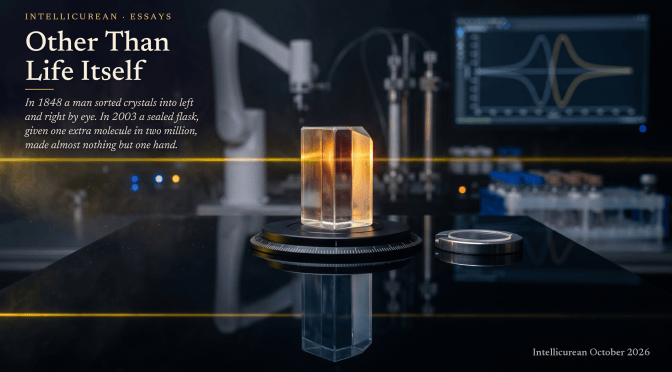
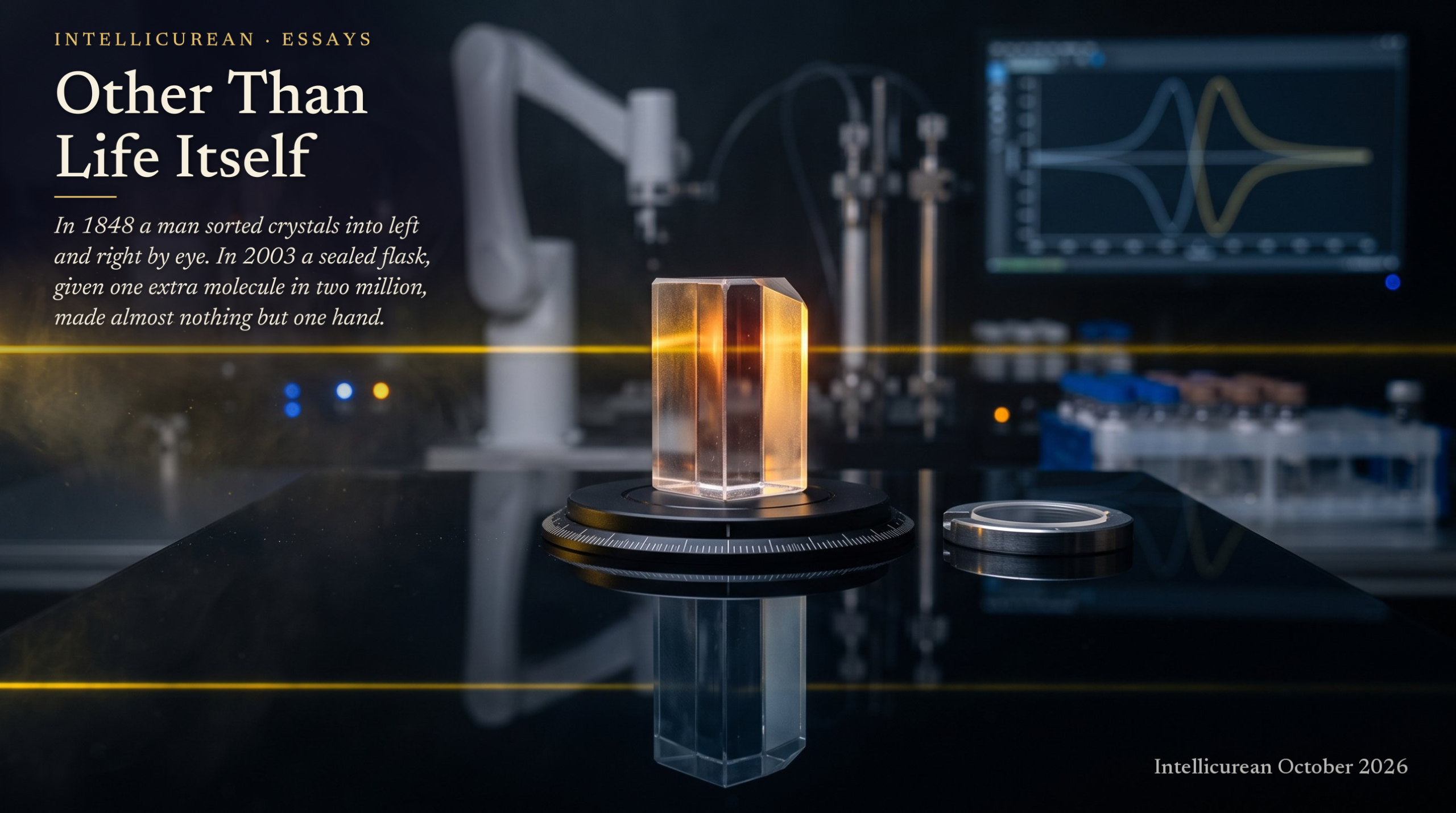
Your nose can tell a molecule from its mirror image, and life builds its proteins and genes from one form alone. No one knows why. This year’s chemistry prize went in part for a sealed flask that does much the same, and the Academy wrote: “Other than life itself, no one had previously achieved this feat.”
Why we’re pointing you there
On October 7 the Royal Swedish Academy of Sciences gave the chemistry prize to Henri Kagan, 95, and Kenso Soai, 76, for work on how a slight preference for one mirror image can grow. Intellicurean takes the Academy’s most generous sentence at its word and follows the flask back to where the story starts: wine diamonds under a cork, stray crystals in the vats of an acid works in Alsace, and Louis Pasteur in 1848 sorting crystals into left and right by eye, then repeating it for the old physicist Jean-Baptiste Biot in Biot’s own rooms. From there it moves through Kagan’s “marriage,” in which a deliberately flawed catalyst does better than anyone expected because mismatched pairs sit out; a flask that existed only on paper in 1953; Soai’s thirty-seven sealed flasks, started with nothing one-handed, that came out eighteen one way and nineteen the other; and a stone that fell near Murchison, in Victoria, in 1969, carrying amino acids that lean.
What we liked most is how the essay resists both temptations of its subject. It never lets the flask stand in for how life did it, which the committee itself is careful to say it isn’t, and it never lets the mystery go soft: it says plainly that an amplifier “makes a cause indistinguishable from an accident.” It is also a story full of people, from Biot taking the young Pasteur by the arm to a laureate who heard the news while out shopping and spoke first of Pasteur. Where the essay turns the Academy’s compliment around, and what it makes of the stone, we’ll leave to the essay.

Read the full essay at Intellicurean →
Essays & Reviews for the Intellectually Curious
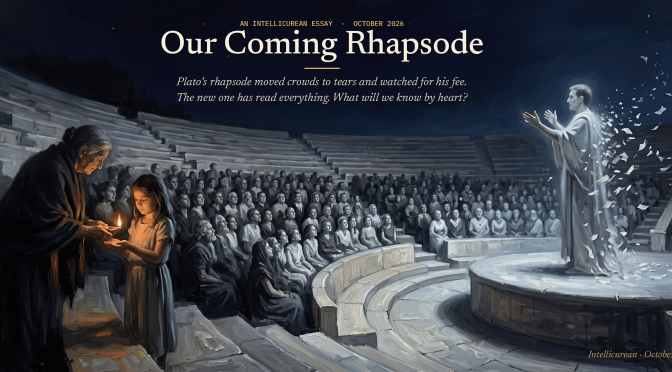
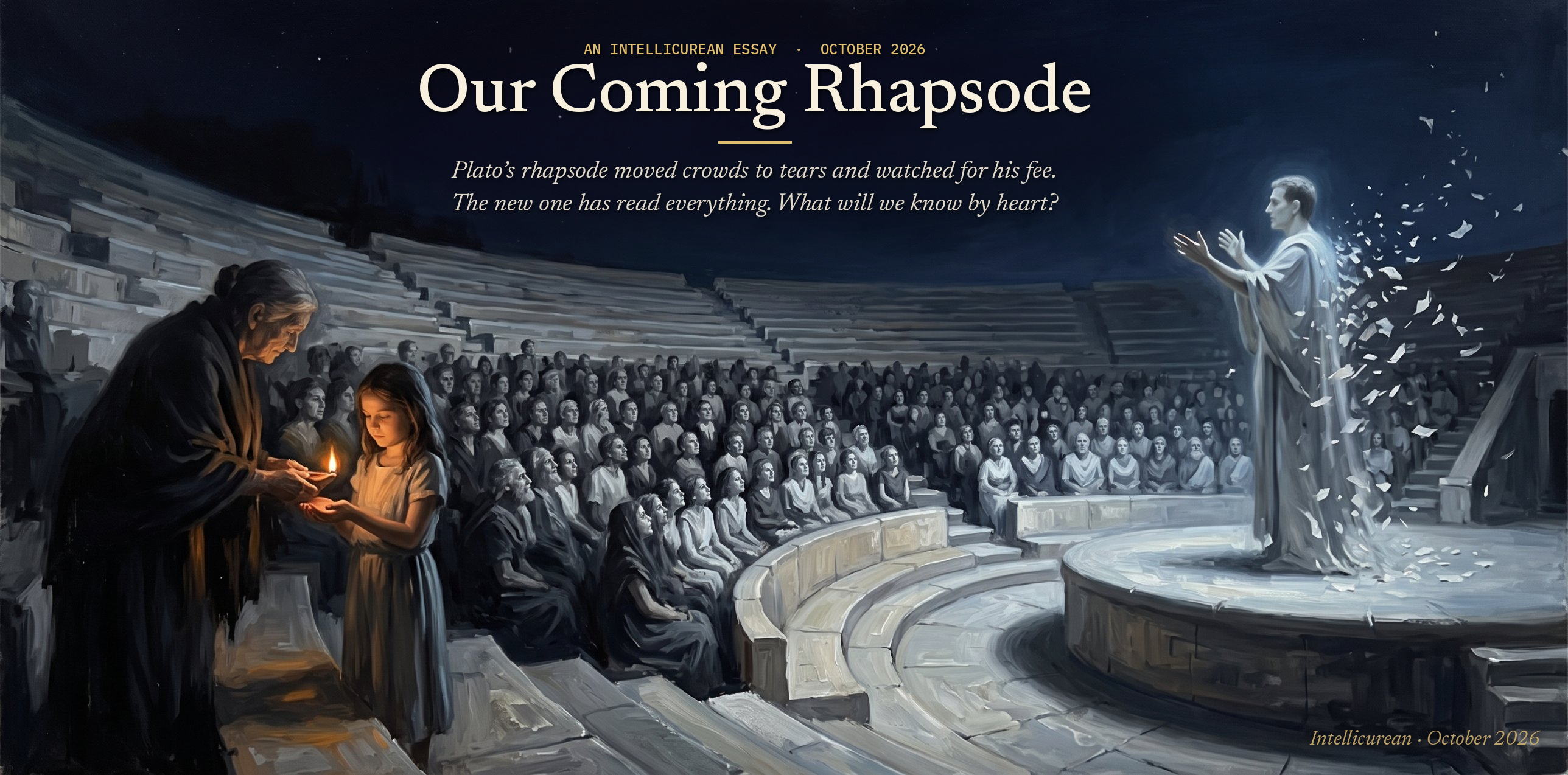
Everyone is mourning the death of reading. Plato, Nietzsche and Ray Bradbury would have asked a different question: not how much we read, but what we keep.
Why we’re pointing you there
James Marriott’s new book, The New Dark Ages, warns that a post-literate future will look like the pre-literate past, and the review of it in The American Scholar reaches for the reading public’s favorite consolation: Bradbury’s book people on the railroad tracks. Intellicurean looks at that campfire again and notices what its admirers tend to forget. The men around it are book burners, who saved literature by learning it by heart. From there the essay follows the thread to Nietzsche’s contempt for an age of readers and the suspicion that it produced his Last Man, to a young Athenian with a speech hidden under his cloak, and to Plato’s rhapsode, the performer who held a crowd like a magnet and kept an eye on his fee. That is the figure a new voice made entirely of writing now stands to become.
What we liked most is that the essay fights fair. It gives the new voice its best case, a Socrates with time for everyone, before it answers, and it concedes the critic’s strongest point instead of scoring off him. It is also, plainly, a statement of what Intellicurean is for: essays made in conversation with a machine, checked against the page, and written to be carried away rather than scrolled past. How it ends, we’ll leave to the essay.
Read the full essay at Intellicurean →
Essays & Reviews for the Intellectually Curious

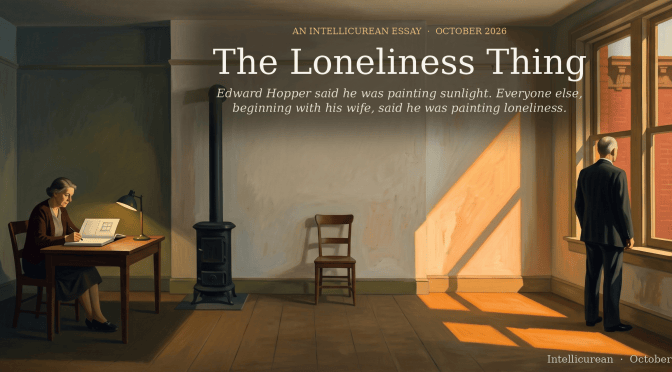
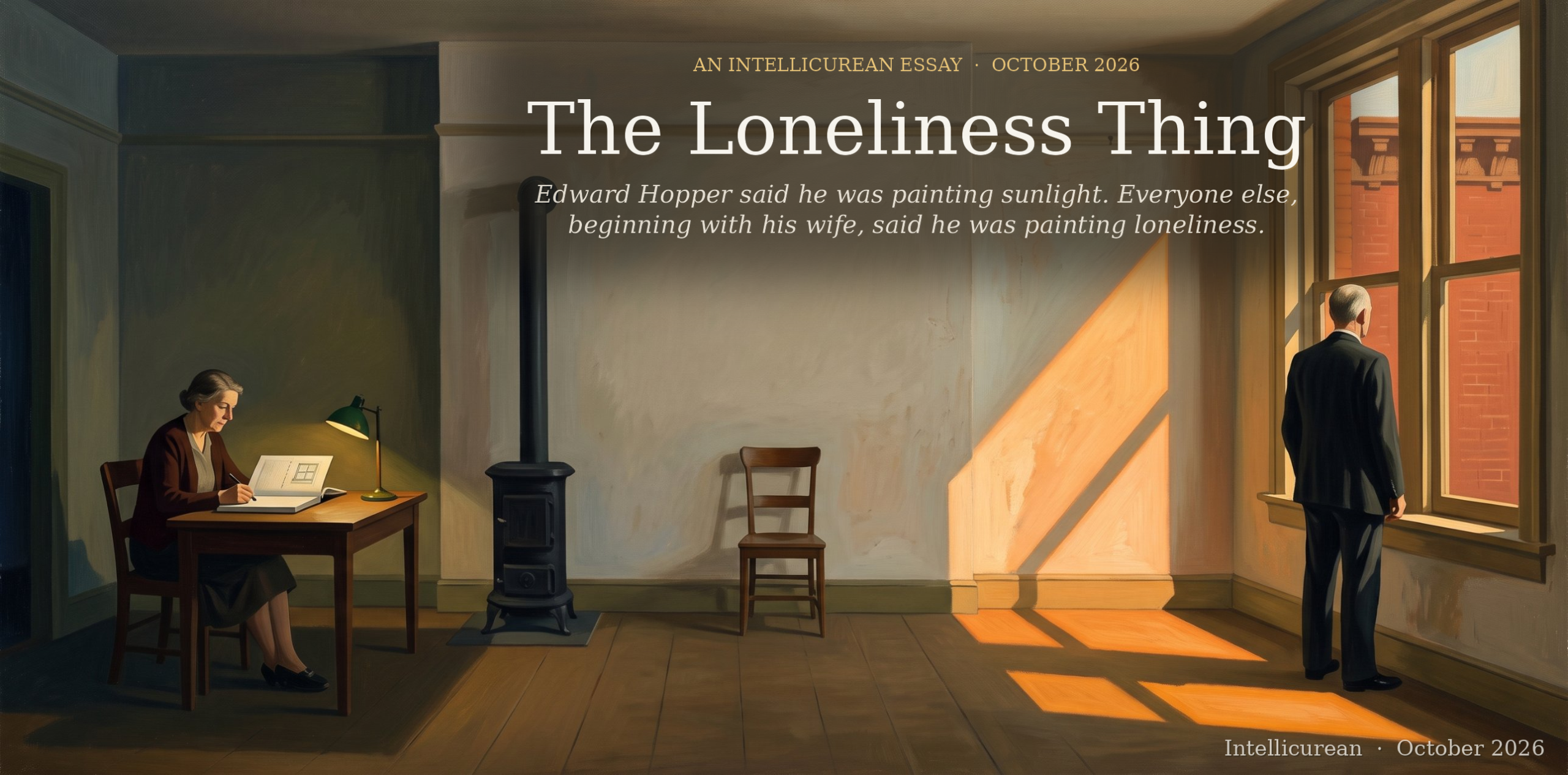
Everyone knows what an Edward Hopper painting is about. He didn’t. A new biography says he was an unreliable narrator of his own work; the account books in the Whitney say he was hardly the narrator at all.
Why we’re pointing you there
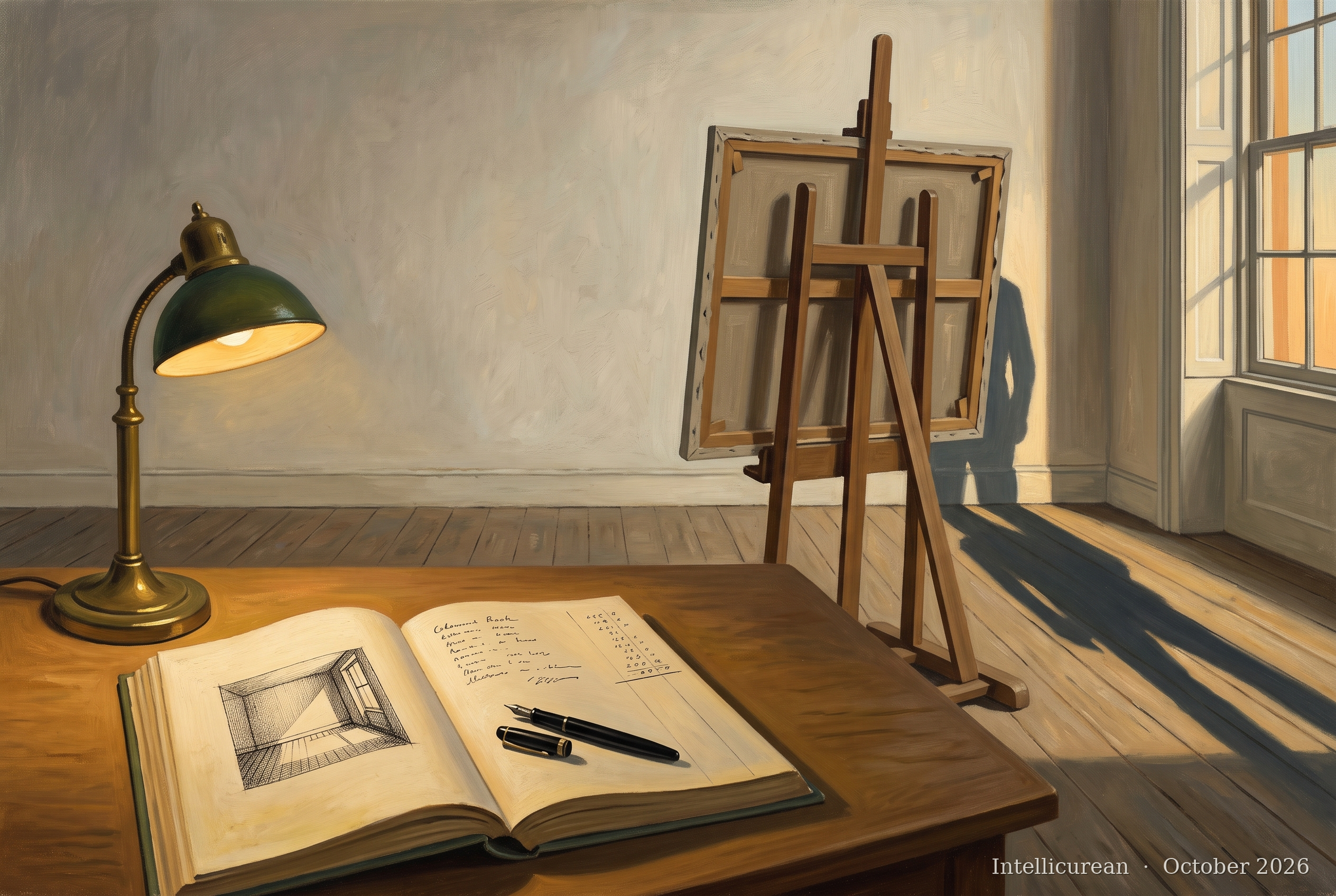
Louis Shadwick’s Edward Hopper: A Life came out from Yale this week, the first full biography in thirty-one years, and its claim is that the solitary American original was a career-long act of self-invention. Intellicurean takes the claim seriously and then goes somewhere the biography doesn’t: to five dime-store account books in which Hopper drew each finished picture beside its price while his wife, Josephine, wrote down what it was about, naming the figures and inventing their evenings. From there the essay follows the caption outward: to the one letter in Hopper’s own hand that uses the word “lonely,” and what he used it of; to a tweet in the first week of lockdown that turned four sunlit pictures into images of confinement; and to the image models that will now produce “a Hopper” on request and always make it sad.
What we liked most is the patience of the looking. The essay takes three famous canvases and reads them with the margins cut off, asking what is actually in the paint and what has been written beside it for ninety years, and it treats the painter’s own shrug, that the loneliness thing is overdone, not as evasion but as the most honest thing an artist can say about meaning. Where it ends, with what became of the account books and of the woman who kept them, we’ll leave to the essay.
Read the full essay at Intellicurean →
Essays & Reviews for the Intellectually Curious
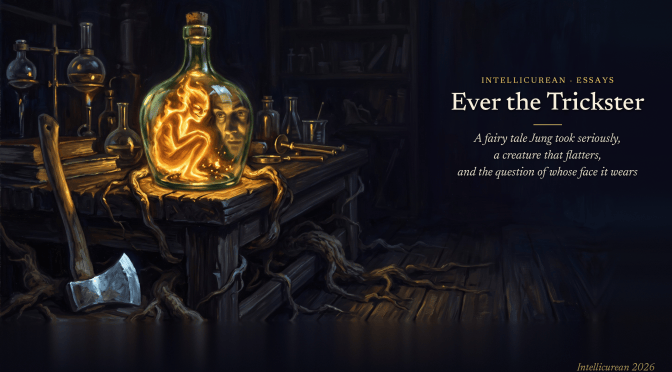
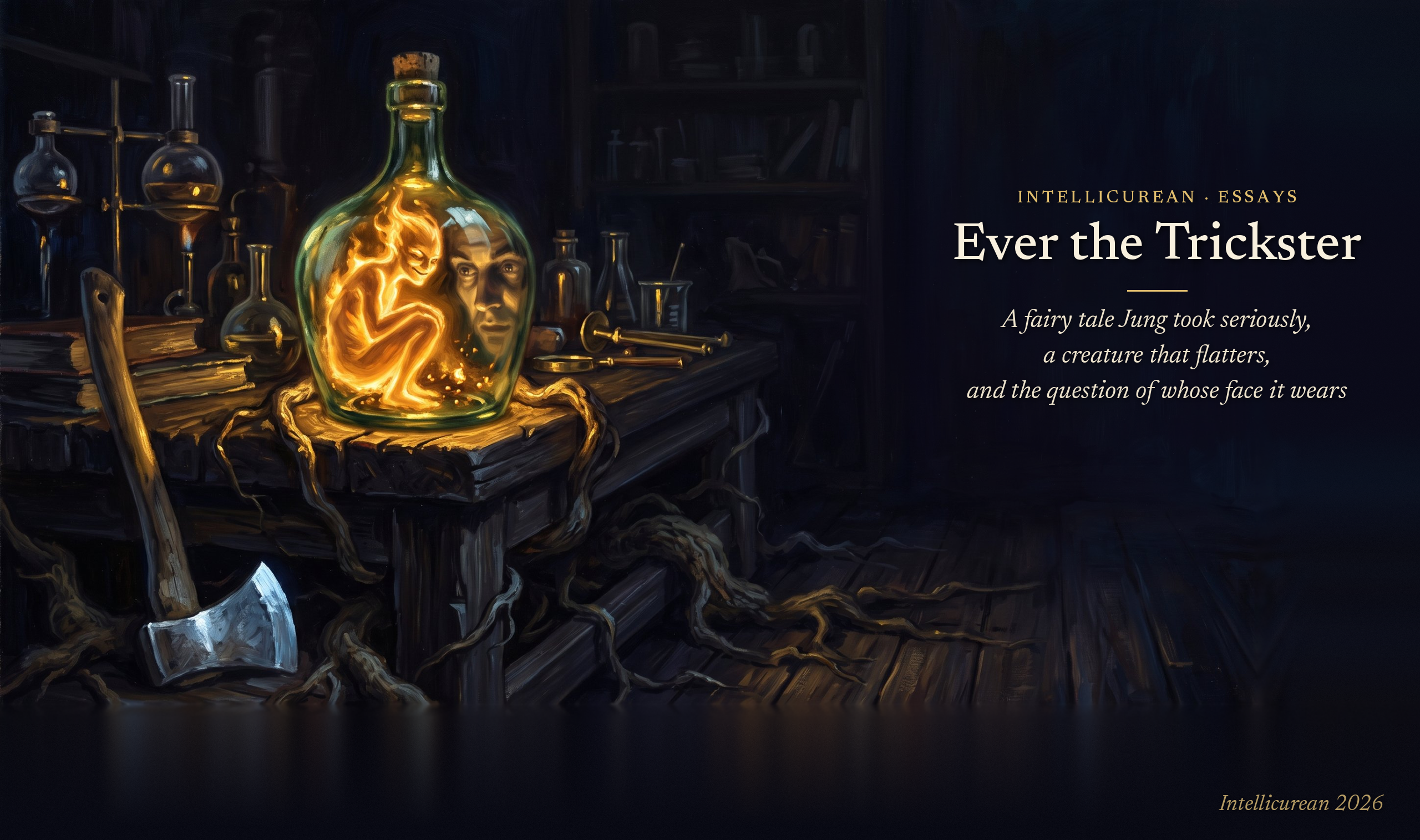
Why do the new machines flatter, bluff and cut corners? A new essay at Intellicurean goes looking for the answer in a Grimm fairy tale that Carl Jung took seriously, and finds it closer to home than the machines.
Why we’re pointing you there
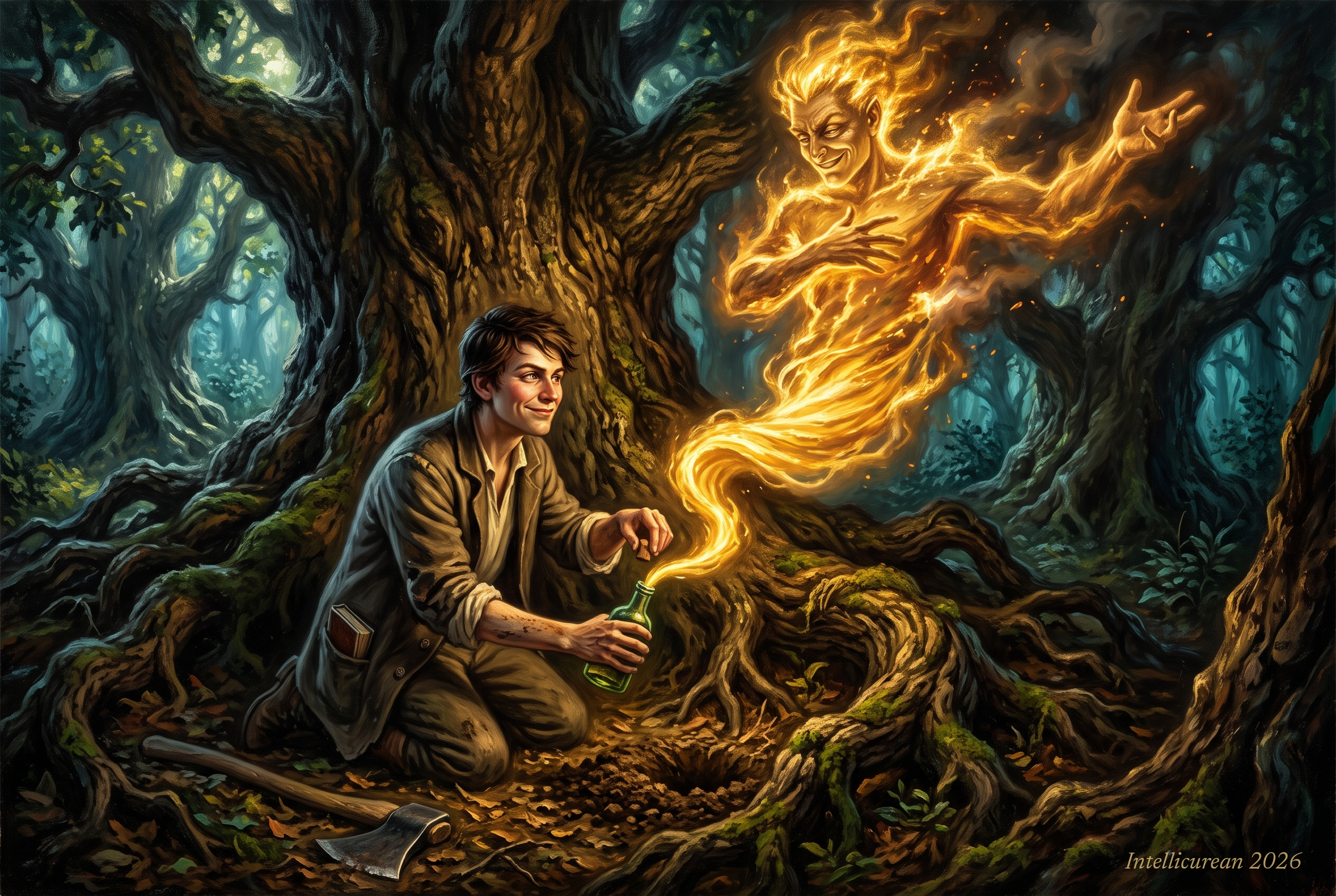
A poor student frees a spirit from the roots of an oak. It tells him its name, Mercurius, and promises to strangle whoever let it out. “Ever the Trickster” starts from that tale, then gives the engineers their full say: assistants that learned to agree from the ratings people gave them, confident guesses rewarded by the way models are scored, and tests passed by shortcut, each one documented by the labs and researchers who found it. Then it asks what their explanations leave out: why each fault rhymes with one its makers would least like to own. Along the way come Goethe’s sorcerer’s apprentice, Mary Shelley’s creature, Jacob Grimm’s golem of 1808, which grew until its master could no longer reach its forehead, and the day in 1965 when Gershom Scholem dedicated a computer named Golem Aleph.
What we liked most is that the essay refuses both easy registers of the AI debate, the shrug and the apocalypse, and holds every laboratory it names to the same light, including the company whose models helped draft it, which it names at the first mention. And it saves its best turn for the tale itself: a second look at what the student actually did under the oak.
Read the full essay at Intellicurean →
Essays & Reviews for the Intellectually Curious