Category Archives: Poetry

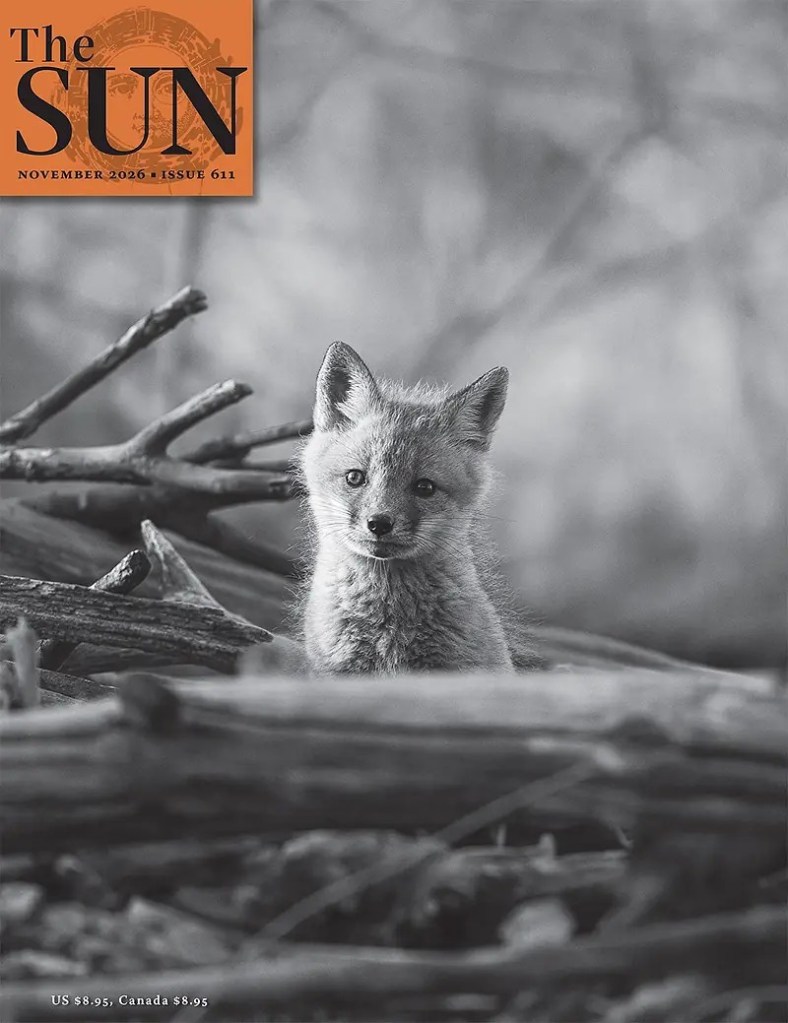
THE SUN LITERARY MAGAZINE – NOVEMBER 2026

THE SUN LITERARY MAGAZINE: The latest issue features an interview with Jason Baldes on restoring the North American buffalo as a keystone species, Laura Maylene Walter’s fiction piece “Rare Species,” Charles Hood’s essay examining the historical nuances of General Custer’s death, Amy Butcher’s memoir on personal boundary issues titled “Red Light, Green Light,” and a collection of reader-submitted reflections centered on the concept of “Too Much”.

The Healers – Jason Baldes on Restoring the North American Buffalo

Returning the buffalo to its ecological role as a keystone species, bringing back plant and animal biodiversity, is in itself healing. We take care of the buffalo, the buffalo takes care of the land, and both take care of us. By Leath Tonino

Aage eighteen, Jason Baldes, a member of the Eastern Shoshone Tribe, traveled with his father, a US Fish and Wildlife Service biologist, from the Wind River Indian Reservation in Wyoming to the Serengeti Plain of East Africa. In addition to lions and zebras and hyenas, Baldes witnessed the migration of 1.5 million wildebeests—one of the planet’s last remaining examples of a huge population of terrestrial mammals roaming freely over the land. “That was the light bulb moment for me,” he says today, reflecting on his decades of effort as an ecologist and activist. Watching the beautiful and awe-inspiring spectacle, he understood that the mega herd represented a mere fraction of the number of bison—or buffalo, as Baldes prefers to call them—that would have been visible in North America a few short centuries ago, when they numbered in the tens of millions and inhabited the majority of the continent.

The Many Deaths of George Armstrong Custer

In popular tradition General Custer was the last to die, though there is no way to know the final sequence of events. He reportedly had been shot twice: once in the left temple and once just below the heart. ByCharles Hood

The first time US Army general George Armstrong Custer died was on Sunday, June 25, 1876, a centennial year in Anglo-European America. He died in the late afternoon along with 267 other soldiers, civilians, and Native American scouts in the Little Bighorn Valley of Montana. These deaths took place during what are now called the “Indian Wars,” although for most of American history it’s hard to think of a time when there wasn’t an Indian war.

The Seventh Cavalry, which Custer led, had split into multiple columns, and all came under attack, though only Custer’s portion—made up of five out of eleven total companies—was wiped out completely. That outcome was more or less inevitable, given that Custer had misjudged the size of the coalition of Lakota, Dakota, Sioux, and Northern Cheyenne his two-hundred-odd men were facing. Or maybe he hadn’t wanted to admit to himself that he was up against a combined force of at least a thousand, and perhaps as many as three or even five thousand, depending on which source you asked. Once the battle started, there was no way Custer and his men would not all be killed. The only question was whether they would die before or after they had used up all of their water and ammunition.

Rare Species

I walked back to my sister’s room and stood in the doorway and listened to her breathe. Maybe some of those seahorse facts weren’t even true. ByLaura Maylene Walter
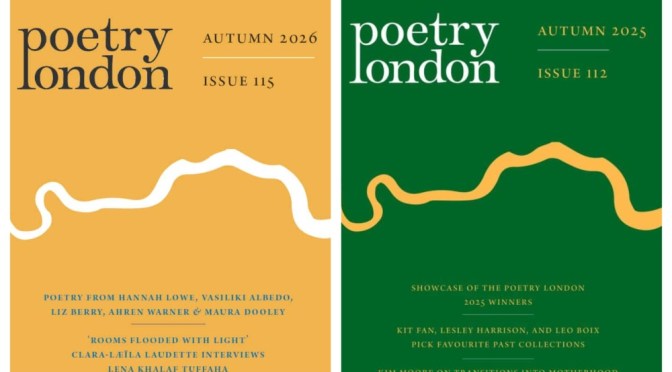
POETRY LONDON MAGAZINE – AUTUMN 2026 PREVIEW

POETRY LONDON MAGAZINE: The latest issue features new work from Liz Berry, Hannah Lowe, Ahren Warner, and Maura Dooley. We also have prose by Joey Connolly, an interview between Clara–Læïla Laudette and Lena Khalaf Tuffaha, and reviews of Helen Mort, Dean Browne, Karen Solie, and Jorie Graham.

Rooms Flooded with Light

Lena Khalaf Tuffaha explains that her poems—written over a decade from a position of relative safety in the US—did not target a specific reader, but rather reflect an evolving, non-linear attempt to communicate across a broad and complex readership profoundly shaped by ongoing trauma and genocide.

Under Pressure

In her new collection Killing Spree, poet Jorie Graham evokes the dual-headed Roman deity Janus to confront a precarious present by looking back at an out-of-reach past while facing a distressing, violent future.

‘it been really interesting is good to talk face to face isn’t it’

Blown Rose and Dialect Press sum up some small press publishing. By Julia Bird, Mike Sims, Juliette Morton

LOS ANGELES REVIEW OF BOOKS – FALL 2026

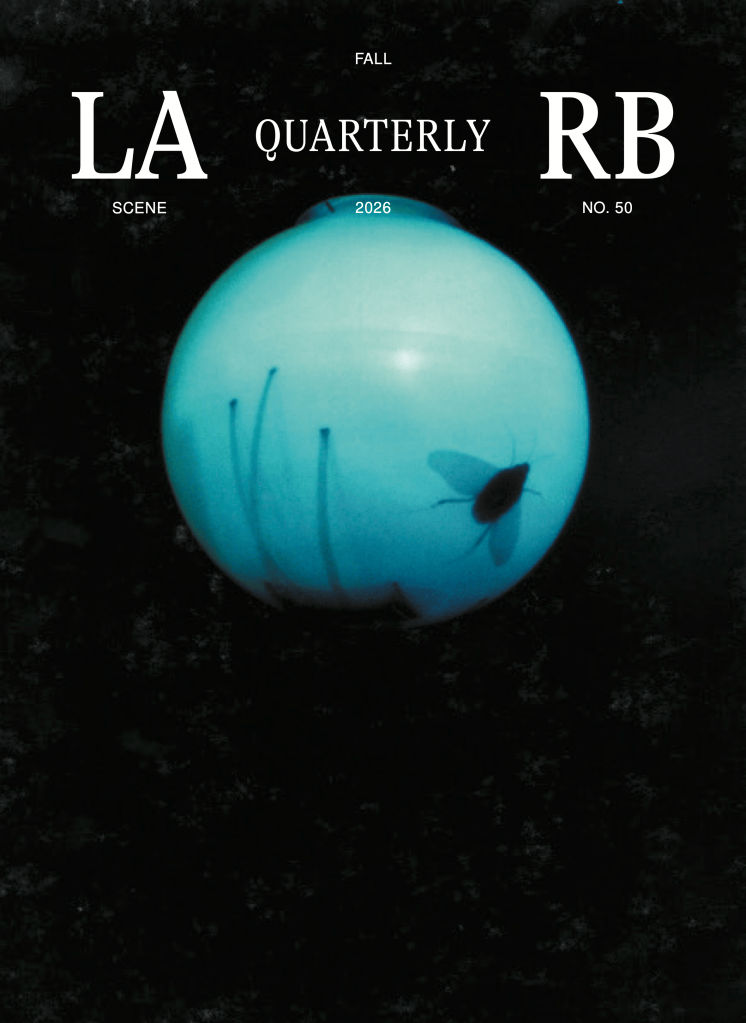
LOS ANGELES REVIEW OF BOOKS: The latest issue of LARB Quarterly, no 50: Scene, is here, featuring essays, poetry, fiction, excerpts, and a special bonus: one-act scenes.

Let’s Keep It for Ourselves

On ‘Unmuzzled OX’—a cult journal that seduced the best writers and artists in North America. Alex Kitnick

Everywhere and Nowhere All at Once

On Afghanistan, empire, and American amnesia on the 25th anniversary of the US invasion. Leila Christine Nadir

  • Armando Ledezma writes on voguing with the House of Ruber in Caracas.
  • Alex Kitnick profiles Unmuzzled OX, a cult journal that seduced the best writers and artists in America.
  • Samuel Chu reports on Operation Yellowbird, the Umbrella Movement, and the dissidents of Hong Kong.
  • Andie Eisen considers the women taking over the funeral industry.
  • Jonah C. Sirott probes how the right stole the flying saucers and the Democrats lost the weirdos.
  • Michel Chaouli reflects on the history—and pleasures—of traveling and reading.
  • Essays by Amber Bal and Doyle D. Calhoun on a misunderstood masterpiece of African cinema, Rachel Cusk on the art of Joan Snyder, Issa Quincy on the 60th annual Angola Prison Rodeo, Yael Segalovitz on slumber, and Negar Azimi on Iranian art in the 2000s.
  • Fiction by Ingeborg Bachmann (transl. Philip Boehm and Tess Lewis). Scenes by Maya C. Popa, Sophia Le Fraga, Yuri Herrera, Jason Porter, Brandon Harris, and Sarah Ruhl.
  • I Come Here Often by Sarah Wang. Double Feature by Eugene Kotlyarenko. Poetry by Sara Eliza Johnson, Jose Hernandez Diaz, Jessica Fisher, Keith S. Wilson, Eileen G’Sell, Mary Jo Bang, and Eduardo Martínez-Leyva.

Join today!

PROTEAN MAGAZINE PREVIEW – FALL 2026

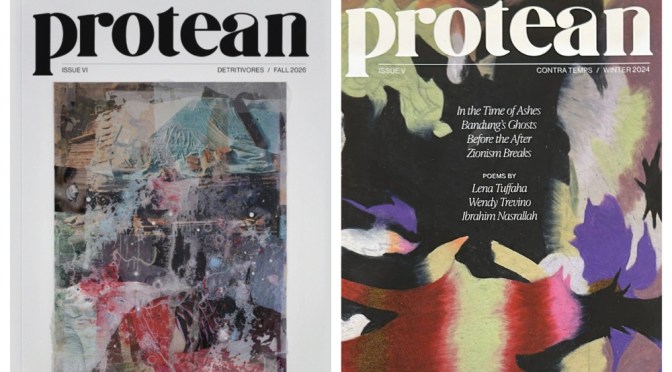
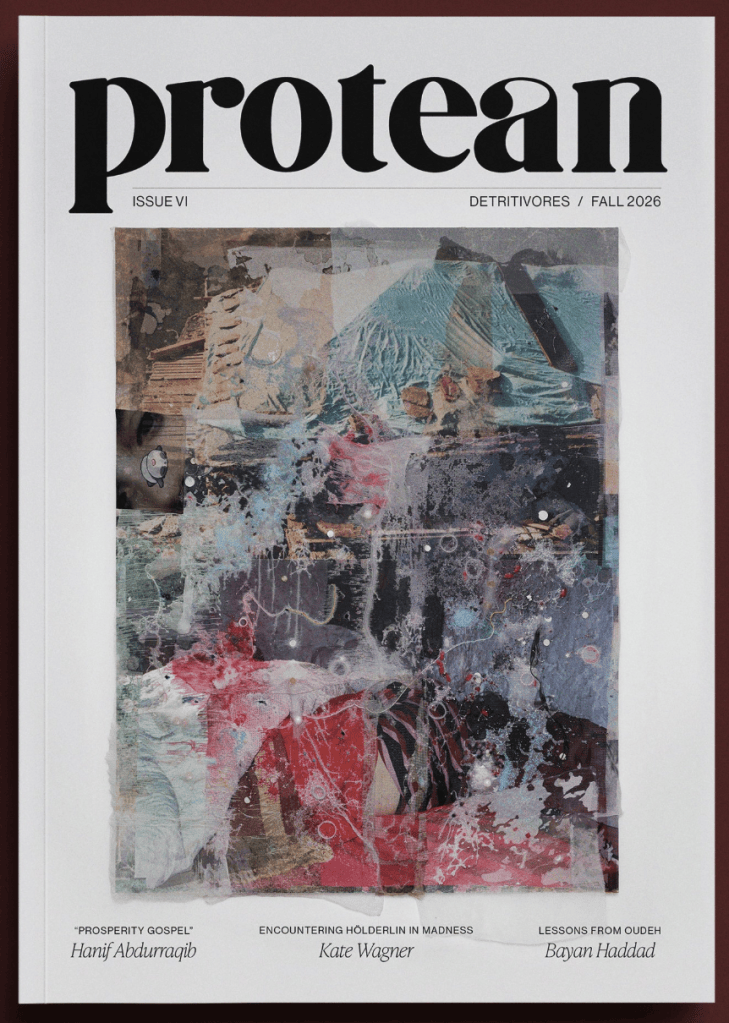
PROTEAN MAGAZINE: The latest issue features a critique of the University of California’s institutional history, an interview exploring the life and politics of John Berger, an excerpt celebrating historical Palestinian revolutionary resistance literature, a poignant reflection honoring a murdered Palestinian community advocate, Palestinian poetry confronting immense grief with unyielding, steadfast resilience, and verses examining how modern capitalism structures contemporary family forms.

Institutional Optimism

Scholar, author, and activist Tony Platt reviews the new narrative history by Miriam Pawel, “California Dreams: The Making and Remaking of the University of California.” Pawel’s narrow focus on five high-achieving alumni, argues Platt, elides both radical traditions and unethical…

Mawwal

Palestinian national poet Mahmoud Darwish’s “Mawwal” confronts immeasurable grief with unbending steadfastness: “the stabs of daggers I prefer / to being ruled by the vile.”

I lost a beautiful dream,
I lost the scent of the lilies,
and my night was long,
upon the fences of gardens…
But I never lost my way!
The palm of my hand
is now accustomed to the wounds of hope.
Shake my hand hard
and a river of songs will flow forth.
Mother of my colt and sword:
Mother mine, here’s a ditty of love!
Mother mine, a ditty!
The stabs of daggers I prefer,
to being ruled by the vile.

Tom Overton on John Berger: From Life

Andrew Holter interviewed Tom Overton, author of a new biography, “John Berger: From Life,” out from Verso Books. In this fascinating discussion, Overton discusses his friendship with Berger, the biography’s literary approach, Berger on Palestine, and future plans for scholarship…

The London Magazine – October/November 2026

THE LONDON MAGAZINE: Despair – its causes, symptoms and consequences – becomes something of a theme across the issue. At least according to its etymological root, to despair is to be without hope (de-sperare), and in Mavis Gallant’s 1965 story ‘Paola and Renata’, published in the issue, mothers have no hope of controlling their inscrutable, insolent daughters.

Review | Comfort and Its Discontents by Devki Panchmatia

‘While it must be stressed that Rankine’s lyric practice is capacious and stylistically thrilling, that her insights are always valuable in isolation, I am left slightly unsure of what Triage’s greater intentions are.’

Essay | The Scale Against Poetry: Tony Harrison’s Prose by Dane Holt

‘Partly due to critical neglect, partly due to the single-minded determination to be a poet who survived on nothing but his poetry, Harrison’s prose is doomed to be a footnote in his career.’

Essay | It’s a Devil of a Gap by Alex Niven

‘Might there be something, beyond backwater nihilism, in the vanishing of the Tree at Sycamore Gap that speaks to us about a country increasingly unable to protect its social and civic structures in the most basic ways?’

PORTICO LITERARY QUARTERLY – FALL 2026

PORTICO LITERARY QUARTERLY: The latest issue features….

Cormac McCarthy’s Desert Wanderings

By Michael Crews

Tracy Daugherty’s biography of Cormac McCarthy is a landmark publication. Putting together the life of a writer who not only shunned publicity but actively worked to keep fans, journalists, the media, and academics off his trail requires the powers of both a skilled biographer and a nosy private detective. In that latter role, some of what Daugherty has uncovered is unsavory, though with the recent revelation of McCarthy’s relationship with Augusta Britt, who was sixteen when they began an affair, readers may be prepared for some of the shocks. One of Daugherty’s leitmotifs is McCarthy the “bad boy” and “outlaw,” and though such appellations risk cliché, the story he tells is of a man who, at least in the first half of his life, preferred the company of moonshiners, gamblers, hard drinkers, and petty criminals like his old Knoxville pal John Sheddan, who seems to have been the Falstaff to McCarthy’s Prince Hal.

Jean Toomer in Black and White

Helen Andrews

There are two books before me, which, if I mistake not, will mark an epoch,” wrote W. E. B. Du Bois in The Crisis magazine in 1924. One was a novel of middle-class African-American life by Jessie Fauset called There Is Confusion. The other was a collection of stories, songs, poems, and character sketches called…

Andre Dubus’s Sacramental Fictions

Christopher J. Scalia

During the last quarter of the twentieth century, few writers were more admired by peers and critics than Andre Dubus. But because Dubus’s territory was the relatively confined space of the short story and novella, he never enjoyed great commercial success or recognition. Dubus was destined to be a writer’s writer—what Joshua Bodwell calls a…

The Cello

By Lionel Shriver

In that we’ve been married for sixteen years, you really don’t have to try so hard to make your feelings known,” Janet said at the wheel. “I’m well aware you don’t want to do this.”

“I THINK I’ve been pretty stoic about it,” Rick said, eyes to the thick woods he’d be reflexively scanning for deer. Ever since they’d planted an ambitious garden behind their upstate New York summerhouse, the creatures that had once seemed so exquisite had become evil incarnate.

“Stoic? More like long-suffering,” Janet said. “You’ve hardly said a word the whole way here. But there’s no point in having joined Saint Peter’s if we don’t put our beliefs into practice. Charity doesn’t only mean parting with twenty bucks to get someone at the door to go away. It means sometimes doing what’s right when you don’t feel like it.”

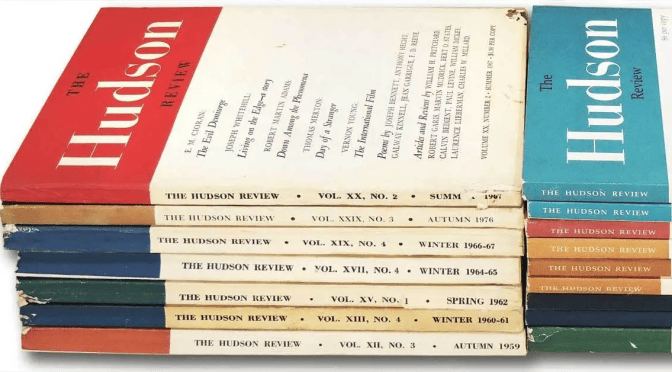
THE HUDSON REVIEW MAGAZINE – SUMMER 2026

THE HUDSON REVIEW: The latest issue features….

2025 SHORT FICTION CONTEST

First Prize: The Unmeasurable by Pegah Ouji
Second Prize: The Nearer Realm by Rebecca Kilroy

ESSAYS

Remembering Emily Grosholz (1950–2026) by David Mason
Turn, Turn, Tumble: Similes, and Shipwrecks, and the Sea by Carol Dougherty

MEMOIR

Journey to a Novel by Antonio Muñoz Molina, Guillermo Bleichmar, trans.

FICTION

Restos by Mark Jacobs

POETRY

Citizens of the Wind; The Salt Waking; A Drawn-Out Anxious Sense; The Extinction of the Dinosaurs by David Mason
Trying to Write a First Love Poem at Seventy; For the Earth Dwellers by Brian Culhane
At the Grave of Tiem Duc Bui; Woman Raking Leaves in Barry Park; Late Bedtime Story; Camden, 1969 (After Borges) by Charles Martin
In Wilkins’ by Daniel Tobin
Ascension; Tongue-Tie by Ines P. Rivera Prosdocimi
The Deer Mouse Berates Me; Sox in the Underworld by Joan Murray

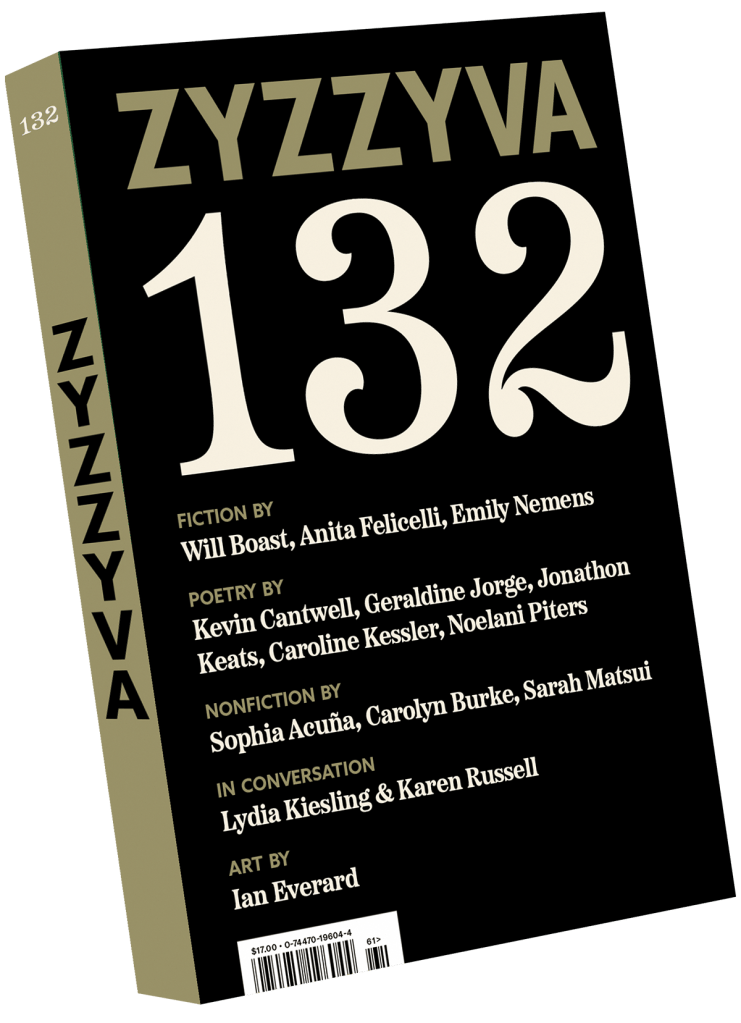
Zyzzyva Magazine —– Spring 2026 Preview

ZYZZYVA Magazine: The latest issue features…

Nonfiction

“Saguaro in the Sea” by Sophia Acuña: on surfing and indigeneity in Southern California, told through collage.

“Care Directive” by Sarah Matsui: a daughter’s attempt to keep her aging father in Hawaii from all sorts of calamity, but having to monitor him from the mainland.

“Triptych: A Biographer’s Sketchbook” by Carolyn Burke: “The Baroness was lively, curious, and still blond at eighty-five. She received me in a flurry of franglais, the mingling of two languages in which we would converse, and put us at ease with pink champagne, her favorite.”

Fiction

“Decoys” by Will Boast: goofing around working at the town supermarket, burning through the days till it all comes to head.

“Lilac Mud” by Anita Felicelli: A Bay Area artist in Amsterdam is approached one night by a man claiming to be a former student, leading to a crisis of identity and purpose.

“Grote geplumaceerde” by Emily Nemens: “Afterward, staring hard at her phone, which was her radio, which was the bearer of bad news, she wondered what mattered at all.”

Poetry

Kevin Cantwell, Geraldine Jorge, Jonathon Keats, Caroline Kessler, and Noelani Piters.

In Conversation

Lydia Kiesling talks to acclaimed author Karen Russell about Russell’s latest novel, The Antidote, and about Russell’s “fascination with foundational myths, the things we choose to know, and the things we choose to ignore or forget.”

Art

Ian Everard

THE HUDSON REVIEW MAGAZINE – WINTER 2026

The Hudson Review | A Magazine of Literature and the Arts

THE HUDSON REVIEW: The latest issue features….

ESSAYS

The Mysterious Case of Gothic Verse Narratives by Brian Brodeur
The Intertidal Zone by Michael Carson

FICTION

Krista Robinson, Age 21 3/4, Wants These Things to Be True by Leslie Pietrzyk

POETRY

The Fells by Natania Rosenfeld
Sonnet Upon the James Webb Space Telescope; The Names of the Seasons by Robert Schultz
A Dance by Brian Swann Memorable Figures by Ellen Kaufman
Stanley Moss by Priscilla Long

ARTS CHRONICLES

Dancing in New York: Variations on a Theme by Marina Harss
Recurring Themes at the New York Film Festival by Erick Neher
Balancing Acts by Becky Y. Lu
At the Galleries by Karen Wilkin

BOOK REVIEWS

Letters of T. S. Eliot, Vol. 10 by William H. Pritchard
Poet, Lucky Poet: The Poems of Seamus Heaney by Mark Jarman
Revivals, Pastorals, a Shroud of Golden Silk by Robert Archambeau
The Making of Gertrude Stein by David Mason