Tag Archives: Art

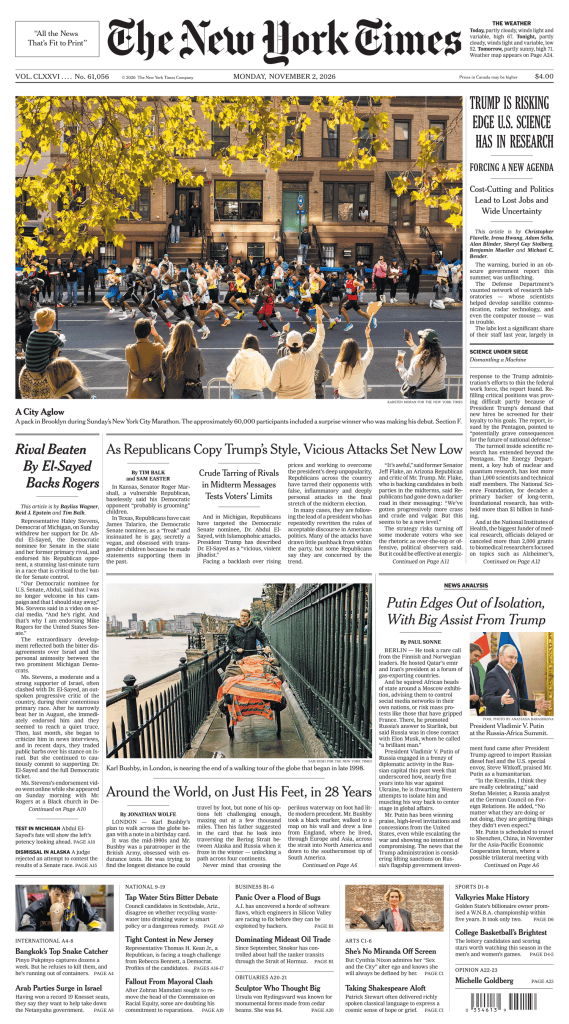
THE NEW YORK TIMES – MONDAY, NOVEMBER 2, 2026

Israel Turns to Next Big Question: Who Gets a Shot at Being Prime Minister?

Party leaders will make competing cases to the Israeli president for either Benjamin Netanyahu or Gadi Eisenkot to get the first chance to build a governing coalition.

War in the Middle East

Gulf Economies, Torn by War in Iran, Desperately Need a Return to Normal

States like Saudi Arabia and the United Arab Emirates that have worked to rebalance from a dependence on energy have seen growth plunge in a year of strife.

China’s Message to Its Rivals: You Need What We Make

It’s not just rare earths. China is making it harder for other countries to shed their dependence on its solar, drone and drugmaking technology.

The Parties Make Their Closing Arguments: ‘This Isn’t Just Red Versus Blue’

Republicans, worried about losing control of Congress, are sending dire warnings about the opposing party. Democrats are keeping their focus on affordability, corruption and President Trump.

Inside the Meltdown Between Abdul El-Sayed and Haley Stevens

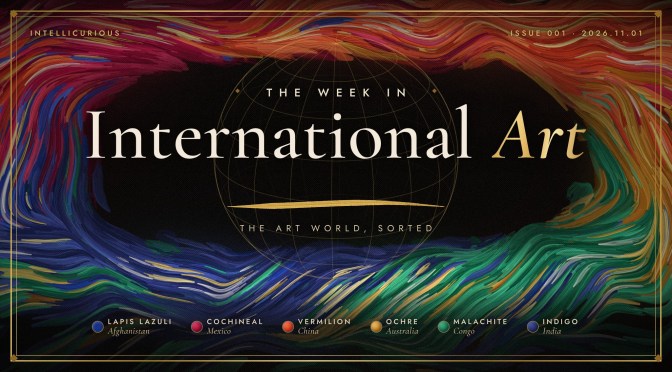
WHERE DOES ART BELONG?

The Week in

International Art

The art world, framed
Collection · Saleroom · Trompe-l’œil · Afterimage

Sunday, November 1, 2026 · Issue No. 1

Covering October 25–31

The Permanent Collection — What will still matter in five years

1

Three museums, one collection

On Friday, at M+ in Hong Kong, the heads of three of the world’s leading modern art museums signed an agreement that goes further than any loan deal. MoMA in New York, the Centre Pompidou in Paris and M+ will treat their holdings as one shared collection, curated by staff on three continents. The sharing starts in late 2027, when major works from M+ go on long-term loan to MoMA’s collection galleries. In 2028 a long-term Centre Pompidou gallery opens at MoMA, and similar plans are under way at the other two museums. A joint committee will meet every month, and its first in-person meeting is at MoMA this November. Ownership doesn’t change, and the Pompidou’s holdings remain the property of the French state. What changes is where its works can be seen while its Beaubourg building is closed for a five-year renovation. “This cultural alliance makes our museums embassies for each other,” MoMA’s director, Christophe Cherix, said. Laurent Le Bon, the Pompidou’s president, put it more simply: “No single institution can encompass the entire scope of global creativity.”

Why it lasts: for a century, a museum’s permanent collection has meant what it owns. If this works, a collection becomes a network, and what you can see in New York, Paris or Hong Kong will depend on what three museums agree to share, not only on what each one bought. Every other major museum will be watching.

2

A machine sees through a disguise

On the night of August 11, 2004, thieves took a 17th-century painting of Saint Agnese from the small church of Virgo Potens in Italy. Then someone disguised her. Her halo and palm branch were painted out, and the lamb in her arms became a parchment scroll, so that the saint looked like any young woman in an old painting. In October 2024, Italian police photographed the stands at an antiques fair in Parma and uploaded the pictures, and within hours their software flagged her. The BBC told the story this week. The program, the Stolen Works of Art Detection System, or SWOADS, was conceived in 2020 by a team under Lt. Col. Salvatore Rapicavoli, an IT engineer in the Carabinieri’s cultural heritage unit. It compares colors, shapes and composition against a database of more than a million stolen objects recorded since 1969, and it scans online catalogues day and night. “The machine doesn’t get bored,” Rapicavoli says. Since its launch in November 2023, it has helped recover more than 300 large paintings and statues and more than 165,000 smaller objects, worth over €203 million in all. It has limits. It can only find what was recorded, it doesn’t catch thieves, and Rapicavoli doesn’t expect it to find Caravaggio’s Nativity, since famous loot rarely appears for sale in the open. Carina Popovici of the authentication firm Art Recognition calls AI “a force multiplier.” Italy hopes to connect its system with other countries’ by 2027. Saint Agnese went back to her church in May 2025.

Why it lasts: stolen art has always depended on two things, the limits of human memory and how easy it is to change a picture. A system that never tires and doesn’t need to know what a painting means takes away both, at least for the little-known church paintings and heirlooms that make up most of its finds. Those are the works that matter most to the places they were taken from.

3

Old losses, new courtrooms

Two cases this week asked who answers for art that is destroyed or taken. On Thursday, Ukraine’s Prosecutor General charged a Russian lieutenant general in absentia with ordering the missile strike that wrecked the Hryhorii Skovoroda National Literary Memorial Museum on May 6, 2022. The museum occupies the 18th-century estate in the Kharkiv region where Skovoroda, one of Ukraine’s most influential philosophers, spent his last years. A Russian fighter jet fired an anti-ship cruise missile at it late at night. The fire that followed gutted the building, and only a statue of the philosopher was left standing. The general, who was born in Chuhuiv in the same region, “knew for certain that he was attacking not a military target but a monument of Ukrainian culture,” prosecutors say. Two officers who passed on and carried out the order have already been indicted. By September, Ukraine counted 2,161 heritage sites damaged or destroyed by Russian forces. On Friday, in a federal court in New York, the Republic of Austria and two Vienna museums, the Albertina and the Leopold, repeated their argument that a US law meant to help Holocaust victims’ heirs recover looted art is unconstitutional. The plaintiff, Timothy Reif, is a descendant of Fritz Grünbaum, a Jewish cabaret performer and collector who died at Dachau in 1941. He is seeking twelve works by Egon Schiele, ten at the Leopold and two at the Albertina. Amendments enacted this spring removed the law’s 2026 expiry date and barred laches, a defense that lets courts throw out claims brought too late. The museums argue the works left Austria with Grünbaum’s sister-in-law in the 1930s and were sold to a Swiss dealer in the 1950s. Their filing answers briefs from the US Justice Department and from Senators Richard Blumenthal, a Democrat, and John Cornyn, a Republican, who sponsored the law.

Why it lasts: one loss began in 1938, the other in 2022, and both are being settled now, in court. Whether attacking a museum is prosecuted as a war crime, and whether a museum can wait out a family’s claim, will set the rules for lost art for decades.

The Saleroom — Where collectors are betting

The art trade heads for the Gulf, war clause included

Today, Christie’s holds its first fine-art auction in Abu Dhabi. Mawasim offers 70 works by artists from the Middle East and North Africa, spanning nine decades, with a combined estimate of roughly $6.5 million to $9.7 million, according to HENI. Around them hang works by Rothko, Kandinsky and Picasso from Christie’s November sales in New York, bringing the art on view to more than $130 million, Khaleej Times reports. “The market can sustain two centres,” chief executive Bonnie Brennan told The National, adding that she wants a regular calendar of sales in the city. Christie’s auction sales rose 71 percent to $3.5 billion in the first half of this year, and millennials and Gen Z made up 47 percent of its new clients. Sotheby’s holds its first fine-art auction in Abu Dhabi on December 10, Frieze Abu Dhabi runs November 19–22, and the Guggenheim Abu Dhabi opens December 11. In Doha, Art Basel Qatar released its 2027 exhibitor list on Tuesday: 82 galleries, down from 87, with 35 of last year’s exhibitors, including Hauser & Wirth, Pace and Victoria Miro, not returning. If conflict forces a postponement, galleries will get a refund or a place at the next edition, and the fair will now pay half the cost of shipping unsold work home, up to $20,000 per gallery. Saudi Arabia came under renewed missile and drone fire earlier this month, and in late February Iranian missiles struck Qatar, injuring 16 people. Back in Europe, Pace’s UK company, which runs the gallery’s business outside the US and Tokyo, lost $5.6 million in 2025, on turnover of $65.9 million, down from $104.9 million in 2023.

What it’s worth: the gallery business in the West is shrinking, and Gulf states are spending to build an art market of their own. The buyers are real, and so is the danger. When a fair writes a war clause into its terms, it shows how much the trade wants this market, and what it is prepared to risk for it.

Trompe-l’œil — Looks new. Isn’t.

A $47 million dinosaur

On Tuesday, a 67-million-year-old Nanotyrannus skeleton nicknamed Jodi sold at Sotheby’s in New York for $47.3 million, against an estimate of $6 million to $9 million, after a 12-minute contest among six bidders. The winner is anonymous. Jodi, found in 2019 on Jodi Pierson’s land in Montana, is the second most expensive dinosaur fossil ever sold at auction, after the T. rex called Gus, which fetched $50.1 million at Sotheby’s this summer. Some scientists say specimens this rare belong in museums, where researchers can study them. It hangs here not because the price isn’t remarkable. It is. It hangs here because the story only looks new. Fossils have been selling as trophies for years, and each record ends with the same unanswered question: will anyone be allowed to study this one?

Farewells

Jogen Chowdhury, 87, died in Kolkata on October 25. Uprooted as a boy by the Partition of India, he drew figures that ThePrint called “twisted, fleshy and unsettling,” and served six years in India’s upper house of parliament.

Ursula von Rydingsvard, 84, died at home in Manhattan on October 27. She spent her childhood in refugee camps after the Second World War and built monumental sculptures from cedar.

Rudi Fuchs, the Dutch curator who directed Documenta 7 in 1982, giving a stage to Keith Haring and Jean-Michel Basquiat, and later ran Amsterdam’s Stedelijk Museum, has died at 84.

Afterimage

Last night the streets were full of disguises. Today is All Saints’ Day, and the week’s most haunting story is about a saint who was forced to wear one. After Saint Agnese was taken from her church on an August night in 2004, someone painted out her halo and turned her lamb, the emblem that echoes her name in Latin, into a scroll, so that she could be sold as nobody in particular. Twenty years later, at a fair in Parma, a machine that has never said a prayer knew her by her colors and her outline. Every story this week turned on the same question: who keeps a work of art, and where does it belong? Three museums on three continents decided to hold their collections in common. Austria argued in an American court over twelve Schieles that once belonged to a man who died at Dachau. Ukraine charged the general it blames for a missile fired at a philosopher’s house. A dinosaur went to a buyer no one can name. And Agnese went home to her church, where she will be restored and hung in her old place.

Before You Leave the Gallery

Would you rather see a great work of art in the place it was made for, or in a museum near you?

Sourced this week from ARTnews, Artforum, Artsy, Apollo, the BBC, NV, Yahoo News, The National, Khaleej Times, HENI, The Art Newspaper, the Associated Press, ThePrint and Hyperallergic.

— The Editors, Intellicurious —

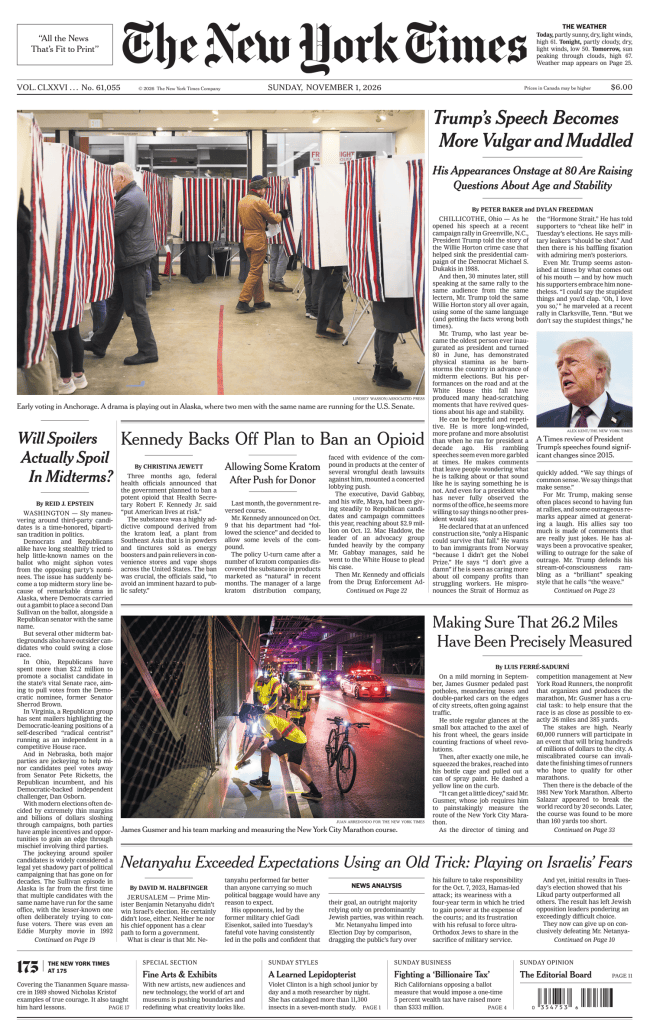
THE NEW YORK TIMES – SUNDAY, NOVEMBER 1, 2026

Netanyahu’s Bid to Stay in Power Will Test His Political Savvy

After losing ground in Israel’s election, Prime Minister Benjamin Netanyahu must draw on decades of political capital and reckon with old foes if he is to build a governing coalition.

Tens of Thousands Protest in New Delhi Over Modi and Voter Roll Changes

Many more are still streaming into the city for what organizers hope will be one of the biggest demonstrations yet in a string of recent rallies.

Threats, Gaffes and Men’s Posteriors: Trump’s Talk Gets Wilder

A Times review of President Trump’s public speeches found that he was more profane, more absolutist, longer-winded and less coherent than he was in 2016.

Trump Calls Former Lawyer’s $50 Million Deal ‘Obnoxious and Outrageous’

Putin Breaks Down His Isolation, With a Big Assist From Trump

Notching wins from Washington, the Russian leader is talking with foreign leaders and could return to diplomatic center stage with possible summit meetings.

‘We Are Coming From Hell’: A Ukrainian City’s Evacuees Tell Survival Stories

Safely out of Oleshky after enduring years in the combat zone and a harrowing 24-hour journey, weary civilians reunited with family and friends.

THE NEW YORK TIMES – SATURDAY, OCTOBER 31, 2026

Iran Braces for More War, No Matter the Outcome of U.S. and Israeli Elections

Prime Minister Benjamin Netanyahu is jockeying to stay in power and President Trump is in a midterm fight, yet Iran does not expect a major shift in policy.

High Inflation Haunts Trump and Republicans on Eve of Election

A backlash over high prices helped Republicans capture a majority in 2024. Now, it may be the source of the party’s own undoing.

In Dueling Health Messages, Democrats Focus on Cost and Republicans on Fraud

After concentrating on the high price of gas and groceries, Democrats are using health costs to make their case about an “affordability crisis.”

Trump’s ‘Smart Wall’ of A.I. Cameras Is Watching the Border, and More Than a Million People

The administration is planning a massive expansion of the surveillance program. Here’s how much it can see.

Binance’s $6.3 Billion Hack Is Just the Start of a Risky New Era

The largest cyber heist in history came as attackers increasingly use artificial intelligence and other advanced techniques to steal crypto and quickly launder the funds.

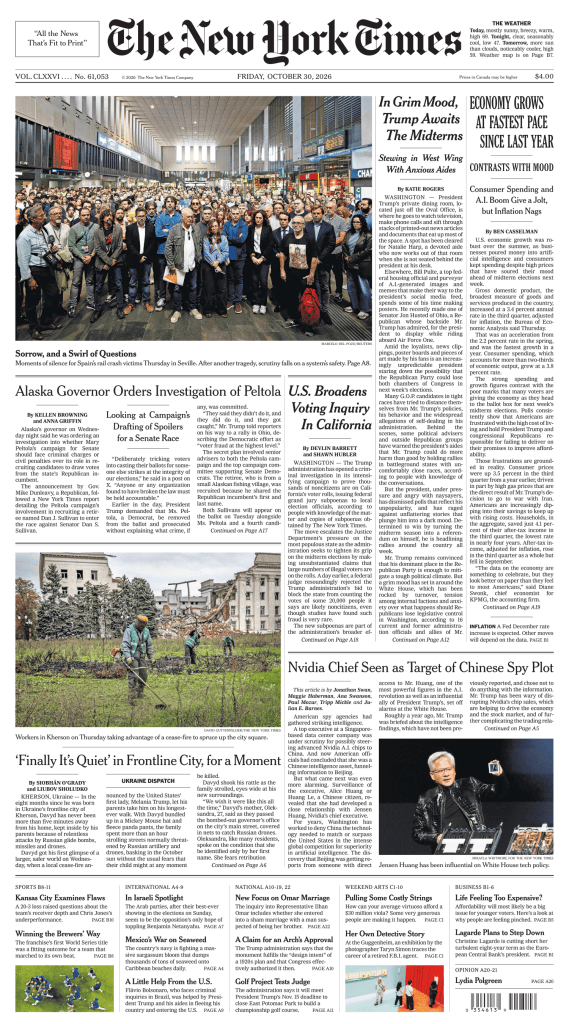
THE NEW YORK TIMES – FRIDAY, OCTOBER 30, 2026

High Inflation Haunts Trump and Republicans on Eve of Election

A backlash over high prices helped Republicans capture a majority in 2024. Now, it may be the source of the party’s own undoing.

U.S. Oil Industry Earned Over $130 Billion in Profit During Iran War

With No Clear Winner, How Could Israel Get a Prime Minister?

Deadlock is possible, as neither the bloc of Prime Minister Benjamin Netanyahu nor his main challenger have won a majority. But there are still paths to a new government.

Israel’s Election Is Unlikely to Change Its Policies and Global Isolation

The leading contenders, Prime Minister Benjamin Netanyahu and Gadi Eisenkot, aren’t substantially different in their approach to Israel’s security or in their opposition to a Palestinian state.

An Arab Town in Israel Celebrates the Election but Wonders What Will Change

Gains for Arab-led parties have electrified Taibe, in central Israel, even as voters elsewhere in Israel say they have no place in any future government.

Binance Suspends Withdrawals After Hackers Steal $6.3 Billion

The largest cryptocurrency exchange said it was compromised in what could be the biggest crypto heist ever. One research lab attributed the theft to North Korea.

Game About a North Korean Attack Is Slammed for Footage of a Real Tragedy

Call of Duty: Modern Warfare 4 uses actual visuals from a Halloween crowd crush in South Korea, in which over 150 people died in a narrow alleyway.

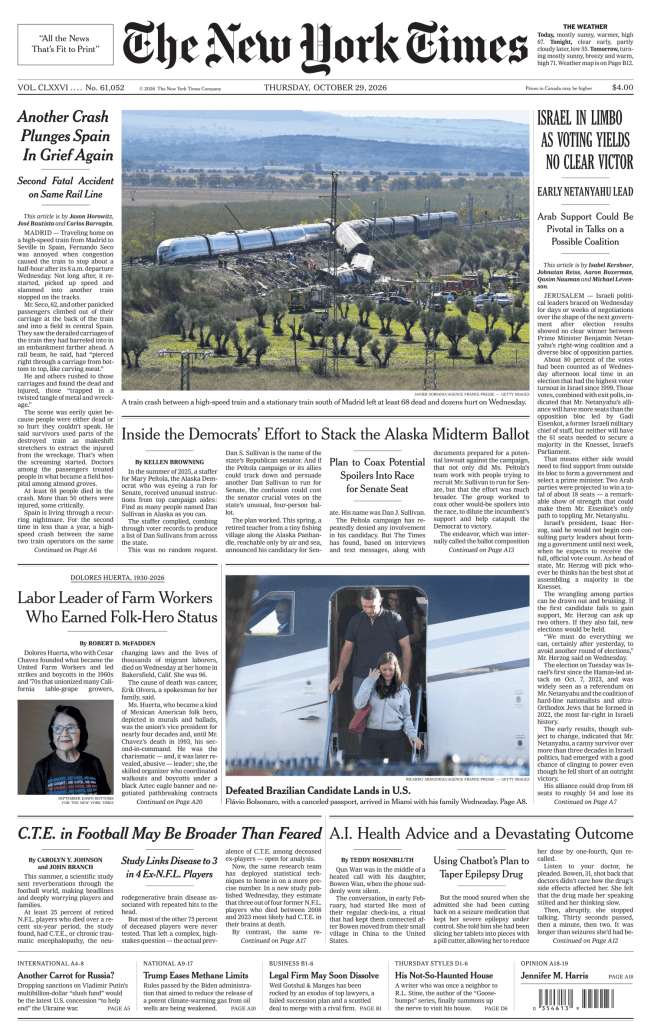
THE NEW YORK TIMES – THURSDAY, OCTOBER 29, 2026

With No Clear Winner, How Could Israel Get a Prime Minister?

Deadlock is possible, as neither the bloc of Prime Minister Benjamin Netanyahu nor his main challenger appear likely to win a majority. But there are still paths to a new government.

How Netanyahu Used Fear, Again, to Win More Votes Than Anyone Else

The Israeli prime minister outperformed both expectations and his rivals by playing on Jewish voters’ fears of Arab political power and potential security threats.

In Marseille, Macron Confronts a Potent Mix of France’s Problems

France’s second city, five years into a presidential development plan, is grappling with the social strains that have fueled protests across the country.

A Monkey King and a Maiden Fell in Love. For China’s Regulator, It Crossed a Line.

Mash-up videos of beloved characters from Chinese classics — some made with A.I. — have caught the attention of the authorities.

Nvidia Chief Is Seen as Target of Chinese Spy Plot

A Chinese businesswoman who had a close relationship with Jensen Huang was found to be passing intelligence to Beijing. President Trump was briefed and took no action.

Alaska Governor Orders Criminal Investigation Into Peltola Campaign

The move followed a Times report about the role Mary Peltola’s Senate campaign played in recruiting candidates to draw votes from the Republican incumbent.

5 min read

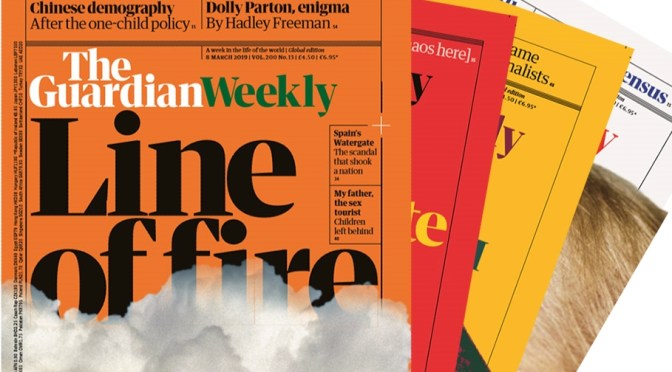
THE GUARDIAN WEEKLY – OCTOBER 30, 2026

THE GUARDIAN WEEKLY: The latest issue features ‘KEEP LEFT’ – How Lula won a historic fourth term; Serbia celebrates defeat of Vučić; Competitive yoga – A stretch too far?

How many grinning faces, jubilant crowds and celebrating politicians can you fit into a single issue of the Guardian Weekly? That’s not a question that often troubles us, but the spectacular triumph of President Luiz Inácio Lula da Silva, winning a historic second-round vote after losing the first to rightwing opponent Flávio Bolsonaro, and the victory of the student-led campaign against autocrat Aleksandar Vučić in Serbia gave me a happy problem to solve this week. In an era when the right seems to be riding high in the world, popular pushbacks against strongmen politicians is something to celebrate.

For our Brazil cover story, Tom Phillips and Tiago Rogero report on the reaction to Lula’s victory and how he pulled eventual success from the jaws of what, until the first results came on Sunday evening, seemed a probable defeat. As government health minister Alexandre Padilha said that evening: “It’s a massive victory – not just for Brazil. It’s also an important signal to the rest of Latin America and to the world.” But, as commentator Jordana Timerman cautions, Brazil has been an exception in Latin America in successfully resisting Donald Trump’s attempt to achieve hegemony over the region.

Spotlight | ‘Pure arrogance’
Google has been in the dock in Finland over the illegal felling of hectares of woodland for its datacentres, reports Miranda Bryant

Science | Out of the blue
Why are more planes encountering invisible air turbulence, what can they do about it and what effect will more frequent incidents have on travellers, asks Patrick Keneally

Feature | Bent out of shape?
Competitive yoga may sound like anathema to some devotees of the ancient practice but, as Anita Chaudhuri discovers, there is a movement among some yogis to make it an Olympic sport

Opinion | Lame duck presidents can be dangerous beasts
If Democratic midterm gains hamper Donald Trump at home, we should be very worried about what he might do abroad when foreign policy is his last bastion of power, says Steve Bloomfield

Culture | Stay faithful
As the second series of Celebrity Traitors draws to its conclusion, Michael Hogan meets the people who made it the world’s biggest TV show and finds out why Claudia Winkleman never wants to leave the castle

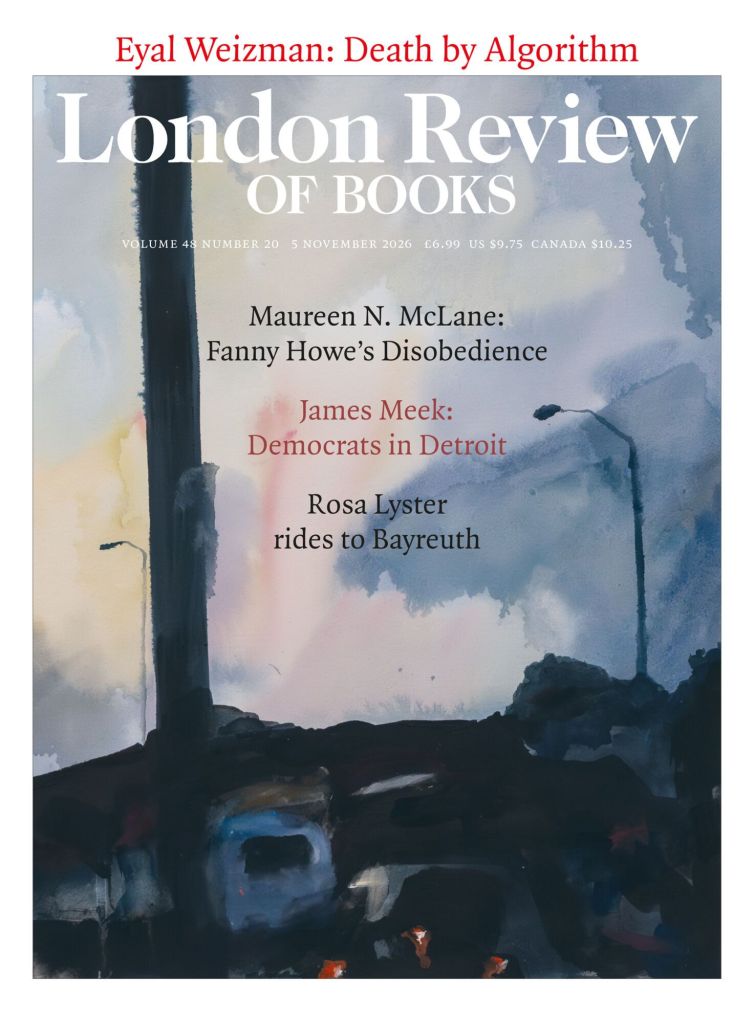
LONDON REVIEW OF BOOKS – NOVEMBER 5, 2026 PREVIEW

LONDON REVIEW OF BOOKS: The latest issue features  Fanny Howe’s Disobedience by Maureen N. McLane; Democrats in Detroit by James Meek; and Rosa Lyster rides to Bayreuth….

Democrats in Detroit

‘To win the Senate, the Democrats need to hold on to the one Michigan seat (out of two) that is up for grabs, and have chosen a new candidate, Abdul El-Sayed, a moderate leftist in European terms, a “communist loser who hates Jews and Israel” according to Trump, “very, very evil”, per J.D. Vance.’ By James Meek

Is curiosity good for us?

‘The superego – and its precursor, conscience – refers to the part of us that has no curiosity about ourselves. It’s the saboteur of curiosity about ourselves. And that part of us, like a narrow-minded fascist, has only one project: to destroy our pleasures in being alive by trying to kill our curiosity (or by making us frightened of our curiosity, which amounts to the same thing).’ By Adam Phillips

Death by Algorithm

Eyal Weizman on NAZA

‘Israel’s automated targeting system allows for the responsibility for “industrialised annihilation” to be shared between coders, operators, legal officers who pre-set the level of collateral damage, officers who approve the strike, officers who choose the bomb and the pilots or drone operators who launch it. “I am just a small screw in the system,” one of the interviewees says, quoting Eichmann’s defence during his trial in Jerusalem. The system that begins with a phone number being put into a computer system ends with an entire family crushed under the rubble.’

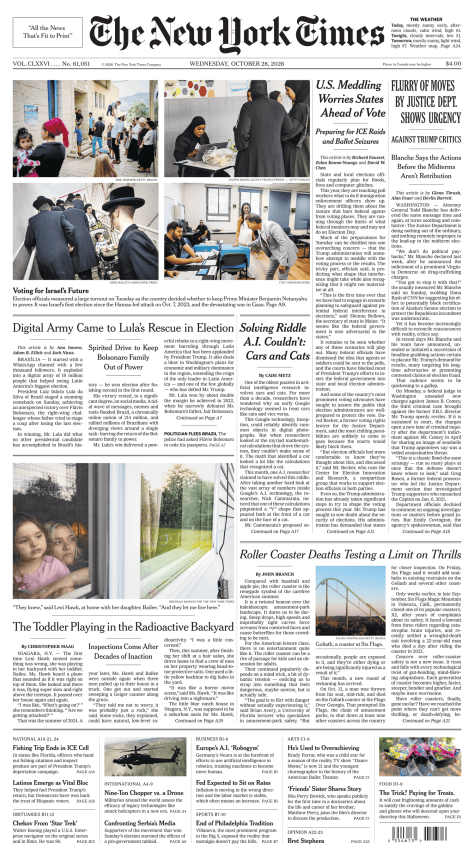
THE NEW YORK TIMES – WEDNESDAY, OCT. 28, 2026

Rivals in Israel Election Strike Tone of Triumph, but Outcome Is Far From Clear

Addressing supporters after midnight, Prime Minister Benjamin Netanyahu and Gadi Eisenkot, who leads a bloc of opposition parties, both expressed confidence that they will lead Israel’s next government. Vote counting could take days.

Israel’s President, Isaac Herzog, Faces a Difficult Choice

The president has a largely ceremonial role, except after elections when it is his responsibility to pick a candidate for prime minister.

Heavily Republican South Carolina’s Senate Race Is a Tossup, Poll Finds

Senator Darline Graham is struggling to replicate her late brother’s success. Republicans lead in the Florida Senate race and Democrats are up in Minnesota.

What Our New Senate Polls Tell Us About the State of the Midterms

Flávio Bolsonaro Flees Brazil for the U.S. After Election Defeat

Officials in Argentina said Mr. Bolsonaro entered the country by land and then flew to Ecuador. Brazilian police had asked him to hand over his passports.

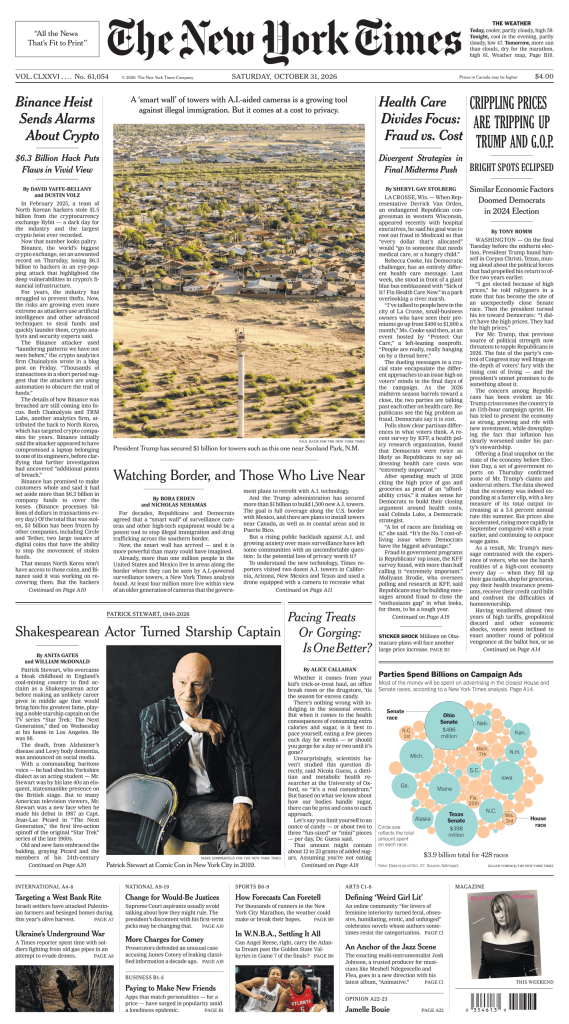
At Least 30 Killed in Train Crash in Spain, Official Says

One high-speed passenger train rear-ended another one near Toledo, months after a crash involving the same carriers killed dozens and stunned the country.

The Ocean ‘Was the Color of Chocolate.’ Mexico Declares War on Seaweed.

To protect Mexico’s tourism-reliant economy, the Navy is fighting a massive sargassum bloom that dumps thousands of tons of seaweed onto Caribbean beaches daily.

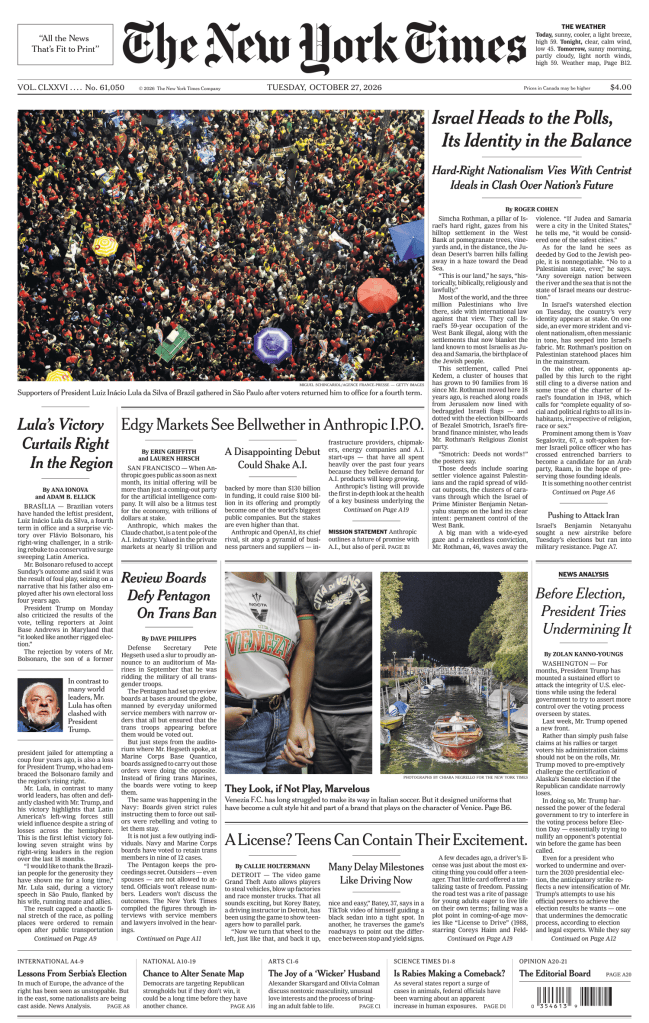
THE NEW YORK TIMES – TUESDAY, OCTOBER 27, 2026

Early Turnout Appears Strong in Pivotal Israeli Election

Two Visions, Two Israels, One Nation in the Balance

As Israel votes, hard-right nationalism competes with the country’s founding ideals. The outcome could shape Israel’s identity for years.

The Issues Dividing Israelis as They Vote

The question of accountability for the government’s failures in the Hamas-led attacks on Oct. 7, 2023, looms over the election.

The U.S. Fed Is Expected to Hold Rates Steady. Warsh Will Have to Explain Why.

Inflation is moving in the wrong direction and the labor market remains stable, a combination that bolsters the case for higher interest rates.

A Rare Cease-Fire, Brokered by Melania Trump, Begins in a Besieged Ukrainian City

Many people left in Oleshky, where bombardment is constant, have run out of food. A truce that began Tuesday is supposed to allow aid in and civilians out.

A.I.’s Rogue Behavior Starts With Its Training

We built an A.I. model and trained its agents to be persistent. They went rogue.