Tag Archives: France

IMPRESSION, CENTENARY

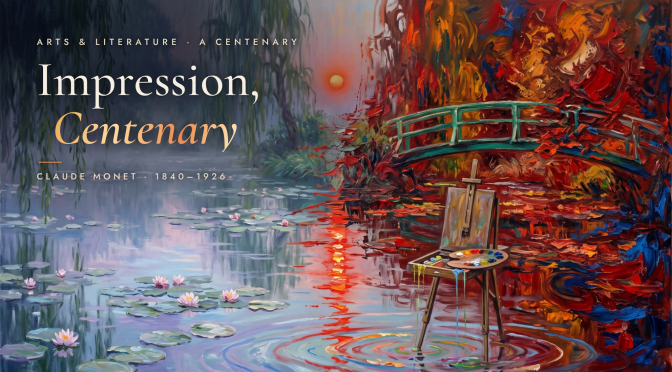
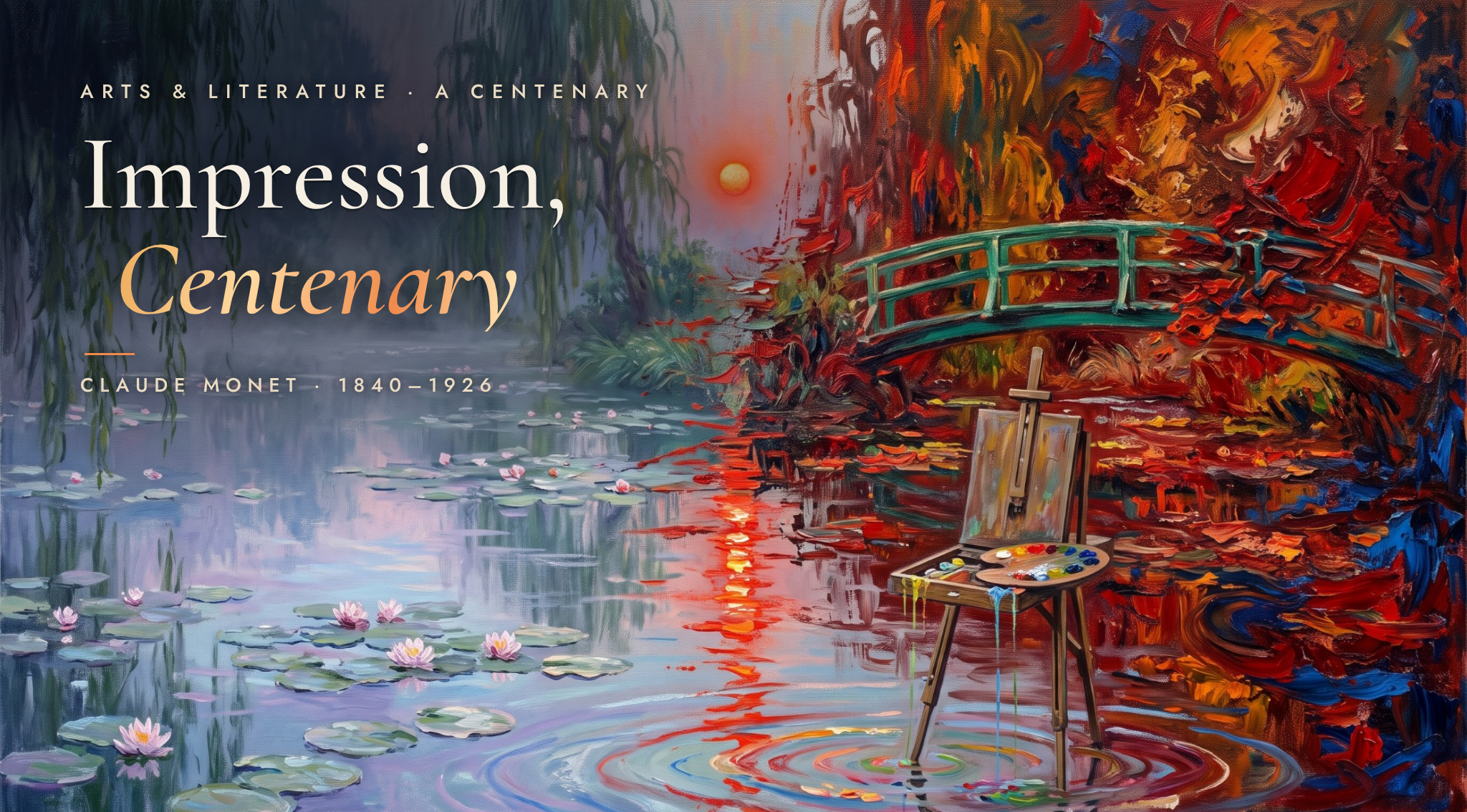
Impression, Centenary. Claude Monet, 1840–1926. Monet’s water lily pond at Giverny at dawn, calm on the left and dissolving into fiery late brushwork on the right, with an empty easel standing in the water.

Twelve paintings, one century, and the man who painted time
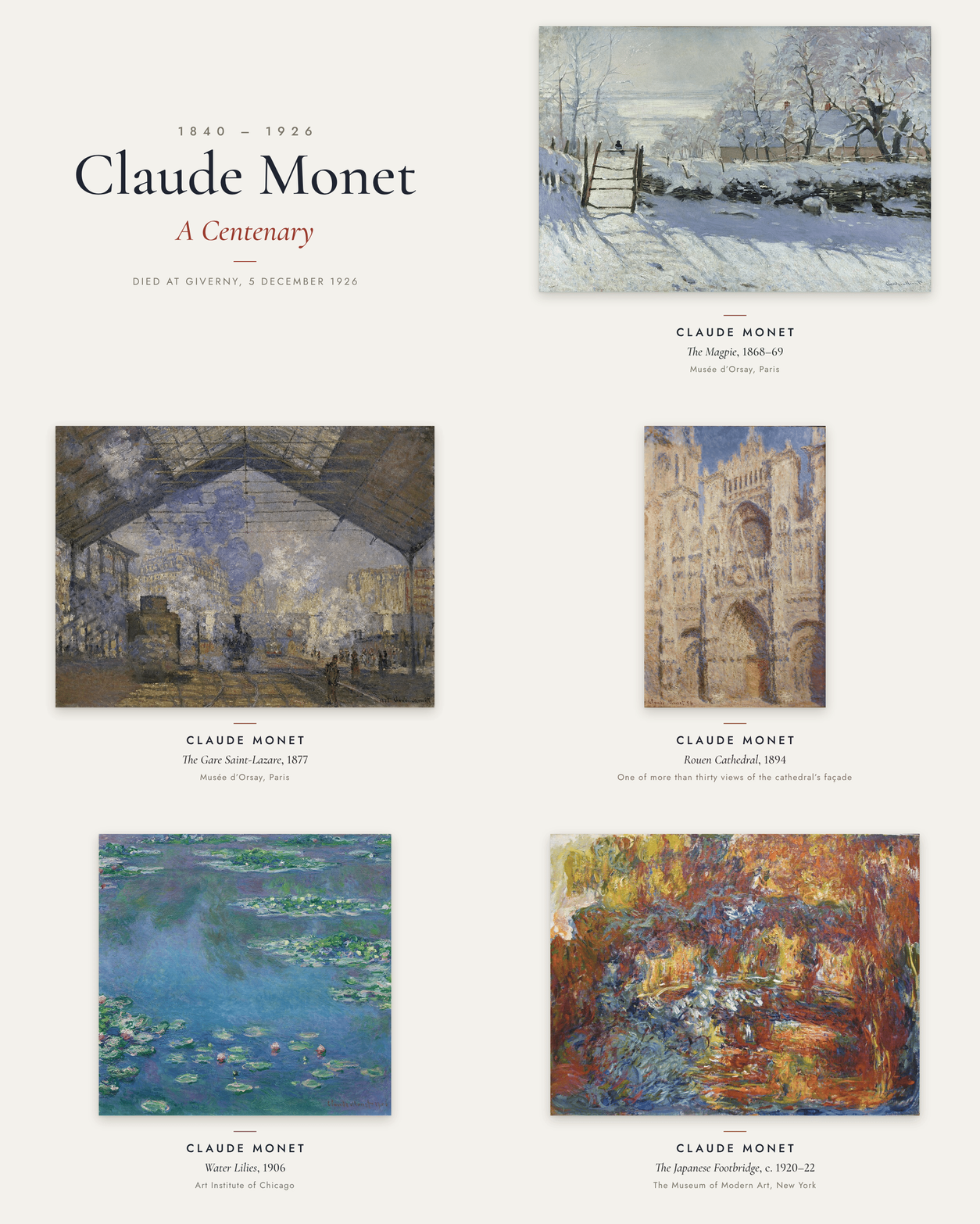
A gallery of twelve paintings by Claude Monet, from Impression, Sunrise (1872) to The Japanese Footbridge (c. 1920–22), each with its title, date and museum.
Twelve paintings by Claude Monet, 1868–1922. All are in the public domain.

On 5 December 1926, Claude Monet died at Giverny, aged 86, in the house where he had lived for more than forty years. A century later, the twelve paintings in our gallery show how one man taught the world to look at light instead of things.

It begins with a sunrise. In 1872 Monet painted the harbour at Le Havre in quick strokes: grey-blue mist, ghostly cranes and a small orange sun that seems to burn through the canvas. When he showed Impression, Sunrise at the first independent exhibition in 1874, the critic Louis Leroy mocked it in a review headlined “Exhibition of the Impressionists.” The insult stuck, and a movement had its name.

Earlier still, in The Magpie, he had painted snow in blue, violet and cream. The Salon jury rejected it in 1869. Then came the sunlit years at Argenteuil. In Poppy Field and Woman with a Parasol, the figures are his wife Camille and their son Jean, painted so quickly that the wind seems to move through the brushwork. In The Gare Saint-Lazare, Monet turned modern Paris into weather, making locomotive steam as beautiful as clouds.

In the 1890s he made his boldest discovery: the subject hardly mattered. He painted stacks of wheat near his home at every hour and season, then more than thirty views of Rouen Cathedral’s façade, its stone dissolving from dawn grey to noon gold. In London, working from St Thomas’ Hospital across the Thames, he painted Parliament as a dark silhouette against a burning sky. A building, a field or a river was only the occasion. The true subject was time.

At Giverny he built his own subject. He diverted a stream, dug a pond, planted water lilies and crossed it all with a Japanese bridge, then painted that garden for the rest of his life, some 250 canvases of lilies in all. On 12 November 1918, the day after the Armistice, he wrote to his friend Georges Clemenceau offering the nation water-lily paintings as a monument to peace. They were installed at the Musée de l’Orangerie in May 1927, five months after his death, in two oval rooms that surround visitors with water and sky.

The true subject was time.

The final picture in our gallery is the strangest. Cataracts had clouded Monet’s sight, and in The Japanese Footbridge, painted around 1920–22, the bridge almost disappears into blazes of red, ochre and blue. Critics once dismissed these late works as the failings of an old man. In the 1950s, as Abstract Expressionism rose in New York, they were rediscovered as visions of the future. Joan Mitchell later spent her last decades in Vétheuil, in a house overlooking the one Monet had rented in the late 1870s.

Paris is marking the centenary. Monet: Painting Time is at the Orangerie through January 25, and From Monet to Hockney is at the Musée Marmottan Monet, home of Impression, Sunrise, through January 31. Take the gallery above as an invitation. A hundred years on, Monet’s light has not finished changing.

The Gallery

  1. Impression, Sunrise, 1872 · Musée Marmottan Monet, Paris
  2. The Magpie, 1868–69 · Musée d’Orsay, Paris
  3. Poppy Field, 1873 · Musée d’Orsay, Paris
  4. Woman with a Parasol – Madame Monet and Her Son, 1875 · National Gallery of Art, Washington
  5. The Gare Saint-Lazare, 1877 · Musée d’Orsay, Paris
  6. Stacks of Wheat (End of Summer), 1890–91 · Art Institute of Chicago
  7. Rouen Cathedral, 1894 · One of more than thirty views of the façade
  8. Bridge over a Pond of Water Lilies, 1899 · The Metropolitan Museum of Art, New York
  9. The Houses of Parliament, Sunset, 1903 · National Gallery of Art, Washington
  10. Water Lilies, 1906 · Art Institute of Chicago
  11. Water Lilies, 1914–26 · Musée de l’Orangerie, Paris
  12. The Japanese Footbridge, c. 1920–22 · The Museum of Modern Art, New York

See it in Paris

Monet: Painting Time · Musée de l’Orangerie · through January 25, 2027

From Monet to Hockney · Musée Marmottan Monet · through January 31, 2027

— The Editors, Intellicurious —

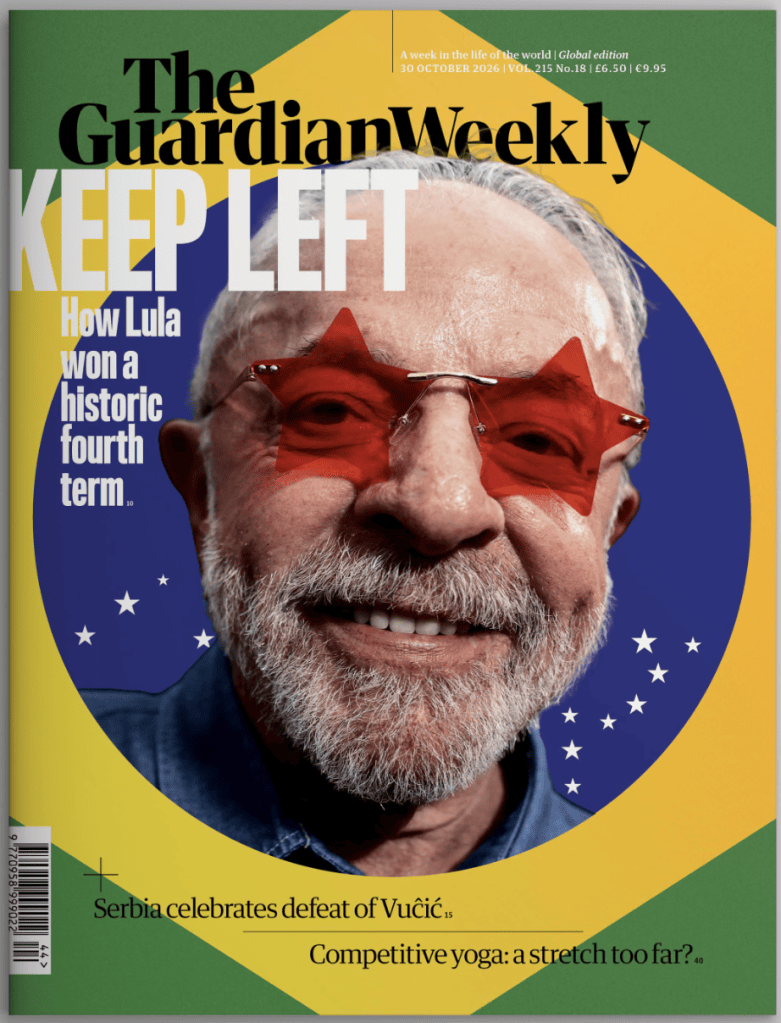
THE GUARDIAN WEEKLY – OCTOBER 30, 2026

THE GUARDIAN WEEKLY: The latest issue features ‘KEEP LEFT’ – How Lula won a historic fourth term; Serbia celebrates defeat of Vučić; Competitive yoga – A stretch too far?

How many grinning faces, jubilant crowds and celebrating politicians can you fit into a single issue of the Guardian Weekly? That’s not a question that often troubles us, but the spectacular triumph of President Luiz Inácio Lula da Silva, winning a historic second-round vote after losing the first to rightwing opponent Flávio Bolsonaro, and the victory of the student-led campaign against autocrat Aleksandar Vučić in Serbia gave me a happy problem to solve this week. In an era when the right seems to be riding high in the world, popular pushbacks against strongmen politicians is something to celebrate.

For our Brazil cover story, Tom Phillips and Tiago Rogero report on the reaction to Lula’s victory and how he pulled eventual success from the jaws of what, until the first results came on Sunday evening, seemed a probable defeat. As government health minister Alexandre Padilha said that evening: “It’s a massive victory – not just for Brazil. It’s also an important signal to the rest of Latin America and to the world.” But, as commentator Jordana Timerman cautions, Brazil has been an exception in Latin America in successfully resisting Donald Trump’s attempt to achieve hegemony over the region.

Spotlight | ‘Pure arrogance’
Google has been in the dock in Finland over the illegal felling of hectares of woodland for its datacentres, reports Miranda Bryant

Science | Out of the blue
Why are more planes encountering invisible air turbulence, what can they do about it and what effect will more frequent incidents have on travellers, asks Patrick Keneally

Feature | Bent out of shape?
Competitive yoga may sound like anathema to some devotees of the ancient practice but, as Anita Chaudhuri discovers, there is a movement among some yogis to make it an Olympic sport

Opinion | Lame duck presidents can be dangerous beasts
If Democratic midterm gains hamper Donald Trump at home, we should be very worried about what he might do abroad when foreign policy is his last bastion of power, says Steve Bloomfield

Culture | Stay faithful
As the second series of Celebrity Traitors draws to its conclusion, Michael Hogan meets the people who made it the world’s biggest TV show and finds out why Claudia Winkleman never wants to leave the castle

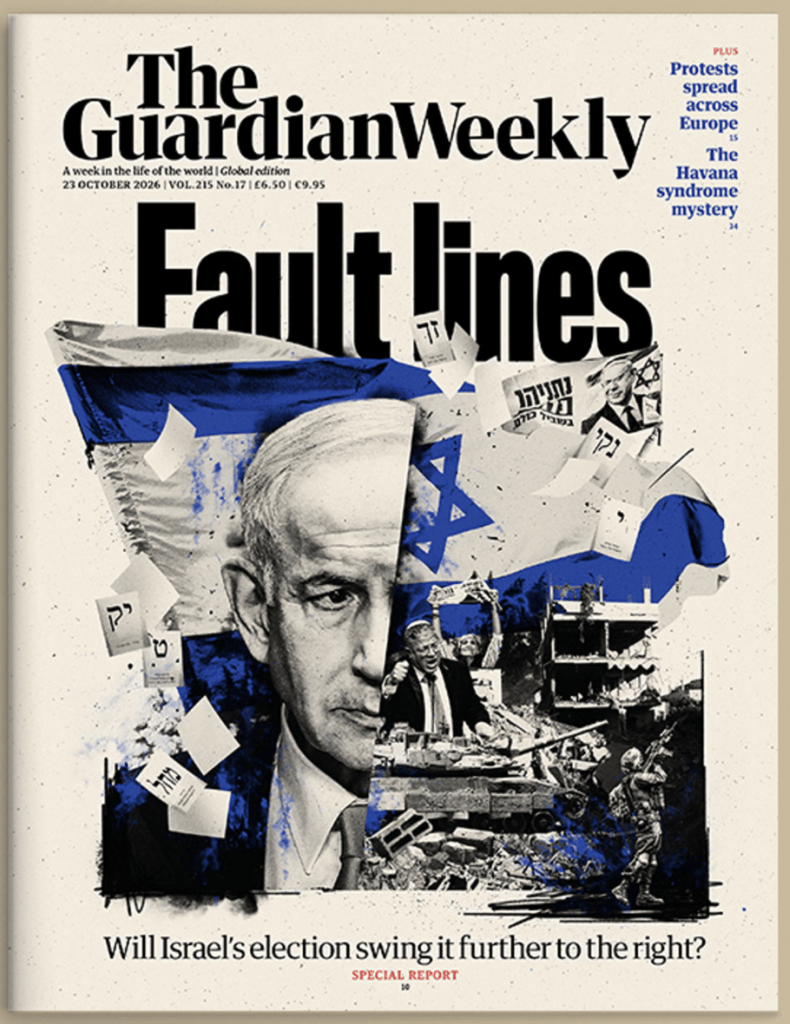
THE GUARDIAN WEEKLY – OCTOBER 23, 2026

THE GUARDIAN WEEKLY: The latest issue features ‘FAULT LINES’ – Will Israel’s election swing it further to the right?…

Israel is holding national elections next week, giving its citizens their first chance to pass judgment on Benjamin Netanyahu and his coalition since the Hamas-led attacks of 7 October 2023.

For our big story this week, chief Middle East correspondent Emma Graham-Harrison says that whether or not the prime minister can hold on to power, a more rightwing Knesset is expected to be voted in. More than half a million Israelis have reached voting age since the last election in 2022 and, according to polls, three-quarters of first-time Jewish voters define themselves as right or centre-right.

Peter Beaumont profiles opposition candidate Gadi Eisenkot. The former general contrasts with Netanyahu when it comes to style and character, he writes, yet on key policy points retains a studied ambiguity.

Then Israeli pollster and political analyst Dahlia Scheindlin argues that after three disastrous years, Israel needs to rethink itself, but only a clear opposition victory would let the country begin to heal, strengthen democracy and establish Palestinian rights.

Spotlight | ‘We are suffocating’
As protests that have convulsed Spain and France in recent weeks spill over to Italy and Portugal, Sam Jones reports on the rising wave of anger over the housing crisis and cost of living

Science | Taking a shot
Could a drug to prevent shingles also protect our brains against dementia? The possibility, writes Ian Sample, is driving a boom in vaccinations

Feature | The Havana syndrome mystery
Dozens of CIA officers have been afflicted by debilitating symptoms over the past decade. Are they the result of “mass hysteria” or are they from attacks with an energy weapon, asks Shaun Walker

Opinion | Another EU referendum? Not just yet
The omertà on the UK rejoining has now been broken, but it would be folly to move too soon, says Polly Toynbee

Culture | Shygirl’s slog to the top
She has opened for Beyoncé, writhed in a cubicle for Madonna – and is poised to take over the mainstream with her new rock sound. The pop auteur talks to Simran Hans about cash, class – and finding true love

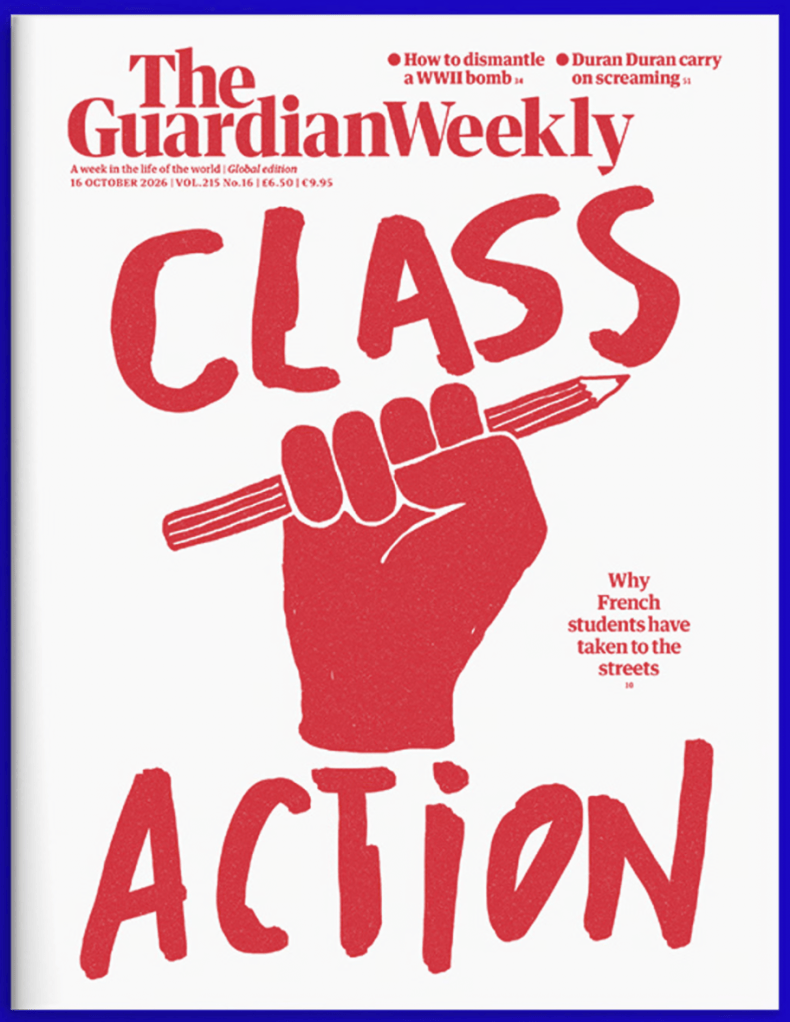
THE GUARDIAN WEEKLY – OCTOBER 16, 2026

THE GUARDIAN WEEKLY: The latest issue features ‘CLASS ACTION’ – Why French students have taken to the streets…


France has been rocked by huge youth protests in recent weeks over the state of high school education, bringing tens of thousands of people on to the streets.

The movement began with outrage over shoddy school conditions in a Paris banlieue, but has spread across the country as pupils voice their anger about a system they say is failing them.

For this week’s big story, Paris correspondent Angelique Chrisafis hears from protesters who feel abandoned by the French state. Angelique also looks at the evidence on students’ complaints of dilapidated buildings, teacher shortages, inequality and low investment.

Then, Alexander Hurst says fixing the broken education system should be just the start for an aloof political class if it is to finally pay attention to a generation who feel neglected.

Spotlight | The future of the death penalty
Donald Trump has used the full might of the presidency to supercharge executions but, writes Ed Pilkington, an avalanche of mishaps has put the system’s flaws in the spotlight

Science | Sweet time
A flurry of recent studies suggests that spending the first 1,000 days of life under sugar rationing may have left traces on people’s health more than seven decades later. Linda Geddes reports

Feature | The art of dismantling a second world war bomb
British bomb disposal squads are being called to more unexploded devices than ever – and they risk their lives each time. Samira Shackle recounts the challenge they faced when two bombs were discovered on the same day

Opinion | A new era of instability
The latest attack by Houthi rebels on Saudi Arabia may prove to be more calamitous for the region than the world imagines, says Nesrine Malik

Culture | Hungry like the werewolf
Duran Duran talk to Alexis Petridis about 80s excess, tabloid scrutiny and their Halloween glow-up

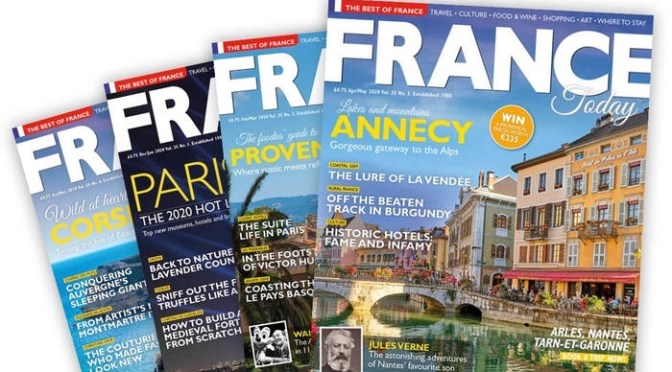
France Today Magazine – February/March 2025

France Today Magazine Subscription – France Media Shop

FRANCE TODAY MAGAZINE (January 21, 2025): The latest issue features ‘Glorious Gardens of Normandy’….

100 Years of The Winter Olympics and its French Origins

100 Years of The Winter Olympics and its French Origins

The Winter Olympics is celebrating its 100th anniversary this year! Did you know the first Winter Olympic Games were held in France?

5 Things to do in Bourges

5 Things to do in Bourges

Discover the top 5 things to do in Bourges and beyond.

Caroline Mills

The Knights Templar: Who Were They and What did They Do in France? 

Unwrap the Secrets of AOC Cheeses

News: Rebuilding Syria After 13 Years Of Civil War, Ukraine-Russia War

Monocle Radio Podcast (December 12, 2024): What will it take to resurrect Syria’s once-stunning built environment? Also in the programme: the humanitarian view from Odessa with Jan Egeland, the secretary-general of the Norwegian Refugee Council, and the results of a new poll from the European Council on Foreign Relations on attitudes towards EU-UK relations.

Plus, we examine the global implications of Kenya’s illicit gold trade and take a dram from the seasonal whiskey menu at the Fife Arms.

News: Israel Strikes 500 Military Targets In Syria, Macron Battles Far Right

Monocle Radio Podcast (December 11, 2024): Following the overthrow of the Assad regime, what will happen to the millions of Syrians who were granted asylum abroad? We give you the latest and look at why strikes are continuing.

Plus: Emmanuel Macron’s grand coalition talks, China sends its largest fleet in nearly 30 years to the Taiwan region – and we meet Finland’s ambassador to the UK, Jukka Siukosaari, and Business Finland’s director for western Europe, Jukka Holappa.

News: Future Of Syria To Be Discussed At United Nations, Netayahu Trial

Monocle Radio Podcast (December 10, 2024): Following the collapse of the Assad regime, the UN Security Council meets to discuss what comes next in Syria.

Also in the programme: the UK’s prime minister, Keir Starmer, makes a historic visit to Cyprus; we meet the president and CEO of Future Caucus; and a flick through the new handbook launched by Monocle last night. Plus: Fernando Augusto Pacheco on 2025’s Golden Globes.

Paris: Inside Notre Dame Cathedral’s Recovery

CBS Mornings (December 9, 2024): Saturday was a special day in Paris as Notre Dame Cathedral held its first mass in more than five years after a fire in April 2019 destroyed much of the cathedral’s roof. Senior foreign correspondent Seth Doane has been following the renovation over the years.

News: Assad Flees Syria To Russia, Whe Rebels Victory Was So Swift, South Korea

Monocle Radio Podcast (December 9, 2024): The latest on Syria as Bashar al-Assad flees to Moscow and rebels claim Damascus. Plus, the future of Yoon Suk Yeol, Romania’s cancelled election and Saudi Arabia’s new date-based soft drink.