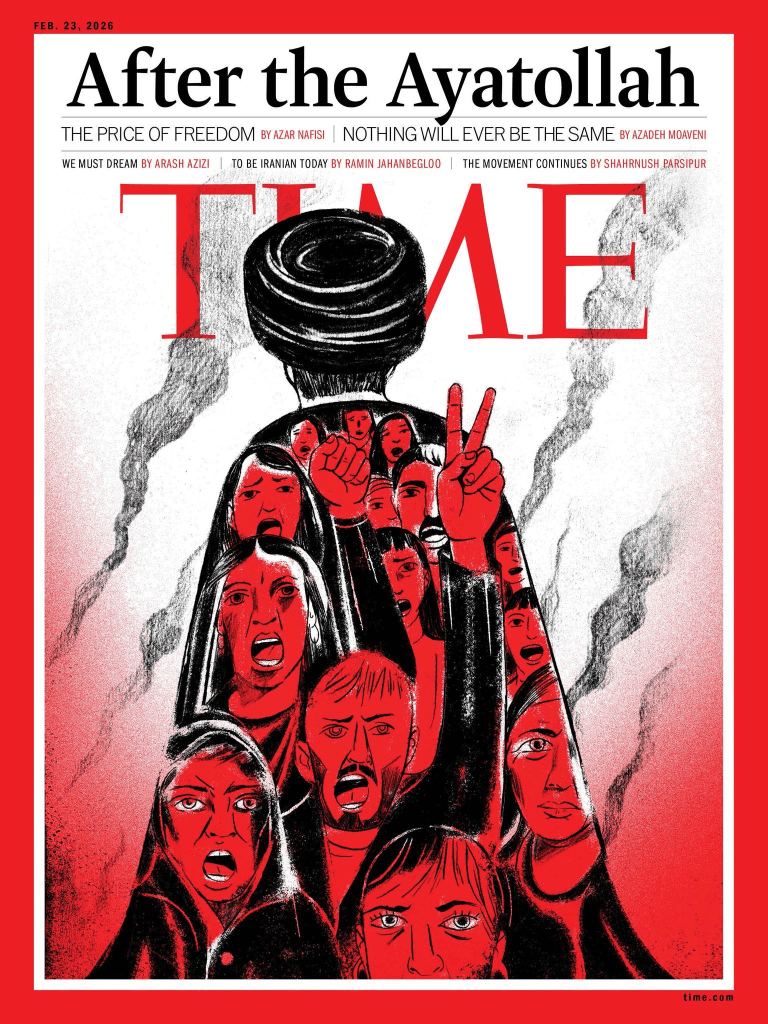
After the Islamic Republic regime unleashed lethal force to quell nationwide protests against its rule, five leading Iranian writers reflect on how the country arrived at this pivotal moment—and where it might go from here.
The Islamic Republic’s Founding Myth
he Islamic Republic’s already lengthy catalogue of fears has ballooned of late: alongside the possibility of being overthrown by its own citizens, it is haunted by the prospect of a full accounting of the massacres it has carried out; by the tenuous loyalty of its army, and its empty coffers; and by the shadow of Israeli spies and Islamic State militants. What terrifies Iran’s theocrats the most, the fear that eclipses all their fears, is the ability of the people at largeto clearly see the essential realities of the present regime.
Iranian Progress Cannot Be Stopped
Today, the Islamic Republic of Iran resembles a half-lifeless body collapsed on the ground, yet still possessing powerful arms. With the support of the Islamic Revolutionary Guard Corps and other military forces, it has attacked the people of Iran and, through widespread killings, has delivered a brutal blow to the popular uprising. Yet this is only a temporary success. The republic is already dead morally, economically, and socially.
“What we have is a fundamental change in the age structure of society,” says John Rowe, professor of health policy and aging at Columbia University’s Aging Center, referring to the way we’re aging—and also the way we’re creating young people, with birth rates plummeting in most countries. Globally, fertility levels have dropped below the so-called population replacement rate of just over two births per woman.
It is a sea change—and one that raises big questions about how we both individually and collectively navigate what, in a sense, is our new old age. How, for example, should we spend our extra time? Should employment still be confined to a finite number of years, or instead ebb and flow throughout an entire lifetime? And where, in a world of acute housing shortages, will everyone live?
Monocle on Sunday (December 15, 2024): Nina dos Santos and Andrew Tuck join Monocle’s editorial director, Tyler Brûlé, to discuss the week’s key topics in this festive programme from Monocle’s Christmas market in London. Plus: a chat with Fiona Wilson, Monocle’s Tokyo bureau chief.
Monocle on Saturday (December 14, 2024): Join Georgina Godwin, Tyler Brûlé, and Latika Bourke for a roundup of the week’s news and culture in this Christmas special, broadcast live from our festive market. Plus: a conversation with Monocle’s Paris bureau chief, Simon Bouvier.
Monocle Radio Podcast (December 12, 2024):What will it take to resurrect Syria’s once-stunning built environment? Also in the programme: the humanitarian view from Odessa with Jan Egeland, the secretary-general of the Norwegian Refugee Council, and the results of a new poll from the European Council on Foreign Relations on attitudes towards EU-UK relations.
Plus, we examine the global implications of Kenya’s illicit gold trade and take a dram from the seasonal whiskey menu at the Fife Arms.
Monocle Radio Podcast (December 11, 2024):Following the overthrow of the Assad regime, what will happen to the millions of Syrians who were granted asylum abroad? We give you the latest and look at why strikes are continuing.
Plus: Emmanuel Macron’s grand coalition talks, China sends its largest fleet in nearly 30 years to the Taiwan region – and we meet Finland’s ambassador to the UK, Jukka Siukosaari, and Business Finland’s director for western Europe, Jukka Holappa.
Monocle Radio Podcast (December 10, 2024): Following the collapse of the Assad regime, the UN Security Council meets to discuss what comes next in Syria.
Also in the programme: the UK’s prime minister, Keir Starmer, makes a historic visit to Cyprus; we meet the president and CEO of Future Caucus; and a flick through the new handbook launched by Monocle last night. Plus: Fernando Augusto Pacheco on 2025’s Golden Globes.
Monocle Radio Podcast (December 9, 2024): The latest on Syria as Bashar al-Assad flees to Moscow and rebels claim Damascus. Plus, the future of Yoon Suk Yeol, Romania’s cancelled election and Saudi Arabia’s new date-based soft drink.
News, Views and Reviews For The Intellectually Curious




 Intellicurious