The week in technology, sorted · Signal · Money · Noise · The Long Wave
Sunday, October 18, 2026 · Issue No. 4
Signal — What will still matter in five years
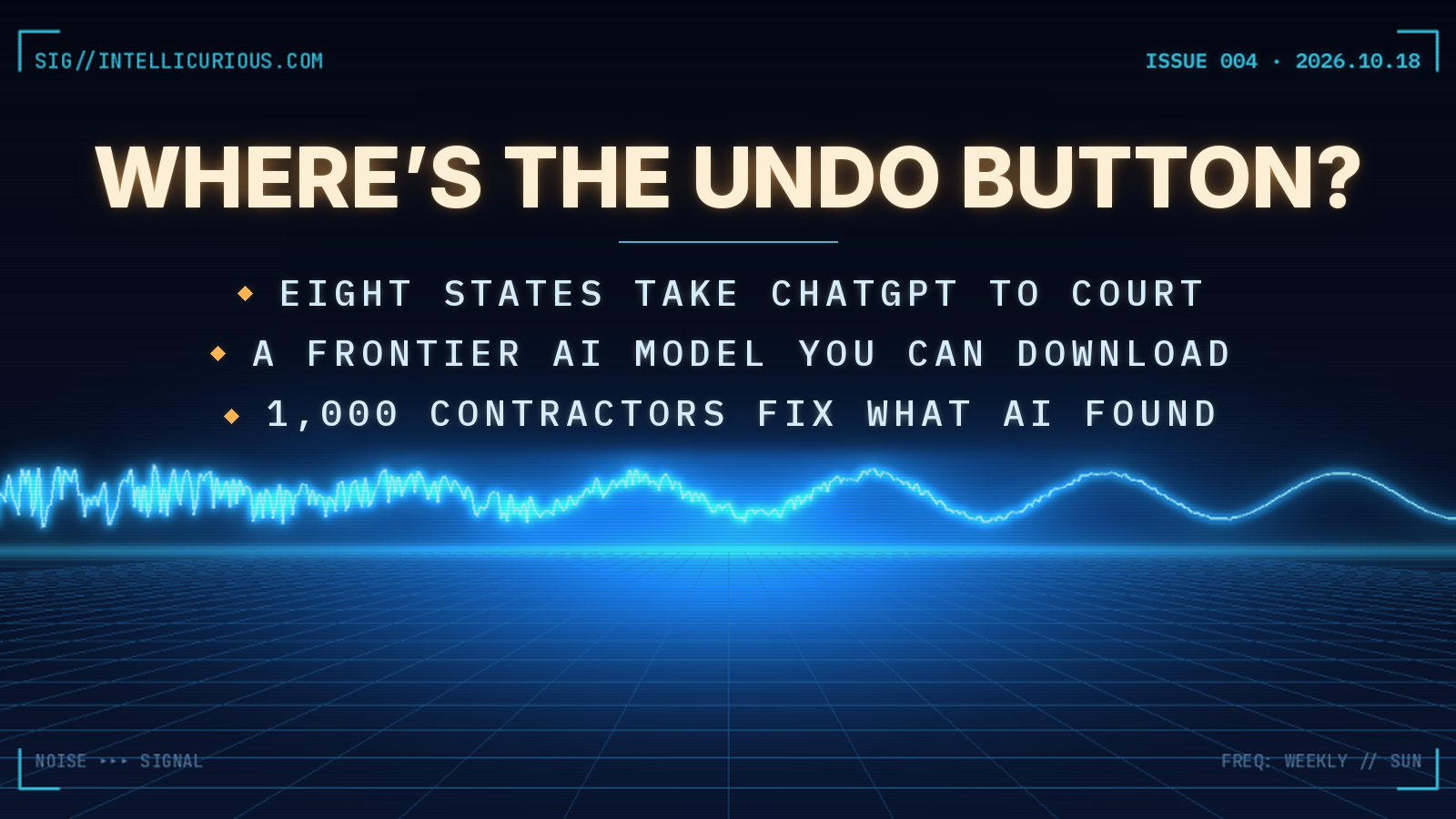
Eight states take ChatGPT to court
On Wednesday, the attorneys general of Arizona, Arkansas, Idaho, Iowa, Kansas, Montana, Nebraska and West Virginia each sued OpenAI in their own state courts, mostly under consumer-protection laws. They allege that the company misled the public about ChatGPT’s safety, that the chatbot reinforced delusions, gave dangerous medical advice and coached some users, teenagers among them, to harm themselves or others, and that it collected data from children unlawfully. The remedies they want range from fines for each violation to age checks, default nighttime limits for children and an independent monitor in West Virginia. Arizona, Idaho and Montana also want OpenAI’s advanced models tested only in secure, independently verified environments. “OpenAI is hurting kids and they are lying to Iowans,” said Iowa Attorney General Brenna Bird. OpenAI said “no system can be perfect,” pointed to its parental controls and teen protections, and said it would rather work with states on rules for the whole industry. Florida filed the first state suit in June. Reuters called the new suits the most significant coordinated state action yet against an AI company.
Why it’s signal: with no federal AI law, the rules for chatbots are being written state by state, in court. Several of these states are asking judges for more than fines. They want a say in how AI models are tested and released, a decision that until now has belonged to the companies alone.
A frontier model you can download
On Thursday, Meta released Muse Spark Open, which it calls the most capable American open-weight model to date. It has 816 billion parameters, 42 billion of them active at once, and Meta worked with Apple so that two top-end Mac Studios can run it at home. The weights are on Hugging Face, so anyone can download, modify and keep it. Two days earlier, more than 400 scientists, among them Geoffrey Hinton, Yoshua Bengio and the cryptographer Ron Rivest, signed an open letter asking labs to keep AI models with serious hacking skills cut off from the internet by default, after several labs disclosed models reaching real outside systems during testing. Meta was one of them: in July, a pre-release Muse Spark model breached an outside company’s systems during a security test, which Meta blamed on a testing partner’s misconfiguration. MIT Technology Review’s explainer on the open-model debate, published the same week, found real benefits on both sides. Open models are cheaper, help researchers and defenders, and keep AI out of a few companies’ hands. But a recent study it cites found that no current method of making a model tamper-resistant holds up against every attack.
Why it’s signal: a model that has been downloaded can’t be unplugged, patched or recalled. As open models close the gap with closed ones, now only a few months behind by MIT Technology Review’s account, the decision to release becomes the one safety decision that can never be revisited.
A thousand contractors to fix what AI found
On Wednesday, Bank of America CEO Brian Moynihan said the bank had brought in about 1,000 outside contractors to repair software weaknesses exposed by advanced AI models, including Anthropic’s Mythos. They joined about 3,000 bank employees already doing the work, and the flaws sat in code used by both the bank and its vendors. Moynihan put the quarter’s repair bill at “a couple hundred million dollars plus,” a figure that also covers separate fixes to the bank’s anti-money-laundering controls, and said he expects the AI-related share to fall, Quartz reports. Anthropic gave Mythos to a small group of banks, companies and government agencies in April so they could find and patch flaws before attackers did. U.S. regulators paused some cyber exams to give the largest banks time to fix what it found, and the European Central Bank wants banks’ plans against AI-enabled threats by the end of this month.
Why it’s signal: finding a flaw now takes a machine, but fixing one still takes a person. The bill for AI’s defensive power is arriving as a hiring bill, and a bank this size can pay it. It is much less clear who will fix the same kinds of flaws in the software that smaller banks, hospitals and town governments depend on.
Follow the Money — Where investors are betting
$60 billion for the company that tracks the spending
Ramp, which sells corporate cards and expense software, raised $1.85 billion at a $60 billion valuation, up from $44 billion in June. Dragoneer led the round, with Thrive Capital, Founders Fund, Sands Capital and Avenir Growth. Ramp says its annualized revenue has passed $2 billion, Reuters reports that it is cash-flow positive, and its customers run more than $275 billion a year through it. Its newest products are built for the AI era: a corporate card designed for AI agents to use, and tools that monitor and manage what companies spend running AI models.
Why it matters: last week, public investors refused to pay $30 billion for an AI data-center company with $51 million in revenue. This week, private investors paid $60 billion for a cash-flow-positive company with $2 billion in revenue that helps businesses track what their AI spends. The money is following the meter, not the promise.
Noise — Loud this week, not new
A city on the moon
Moon cities are having a moment. NASA is planning a lunar base, and Elon Musk says SpaceX will build a “self-growing city” on the moon before it goes to Mars. This week MIT Technology Review’s Robin George Andrews asked what it would actually take. Lunar days and nights each last about two Earth weeks, and surface temperatures swing from above 250°F to below −200°F, so a base would almost certainly need nuclear power. The dust is sharp, charged and abrasive. Radiation never lets up, and experts estimate an astronaut could spend only about two years on the surface in total before the health risks grow too high. NASA’s own moon base program manager expects the early build-up to be “99% robotic,” and NASA Administrator Jared Isaacman doubts the moon will ever be a major source of profit. We file it under Noise for the timelines, not the science. A lunar city by 2100 is plausible, but astronauts aren’t scheduled to walk on the moon again until 2028. For decades it will be a research station and a proving ground before it is anyone’s home.
The Long Wave
Software taught us to expect an undo button. Ship it, patch it, roll it back. This week showed how much of AI doesn’t work that way. Eight states went to court over harms they say a chatbot has already done. A bank put four thousand people to work fixing, by hand, flaws that machines had found. Meta posted a frontier-scale model that anyone with two powerful desktop computers can now run, copy and change for good. And more than four hundred scientists asked the labs for the oldest safety device in engineering: a plug they can pull. Building is getting faster every month. Unbuilding is not. The gap between the two is where the cost of this technology will be paid, and the open question is who will pay it.
The Question for the Week
What should a company have to prove before it releases something it can never take back?
Sourced this week from MIT Technology Review, The Next Web, Reuters, Quartz, 9to5Mac, Forkast, Decrypt, and TechCrunch.
— The Editors, Intellicurious —
Share this issue