This fall, China made Charlotte Brontë’s Jane Eyre compulsory reading for 14- and 15-year-olds across the country. Writing in UnHerd, the novelist Philip Hensher notes the official reasoning, as reported in the Party-backed press: “the innocent, budding stage of first love is a crucial period for shaping a well-rounded personality.”
Hensher thinks Beijing has assigned more than a love story. Jane is the orphan who tells her cruel aunt that “the very thought of you makes me sick,” and she grows into a woman who answers to her own conscience rather than to the man with power over her. Those are dangerous lessons, he suggests, to hand every teenager in a country that ranks 178th of 180 in the World Press Freedom Index.
His conclusion is hopeful. A state that assigns a book about speaking the truth may be teaching it.
vs
THE ANSWER
The reporting tells a different story. China has had Jane Eyre for a century. A Chinese translation appeared in 1925, and a 1979 British film adaptation played in Chinese theaters as the country reopened after the Cultural Revolution (New York Times). Generations have read it, and the system has stood.
The choice also looks deliberate. Beijing Daily pitched the novel as a counterweight to social media’s “superficial notions about appearance and wealth” (CNN). UC San Diego scholar Ping Zhu told the Times that Jane is “an independent woman, but she’s not too outrageous in her challenge of patriarchal power.” She ends the book married and a mother, which fits a government urging young people to start families.
On this view, Beijing didn’t assign a rebel by accident. It chose a heroine whose independence ends in a home.
iC
THE INTELLITAKE
Both sides are reading the same novel and stopping at different chapters. Beijing assigned Jane Eyre for its ending: the marriage, the home, love that money can’t buy. Hensher is betting on its beginning: the child who talks back and the young woman who walks away from Thornfield with nothing rather than betray herself.
Notice what the two arguments share. Each assumes a book does what its readers are told it does. A ministry can set the exam question, but not the moment a 15-year-old reaches Jane’s declaration, “I am no bird; and no net ensnares me.” A novel doesn’t topple a government. It builds an inner life, and inner lives are the one thing no curriculum fully controls.
There is something worth admiring in the choice itself. A nation that wants its teenagers to value character over wealth reached for a Victorian Englishwoman’s conscience, and trusted 14-year-olds with it. Whatever Beijing intends, it has given millions of young readers a heroine who insists on choosing for herself.
TODAY’S PROVOCATION
Can a government assign a book without assigning what it means?
A Cotswold manor is for sale at £15 million, honey-coloured and perfectly symmetrical. Two centuries ago three sisters held it, in the very decade Jane Austen was writing about sisters who could hold no land.
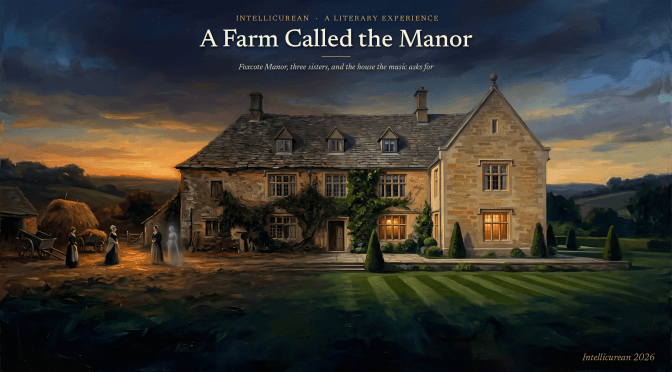
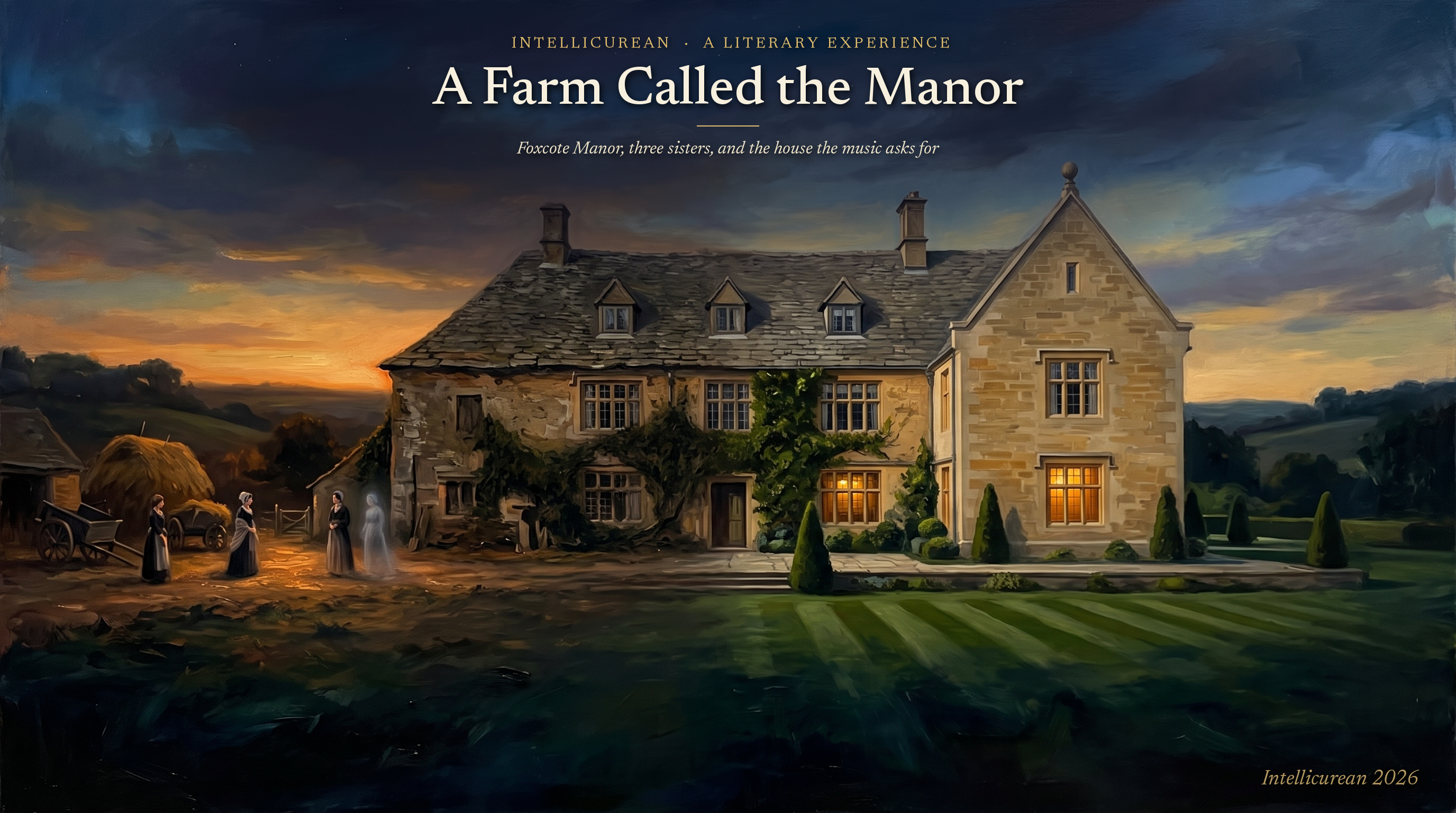
Foxcote at dusk in two eras, made for the essay.
Why we’re pointing you there
Foxcote Manor, near Withington in Gloucestershire, came to market this autumn transformed, its ivy stripped and its rooms gone cream. Intellicurean’s first Literary Experience sets the sale beside the county history, the listing and two Austen novels, and finds that almost nothing in the picture is what it seems. A woman named Sarah Jordan left the manor to three nieces, a will that runs the other way from the one that opens Sense and Sensibility. William Cobbett rode through in 1826 and read the village church as proof of decline, and the census answers him. The symmetrical stone front turns out to be more than three hundred years of work, dressed to look like a single moment.
What we liked most is how carefully it listens to the record, and to its silences. Where the documents can correct what we see, they do, plainly. Where they fall quiet, about a bequest, two weddings and a third sister who simply disappears, the essay lets the music in and asks what that longing is worth.
A sale-staged dining room with a tenant the record lost, made for the essay.
Just a decade ago, it was nothing more than the dream of scientists in the lab. Recent advances by IBM, IonQ, Nvidia, and others illustrate the new promise of the complex technology. Investors are taking notice.
Veeva Systems stock can rally by 30% over the next year.
The Stock Market Is Looking Ahead to Earnings Season—and It Likes What It Sees
Get out your trust rope and harness. Investors are once again climbing the proverbial wall of worry—and earnings season could provide the piton that supports the stock market’s next move higher.
President Vladimir Putin brought up a sale of Russian energy assets with Jared Kushner and Steve Witkoff. The deal raises new questions about conflicts of interest.
The Parti Québécois has vowed to hold a referendum on independence, three decades after Quebec voted “no.” Voters want change, but maybe not that much.
Records showed that campus police officers informed prosecutors that they had conducted interviews beyond taking a statement from the woman who said she was raped.