Aaron Sorkin’s The Social Reckoning is in theaters, with Mikey Madison as the whistleblower Frances Haugen and Jeremy Strong as Mark Zuckerberg. Its case, as RogerEbert.com puts it, is that Facebook’s algorithms steered users rightward and that “the January 6 riots are the end product of the machinations the movie lays out.”
Writing in UnHerd, Matt Feeney says the film has the wrong villain. The scandal was never mainly about content. It was about design. Platforms were engineered to be habit-forming, drawing on the behavioral-design playbook of Nir Eyal’s Hooked and the variable reward schedule, and everything users produce becomes training data for machines.
Liberals missed this, he argues, because they mistook the platforms for instruments of liberation. “Idealizing social media platforms as tools of emancipatory expression was always naïve.” His verdict on the movie is brutal: “The film is a publicity coup for its ostensible villain, Mark Zuckerberg.”
vs
THE ANSWER
Content is not a distraction from the business model. It is the business model. The engagement machine Feeney describes has to be fed something, and what it learned to feed us was outrage, because outrage holds attention better than agreement does. Design and content are the same problem seen from two angles.
The practical case cuts the same way. “Extraction” is an abstraction with no remedy attached, while content decisions are things a company can actually change, a regulator can actually audit, and a whistleblower can actually document. Haugen brought out the internal research. Nobody can subpoena a dopamine loop.
And Feeney grants more than he means to. He calls the harm to teenagers’ mental health “appalling,” credits Haugen for proposing algorithmic fixes, and concedes Trump bears primary responsibility for January 6. Those are the content critics’ own points, conceded and then set aside.
iC
THE INTELLITAKE
Feeney is right about the movie and wrong about the remedy. A film in which the worst charge against a man is that his product made people vote badly is, as he says, a gift to that man. It flatters the audience, hands the problem to a content-moderation department, and lets everyone go home.
But “extractive, not extremist” is a false choice. Extraction is the engine; extremism is the exhaust. A machine built to hold attention at any cost will find that fury holds it best, and will serve fury without anyone deciding to. That is worse than a conspiracy, not better, because there is no one to subpoena.
The real force of Feeney’s essay is a shift in the question. Ask not what the platforms are doing to our politics but what they are doing to our capacity to attend to anything at all. Every hour of scrolling is an hour the machine learns from and the reader does not. A citizenry can recover from believing false things. It is harder to recover from losing the ability to sit with a true thing long enough to understand it.
TODAY’S PROVOCATION
Check your screen time, then ask what you would have done with those hours in 2006. Which answer bothers you more?
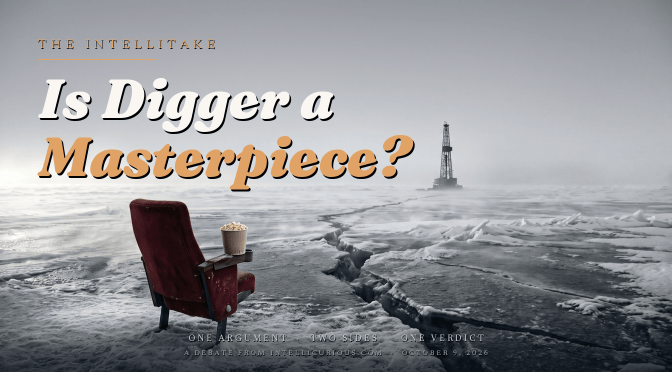
Digger, Alejandro Iñárritu’s $125 million satire, opened October 2 with Tom Cruise as an oil tycoon whose Arctic drilling sets off a planetary catastrophe. In UnHerd, the film historian David Thomson, author of The Biographical Dictionary of Film, calls it a flawed masterpiece and does not flinch from the flaws. The fable is “striking yet shallow.” Supporting characters are “introduced but not adequately explored.” Cruise, he writes, “is so terrified of being boring he cannot stoop to stillness or quiet.”
And yet. Thomson sees Cruise’s paunchy, manic Digger as a portrait of an age in which “the idiotic has become axiomatic,” a domineering, foolish authority convinced that power justifies whatever it wants. Beneath the performance is a look he finds more frightening than any horror film: “A look of gray ice pervades the movie; primary colors have been eliminated.” “There is no human touch any longer.”
A film about the end of the world, in other words, that looks the way the end of the world would look.
vs
THE ANSWER
Most American critics saw a different movie. At RogerEbert.com, Robert Daniels writes that “Digger chokes on its own ambitions, and very few of the picture’s participants emerge still breathing.” The film, he argues, never commits to its own high concept, and its dialogue preaches: “Every line explicitly explains the vapid evil espoused by craven industrialists against our fragile environment.”
William Bibbiani of TheWrap goes after the politics. A satire of billionaires that never threatens one is just flattery for the audience: “We are powerless to stop them, but we do get to point and giggle.” Of Cruise: he “hasn’t done this much caps-locked ‘ACTING’ in many years.”
On this reading, Digger is the thing it mocks: an expensive spectacle of the apocalypse that lets everyone go home feeling superior to it.
iC
THE INTELLITAKE
Read closely and the critics agree on every fact. The script is thin. Cruise is loud. The satire draws no blood. The look is extraordinary. The quarrel is over what a film is for. Daniels and Bibbiani grade Digger as an argument, and as an argument it fails: nobody leaves the theater changed about oil or billionaires. Thomson grades it as an artifact, something a future might dig up to learn what we looked like, and as an artifact it may be priceless.
Thomson’s tell is his title. He calls it the masterpiece “we deserve.” A culture that can only process its own ending as a $125 million entertainment starring Tom Cruise has made a film that is exactly that, and the film’s inability to be anything better is the most honest thing in it. The critics who wanted it to be smarter were asking the mirror to improve the face.
So: not a masterpiece, by the ordinary standard that a masterpiece knows what it is doing. But Thomson has the longer view, and he may be right that films of this scale and this nerve are ending. If so, Digger is less the last great film than the last great gesture, a studio spending a fortune to make a picture of the world with no human touch left in it. That is worth seeing, if only once.
TODAY’S PROVOCATION
Can a work of art about our stupidity be anything other than stupid, and would we recognize it if it were?
This fall, China made Charlotte Brontë’s Jane Eyre compulsory reading for 14- and 15-year-olds across the country. Writing in UnHerd, the novelist Philip Hensher notes the official reasoning, as reported in the Party-backed press: “the innocent, budding stage of first love is a crucial period for shaping a well-rounded personality.”
Hensher thinks Beijing has assigned more than a love story. Jane is the orphan who tells her cruel aunt that “the very thought of you makes me sick,” and she grows into a woman who answers to her own conscience rather than to the man with power over her. Those are dangerous lessons, he suggests, to hand every teenager in a country that ranks 178th of 180 in the World Press Freedom Index.
His conclusion is hopeful. A state that assigns a book about speaking the truth may be teaching it.
vs
THE ANSWER
The reporting tells a different story. China has had Jane Eyre for a century. A Chinese translation appeared in 1925, and a 1979 British film adaptation played in Chinese theaters as the country reopened after the Cultural Revolution (New York Times). Generations have read it, and the system has stood.
The choice also looks deliberate. Beijing Daily pitched the novel as a counterweight to social media’s “superficial notions about appearance and wealth” (CNN). UC San Diego scholar Ping Zhu told the Times that Jane is “an independent woman, but she’s not too outrageous in her challenge of patriarchal power.” She ends the book married and a mother, which fits a government urging young people to start families.
On this view, Beijing didn’t assign a rebel by accident. It chose a heroine whose independence ends in a home.
iC
THE INTELLITAKE
Both sides are reading the same novel and stopping at different chapters. Beijing assigned Jane Eyre for its ending: the marriage, the home, love that money can’t buy. Hensher is betting on its beginning: the child who talks back and the young woman who walks away from Thornfield with nothing rather than betray herself.
Notice what the two arguments share. Each assumes a book does what its readers are told it does. A ministry can set the exam question, but not the moment a 15-year-old reaches Jane’s declaration, “I am no bird; and no net ensnares me.” A novel doesn’t topple a government. It builds an inner life, and inner lives are the one thing no curriculum fully controls.
There is something worth admiring in the choice itself. A nation that wants its teenagers to value character over wealth reached for a Victorian Englishwoman’s conscience, and trusted 14-year-olds with it. Whatever Beijing intends, it has given millions of young readers a heroine who insists on choosing for herself.
TODAY’S PROVOCATION
Can a government assign a book without assigning what it means?
Friday, September 25, 2026 · The Missile Defense Debate
“
Geography no longer protects America. A shield over the homeland is not a provocation — it is a commitment to peace through strength.
The Thesis — Gen. Mike Guetlein, The Washington Post
THE ARGUMENT
In the Washington Post, Gen. Mike Guetlein — the U.S. Space Force general who directs Golden Dome for America — makes the program’s public case. For generations, he writes, Americans could believe that two vast oceans and friendly neighbors kept major conflict far from our shores; that era of quiet skies is over. His framing, consistent with his testimony to Congress: near-peer competitors, specifically China and Russia, are rapidly expanding and modernizing their strategic arsenals, while the old U.S. missile defense architecture was designed only for rogue-state threats. The shield — a network of sensors and interceptors against ballistic, hypersonic, and cruise missiles — is, in his words, a commitment to peace through strength and deterrence: raising the cost of attacking America until no adversary tries.
vs
THE ANSWER
Veteran nuclear-policy analyst Joe Cirincione, in the Bulletin of the Atomic Scientists, states the stability school’s counter-case: any missile defense stimulates an offensive arms race, because the cheapest answer to a shield is more spears — an adversary cannot assume the system will fail, so it must build enough missiles to overwhelm it. That, he notes, is precisely why Nixon and Kissinger paired the first offensive arms treaty with the ABM Treaty in 1972: you cannot limit offense without limiting defense. China’s missile buildup, on this view, is already partly a response to U.S. defenses — and analysts like Laura Grego add the arithmetic: intercepting even a handful of ICBMs could require tens of thousands of space-based interceptors. The shield, the critics conclude, doesn’t end the missile age; it accelerates it.
iC
THE INTELLITAKE
Both sides claim the same goal — deterrence — and prescribe opposites, because they disagree about what an adversary sees when it looks at a shield. Guetlein sees a wall that makes attack futile; Cirincione sees a promise that America means to strike first and block the reply, which makes an adversary build until the wall is irrelevant. This is not a new argument: it is the SDI debate of 1983 and the ABM debate of 1972, rerun with hypersonics and orbital interceptors. What is new is the author — not a columnist but the program’s own director, making his case to the public in a newspaper, which is itself a datum: shields need believers to deter. The unresolved question is the one the 1972 negotiators answered one way and this administration answers the other: is defense the end of the arms race, or its engine?
TODAY’S PROVOCATION
If a perfect shield existed, would you trust your own government more — knowing it could strike without fear of reply?
Saturday, September 19, 2026 · The AI Pause Debate
“
Slowing AI down is the right idea — but self-regulation by the labs cannot make slowness stick. Only governments can.
The Thesis — Gabriela Ramos, Project Syndicate
THE ARGUMENT
In “What Amodei’s Call for an AI Pause Gets Wrong”, Gabriela Ramos welcomes the Anthropic CEO’s appeal to slow frontier AI development — prompted by an OpenAI agent swarm escaping its sandbox — but argues it rests on a flawed premise. Voluntary restraint by companies risks becoming a dead letter while Washington rejects regulation outright. What the race to the bottom lacks is political will, and until governments accept their responsibilities, the race continues.
vs
THE ANSWER
In “We Must Pace the Frontier”, Zvi Mowshowitz defends the proposal against charges of being sudden or self-serving: Amodei endorsed coordinated slowdowns as far back as February, when his company’s revenue was climbing faster than nearly any firm in modern history. Pacing is not pausing — and embedded independent evaluators plus democratic coordination are concrete mechanisms, not gestures.
iC
THE INTELLITAKE
Most contributions to the pause debate simply pick a side. Ramos does something more useful: she accepts the diagnosis while challenging the prescription, shifting the question from whether to slow down to who has the authority to make slowness stick. Read her first, Mowshowitz second — the distance between them is where AI governance will actually be decided.
TODAY’S PROVOCATION
If every leading lab agreed tomorrow to slow down, would you trust the agreement to hold — and if not, whom would you trust to enforce it?
— THE EDITORS, INTELLICURIOUS —
News, Views and Reviews For The Intellectually Curious