Tag Archives: Nuclear Weapons

DOES A SHIELD MAKE PEACE?

The Intellitake
One argument · Two sides · One verdict · Daily
Friday, September 25, 2026 · The Missile Defense Debate
“

Geography no longer protects America. A shield over the homeland is not a provocation — it is a commitment to peace through strength.

The Thesis — Gen. Mike Guetlein, The Washington Post

THE ARGUMENT

In the Washington Post, Gen. Mike Guetlein — the U.S. Space Force general who directs Golden Dome for America — makes the program’s public case. For generations, he writes, Americans could believe that two vast oceans and friendly neighbors kept major conflict far from our shores; that era of quiet skies is over. His framing, consistent with his testimony to Congress: near-peer competitors, specifically China and Russia, are rapidly expanding and modernizing their strategic arsenals, while the old U.S. missile defense architecture was designed only for rogue-state threats. The shield — a network of sensors and interceptors against ballistic, hypersonic, and cruise missiles — is, in his words, a commitment to peace through strength and deterrence: raising the cost of attacking America until no adversary tries.

vs

THE ANSWER

Veteran nuclear-policy analyst Joe Cirincione, in the Bulletin of the Atomic Scientists, states the stability school’s counter-case: any missile defense stimulates an offensive arms race, because the cheapest answer to a shield is more spears — an adversary cannot assume the system will fail, so it must build enough missiles to overwhelm it. That, he notes, is precisely why Nixon and Kissinger paired the first offensive arms treaty with the ABM Treaty in 1972: you cannot limit offense without limiting defense. China’s missile buildup, on this view, is already partly a response to U.S. defenses — and analysts like Laura Grego add the arithmetic: intercepting even a handful of ICBMs could require tens of thousands of space-based interceptors. The shield, the critics conclude, doesn’t end the missile age; it accelerates it.

iC

THE INTELLITAKE

Both sides claim the same goal — deterrence — and prescribe opposites, because they disagree about what an adversary sees when it looks at a shield. Guetlein sees a wall that makes attack futile; Cirincione sees a promise that America means to strike first and block the reply, which makes an adversary build until the wall is irrelevant. This is not a new argument: it is the SDI debate of 1983 and the ABM debate of 1972, rerun with hypersonics and orbital interceptors. What is new is the author — not a columnist but the program’s own director, making his case to the public in a newspaper, which is itself a datum: shields need believers to deter. The unresolved question is the one the 1972 negotiators answered one way and this administration answers the other: is defense the end of the arms race, or its engine?

TODAY’S PROVOCATION

If a perfect shield existed, would you trust your own government more — knowing it could strike without fear of reply?

— THE EDITORS, INTELLICURIOUS —

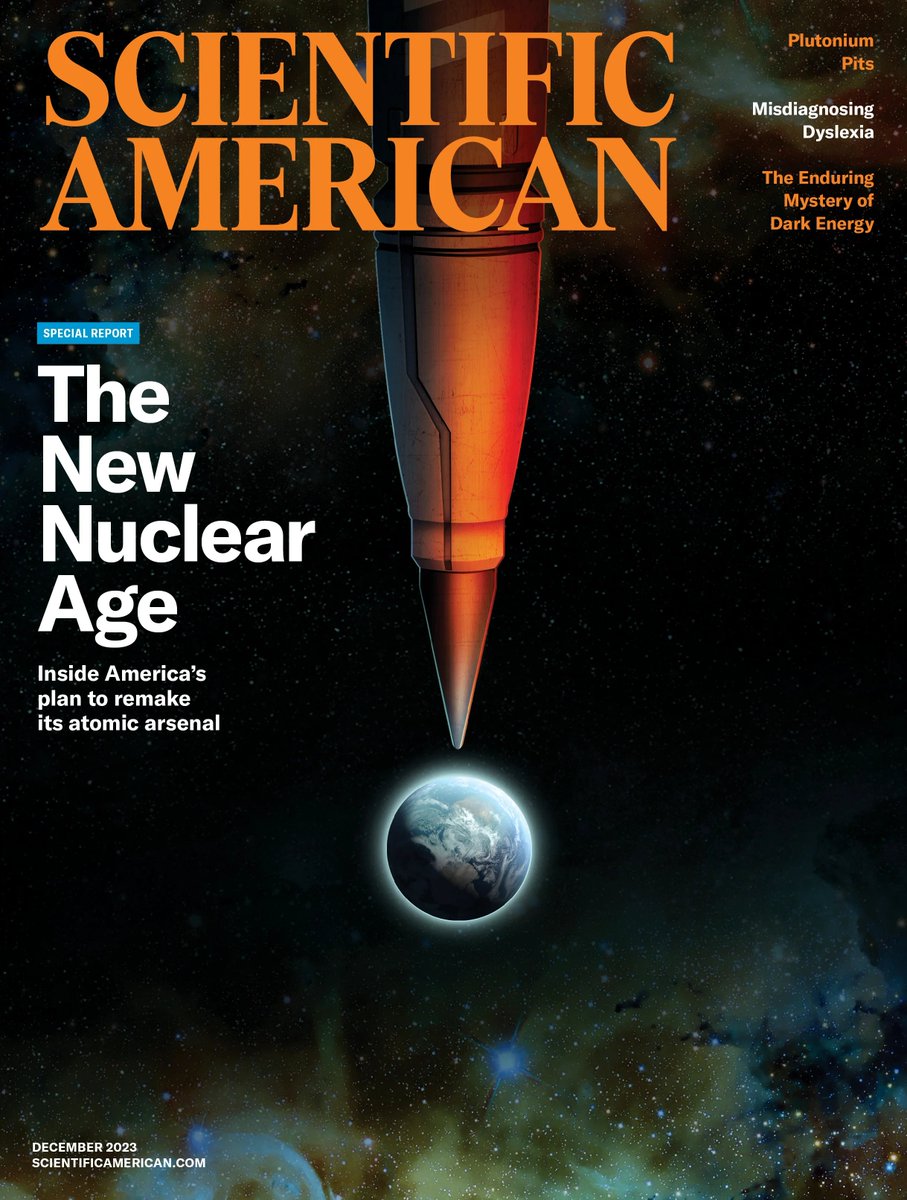
Science Review: Scientific American – December 2023

Image

Scientific American – November 2023: The issue features The New Nuclear Age – Inside America’s plan to remake its atomic arsenal; The Most Shocking Discovery in Astrophysics Is 25 Years Old – Scientists are still trying to figure out dark energy; Behind the Scenes at a U.S. Factory Building New Nuclear Bombs – The U.S. is ramping up construction of new “plutonium pits” for nuclear weapons….

The Most Shocking Discovery in Astrophysics Is 25 Years Old

Image from the The Dark Energy Spectroscopic Instrument

A quarter of a century after detecting dark energy, scientists are still trying to figure out what it is

BY RICHARD PANEK

One afternoon in early 1994 a couple of astronomers sitting in an air-conditioned computer room at an observatory headquarters in the coastal town of La Serena, Chile, got to talking. Nicholas Suntzeff, an associate astronomer at the Cerro Tololo Inter-American Observatory, and Brian Schmidt, who had recently completed his doctoral thesis at the Center for Astrophysics | Harvard & Smithsonian, were specialists in supernovae—exploding stars. Suntzeff and Schmidt decided that the time had finally come to use their expertise to tackle one of the fundamental questions in cosmology: What is the fate of the universe?

Inside the $1.5-Trillion Nuclear Weapons Program You’ve Never Heard Of

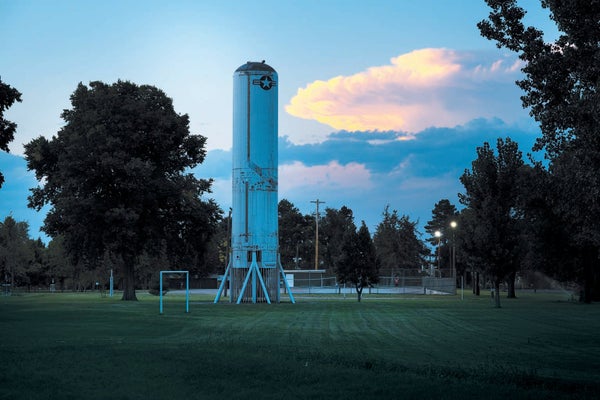
Missile shown in a public park setting.

A road trip through the communities shouldering the U.S.’s nuclear missile revival

BY ABE STREEP

The point of the thing was to forever change our concept of power. When the U.S. military assembled a team of scientists, led by physicist J. Robert Oppenheimer, to build a nuclear bomb during World War II with the hope of beating the Nazis to such a terrible creation, many of those involved saw their efforts as a strange kind of civic destiny. The Manhattan Project, wrote Richard Rhodes, Pulitzer-winning author of The Making of the Atomic Bomb, was “compelled from the beginning not by malice or hatred but by hope for a better world.” Oppenheimer himself once said, “The atomic bomb was the turn of the screw. It made the prospect of future war unendurable. It has led us up those last few steps to the mountain pass; and beyond there is a different country.”

Research Preview: Science Magazine – April 21, 2023

Science | AAAS

Science Magazine – April 21, 2023 issue:

“It’s just mind boggling.” More than 19,000 undersea volcanoes discovered

Sonar mapping image of underwater seamounts including 4776-meter-tall Pao Pao Seamount
The 4776-meter-tall Pao Pao Seamount (right) in the South Pacific Ocean has been mapped by sonar. Many others haven’t.

New seamount maps could aid in studies of ecology, plate tectonics, and ocean mixing

Sleeping deep

Although northern elephant seals do sleep on land, like the one pictured here in California, they can also sleep while diving to 300 meters underwater.PHOTO: RACHEL HOLSER, NMFS 23188

Sleep is essential, but not all mammals live in environments where long periods of time asleep are possible. Marine mammals encounter especially challenging conditions for sleep when they are at sea. 

Morning News: Nuclear Weapons, Theranos CEO Conviction, David Bowie

Why are the world’s most heavily armed nations trying to stop the build-up of nuclear weapons? 

Plus: we explore the significance of Elizabeth Holmes’s conviction, review the Swiss papers and find out why David Bowie’s estate has sold the publishing rights to his “entire body of work”.

Analysis: What Is Known About Iran’s Nuclear Sites

While Iran says it isn’t trying to build nuclear weapons, a look at its key facilities suggests it could develop the technology to make them. WSJ breaks down Tehran’s capabilities as it hits new milestones in uranium enrichment and limits access to inspectors. Photo illustration: George Downs

GLOBAL NEWS PODCAST: Nuclear Nations, West Bank & Gaza, Boeing Flies

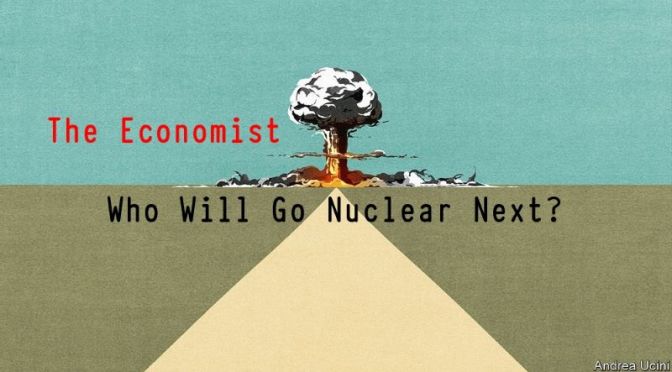
A selection of three essential articles read aloud from the latest issue of The Economist. This week: who will go nuclear next?, new leadership is needed in the West Bank and Gaza (9:45) and can Boeing fly without government help? (15:35)