Tag Archives: National Security

DOES A SHIELD MAKE PEACE?

The Intellitake
One argument · Two sides · One verdict · Daily
Friday, September 25, 2026 · The Missile Defense Debate
“

Geography no longer protects America. A shield over the homeland is not a provocation — it is a commitment to peace through strength.

The Thesis — Gen. Mike Guetlein, The Washington Post

THE ARGUMENT

In the Washington Post, Gen. Mike Guetlein — the U.S. Space Force general who directs Golden Dome for America — makes the program’s public case. For generations, he writes, Americans could believe that two vast oceans and friendly neighbors kept major conflict far from our shores; that era of quiet skies is over. His framing, consistent with his testimony to Congress: near-peer competitors, specifically China and Russia, are rapidly expanding and modernizing their strategic arsenals, while the old U.S. missile defense architecture was designed only for rogue-state threats. The shield — a network of sensors and interceptors against ballistic, hypersonic, and cruise missiles — is, in his words, a commitment to peace through strength and deterrence: raising the cost of attacking America until no adversary tries.

vs

THE ANSWER

Veteran nuclear-policy analyst Joe Cirincione, in the Bulletin of the Atomic Scientists, states the stability school’s counter-case: any missile defense stimulates an offensive arms race, because the cheapest answer to a shield is more spears — an adversary cannot assume the system will fail, so it must build enough missiles to overwhelm it. That, he notes, is precisely why Nixon and Kissinger paired the first offensive arms treaty with the ABM Treaty in 1972: you cannot limit offense without limiting defense. China’s missile buildup, on this view, is already partly a response to U.S. defenses — and analysts like Laura Grego add the arithmetic: intercepting even a handful of ICBMs could require tens of thousands of space-based interceptors. The shield, the critics conclude, doesn’t end the missile age; it accelerates it.

iC

THE INTELLITAKE

Both sides claim the same goal — deterrence — and prescribe opposites, because they disagree about what an adversary sees when it looks at a shield. Guetlein sees a wall that makes attack futile; Cirincione sees a promise that America means to strike first and block the reply, which makes an adversary build until the wall is irrelevant. This is not a new argument: it is the SDI debate of 1983 and the ABM debate of 1972, rerun with hypersonics and orbital interceptors. What is new is the author — not a columnist but the program’s own director, making his case to the public in a newspaper, which is itself a datum: shields need believers to deter. The unresolved question is the one the 1972 negotiators answered one way and this administration answers the other: is defense the end of the arms race, or its engine?

TODAY’S PROVOCATION

If a perfect shield existed, would you trust your own government more — knowing it could strike without fear of reply?

— THE EDITORS, INTELLICURIOUS —
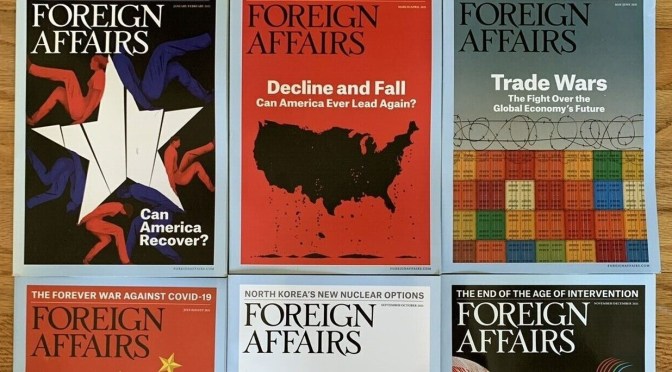
Politics: Foreign Affairs Magazine – November 2024

Image

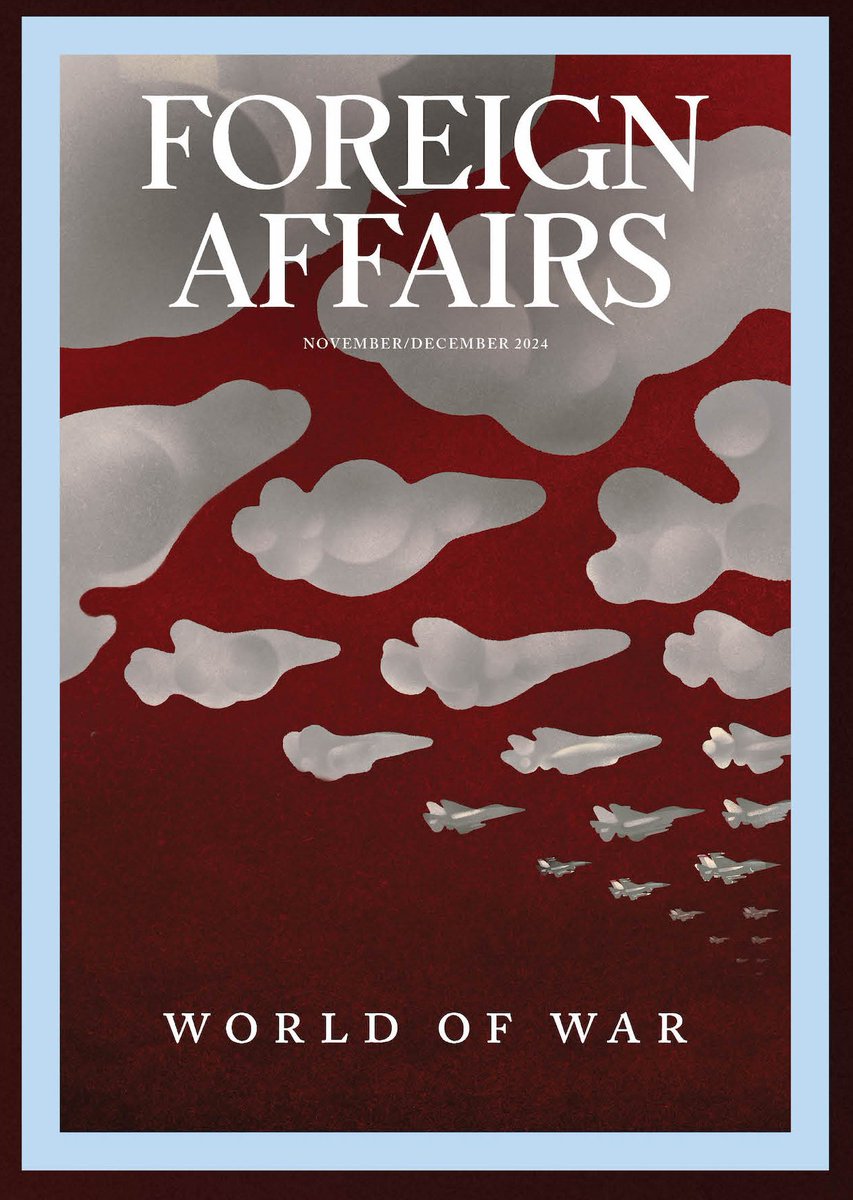
Foreign Affairs (October 27, 2024): The latest issue features ‘World Of War’

The Return of Total War

Understanding—and Preparing for—a New Era of Comprehensive Conflict

By Mara Karlin

Wars Are Not Accidents

Managing Risk in the Face of Escalation

Erik Lin-Greenberg

China’s Agents of Chaos

The Military Logic of Beijing’s Growing Partnerships

Oriana Skylar M

Politics: Foreign Affairs Magazine – Sep/Oct 2024

September/October 2024

Foreign Affairs (August 20, 2024): The latest issue features ‘America Adrift’ ….

The Perils of Isolationism

The World Still Needs America—and America Still Needs the World by Condoleezza Rice

America Isn’t Ready for the Wars of the Future

And They’re Already Here by Mark A. Milley and Eric Schmidt

What Was the Biden Doctrine?

Leadership Without HegemonyJessica T. Mathews

Politics: Foreign Affairs Magazine – July/Aug 2024

July/August 2024

Foreign Affairs (June 25, 2024): The latest issue features ‘Does America Need a New Foreign Policy?…

A Foreign Policy for the World as It Is

Biden and the Search for a New American Strategy

“America is back.” In the early days of his presidency, Joe Biden repeated those words as a starting point for his foreign policy. The phrase offered a bumper-sticker slogan to pivot away from Donald Trump’s chaotic leadership. It also suggested that the United States could reclaim its self-conception as a virtuous hegemon, that it could make the rules-based international order great again. Yet even though a return to competent normalcy was in order, the Biden administration’s mindset of restoration has occasionally struggled against the currents of our disordered times. An updated conception of U.S. leadership—one tailored

The Return of Peace Through Strength

Making the Case for Trump’s Foreign Policy

Si vis pacem, para bellum is a Latin phrase that emerged in the fourth century that means “If you want peace, prepare for war.” The concept’s origin dates back even further, to the second-century Roman emperor Hadrian, to whom is attributed the axiom, “Peace through strength—or, failing that, peace through threat.”

America Is Losing the Arab World

And China Is Reaping the Benefits

Politics: Foreign Affairs Magazine – May/June 2024

May/June 2024

Foreign Affairs (April 23, 2024): The latest issue features Can China Remake the World?; Russia’s Divergent Futures; Iran’s Winning Strategy…

China’s Alternative Order

And What America Should Learn From It

By Elizabeth Economy

By now, Chinese President Xi Jinping’s ambition to remake the world is undeniable. He wants to dissolve Washington’s network of alliances and purge what he dismisses as “Western” values from international bodies. He wants to knock the U.S. dollar off its pedestal and eliminate Washington’s chokehold over critical technology. In his new multipolar order, global institutions and norms will be underpinned by Chinese notions of common security and economic development, Chinese values of state-determined political rights, and Chinese technology. China will no longer have to fight for leadership. Its centrality will be guaranteed.

No Substitute for Victory

America’s Competition With China Must Be Won, Not Managed

By Matt Pottinger and Mike Gallagher

Politics: Foreign Affairs Magazine- January 2024

Image

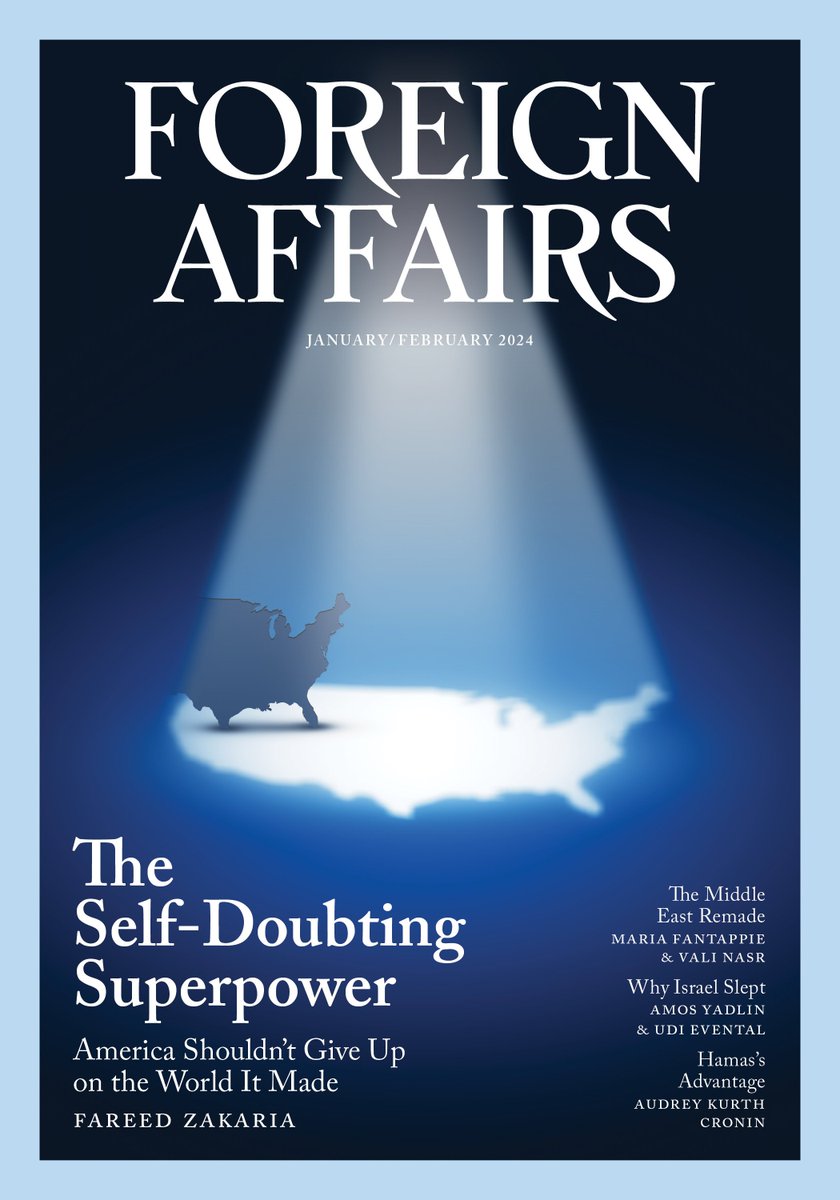
Foreign Affairs (December 13, 2023): The new January/February 2024 issue features ‘The Self-Doubting Superpower’ – America shouldn’t give up on the World It Made; The Middle East Remade; Why Israel Slept; Hamas’s Advantage, and more….

The Self-Doubting Superpower

America Shouldn’t Give Up on the World It Made

By Fareed Zakaria

Most Americans think their country is in decline. In 2018, when the Pew Research Center asked Americans how they felt their country would perform in 2050, 54 percent of respondents agreed that the U.S. economy would be weaker. An even larger number, 60 percent, agreed that the United States would be less important in the world. This should not be surprising; the political atmosphere has been pervaded for some time by a sense that the country is headed in the wrong direction. According to a long-running Gallup poll, the share of Americans who are “satisfied” with the way things are going has not crossed 50 percent in 20 years. It currently stands at 20 percent.

Why Israel Slept

The War in Gaza and the Search for Security

By Amos Yadlin and Udi Evental

In a barbaric surprise attack launched by Hamas on October 7, more Jews were slaughtered than on any day since the Holocaust. Thousands of elite Hamas militants from the Gaza Strip infiltrated small communities and cities in southern Israel, where they proceeded to commit sadistic, repulsive crimes against humanity, filming their vile deeds and boasting about them to friends and family back home.

Preview: Foreign Affairs Magazine- NOV/DEC 2023

Image

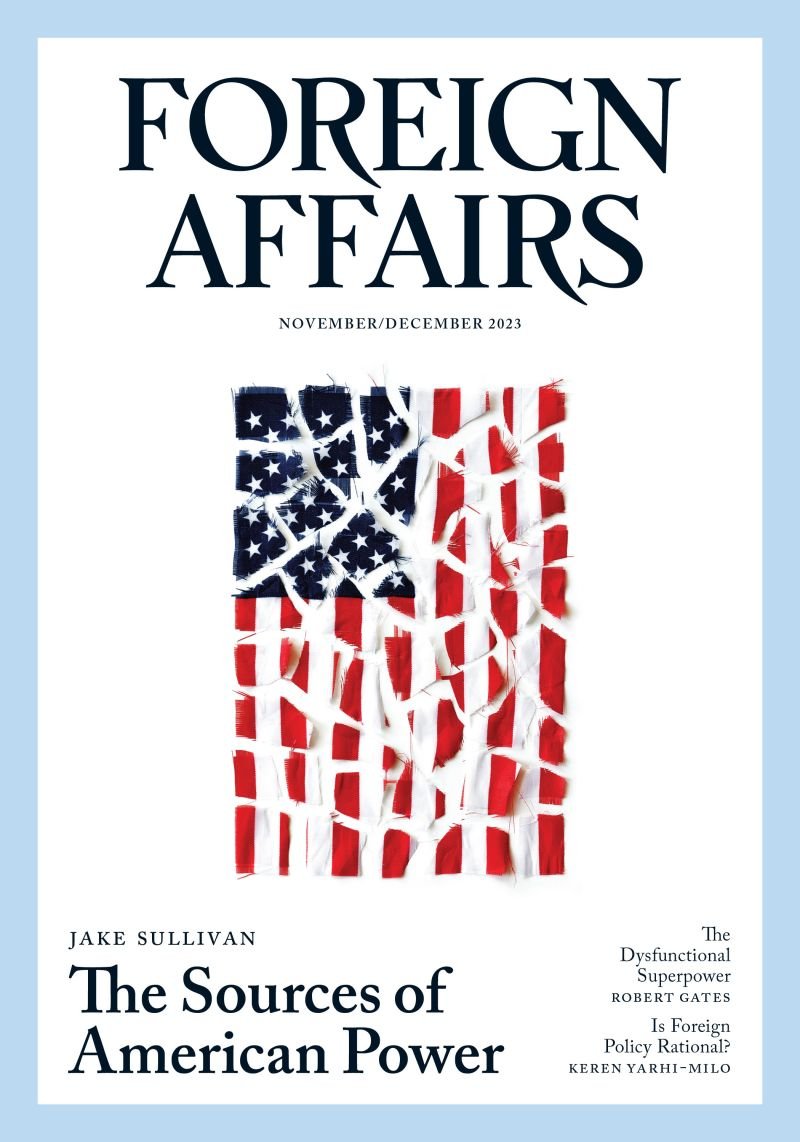
Foreign Affairs November/December 2023: The new issue features  new essays by today’s leading policymakers and thinkers, including U.S. National Security Adviser Jake Sullivan on the future of American foreign policy, former U.S. Undersecretary of Defense for Policy Michèle Flournoy on how artificial intelligence will transform the military, and scholars Henry Farrell and Abraham Newman on the convergence of economic and national security. 

The Sources of American Power

A Foreign Policy for a Changed World

By Jake Sullivan

Nothing in world politics is inevitable. The underlying elements of national power, such as demography, geography, and natural resources, matter, but history shows that these are not enough to determine which countries will shape the future. It is the strategic decisions countries make that matter most—how they organize themselves internally, what they invest in, whom they choose to align with and who wants to align with them, which wars they fight, which they deter, and which they avoid.

The Dysfunctional Superpower

Can a Divided America Deter China and Russia?

By Robert M. Gates

The United States now confronts graver threats to its security than it has in decades, perhaps ever. Never before has it faced four allied antagonists at the same time—Russia, China, North Korea, and Iran—whose collective nuclear arsenal could within a few years be nearly double the size of its own. Not since the Korean War has the United States had to contend with powerful military rivals in both Europe and Asia. And no one alive can remember a time when an adversary had as much economic, scientific, technological, and military power as China does today.

Politics: The Independent Review – Spring 2023

The Independent Review - Spring 2023 https://scientificmagazines.top/the -independent-review-spring-2023 | VK


Independent Institute (May 22, 2023) – In this issue: A tongue-in-cheek playbook for the national-security elite on how to run wars; monetary policy during the Great Depression and Great Recession; a critical review of child support enforcement; the history of labor rights in Brazil; and more.

Crisis and Credit Allocation: The Effect of Ideology on Monetary Policy during the Great Depression and the Great Recession

By James L. Caton

The Lords of Easy Money: How the Federal Reserve Broke the American Economy

By Christopher Leonard

The Economic Weapon: The Rise of Sanctions as a Tool of Modern War

By Nicholas Mulder