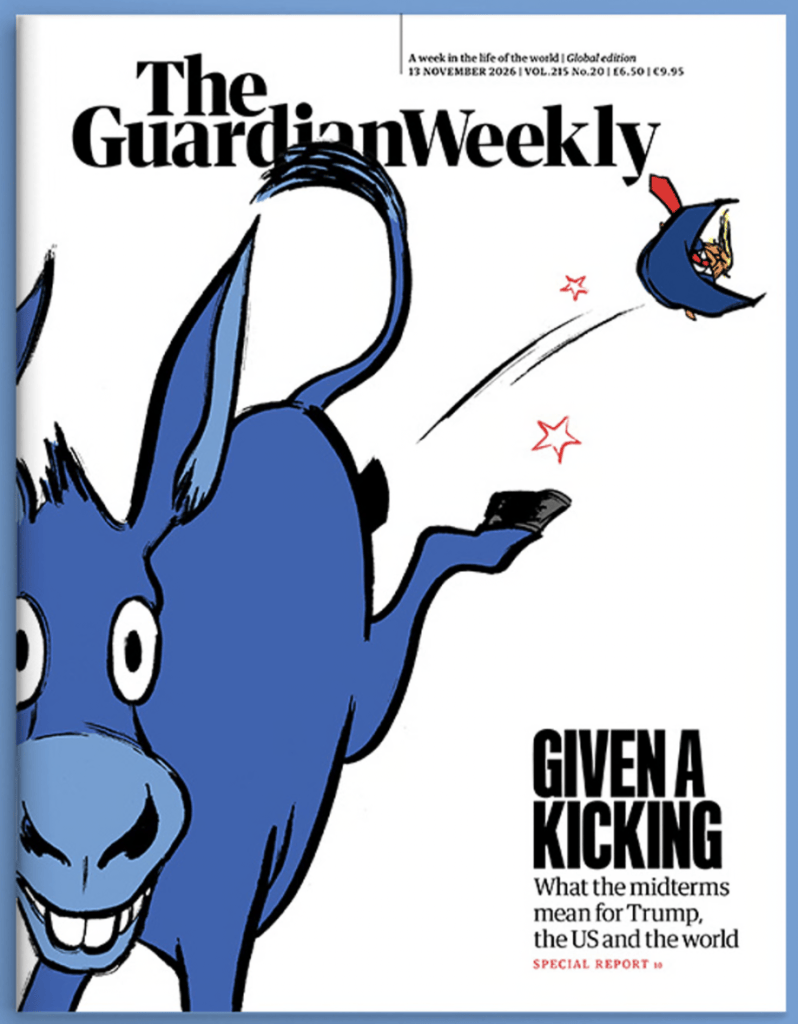
Donald Trump was dealt a devastating blow in the US midterm elections last week that saw his Republican party stripped of control of both the Senate and the House.
Our big story this week assesses the transformed political landscape ushered in by this blue tsunami.
The Republicans’ shellacking spells the end of Maga as we know it, writes David Smith, while Chris Stein runs through the likely Democrat agenda for the coming two years, and Uwa Ede-Osifo and Auzzy Byrdsell run through 10 historic firsts recorded as candidates shattered racial and gender ceilings.
Looking beyond the US, Deepa Parent spoke to Iranians about their feelings of uncertainty following the midterm elections, and Alice Speri says the results were a thumping rebuke of Washington’s relationship with Israel.
Then, foreign affairs commentator Simon Tisdall asks what the implications of Trump’s waning powers are for Iran, Russia, Israel – and the rest of the world.
Spotlight| A new cold war Do hot fridges, a fake nuclear alert and a $6bn heist suggest we in the foothills of a hacking epidemic, ask Dan Milmo and Aisha Down
Science| Deep secrets Beneath South Dakota’s Black Hills, scientists are building giant detectors to analyse neutrino particles – and possibly find the answer to existence. Ian Sample reports
Feature| An Indian political dynasty In a rare interview, Sonia Gandhi talks to Hannah Ellis-Petersen about her reluctant rise to power, Narendra Modi’s repressive regime – and why youth protests give her hope for the future
Opinion| A landmark victory on consent Russell Brand’s conviction for rape and sexual assault upholds the vital principle that women can say no, even after they’ve said yes, writes Gaby Hinsliff
By leaning into nativist absolutism, Netanyahu almost doubled the Arab vote, creating a political — and foundational — crisis for Israel.By Roger Cohen
In 1995, Itamar Ben-Gvir appeared on camera brandishing the hood ornament of the Israeli prime minister Yitzhak Rabin’s Cadillac. “We got to his car,” he vowed, “and we’ll get him, too.” Soon after, in one of history’s most successful assassinations, Rabin was killed by a fanatical religious-nationalist Jew, and 27 years later the teenage hoodlum who boasted of his theft became Israel’s minister of national security.
There is perhaps no better representation of Israel’s steady march rightward over the past three decades than the ascent of Ben-Gvir to the high office he still holds. The vandal became responsible for preventing vandalism, the ethnocentric fanatic for stopping sectarian violence. This unhappy outcome, and its predictable consequences, reflects the nationalist and more messianic country that Israel has become as the idea of a two-state peace, the ultimate target of Rabin’s assassination, withered and died.
There used to be an honorable way to try to profit from online infamy: selling nearly worthless memecoins. The machines could take it over. By Willy Staley
I’m not afraid to admit it, right here in the newspaper: It finally happened to me. I saw an A.I. video, and I thought — if that’s the right word — it was real. It showed a guy standing on a street corner somewhere in Europe, with an insane haircut and a houndstooth suit, shadowboxing while a French rap song played in the background. In his misplaced confidence and swagger, he called to mind a protomemetic figure from my youth, Napoleon Dynamite.
This was Jean Phil, someone who — as far as anyone can tell — doesn’t exist. Has never existed. Was conjured from a bunch of NVIDIA chips in a low-slung building outside of Kenosha.
The term captures the self-defeating loop of losing and not being able to stop. It also describes doomscrolling, politics and our society’s default state. By Mitch Therieau
Five experts on how best to limit a rapidly evolving technology. By Emily Bazelon
Oct. 26, 2026
Artificial intelligence is alarming many of its human creators by leaping the guardrails designed to contain it. In the last few months, safety researchers have resigned from OpenAI and Anthropic, warning that their former employers could be courting disaster: A.I. that escapes our control irrevocably. The companies are reportedly gaming out scenarios of a catastrophic cyberattack or other event in the next six to 12 months.
Voters demand a new way of doing things in Washington. Let them have it
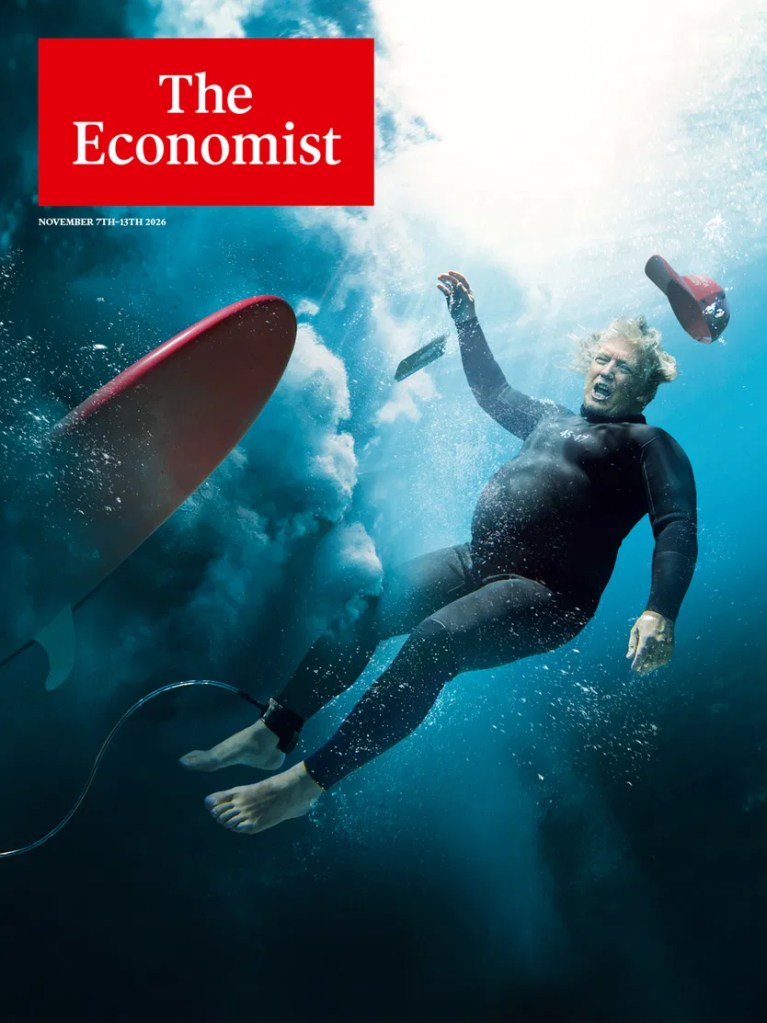
SURFERS CALL it the washing machine. When a giant wave throws you off your board and plunges you underwater, you lose all sense of where you are. That is what befell Donald Trump and his party on November 3rd, as they were slammed by tens of millions of American voters. They have still to grasp just how much their country has changed.
Already it is clear this was not a normal midterm swing against a sitting president, but the biggest wave-election since the aftermath of Watergate more than 50 years ago. Democrats won control of both chambers of Congress, flipping seats deep into once-safe red waters, from South Carolina to Texas.
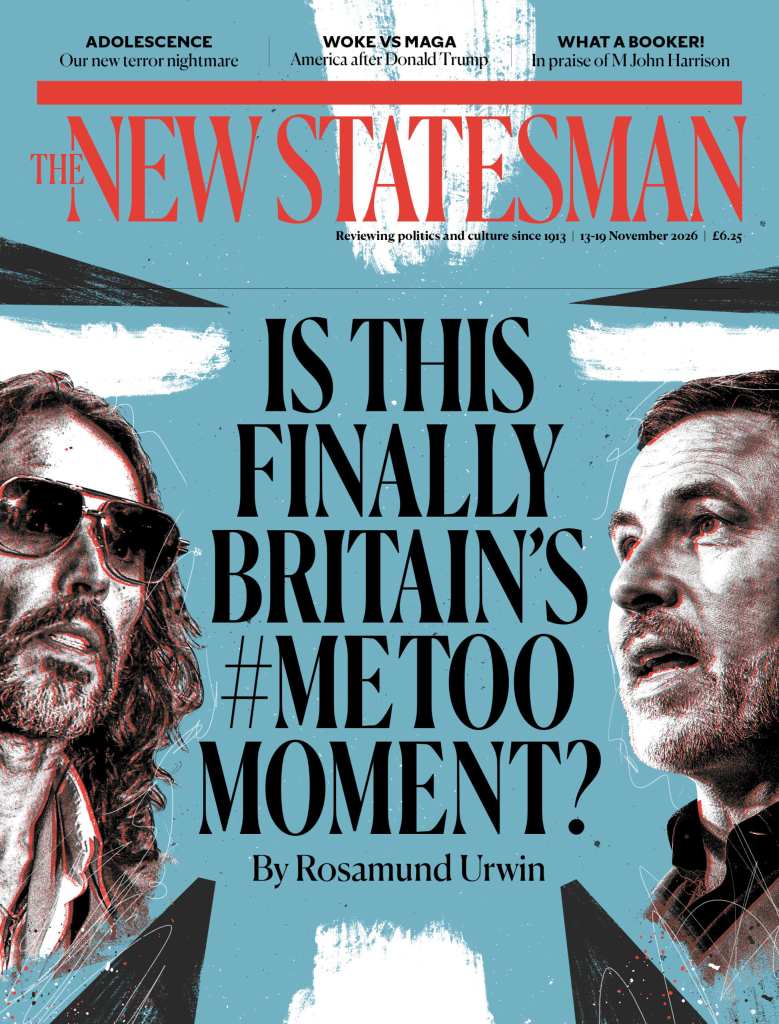
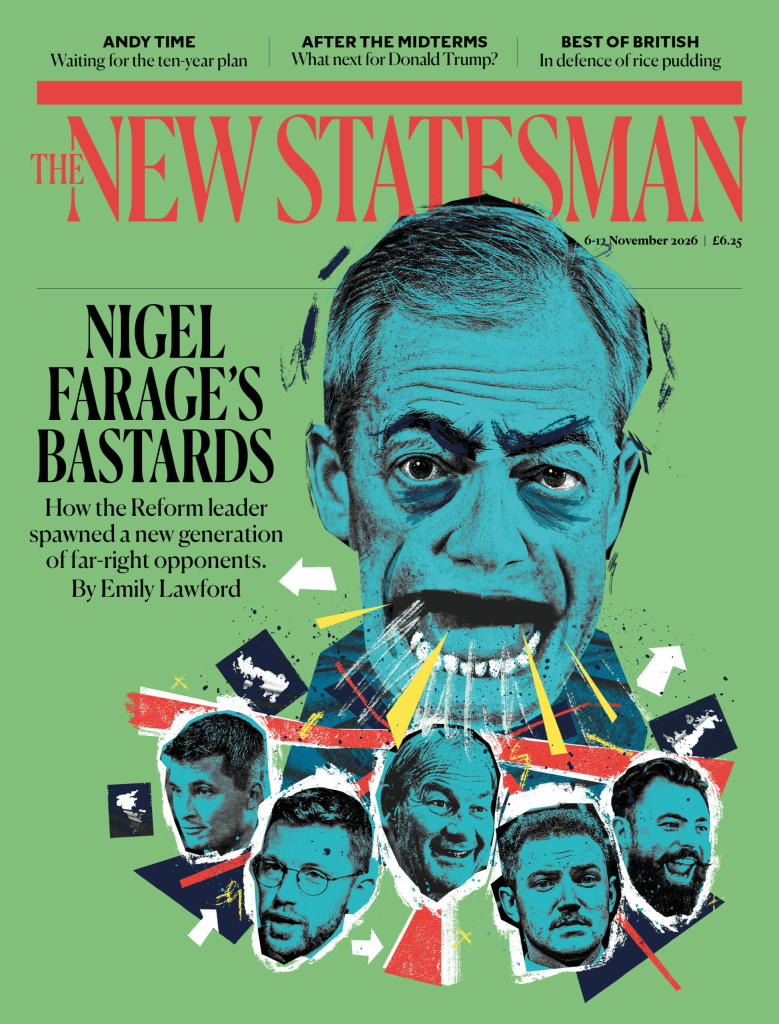
THE NEW STATESMAN: The latest issue features Emily Lawford’s cover story shows how Nigel Farage, by calling mass deportation “impossible” in 2024, drove young online nationalists to Rupert Lowe’s Restore Britain, whose small but growing vote now splits Reform’s and has pulled Farage and the mainstream right toward harder ethnic politics; Gideon Levy argues that Israel’s anti-Netanyahu bloc, which reaches 67 Knesset seats only by counting Arab parties that won a record 19 but that almost no one will govern with, has handed Benjamin Netanyahu a deadlock he can ride as caretaker or turn into a unity government; and Chris Thornton recounts how the five McCartney sisters’ campaign over their brother Robert’s 2005 murder in Belfast carried them to the White House and helped push the IRA to put its weapons beyond use, even though his killers were never convicted.
I’m writing this as the world wakes up to news of a blue wave of Democrat wins in the US midterms. What they mean for America and the world will be the subject of next week’s issue but this week we are focusing on Israel.
As seasoned Knesset watchers know, the plethora of parties on the ballot and proportional representation rarely produce immediate clear winners and a new government in short order. But as Jonathan Freedland puts it in this week’s cover story, the 2026 election presents a philosophical as well as a political puzzle.
Benjamin Netanyahu may have lost his parliamentary majority, but the opposition bloc needs more than Jewish parties to take control of the Knesset and offer Gadi Eisenkot the premiership. As Jonathan explains, Netanyahu’s loss contains the path to a possible win, while the road to success for Eisenkot means working with Palestinian parties, a red line many Jewish voters and MPs may not be willing to cross.
Spotlight| Connected through chaos As Donald Trump fans the flames of a world on fire with his vengeful foreign policy, can rational actors on the diplomatic stage douse the conflagration, asks Patrick Wintour
Science| The tales one fish can tell Pioneering research into the tambaqui has shown that it is a vital canary in the coalmine to monitor the effects of global heating and oxygen loss in the Amazon, reports Mac Margolis
Feature| A spectrum of opinion on autism Why have the numbers of people diagnosed with the condition ballooned over the past 20 years: is it overdiagnosis or an overly expansive definition? John Harris investigates
Opinion| Serbia deserves to succeed But the victorious Student List’s ability to consolidate democracy relies on a future in Europe and Brussels must court these new leaders, argues Srđjan Cvijić
Culture| Still on the line Jimmy Webb, who wrote the ever poignant Wichita Lineman for Glen Campbell as well other classic American hits, tells Dave Simpson about a new album and why, at 80, he still loves playing live
American women’s most listened-to podcast is Call Her Daddy. It is hosted by the glamorous Alex Cooper, whose shtick is grilling female celebrities on their sex lives. For example, she made Gwyneth Paltrow rank all her boyfriends according to their sexual skills. I hope her husband and kids didn’t bother listening to that episode. She recently hosted an actress named Sophia Bush. They discussed Sophia’s multiple divorces while Alex declared breathlessly that if a woman is questioning whether she can do better than her current husband, “the answer is always yes.” Sophia agreed. “The answer is always yes, and this idea that it’s too late or you’re too old, or who are you to want more – that’s patriarchy. That is crazy!” Something around here is crazy, yes, Ms. Bush.
Donald Trump has so dominated the news over the past decade that it is hard to imagine American politics without him. Yet now we are in the last 27 months of his presidency. And as this year ends and the next approaches, the national conversation turns toward the looming election cycle of 2028 and the vital question of who comes next. The Democratic nomination seems destined to be a complicated struggle between various factions and candidates. The outgoing Governor of California, Gavin Newsom, is a figure of ridicule yet strangely unsquashable. He remains the betting favorite. Senator Jon Ossoff, this magazine’s last cover star, is a contender. Alexandria Ocasio-Cortez is a telegenic and increasingly influential force – and Kamala Harris just won’t take no for an answer.
I’ve had hexes put on me by a university professor, had online vigilantes send packages of dogshit to my childhood home in New Jersey and been hounded by the trauma-informed journalists of the New York Times. CNN, Reuters, Agence France-Presse and other estimable sources have credited me with starting a dark…
In the fall of 2017, Virginia was going through its quadrennial tradition of giving the nation an electoral check-in on the president by holding an off-year gubernatorial election. The nation’s mood was, to say the least, heated. Four months earlier, at a baseball field in Alexandria, a radicalized and mentally imbalanced left-wing activist had nearly killed House whip Steve Scalise and three others in a shooting. So it was with some recklessness that Latino Victory Project, in
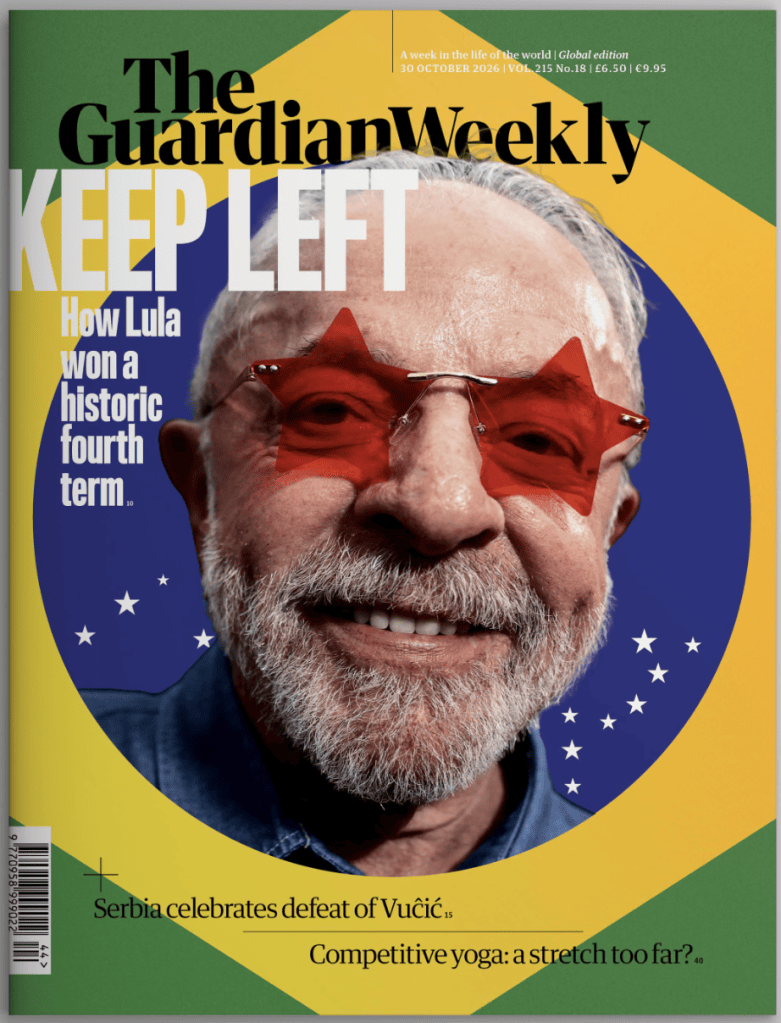
How many grinning faces, jubilant crowds and celebrating politicians can you fit into a single issue of the Guardian Weekly? That’s not a question that often troubles us, but the spectacular triumph of President Luiz Inácio Lula da Silva, winning a historic second-round vote after losing the first to rightwing opponent Flávio Bolsonaro, and the victory of the student-led campaign against autocrat Aleksandar Vučić in Serbia gave me a happy problem to solve this week. In an era when the right seems to be riding high in the world, popular pushbacks against strongmen politicians is something to celebrate.
For our Brazil cover story, Tom Phillips and Tiago Rogero report on the reaction to Lula’s victory and how he pulled eventual success from the jaws of what, until the first results came on Sunday evening, seemed a probable defeat. As government health minister Alexandre Padilha said that evening: “It’s a massive victory – not just for Brazil. It’s also an important signal to the rest of Latin America and to the world.” But, as commentator Jordana Timerman cautions, Brazil has been an exception in Latin America in successfully resisting Donald Trump’s attempt to achieve hegemony over the region.
Spotlight| ‘Pure arrogance’ Google has been in the dock in Finland over the illegal felling of hectares of woodland for its datacentres, reports Miranda Bryant
Science| Out of the blue Why are more planes encountering invisible air turbulence, what can they do about it and what effect will more frequent incidents have on travellers, asks Patrick Keneally
Feature| Bent out of shape? Competitive yoga may sound like anathema to some devotees of the ancient practice but, as Anita Chaudhuri discovers, there is a movement among some yogis to make it an Olympic sport
Opinion| Lame duck presidents can be dangerous beasts If Democratic midterm gains hamper Donald Trump at home, we should be very worried about what he might do abroad when foreign policy is his last bastion of power, says Steve Bloomfield
Culture| Stay faithful As the second series of Celebrity Traitors draws to its conclusion, Michael Hogan meets the people who made it the world’s biggest TV show and finds out why Claudia Winkleman never wants to leave the castle
THE NEW STATESMAN: The latest issue features Tom McTague defending the magazine’s radical spirit, arguing that every publication needs a driving project. Emily Lawford examines the modern Conservative party, noting that true believers remain undeterred by recent electoral failures. Nicholas Harris uses Cornish nationalism as a mirror for broader British politics, while Andrew Marr warns Labour against falling for opposition election strategies. Internationally, JS Rafaeli critiques the Israeli state following an arrest in the West Bank. Finally, the collection includes a public letters feature emphasizing legal equality.
In defence of the New Statesman’s capital-R Radical spirit
Last week’s open letter in support of Sally Rooney, calling for the Terrorism Act to be amended to protect free expression, generated an extraordinary response. Not all of it has been positive, of course. While many readers wrote in to endorse the letter, others argued – reasonably and often forcefully – that it was Rooney who was to blame for the situation, not the government. She has chosen, of her own volition, to self-censor by going out of her way to breach a law that, irrespective of its merits, should be followed because it is the result of a democratic process. One reader, Peter O’Halloran, from Cavan, Ireland, was among many who got in touch to make this point: “While taking a moral stance is, of course, to be admired, surely the law is the law?”
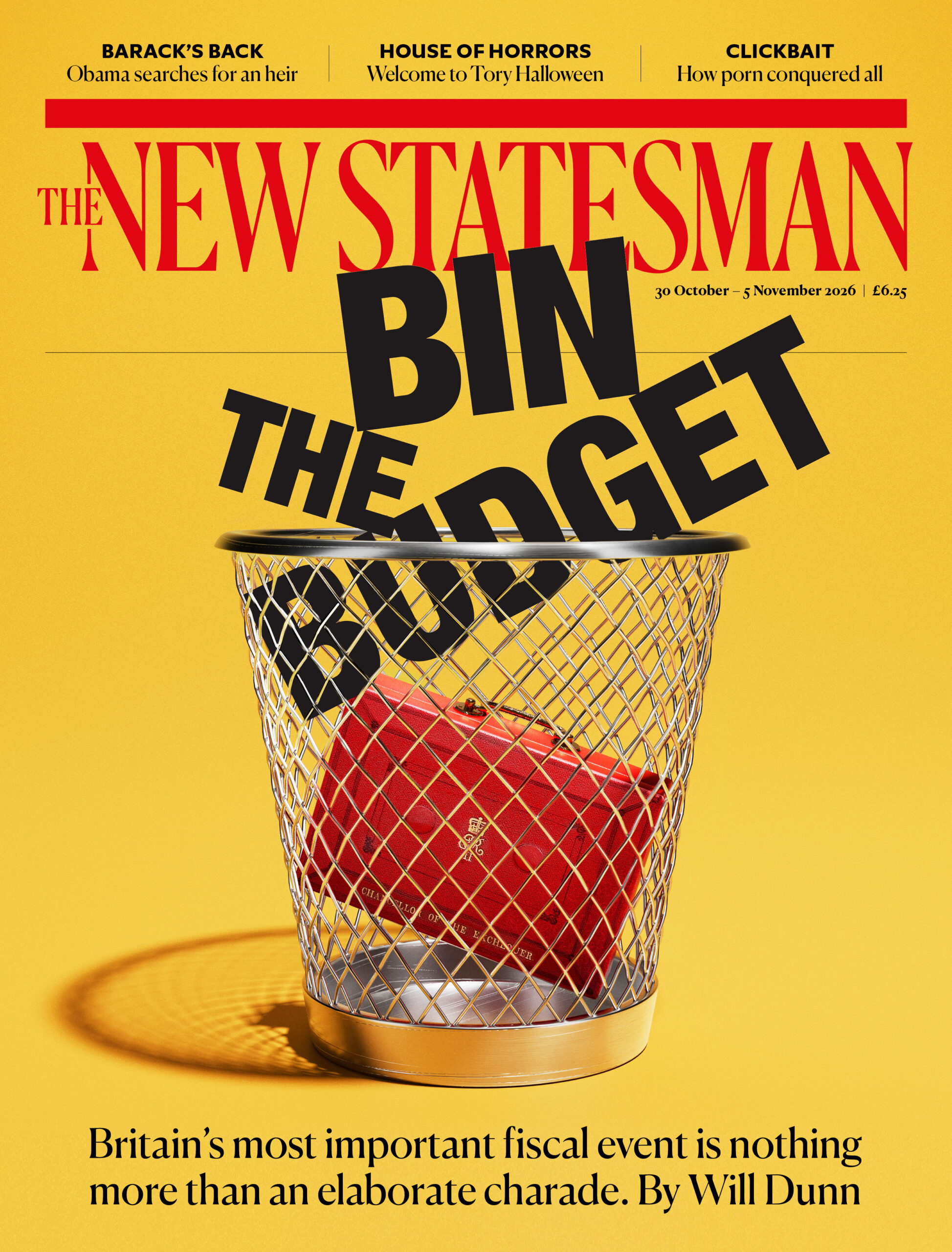
It is an inherently dishonest way to run a country By Will Dunn
In recent decades, a sinister new force has assumed power in Westminster. They can appear in any political party. They are formidable at converting politicians to their cause. They’re not the Blob, or the Deep State, or the Lizard People. They’re worse. They are the Budgetarians, and no matter which party is in power, they are running the country.
Don’t try to read the mind of the British Everyman By Anoosh Chakelian
Every few weeks, I am surveyed for my opinions – not as a journalist, but as a human – by a polling firm. Five years ago, our household was chosen by whatever magical selection process these companies concoct to be part of a polling panel, answering questions about everything from pension literacy to the state of our neighbourhood to how we feel on an emotional scale about heat pumps.
I sometimes wonder how to answer. Should I tick “yes” that I’ve heard of political buzz terms such as “levelling up” or “net zero”? Would someone of my demographic have come across them if it hadn’t been for having a job like mine? And am I being misleading about my media habits if I tick that I read every newspaper, multiple times a month, even if it’s only for work?
News, Views and Reviews For The Intellectually Curious