Tag Archives: The New York Times Magazine

THE NEW YORK TIMES MAGAZINE – NOV. 1, 2026

Current cover

THE NEW YORK TIMES MAGAZINE: The 11.1.26 Issue features Marcela Valdes on the actor Penélope Cruz; Francesca D’annunzio McKenzie Funk and Kirsten Luce on a small town in Texas and a local deputy who became the face of deportation; Sophie Haigney on dark nutrition; Lisa Lerer on OB-GYNs in Idaho; and more.

How Silicon Valley Stole the Future

A.I. will reshape our world. But does that mean the people who make the technology get to control our imagination, too? By Linda Kinstler

These days, the leading tech companies are not primarily fighting one another for market share or talent or computing power. The bigger battle is over who can claim to know the future.

In August, Meta’s chief executive, Mark Zuckerberg, published a manifesto titled “The Future Is for Everyone,” in which he argued that artificial intelligence will bring about “an abundance of personal agency” and other riches — but only if Meta is in charge. “If our beliefs and principles lead,” he wrote of his company, “then the balance of power will favor individuals and a better future for everyone.” In September, Sam Altman of OpenAI told the United Nations Security Council that A.I. could lead to either a society in which “more people can participate in the future” or one in which humans have lost “control of the future.” And in his recent call for the voluntary slowdown of A.I. development, Dario Amodei of Anthropic claimed it was imperative to stave off the future we are headed toward, if only for an “extra year or two.”

Martin McDonagh Says Art Can Change the World. Just Not as Much as Murder

The writer-director Martin McDonagh has carved out a highly esteemed cinematic career as a chronicler of extreme, and often extremely bloody, behavior carried out on a relatively intimate scale. “The Banshees of Inisherin” (2022), to pick one of his films, was about two friends on a remote Irish island descending into a feud. “Three Billboards Outside Ebbing, Missouri” (2017), to pick another, looked at a mother’s attempt to get justice for her murdered daughter. That those movies, despite their dark setups, are often as vulgarly funny as they are emotionally affecting is evidence of McDonagh’s originality — and his skill too. (McDonagh was an enfant terrible of the British theatrical world before he turned to filmmaking.) The 56-year-old’s films have earned a cumulative 18 Academy Award nominations, and “Six Shooter” (2004) earned him an Oscar for best live-action short. By David Marchese

The Vibe Is Dissatisfaction. The Result Is Endless Political Deadlock.

From France to Brazil, voters are railing against the status quo, even as the politics of disenchantment make lasting change nearly impossible. By David Wallace-Wells

She Was Racked With Anxiety and Crushed by Insomnia. Finally She Understood Why.

The woman’s symptoms were common, but the cause was not. By Lisa Sanders, M.D.

THE NEW YORK TIMES MAGAZINE-OCTOBER 25, 2026

Current cover

THE NEW YORK TIMES MAGAZINE:  The 10.25.26 Issue Michael Steinberger on how California’s ultrarich are fighting against the world’s first billionaire tax; Charles Homans on who runs the Democratic party; Matthew Shaer on the director Sterlin Harjo; and more.

Some Tabloid Headline Staples Are Fun. Then There’s ‘Breaks Silence.’

It’s a term like “bombshell” or “flop,” but it often implies a more sinister set of assumptions the press has about celebrities. By Nitsuh Abebe

What This Democrat’s Surge in Texas Says About the Midterms


Gina Hinojosa, the Democratic nominee for governor, on her appeal to MAGA voters and her refusal to engage in the “culture wars.” By Lulu Garcia-Navarro

50 Years In, What’s the Point of U2? Bono and the Edge Have Answers.

The longtime friends and creative partners on what U2 still means — and what would make them call it quits.

THE NEW YORK TIMES MAGAZINE-OCTOBER 18, 2026

Current cover

THE NEW YORK TIMES MAGAZINE: The 10.18.26 Issue  features Brooke Jarvis walks across 20 islands near Stockholm on the archipelago trail; Dan Duane processes his father’s death by climbing in Yosemite; Jonathan Gluck goes fly fishing with 10 fellow cancer patients; Blair Braverman writes about an adventurer who set out to cross Canada and only his dogs came back; and more.

Is Anyone Actually in Charge of the Democratic Party? And Does It Matter?

This year’s midterm elections are a test of whether a party can be a success and a failure at the same time.

Processing My Father’s Death by Climbing in His Footsteps

Yosemite is where my father taught me to climb. It’s also where he made a mistake that nearly cost me my life. By Daniel Duane

How ‘Alignment’ Took Over the Worlds of Business and Tech

Whether an A.I. or a human, you’re encouraged to be aligned. How did we get here? By Nitsuh Abebe

How California’s Ultrarich Are Trying to Stop the World’s First Billionaire Tax

Billionaires feel like they “have become piñatas for politicians.” Instead of taking a hit, they’re swinging back. By Michael Steinberger

THE NEW YORK TIMES MAGAZINE-OCTOBER 11, 2026

Current cover

THE NEW YORK TIMES MAGAZINE: The 10.11.26 Issue features Daniel Kolitz on the rise of microdramas; Janet Reitman on a group of Texans accused of being Antifa terrorists; Marcela Valdes on the author Min Jin Lee; and more.

Secret Billionaires, Mafia Brides, Alpha Kings: The Insane World of Microdramas

Vertical soap operas for your phone have taken over film and TV production, and they may soon need no humans at all. By Daniel Kolitz

The Dirty Secret Behind the Farmed Fish You Eat

Forced labor, rancid waste, harmful chemicals. What to know about the seafood that could end up on your plate. By Ian Urbina

Every Generation’s Campus Rape Story Is New

Politics, technology and sexual norms change. But the power dynamics — and the outrage — are familiar. By Susan Dominus

Congress Is Supposed to Be More Powerful Than the Supreme Court. Why Isn’t It?

Trump and his allies in the Capitol have revealed a problem that has been developing for decades.

THE NEW YORK TIMES MAGAZINE- OCTOBER 4, 2026

THE NEW YORK TIMES MAGAZINE: The latest issue features Trisha Thadani’s cover essay on alternative medical clinics targeting cancer patients with misinformation, alongside Max Read’s examination of Silicon Valley products adopting the logic of gambling, and Kwame Anthony Appiah’s Ethicist column on sponsoring a caregiver’s career.

Min Jin Lee Was Underestimated for Half Her Life. Then She Started to Write.

A torch bearer for the great 19th-century tradition of social realism, she’s become one of the most important novelists of her generation.

When Did Everyone Start Talking Like a Hollywood Windbag?

The phrase “the X of it all” started as a joke to mock the vague lingo of studio bosses. But there’s something widely appealing about speaking “casually, broadly and vaguely in order to reduce friction.” By Nitsuh Abebe

They Kept Outsiders Away for 500 Years. Their World Is About to Change.

My father dedicated his life to studying the Guna people of Panama, and they may soon allow unprecedented development through their land. I went on a trek through the jungle to find out why. By Ben Ryder Howe and Federico Rios

How Everything Became Gambling

It’s not just DraftKings and Polymarket — the logic of gambling undergirds everything coming out of Silicon Valley.

THE NEW YORK TIMES MAGAZINE- SEPT. 27, 2026

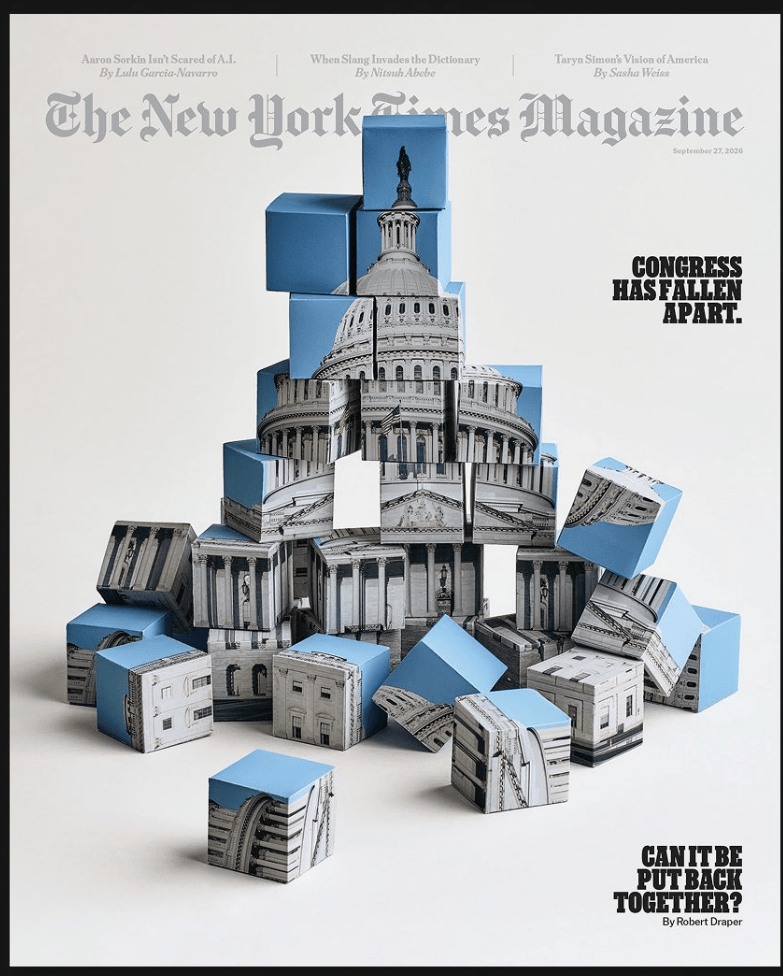
THE NEW YORK TIMES MAGAZINE: The latest issue features ‘Can It Be Put Back Together?’….

They Kept Outsiders Away for 500 Years. Their World Is About to Change.

My father dedicated his life to studying the Guna people of Panama, and they may soon allow unprecedented development through their land. I went on a trek through the jungle to find out why. By Ben Ryder Howe and Federico Rios

The Problem With Apocalyptic Thinking

From climate to Covid to A.I., we face a terrifying feeling of exponential growth spinning out of our control. Are we right?

Has a Dash of ‘Whimsy’ Become Less Whimsical?

The push to optimize the magic in our lives is starting to feel like a trick for consumers. By Mitch Therieau

Back to School With Bulletproof Backpacks

Three people trying to quell their school-shooting anxiety. By Coralie Kraft

THE NEW YORK TIMES MAGAZINE- SEPT. 20, 2026

Current cover

THE NEW YORK TIMES MAGAZINE: The 9.20.26 Issue features David Wallace-Wells on our age of perpetual climate disaster; Eve Fairbanks on a superintendent who rebuilt his devestated schools; Mark Chiusano on the New York City subway system and flooding; and more.

In an Age of Perpetual Climate Disaster, Rebuilding Is the Wrong Goal

But every crisis is an opportunity.

Congress May Be Broken Beyond Repair. Lawmakers Told Us How It Happened.

Members from both parties say the legislative branch has descended into a state of dysfunction in the Trump era. By Robert Draper

He Rebuilt His City’s Devastated Schools. Then Came the Backlash.

A former superintendent in Joplin, Mo., is trying to apply what he learned to other shattered districts — and reckoning with the toll of the disaster on his own life. By Eve Fairbanks

After 21 Years of Calling the Mets, Howie Rose Somehow Still Believes in Miracles

THE NEW YORK TIMES MAGAZINE- SEPT. 13, 2026

THE NEW YORK TIMES MAGAZINE: The latest issue features features articles on cultural retrospectives, corporate collapses, linguistics, and ethical dilemmas. Highlights include an examination of Dolly Parton’s cultural impact, an investigation into the collapse of Guidepost Montessori, and an analysis of household “familects”

Did 9/11 Really Change Everything?

Were the terrorist attacks that day the end of an idyllic era? The beginning of our current dystopia? Or just a middle chapter?

Will ‘Woke’ Go the Way of Scalawags and Mugwumps?

The word is used across the political spectrum, but it’s embraced by few.

‘We’re Going to Bring It Back to Life’: The Long Road to Reviving Lahaina

Hawaii’s housing crisis was at a breaking point even before the fire. Since then, displaced families have struggled to rebuild their lives.

New York’s Subways Weren’t Built for This

In an era of heavy rain, a transit system with 47,000 openings is bound to leak.

THE NEW YORK TIMES MAGAZINE- SEPT. 6, 2026

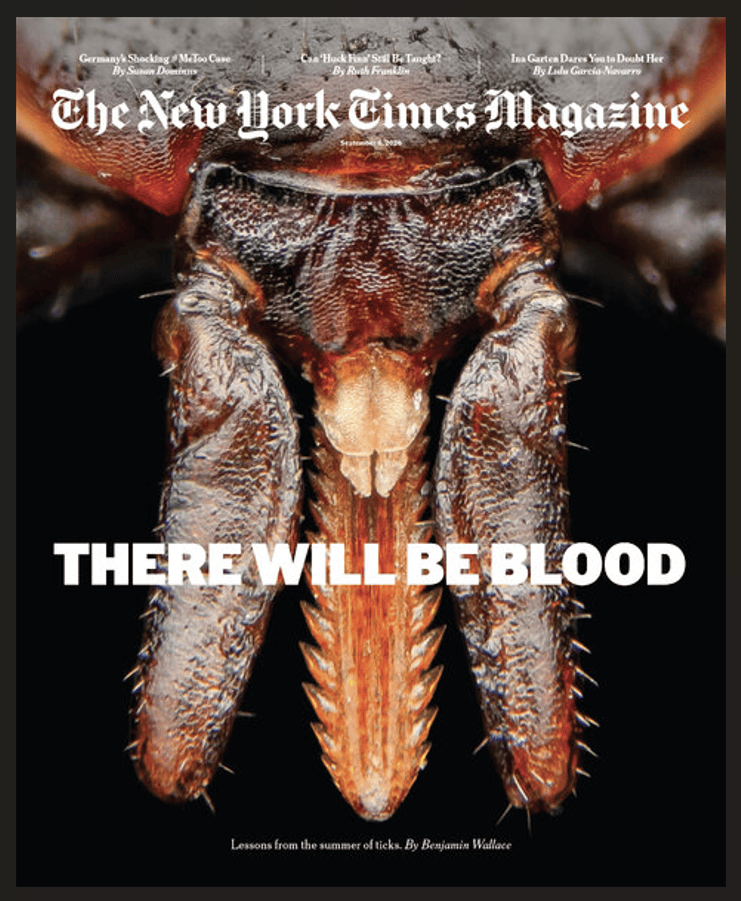
THE NEW YORK TIMES MAGAZINE: The 9.6.26 Issue features Benjamin Wallace on the summer ticks took over; Ruth Franklin on teaching Huck Finn in 2026; Susan Dominus on Collien Fernandes and her quest to find out who was impersonating her online; and more.

The Summer the Ticks Took Over

A scientific and civilizational horror story.

In an Age of Perpetual Climate Disaster, Rebuilding Is the Wrong Goal

But every crisis is an opportunity. By David Wallace-Wells

Every Family Has Its Own Private Language. What Does That Tell Us About Ourselves?

“Familects” emerge out of in-jokes and mispronunciations, but they reveal something about how all language evolves. By Nitsuh Abebe

Baseball In the Ashes: The Riveting, Heartbreaking Drama of the Yankees’ Post-9/11 Run

George W. Bush, Billy Crystal, Tino Martinez and others describe how baseball and a thrilling postseason became a rallying cry for the country. By Garrett Graff

THE NEW YORK TIMES MAGAZINE- AUGUST 30, 2026

Current cover

THE NEW YORK TIMES MAGAZINE: The 8.30.26 Issue features Charles Homans on Democratic Socialists; Chien-Chi Chang on civil-defense drills in Taiwan; Jon Ronson on Greg Chism’s strange journey with YouTube; and more.

Rachel Cusk Tried to Caricature Natalie Portman. She Only Caricatured Herself.

Her latest novel appears to savage a celebrity. But Cusk has, once again, managed to turn herself into the victim.

In ‘9 to 5,’ Dolly Parton Put a Friendly Face on Feminism

In 1980, feminists were often stereotyped as man-hating or out of touch. Then Parton gave the movement a boost — and an anthem. By Susan Dominus

It’s One of Our Greatest and Most Controversial Novels. How Should It Be Taught?

I traveled around the country to find out if “Adventures of Huckleberry Finn” still has a place in the classroom. By Ruth Franklin

‘Cult’ Used to Mean Something. Now It Applies to Taylor Swift and Trader Joe’s.

The word today applies to more than religious sects, but it says something about our worshipful attitude toward consumption. By Sophie Haigney