The movement has often seen its ideas flourish as its organizations withered. Will today’s resurgence follow the same course?
The Ubiquitous Melancholy of Max Richter
The composer’s song “On the Nature of Daylight” has popped up in countless sob fests including “Arrival” and “Hamnet.” With billions of streams, he’s become one of the most popular and successful composers of our time.
An N.B.A. Player Got Hooked on Sports Betting. Soon, He Became the Bet
Jontay Porter got deep into FanDuel, and in debt to the wrong people. The only way out, it seemed, was to gamble on himself.
IDLER MAGAZINE: This Christmas special of The Idler (issue 113) mixes the seasonal with the quirky, promising the secrets of churchyard lichens, a tale of Dickens’ favourite outlaw, the oyster thief, John Harris on why he hates whistling, an explanation of why fitness gadgets fail, a new Bullshit Detector column with Murray Lachlan Young, and a first-person story of becoming a chimney sweep, plus Georgia Mann, Rowley Leigh and Arthur Smith, a Yayoi Kusama exhibition, a Cinderella story, spies on screen, walks around old York, lunch in Whitstable, scientists in sheds, a car turned into canvas, allotments, cassoulet, saving with sumo and Christmas ukulele albums.
Don’t rake them away, let them decay. Autumn’s fallen leaves will enrich your garden’s soil – or you can turn them into multi-purpose leaf mould, says Graham Burnett
Look at the trees nearest to where you are right now. Whether in your back garden, local park, woodland or out of a train window, they don’t seem to be doing much, do they? But trees are far from idle, even though much of their activity happens in ways imperceptible to our senses.
Since early spring, tap roots have been constantly pumping underground water and soil nutrients to the highest branches of the leafy canopy. Each of those tens of thousands of individual leaves is a highly efficient solar panel carrying out the magic of photosynthesis.
Join “A Drink with the Idler” as we chat to journalist Sarah O’Connor about the future of work in a world with AI, the perils and the potential.
Sarah O’Connor talks to Idler editor Tom about how AI and robots can change the ways we work, in both sinister and useful ways, and how we can harness new technology and shape its development in a way that makes jobs better, safer and more enjoyable.
Join Sarah and Tom as they discuss the ideas in her book We Are Not Machines, which is inspired by stories from nineteenth-century English cotton mills to twenty-first century Swedish mines, and how we can fight for work which is more respectful of our limits, and more worthy of our minds.
The discussion between Sarah and Tom will be followed by a live Q&A when you will be given the chance to ask Sarah your own questions.
We’ll have a philosophical “Thought for the Week” from Dr Mark Vernon and the event will be hosted by Idler Academy director Victoria Hull.
Welcome to How the Stoics Can Help You Get Happy. Over six lessons, Idler editor Tom will teach you how to apply Stoic wisdom to your outlook on life. Drawing on the ideas of ancient Greek philosophers from Zeno to Socrates and Plato, and touching on themes of politics, love, freedom and death, Tom will show you how the Stoics can help you live a happier life.
By leaning into nativist absolutism, Netanyahu almost doubled the Arab vote, creating a political — and foundational — crisis for Israel.By Roger Cohen
In 1995, Itamar Ben-Gvir appeared on camera brandishing the hood ornament of the Israeli prime minister Yitzhak Rabin’s Cadillac. “We got to his car,” he vowed, “and we’ll get him, too.” Soon after, in one of history’s most successful assassinations, Rabin was killed by a fanatical religious-nationalist Jew, and 27 years later the teenage hoodlum who boasted of his theft became Israel’s minister of national security.
There is perhaps no better representation of Israel’s steady march rightward over the past three decades than the ascent of Ben-Gvir to the high office he still holds. The vandal became responsible for preventing vandalism, the ethnocentric fanatic for stopping sectarian violence. This unhappy outcome, and its predictable consequences, reflects the nationalist and more messianic country that Israel has become as the idea of a two-state peace, the ultimate target of Rabin’s assassination, withered and died.
There used to be an honorable way to try to profit from online infamy: selling nearly worthless memecoins. The machines could take it over. By Willy Staley
I’m not afraid to admit it, right here in the newspaper: It finally happened to me. I saw an A.I. video, and I thought — if that’s the right word — it was real. It showed a guy standing on a street corner somewhere in Europe, with an insane haircut and a houndstooth suit, shadowboxing while a French rap song played in the background. In his misplaced confidence and swagger, he called to mind a protomemetic figure from my youth, Napoleon Dynamite.
This was Jean Phil, someone who — as far as anyone can tell — doesn’t exist. Has never existed. Was conjured from a bunch of NVIDIA chips in a low-slung building outside of Kenosha.
The term captures the self-defeating loop of losing and not being able to stop. It also describes doomscrolling, politics and our society’s default state. By Mitch Therieau
Five experts on how best to limit a rapidly evolving technology. By Emily Bazelon
Oct. 26, 2026
Artificial intelligence is alarming many of its human creators by leaping the guardrails designed to contain it. In the last few months, safety researchers have resigned from OpenAI and Anthropic, warning that their former employers could be courting disaster: A.I. that escapes our control irrevocably. The companies are reportedly gaming out scenarios of a catastrophic cyberattack or other event in the next six to 12 months.
American women’s most listened-to podcast is Call Her Daddy. It is hosted by the glamorous Alex Cooper, whose shtick is grilling female celebrities on their sex lives. For example, she made Gwyneth Paltrow rank all her boyfriends according to their sexual skills. I hope her husband and kids didn’t bother listening to that episode. She recently hosted an actress named Sophia Bush. They discussed Sophia’s multiple divorces while Alex declared breathlessly that if a woman is questioning whether she can do better than her current husband, “the answer is always yes.” Sophia agreed. “The answer is always yes, and this idea that it’s too late or you’re too old, or who are you to want more – that’s patriarchy. That is crazy!” Something around here is crazy, yes, Ms. Bush.
Donald Trump has so dominated the news over the past decade that it is hard to imagine American politics without him. Yet now we are in the last 27 months of his presidency. And as this year ends and the next approaches, the national conversation turns toward the looming election cycle of 2028 and the vital question of who comes next. The Democratic nomination seems destined to be a complicated struggle between various factions and candidates. The outgoing Governor of California, Gavin Newsom, is a figure of ridicule yet strangely unsquashable. He remains the betting favorite. Senator Jon Ossoff, this magazine’s last cover star, is a contender. Alexandria Ocasio-Cortez is a telegenic and increasingly influential force – and Kamala Harris just won’t take no for an answer.
I’ve had hexes put on me by a university professor, had online vigilantes send packages of dogshit to my childhood home in New Jersey and been hounded by the trauma-informed journalists of the New York Times. CNN, Reuters, Agence France-Presse and other estimable sources have credited me with starting a dark…
In the fall of 2017, Virginia was going through its quadrennial tradition of giving the nation an electoral check-in on the president by holding an off-year gubernatorial election. The nation’s mood was, to say the least, heated. Four months earlier, at a baseball field in Alexandria, a radicalized and mentally imbalanced left-wing activist had nearly killed House whip Steve Scalise and three others in a shooting. So it was with some recklessness that Latino Victory Project, in
Corruption is always an issue, but this year will it finally catapult from a topic of chronic bellyaching to an actual mechanism for changing votes? By Ruth Marcus
How a culture of dehumanization and denial keeps ICE and Border Patrol personnel “at war with an enemy that does not fight back.” By Francisco Cantú
Did the World Just Gain Hundreds of Millions of Alzheimer’s Patients?
A new definition of Alzheimer’s includes people without symptoms. Experts are fiercely divided over whether that makes sense—and whether the new drugs really help. By Manvir Singh
Roy Lichtenstein’s Witty Critiques of Masculinity
The artist’s best work, in a new retrospective at the Whitney Museum, directs his campy humor at gender stereotypes. By Hilton Als
THE NEW YORK TIMES MAGAZINE: The 11.1.26 Issue features Marcela Valdes on the actor Penélope Cruz; Francesca D’annunzio McKenzie Funk and Kirsten Luce on a small town in Texas and a local deputy who became the face of deportation; Sophie Haigney on dark nutrition; Lisa Lerer on OB-GYNs in Idaho; and more.
A.I. will reshape our world. But does that mean the people who make the technology get to control our imagination, too? By Linda Kinstler
These days, the leading tech companies are not primarily fighting one another for market share or talent or computing power. The bigger battle is over who can claim to know the future.
In August, Meta’s chief executive, Mark Zuckerberg, published a manifesto titled “The Future Is for Everyone,” in which he argued that artificial intelligence will bring about “an abundance of personal agency” and other riches — but only if Meta is in charge. “If our beliefs and principles lead,” he wrote of his company, “then the balance of power will favor individuals and a better future for everyone.” In September, Sam Altman of OpenAI told the United Nations Security Council that A.I. could lead to either a society in which “more people can participate in the future” or one in which humans have lost “control of the future.” And in his recent call for the voluntary slowdown of A.I. development, Dario Amodei of Anthropic claimed it was imperative to stave off the future we are headed toward, if only for an “extra year or two.”
The writer-director Martin McDonagh has carved out a highly esteemed cinematic career as a chronicler of extreme, and often extremely bloody, behavior carried out on a relatively intimate scale. “The Banshees of Inisherin” (2022), to pick one of his films, was about two friends on a remote Irish island descending into a feud. “Three Billboards Outside Ebbing, Missouri” (2017), to pick another, looked at a mother’s attempt to get justice for her murdered daughter. That those movies, despite their dark setups, are often as vulgarly funny as they are emotionally affecting is evidence of McDonagh’s originality — and his skill too. (McDonagh was an enfant terrible of the British theatrical world before he turned to filmmaking.) The 56-year-old’s films have earned a cumulative 18 Academy Award nominations, and “Six Shooter” (2004) earned him an Oscar for best live-action short. By David Marchese
From France to Brazil, voters are railing against the status quo, even as the politics of disenchantment make lasting change nearly impossible. By David Wallace-Wells
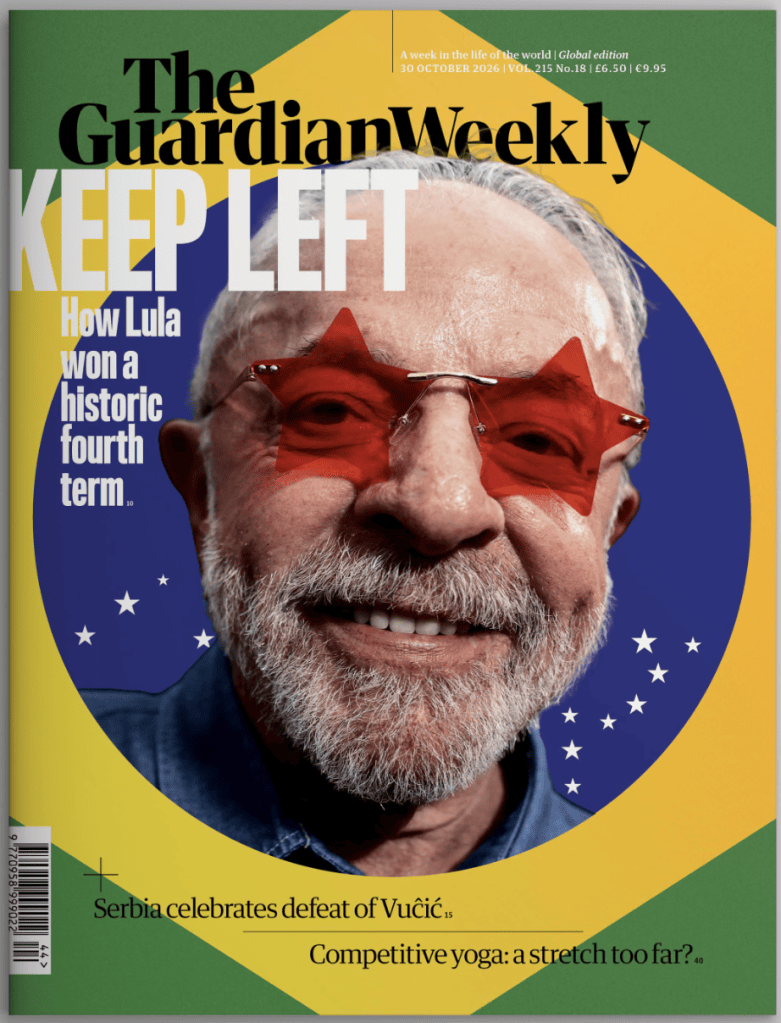
How many grinning faces, jubilant crowds and celebrating politicians can you fit into a single issue of the Guardian Weekly? That’s not a question that often troubles us, but the spectacular triumph of President Luiz Inácio Lula da Silva, winning a historic second-round vote after losing the first to rightwing opponent Flávio Bolsonaro, and the victory of the student-led campaign against autocrat Aleksandar Vučić in Serbia gave me a happy problem to solve this week. In an era when the right seems to be riding high in the world, popular pushbacks against strongmen politicians is something to celebrate.
For our Brazil cover story, Tom Phillips and Tiago Rogero report on the reaction to Lula’s victory and how he pulled eventual success from the jaws of what, until the first results came on Sunday evening, seemed a probable defeat. As government health minister Alexandre Padilha said that evening: “It’s a massive victory – not just for Brazil. It’s also an important signal to the rest of Latin America and to the world.” But, as commentator Jordana Timerman cautions, Brazil has been an exception in Latin America in successfully resisting Donald Trump’s attempt to achieve hegemony over the region.
Spotlight| ‘Pure arrogance’ Google has been in the dock in Finland over the illegal felling of hectares of woodland for its datacentres, reports Miranda Bryant
Science| Out of the blue Why are more planes encountering invisible air turbulence, what can they do about it and what effect will more frequent incidents have on travellers, asks Patrick Keneally
Feature| Bent out of shape? Competitive yoga may sound like anathema to some devotees of the ancient practice but, as Anita Chaudhuri discovers, there is a movement among some yogis to make it an Olympic sport
Opinion| Lame duck presidents can be dangerous beasts If Democratic midterm gains hamper Donald Trump at home, we should be very worried about what he might do abroad when foreign policy is his last bastion of power, says Steve Bloomfield
Culture| Stay faithful As the second series of Celebrity Traitors draws to its conclusion, Michael Hogan meets the people who made it the world’s biggest TV show and finds out why Claudia Winkleman never wants to leave the castle
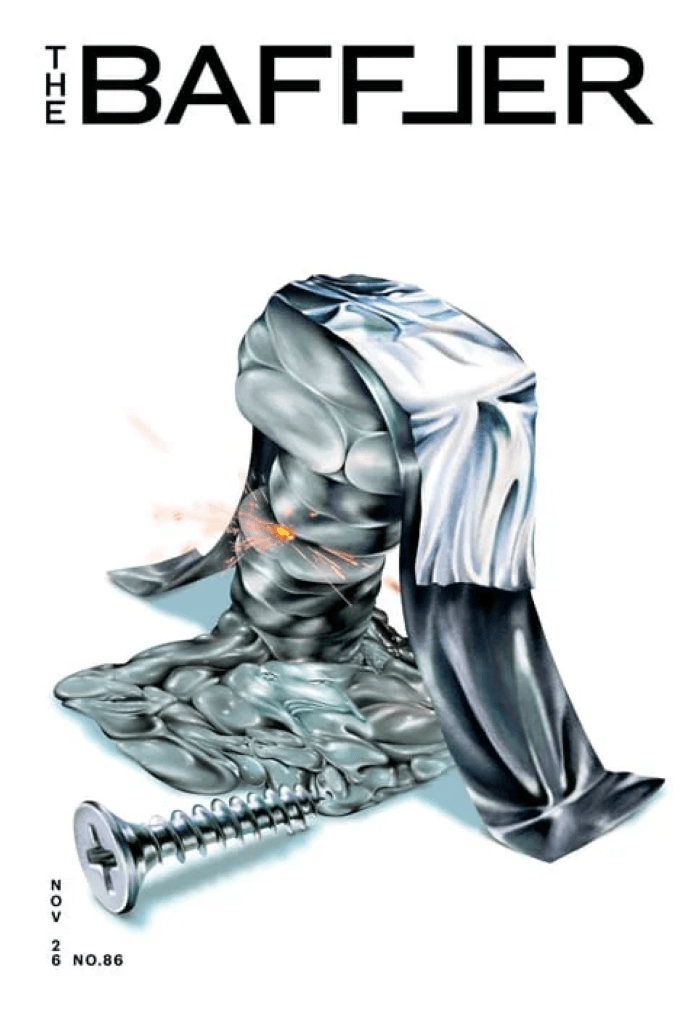
The socialist cash that collected capitalist trash by David I. Backer
Today, the crossroads of socialism and barbarism meet in cities across America. In New York, Seattle, and Chicago, organizers have seized local and state authority, empowering mayors Zohran Mamdani, Katie Wilson, and Brandon Johnson—and a nonnegligible number of other politicians—to pursue the left project municipally. These local victories, won in the years since 2020, have kicked off a positive feedback loop and inspired yet more socialists to run for office in our time. The candidates tell us they want to collectivize the relations of production. Can they?
Last winter, the Mexican Army killed its main foe. Nemesio Oseguera Cervantes was spending a Sunday in Tapalpa, a tourist town just south of Guadalajara, the capital of Jalisco. Maybe Oseguera, a cartel leader who rose to international infamy over the past two decades, was there to visit the sixteenth-century chapel that’s nestled behind the main square, or maybe he wanted to admire the town’s snake-decorated fountains. In all likelihood, he was confident that authorities in that part of the country would ignore him spending time in the state that gave its name to his organization, Cártel de Jalisco Nueva Generación.
On reality television, all tenants are squatters by Michael Friedrich
A bouncer-looking guy with a steel-wool goatee lies his way into a woman’s Washington State home, posing as an inspector. He moves from room to drywall-covered room, testing smoke alarms. The home’s occupant, a quiet, middle-aged woman named Sally Barton Jeffries, offers the guy a glass of water. Her place looks cozy enough, furnished with an orange sectional, a checkered rug, and a table in the eat-in kitchen. She mentions that she has lived there for nine months.
Before we saw a single parakeet, we heard them: a disembodied static that grew louder as we approached Hither Green Cemetery in southeast London. It was an early evening in late June, and we had come to witness an invasion. By the time my friend and I reached the cemetery’s western edge, the clamor was all-encompassing. We hopped the fence and picked our way across the gravestones. Above us now were the birds themselves, their kryptonite-green plumage, scab-red beaks, pearly black collars, and trailing tail feathers unmistakable: Psittacula krameri, the ring-necked parakeet.
Since taking up his post in Paris, Kushner has become known for lobbing provocations onto France’s domestic scene at sensitive moments. As he put it, “Nobody has the courage to say what I say.” By Lauren Collins
Donald Trump has tried to purge voter rolls nationwide. Deidre Henderson, the Republican lieutenant governor of Utah, is among the chief election officers standing in his way. By Barton Gellman
THE NEW YORK TIMES MAGAZINE: The 10.25.26 Issue Michael Steinberger on how California’s ultrarich are fighting against the world’s first billionaire tax; Charles Homans on who runs the Democratic party; Matthew Shaer on the director Sterlin Harjo; and more.
Gina Hinojosa, the Democratic nominee for governor, on her appeal to MAGA voters and her refusal to engage in the “culture wars.” By Lulu Garcia-Navarro