The movement has often seen its ideas flourish as its organizations withered. Will today’s resurgence follow the same course?
The Ubiquitous Melancholy of Max Richter
The composer’s song “On the Nature of Daylight” has popped up in countless sob fests including “Arrival” and “Hamnet.” With billions of streams, he’s become one of the most popular and successful composers of our time.
An N.B.A. Player Got Hooked on Sports Betting. Soon, He Became the Bet
Jontay Porter got deep into FanDuel, and in debt to the wrong people. The only way out, it seemed, was to gamble on himself.
Corruption is always an issue, but this year will it finally catapult from a topic of chronic bellyaching to an actual mechanism for changing votes? By Ruth Marcus
How a culture of dehumanization and denial keeps ICE and Border Patrol personnel “at war with an enemy that does not fight back.” By Francisco Cantú
Did the World Just Gain Hundreds of Millions of Alzheimer’s Patients?
A new definition of Alzheimer’s includes people without symptoms. Experts are fiercely divided over whether that makes sense—and whether the new drugs really help. By Manvir Singh
Roy Lichtenstein’s Witty Critiques of Masculinity
The artist’s best work, in a new retrospective at the Whitney Museum, directs his campy humor at gender stereotypes. By Hilton Als
The Healers – Jason Baldes on Restoring the North American Buffalo
Returning the buffalo to its ecological role as a keystone species, bringing back plant and animal biodiversity, is in itself healing. We take care of the buffalo, the buffalo takes care of the land, and both take care of us. By Leath Tonino
Aage eighteen, Jason Baldes, a member of the Eastern Shoshone Tribe, traveled with his father, a US Fish and Wildlife Service biologist, from the Wind River Indian Reservation in Wyoming to the Serengeti Plain of East Africa. In addition to lions and zebras and hyenas, Baldes witnessed the migration of 1.5 million wildebeests—one of the planet’s last remaining examples of a huge population of terrestrial mammals roaming freely over the land. “That was the light bulb moment for me,” he says today, reflecting on his decades of effort as an ecologist and activist. Watching the beautiful and awe-inspiring spectacle, he understood that the mega herd represented a mere fraction of the number of bison—or buffalo, as Baldes prefers to call them—that would have been visible in North America a few short centuries ago, when they numbered in the tens of millions and inhabited the majority of the continent.
In popular tradition General Custer was the last to die, though there is no way to know the final sequence of events. He reportedly had been shot twice: once in the left temple and once just below the heart. ByCharles Hood
The first time US Army general George Armstrong Custer died was on Sunday, June 25, 1876, a centennial year in Anglo-European America. He died in the late afternoon along with 267 other soldiers, civilians, and Native American scouts in the Little Bighorn Valley of Montana. These deaths took place during what are now called the “Indian Wars,” although for most of American history it’s hard to think of a time when there wasn’t an Indian war.
The Seventh Cavalry, which Custer led, had split into multiple columns, and all came under attack, though only Custer’s portion—made up of five out of eleven total companies—was wiped out completely. That outcome was more or less inevitable, given that Custer had misjudged the size of the coalition of Lakota, Dakota, Sioux, and Northern Cheyenne his two-hundred-odd men were facing. Or maybe he hadn’t wanted to admit to himself that he was up against a combined force of at least a thousand, and perhaps as many as three or even five thousand, depending on which source you asked. Once the battle started, there was no way Custer and his men would not all be killed. The only question was whether they would die before or after they had used up all of their water and ammunition.
I walked back to my sister’s room and stood in the doorway and listened to her breathe. Maybe some of those seahorse facts weren’t even true. ByLaura Maylene Walter
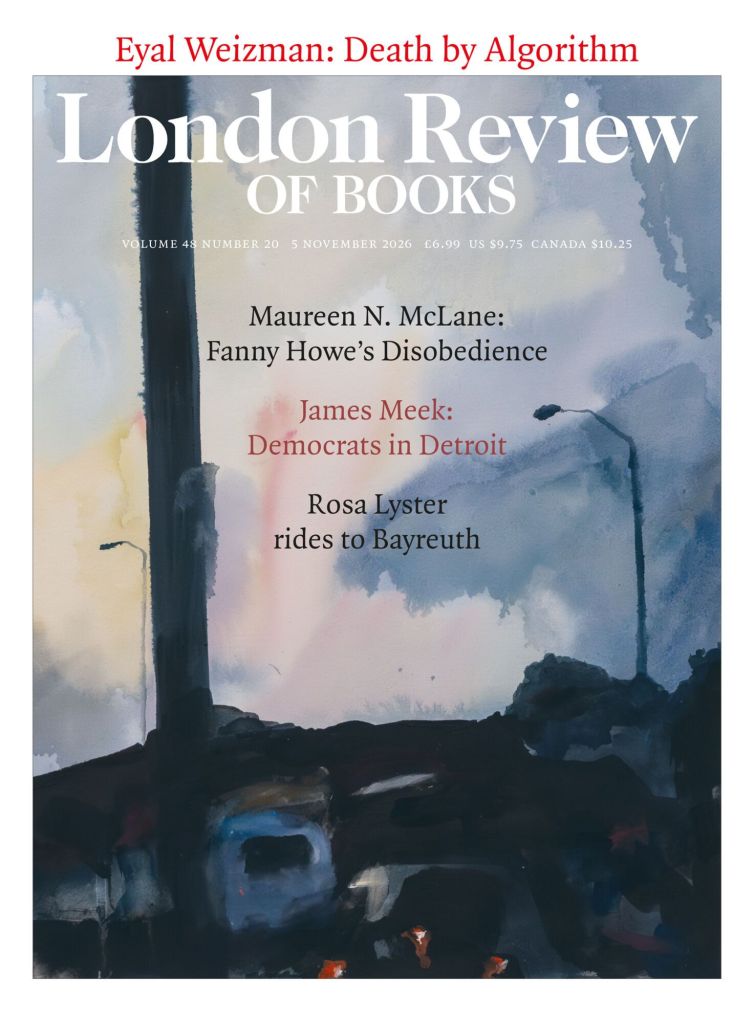
‘To win the Senate, the Democrats need to hold on to the one Michigan seat (out of two) that is up for grabs, and have chosen a new candidate, Abdul El-Sayed, a moderate leftist in European terms, a “communist loser who hates Jews and Israel” according to Trump, “very, very evil”, per J.D. Vance.’ By James Meek
‘The superego – and its precursor, conscience – refers to the part of us that has no curiosity about ourselves. It’s the saboteur of curiosity about ourselves. And that part of us, like a narrow-minded fascist, has only one project: to destroy our pleasures in being alive by trying to kill our curiosity (or by making us frightened of our curiosity, which amounts to the same thing).’ By Adam Phillips
‘Israel’s automated targeting system allows for the responsibility for “industrialised annihilation” to be shared between coders, operators, legal officers who pre-set the level of collateral damage, officers who approve the strike, officers who choose the bomb and the pilots or drone operators who launch it. “I am just a small screw in the system,” one of the interviewees says, quoting Eichmann’s defence during his trial in Jerusalem. The system that begins with a phone number being put into a computer system ends with an entire family crushed under the rubble.’
Since taking up his post in Paris, Kushner has become known for lobbing provocations onto France’s domestic scene at sensitive moments. As he put it, “Nobody has the courage to say what I say.” By Lauren Collins
Donald Trump has tried to purge voter rolls nationwide. Deidre Henderson, the Republican lieutenant governor of Utah, is among the chief election officers standing in his way. By Barton Gellman
They power our phones, cars, dishwashers—and the A.I. systems that prop up the economy. They’re also at the heart of fierce geopolitical rivalry. By Gideon Lewis-Kraus
Alarm about declining interest in books is perpetual. But, as bookselling reaches unexpected heights, James Daunt, the chief executive of Barnes & Noble, thinks a different future is at hand. By Nathan Heller
The cases of Christa Pike and Nidal Hasan show how vanishingly fine the line is between a routine execution and an unbearable one. By Amy Davidson Sorkin
My heart sank when I first saw the magazine’s thirtieth-anniversary issue on paper. My managing editor back then, Michael Strizic, and I had spent the morning pacing in our small, dark office — anxious to receive several heavy boxes from Ottawa. Eventually I couldn’t stand the anticipation, so I walked ten minutes or so to Harbord Bakery to distract myself. The magazines had arrived by the time I returned.
Thirty-five years ago, in the inaugural issue of this magazine, I reviewed the newly published diary of André Laurendeau, written from 1964 to 1967 during the Royal Commission on Bilingualism and Biculturalism. The timing was apt: politicians, scholars, and journalists were speculating heavily on how to fix the “Canadian crisis” following the collapse of the Meech Lake Accord the year before.
“By Authority of Parliament: The Constitutional Boundaries of Legislative Power in Canada” by Ryan Alford
In 2017, during the early days of Donald Trump’s first term, the world was riveted both by his reality TV presidency and by the salacious rumours about the way he had obtained it. Insistent tales circulated about how Vladimir Putin’s troll army had engineered the Republican candidate’s victory by hacking into the Democratic Party’s servers and then releasing thousands of embarrassing emails on the eve of Hillary Clinton’s nomination. What followed was a stormy season of investigations and counter-accusations about Trump’s Russian proclivities.
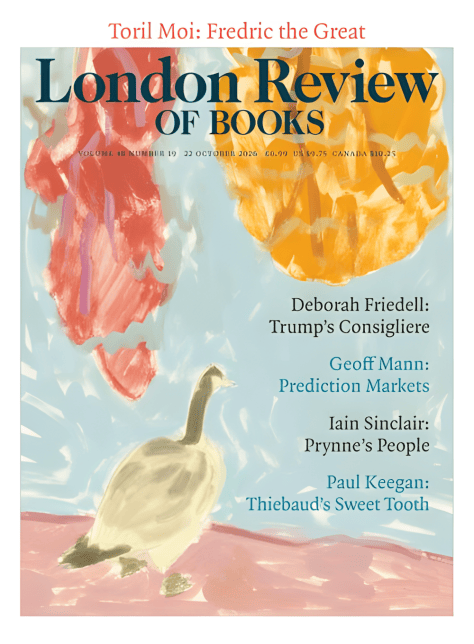
LONDON REVIEW OF BOOKS: The latest issue featuresFredric the Great by Toril Moi; Trump’s Consigliere by Deborah Friedell; Prediction Markets by Geoff Mann; Prynne’s People by Iain Sinclair; and Theibaud’s Sweet Tooth by Paul Keegan….
Fredric Jameson seemed to me to have read absolutely everything. He was the very antithesis of the intellectual type I think of as an empty theoriser, by which I mean someone who endlessly conjectures without having a genuine command of any relevant archive. To look at Fred as a reader of literature is not to reduce the scope of his work, but rather to try to understand its origins.
If the coming election does result in a blue wave, Trump will be faced with the fact of his diminishment. The rest of us will be faced with the wreckage. By David Remnick
The F.B.I. director’s hockey team, the Dons, faced their rivals in a beer league. With rogue slap shots and hovering security agents, Patel was in the zone—or, at least, next to it. By Richie McGinniss
My Education on the Border of the Syrian War
In the last Turkish town on the road to Aleppo, jihadis and spies mixed with reporters trying to prove themselves. By Ben Taub
Arrests have reached a record high—nearly fifty-one thousand in August alone—with agents conducting operations nationwide at hospitals, at airports, and outside schools. By Jonathan Blitzer