The movement has often seen its ideas flourish as its organizations withered. Will today’s resurgence follow the same course?
The Ubiquitous Melancholy of Max Richter
The composer’s song “On the Nature of Daylight” has popped up in countless sob fests including “Arrival” and “Hamnet.” With billions of streams, he’s become one of the most popular and successful composers of our time.
An N.B.A. Player Got Hooked on Sports Betting. Soon, He Became the Bet
Jontay Porter got deep into FanDuel, and in debt to the wrong people. The only way out, it seemed, was to gamble on himself.
Super-Beast: The Mysterious Life of Saki By Oliver Soden
In some ways all you really need to know about Hector Hugh Munro (1870–1916) can be gleaned from the short story ‘Sredni Vashtar’, first published in the Westminster Gazette in the summer of 1910. Conradin – Munro’s heroes nearly always have these hifalutin names – is a sickly small boy quartered on a tyrannical guardian called Mrs de Ropp. Denied much in the way of freedom or material comfort, in particular the hot buttered toast he craves, Conradin makes a fetish out of a savage polecat-ferret hidden in the garden shed, worships it as a god and looks to it for vengeance.
Here in the World
Letters: 1944–1959 By Albert Camus & Maria Casarès (Edited by Béatrice Vaillant, translated from French by Sandra Smith & Cory Stockwell)
What an amazing behemoth of a book! I’ve been lugging it around for weeks. Nearly a thousand letters: the intimate correspondence of Albert Camus and Maria Casarès. When they first met in Paris – on D-Day, 1944 – Camus had already published L’Etranger (1942; The Outsider). Born and raised in Algeria, he was in Paris when the Second World War broke out, and later joined the French Resistance. Camus’s wife, Francine Faure, a mathematician and pianist, remained in Algeria. Maria Casarès was originally from Galicia, the daughter of an exiled former prime minister of Spain, Santiago Casares Quiroga. In 1944, Casarès was already known as an actress, having played the titular role in J M Synge’s Deirdre of the Sorrows. She later starred in Les Enfants du paradis (1945), Cocteau’s Orphée (1950) and La Lectrice (1988), among other films and plays.
Talk to the Animals
Minds I’ve Met: From Denying to Embracing the Inner Lives of Animals By Frans de Waal
Some years ago, a prominent animal-behaviour scientist hosted a colleague at his field station devoted to the study of chimpanzees. Talking together on top of the observation tower, the pair glanced at the apes but mostly stayed absorbed in conversation. Then a female chimpanzee named Thai began to scream and hit herself in dramatic fashion. In response to her outburst, other chimpanzees rushed to embrace, hold and kiss her.
Corruption is always an issue, but this year will it finally catapult from a topic of chronic bellyaching to an actual mechanism for changing votes? By Ruth Marcus
How a culture of dehumanization and denial keeps ICE and Border Patrol personnel “at war with an enemy that does not fight back.” By Francisco Cantú
Did the World Just Gain Hundreds of Millions of Alzheimer’s Patients?
A new definition of Alzheimer’s includes people without symptoms. Experts are fiercely divided over whether that makes sense—and whether the new drugs really help. By Manvir Singh
Roy Lichtenstein’s Witty Critiques of Masculinity
The artist’s best work, in a new retrospective at the Whitney Museum, directs his campy humor at gender stereotypes. By Hilton Als
The Healers – Jason Baldes on Restoring the North American Buffalo
Returning the buffalo to its ecological role as a keystone species, bringing back plant and animal biodiversity, is in itself healing. We take care of the buffalo, the buffalo takes care of the land, and both take care of us. By Leath Tonino
Aage eighteen, Jason Baldes, a member of the Eastern Shoshone Tribe, traveled with his father, a US Fish and Wildlife Service biologist, from the Wind River Indian Reservation in Wyoming to the Serengeti Plain of East Africa. In addition to lions and zebras and hyenas, Baldes witnessed the migration of 1.5 million wildebeests—one of the planet’s last remaining examples of a huge population of terrestrial mammals roaming freely over the land. “That was the light bulb moment for me,” he says today, reflecting on his decades of effort as an ecologist and activist. Watching the beautiful and awe-inspiring spectacle, he understood that the mega herd represented a mere fraction of the number of bison—or buffalo, as Baldes prefers to call them—that would have been visible in North America a few short centuries ago, when they numbered in the tens of millions and inhabited the majority of the continent.
In popular tradition General Custer was the last to die, though there is no way to know the final sequence of events. He reportedly had been shot twice: once in the left temple and once just below the heart. ByCharles Hood
The first time US Army general George Armstrong Custer died was on Sunday, June 25, 1876, a centennial year in Anglo-European America. He died in the late afternoon along with 267 other soldiers, civilians, and Native American scouts in the Little Bighorn Valley of Montana. These deaths took place during what are now called the “Indian Wars,” although for most of American history it’s hard to think of a time when there wasn’t an Indian war.
The Seventh Cavalry, which Custer led, had split into multiple columns, and all came under attack, though only Custer’s portion—made up of five out of eleven total companies—was wiped out completely. That outcome was more or less inevitable, given that Custer had misjudged the size of the coalition of Lakota, Dakota, Sioux, and Northern Cheyenne his two-hundred-odd men were facing. Or maybe he hadn’t wanted to admit to himself that he was up against a combined force of at least a thousand, and perhaps as many as three or even five thousand, depending on which source you asked. Once the battle started, there was no way Custer and his men would not all be killed. The only question was whether they would die before or after they had used up all of their water and ammunition.
I walked back to my sister’s room and stood in the doorway and listened to her breathe. Maybe some of those seahorse facts weren’t even true. ByLaura Maylene Walter
As Israel’s assault on Gaza grew worse and worse, Joe Biden and his advisers acted as though they had no option but to offer their unconditional support. Why couldn’t they see the destruction they were enabling? By Ben Rhodes
Mary K. Simkhovitch, the founder of Greenwich House, believed in the radical idea that housing should be made as livable for the working class as it was for the middle class. By Vivian Gornick
A forensic study of a rape survivor from 1473 Dijon reveals a legal process surprisingly accepting of imperfect victims and contradictory testimony. By Erin Maglaque
‘To win the Senate, the Democrats need to hold on to the one Michigan seat (out of two) that is up for grabs, and have chosen a new candidate, Abdul El-Sayed, a moderate leftist in European terms, a “communist loser who hates Jews and Israel” according to Trump, “very, very evil”, per J.D. Vance.’ By James Meek
‘The superego – and its precursor, conscience – refers to the part of us that has no curiosity about ourselves. It’s the saboteur of curiosity about ourselves. And that part of us, like a narrow-minded fascist, has only one project: to destroy our pleasures in being alive by trying to kill our curiosity (or by making us frightened of our curiosity, which amounts to the same thing).’ By Adam Phillips
‘Israel’s automated targeting system allows for the responsibility for “industrialised annihilation” to be shared between coders, operators, legal officers who pre-set the level of collateral damage, officers who approve the strike, officers who choose the bomb and the pilots or drone operators who launch it. “I am just a small screw in the system,” one of the interviewees says, quoting Eichmann’s defence during his trial in Jerusalem. The system that begins with a phone number being put into a computer system ends with an entire family crushed under the rubble.’
Misrepresented by the right and misunderstood by the left, the Sage of Baltimore delivered scathing—and still bracing—indictments of American injustice. By Andrew Holter
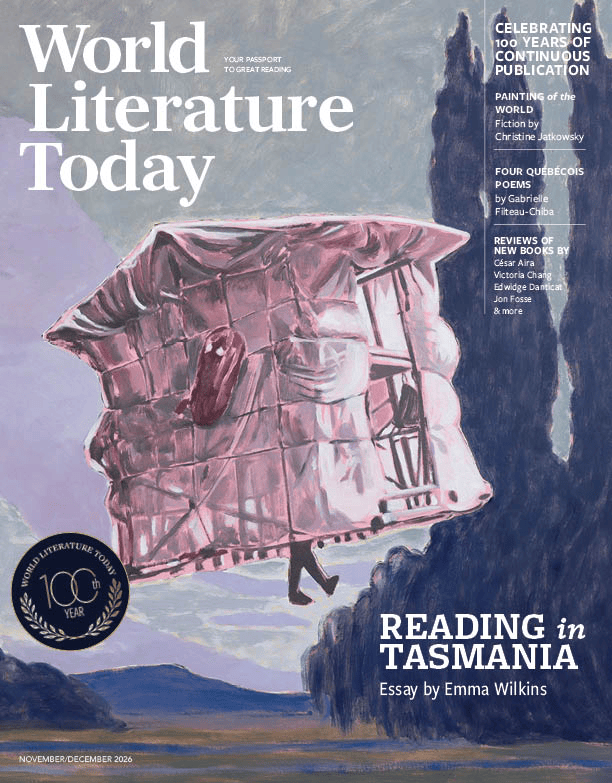
WORLD LITERATURE TODAY: The latest issue features ‘Reading in Tasmania’. The 100th year of continuous publicationgifts readers all their favorite genres—a profusion of essays, poetry, book reviews, creative nonfiction, fiction, interviews, a booklist for Trans Awareness Month, a postcard from Colombia, and more. Emma Wilkins’s essay on Tasmanian literature provides the cover feature, and translated work from China, Egypt, Mexico, Quebec, and Russia enlivens the issue. Reviews of new books by Solvej Balle, Emmanuel Carrère, Victoria Chang, Edwidge Danticat, Jon Fosse, and dozens more round out the year with essential reading-list titles.