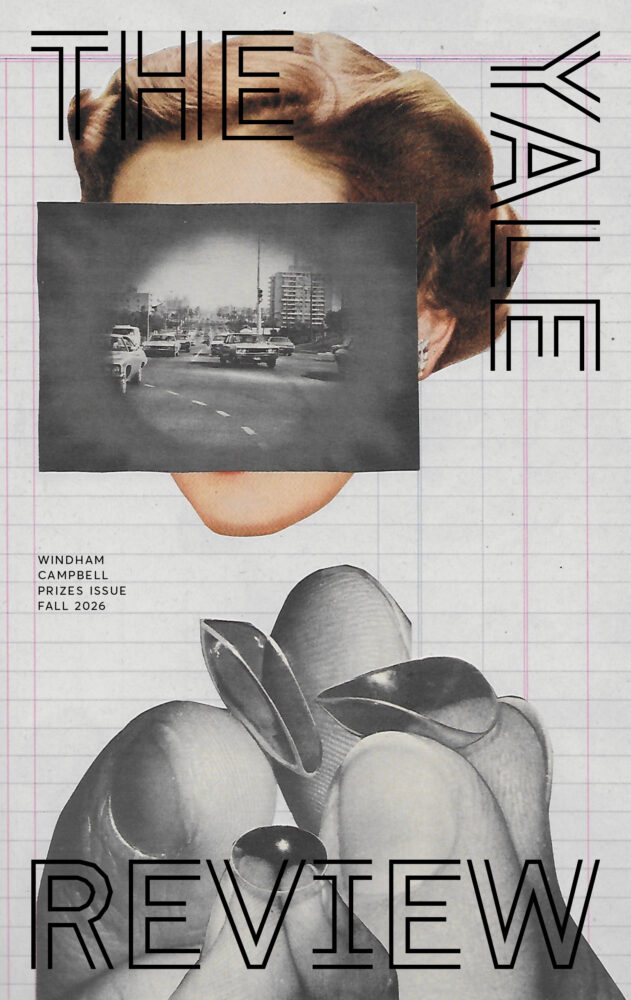
On Afghanistan, empire, and American amnesia on the 25th anniversary of the US invasion. Leila Christine Nadir
Armando Ledezma writes on voguing with the House of Ruber in Caracas.
Alex Kitnick profiles Unmuzzled OX, a cult journal that seduced the best writers and artists in America.
Samuel Chu reports on Operation Yellowbird, the Umbrella Movement, and the dissidents of Hong Kong.
Andie Eisen considers the women taking over the funeral industry.
Jonah C. Sirott probes how the right stole the flying saucers and the Democrats lost the weirdos.
Michel Chaouli reflects on the history—and pleasures—of traveling and reading.
Essays by Amber Bal and Doyle D. Calhoun on a misunderstood masterpiece of African cinema, Rachel Cusk on the art of Joan Snyder, Issa Quincy on the 60th annual Angola Prison Rodeo, Yael Segalovitz on slumber, and Negar Azimi on Iranian art in the 2000s.
Fiction by Ingeborg Bachmann (transl. Philip Boehm and Tess Lewis). Scenes by Maya C. Popa, Sophia Le Fraga, Yuri Herrera, Jason Porter, Brandon Harris, and Sarah Ruhl.
I Come Here Often by Sarah Wang. Double Feature by Eugene Kotlyarenko. Poetry by Sara Eliza Johnson, Jose Hernandez Diaz, Jessica Fisher, Keith S. Wilson, Eileen G’Sell, Mary Jo Bang, and Eduardo Martínez-Leyva.
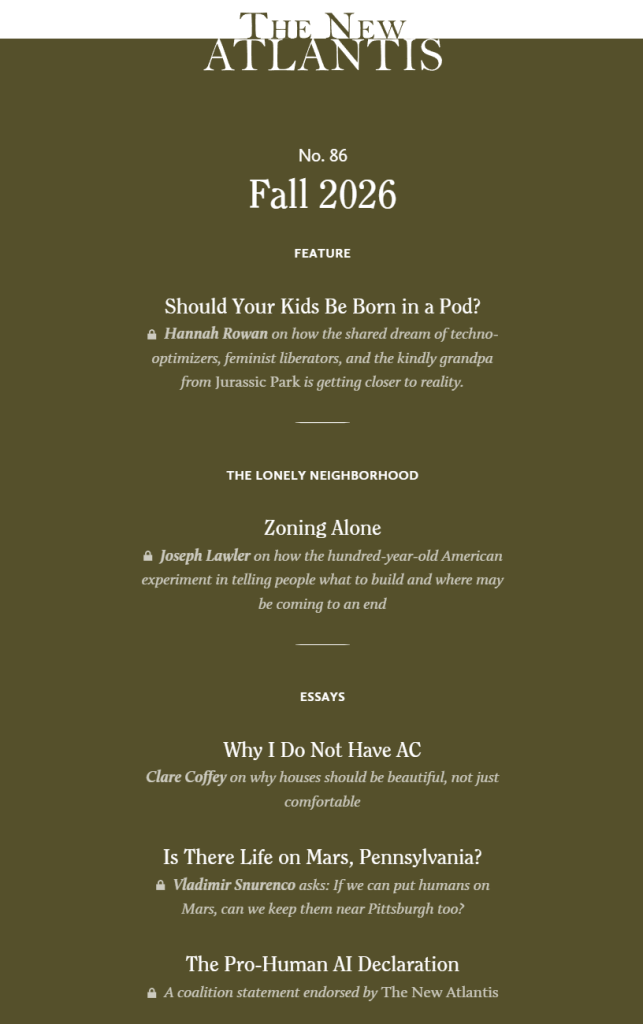
The shared dream of techno-optimizers, feminist liberators, and the kindly grandpa from Jurassic Park is getting closer to reality.
Zoning Alone
A hundred-year-old experiment in telling people what to build and where is part of why Americans have become so isolated. The Supreme Court may soon bring it to an end — and help bring back real neighborhoods.
The Pro-Human AI Declaration
A statement endorsed by The New Atlantis
In March 2026, a coalition of interest groups and individuals, organized by the Future of Life Institute, issued the following declaration at HumanStatement.org.
As companies race to develop and deploy AI systems, humanity faces a fork in the road. One path is a race to replace: humans replaced as creators, counselors, caregivers and companions, then in most jobs and decision-making roles, concentrating ever more power in unaccountable institutions and their machines. An influential fringe even advocates altering or replacing humanity itself. This race to replace poses risks to societal stability, national security, economic prosperity, civil liberties, privacy, and democratic governance. It also imperils the human experiences of childhood and family, faith, and community.
A remarkably broad coalition rejects this path, united by a simple conviction: artificial intelligence should serve humanity, not the reverse. There is a better path, where trustworthy and controllable AI tools amplify rather than diminish human potential, empower people, enhance human dignity, protect individual liberty, strengthen families and communities, preserve self-governance and help create unprecedented health and prosperity. This path demands that those who wield technological power be accountable to human values and needs, in support of human flourishing.
1. Keeping Humans in Charge
Human Control Is Non-Negotiable: Humanity must remain in control. Humans should choose how and whether to delegate decisions to AI systems.
Meaningful Human Control: Humans should have authority and capacity to understand, guide, proscribe, and override AI systems.
No Superintelligence Race: Development of superintelligence should be prohibited until there is broad scientific consensus that it can be done safely and controllably, and there is strong public buy-in.
Off-Switch: Powerful AI systems must have mechanisms that allow human operators to promptly shut them down.
No Reckless Architectures: AI systems must not be designed so that they can self-replicate, autonomously self-improve, resist shutdown, or control weapons of mass destruction.
Independent Oversight: Highly autonomous AI systems where controllability is not obvious require pre-development review and independent oversight: genuine authority to understand, prohibit, and override, not industry self-regulation.
Capability Honesty: AI companies must provide clear, accurate and honest representations of their systems’ capabilities and limitations.
2. Avoiding Concentration of Power
No AI Monopolies: AI monopolies that concentrate power, stifle innovation, and imperil entrepreneurship must be avoided.
Shared Prosperity: The benefits and economic prosperity created by AI should be shared broadly.
No Corporate Welfare: AI corporations should not be exempted from regulatory oversight or receive government bailouts.
Genuine Value Creation: AI development should prioritize solving real problems and creating authentic value.
Democratic Authority Over Major Transitions: Decisions about AI’s role in transforming work, society, and civic life require democratic support, not unilateral corporate or government decree.
Avoid Societal Lock-In: AI development must not severely limit humanity’s future options or irreversibly limit our agency over our future.
3. Protecting the Human Experience
Defense of Family and Community Bonds: AI should not supplant the foundational relationships that give life meaning — family, friendship, faith communities, and local connections.
Child Protection: Companies must not be allowed to exploit children or undermine their wellbeing with AI interactions creating emotional attachment or leverage.
Right to Grow: AI companies should not be allowed to stunt children’s physical, mental or social growth or deprive them of essential experiences for healthy development during critical periods.
Pre-Deployment Safety Testing: Like drugs, chatbots must undergo pre-deployment testing for increased suicidal ideation, exacerbation of mental health disorders, escalation of acute crisis situations, and other known harms.
Bot-or-Not Labeling: AI-generated content that could reasonably be mistaken for human-generated must be clearly labeled as such.
No Deceptive Identity: AI should clearly and correctly identify itself as artificial, nonhuman, and not a professional, and it should not claim experiences it lacks.
No Behavioral Addiction: AIs should not cause addiction or compulsive use through manipulation, sycophantic validation, or attachment formation.
4. Human Agency and Liberty
No AI Personhood: AI systems must not be granted legal personhood, and AI systems should not be designed such that they deserve personhood.
Trustworthiness: AI must be transparent, accountable, reliable, and free from perverse private or authoritarian interests.
Liberty: AI must not curtail individual liberty, freedom of speech, religious practice, or association.
Data Rights and Privacy: People should have power over their personal data, with rights to access, correct, and delete it from active systems, AI training sets, and derived inferences.
Psychological Privacy: AI should not be allowed to exploit data about the mental or emotional states of users.
Avoiding Enfeeblement: AI systems should be designed to empower, rather than enfeeble their users.
5. Responsibility and Accountability for AI Companies
No Liability Shield: AI must not be able to act as a liability shield, preventing those deploying it from being legally responsible for their actions.
Developer Liability: Developers and deployers bear legal liability for defects, misrepresentation of capabilities, and inadequate safety controls, with statutes of limitation that account for harms emerging over time.
Personal Liability: There should be criminal penalties for executives responsible for prohibited child-targeted systems or ones causing catastrophic harm.
Independent Safety Standards: AI development shall be governed by independent safety standards and rigorous oversight.
No Regulatory Capture: AI companies must not be allowed undue influence over rules that govern them.
Failure Transparency: If an AI system causes harm, it should be possible to ascertain why as well as who is responsible.
AI Loyalty: AI systems performing functions in professions with fiduciary duties, such as health, finance, law, or therapy, must fulfill all of those duties, including mandated reporting, duty of care, conflict of interest disclosure, and informed consent.
Tracy Daugherty’s biography of Cormac McCarthy is a landmark publication. Putting together the life of a writer who not only shunned publicity but actively worked to keep fans, journalists, the media, and academics off his trail requires the powers of both a skilled biographer and a nosy private detective. In that latter role, some of what Daugherty has uncovered is unsavory, though with the recent revelation of McCarthy’s relationship with Augusta Britt, who was sixteen when they began an affair, readers may be prepared for some of the shocks. One of Daugherty’s leitmotifs is McCarthy the “bad boy” and “outlaw,” and though such appellations risk cliché, the story he tells is of a man who, at least in the first half of his life, preferred the company of moonshiners, gamblers, hard drinkers, and petty criminals like his old Knoxville pal John Sheddan, who seems to have been the Falstaff to McCarthy’s Prince Hal.
There are two books before me, which, if I mistake not, will mark an epoch,” wrote W. E. B. Du Bois in The Crisis magazine in 1924. One was a novel of middle-class African-American life by Jessie Fauset called There Is Confusion. The other was a collection of stories, songs, poems, and character sketches called…
During the last quarter of the twentieth century, few writers were more admired by peers and critics than Andre Dubus. But because Dubus’s territory was the relatively confined space of the short story and novella, he never enjoyed great commercial success or recognition. Dubus was destined to be a writer’s writer—what Joshua Bodwell calls a…
In that we’ve been married for sixteen years, you really don’t have to try so hard to make your feelings known,” Janet said at the wheel. “I’m well aware you don’t want to do this.”
“I THINK I’ve been pretty stoic about it,” Rick said, eyes to the thick woods he’d be reflexively scanning for deer. Ever since they’d planted an ambitious garden behind their upstate New York summerhouse, the creatures that had once seemed so exquisite had become evil incarnate.
“Stoic? More like long-suffering,” Janet said. “You’ve hardly said a word the whole way here. But there’s no point in having joined Saint Peter’s if we don’t put our beliefs into practice. Charity doesn’t only mean parting with twenty bucks to get someone at the door to go away. It means sometimes doing what’s right when you don’t feel like it.”
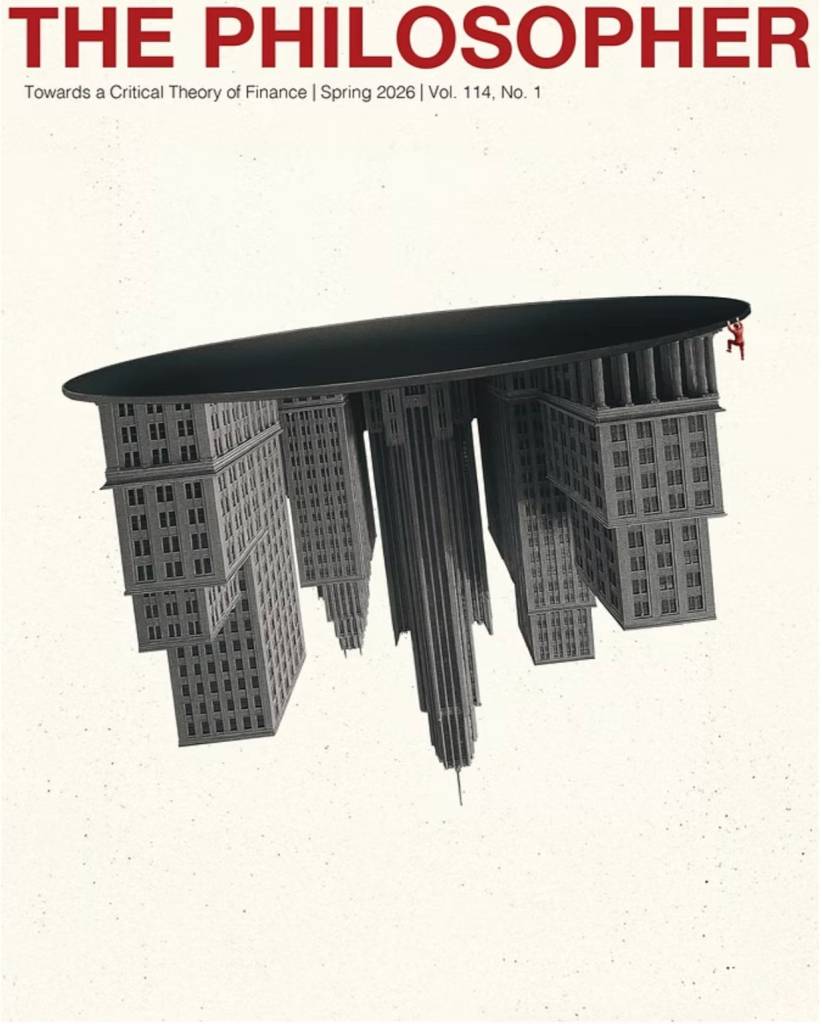
Hegel turned the world onto its head and Marx turned it back on its feet, and now finance is turning the world on its head again. In the early 19th century, Hegel proposed that human history was shaped by consciousness, by human spirit, by the head. Marx argued, in turn, that history was actually determined by practical social conditions, by the way people make their means of living, standing on their feet. It was capitalism that made it seem like heads, owners of industry and leaders of states and their apologists, intellectuals, made history happen, and not workers. The feet were the source of power while the heads claimed all the power for themselves. It is harder to believe this is true now. Industry does not matter much to finance, and labor even less. Finance packages up the productive economy to resell it according to its own rules. A few prescient people have been studying the way the new rules ruin living conditions, pervert political possibilities, and increasingly dominate the global order. Yet, there is still no field dedicated to theorising the ill effects of the newly upside-down world. We need, in short, a critical theory of finance.
In ‘Money,’ Stefan Eich exposes a paradox. Money needs everyone’s trust to operate, and yet economists and politicians claim that only they can decide on its uses. In ‘What is Monetary Policy,’ Leah Downey explains how the technocratic apparatus of policy prevents democratic decision-making. Melinda Cooper considers the challenge supposedly presented by Schumpeter’s view of the relation between family, capitalism, and democracy. Radhika Desai demonstrates a tradition in Marxist thought that already predicts financialisation and has a strong theory of it. Finally, Paul North briefly evaluates four very general positions from which to critique finance, as a preparation for a critical theory of finance.
Also in this issue, Peter West explores how Plato continues to speak to our present moment, with Angie Hobbs’ recent book offering a timely defence of dialogue against the rise of censorship, polarisation, and performative debate. Meanwhile, Marie Snyder reflects on The End Doesn’t Happen All at Once, a pandemic memoir in letters that traces how friendship, literature, and mutual care sustained lives through the disorientation and inequalities of Covid.
Kristie Miller puzzles over our preference for how our well-being is distributed over time; Alison Stone delves into Victorian philosophy as a distinct tradition in which women philosophers played a significant role; Matthew Sharpe makes the case for reclaiming Stoicism from the manosphere and the far right; Mary Peterson continues a conversation started in her 2024 article in The Philosopher, on restorative justice and sexual misconduct; and Adrian K. Yee asks what ethical issues are raised by the use of machine learning in counterterrorism.
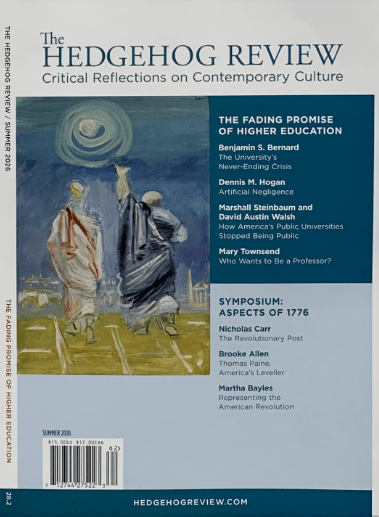
A loss of public faith in higher education and and what it represents for the larger community. This issue also features a Symposium on Aspects of 1776 in commemoration of America at 250.
The University’s Never-Ending Crisis
Higher education has dealt with epistemic revolution before.
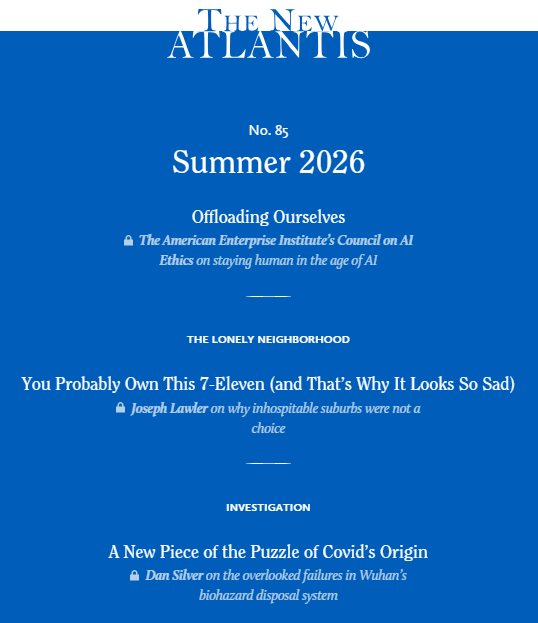
Wuhan’s biohazard disposal system suffered a cascade of failures in the months leading up to Covid: new revelations that official investigators have overlooked
You Probably Own This 7-Eleven (and That’s Why It Looks So Sad)
The qualities that make built places charming are best stewarded by people who live there. But America’s soul-crushing suburban districts are now owned by people far away — people who don’t even know they’re owners at all.
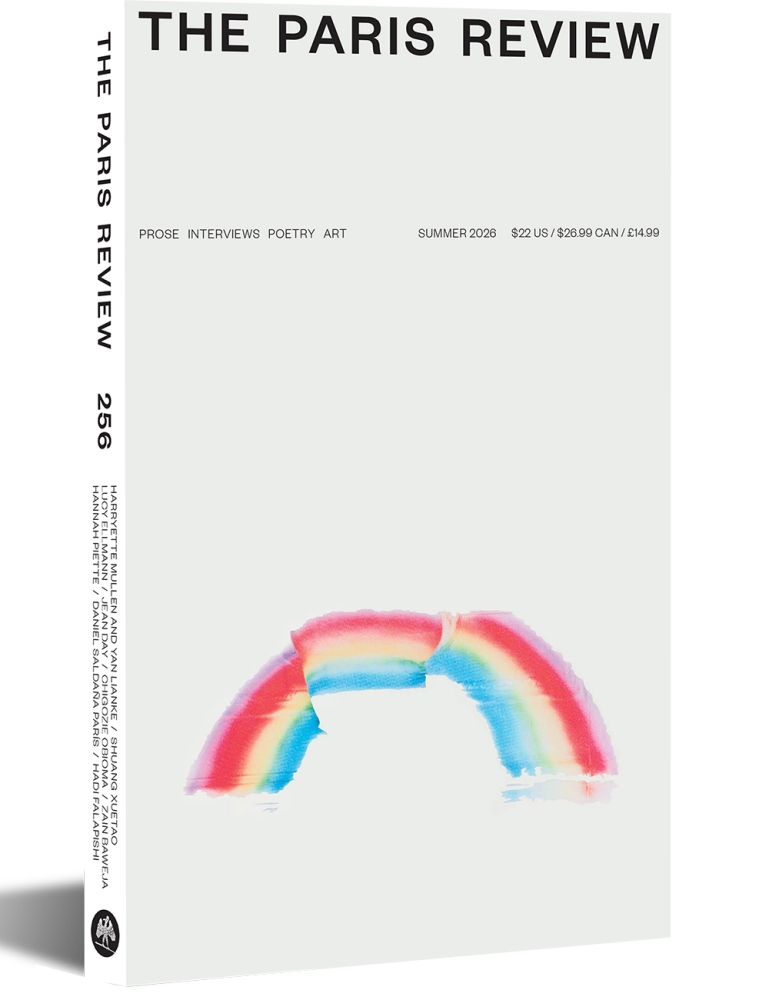
Harryette Mullen on the Art of Poetry: “I knew I would exhaust myself as subject matter, but I could take something and turn it upside down, inside out, add a few doodads, and that way it would become inexhaustible.”
Yan Lianke on the Art of Fiction: “I personally didn’t think there was anything anti-war in writing about how an individual might be terrified of battle. I was really writing about my own fear.”
Prose by Lucy Ellmann, Chad Fore, Daisy Hildyard, Chigozie Obioma, Daniel Saldaña París, and Shuang Xuetao.
Poetry by Zain Baweja, Jean Day, Hannah Piette, Frederick Seidel, Shamsher Bahadur Singh, Katana Smith, and Tran Hang My.
Art by Hadi Falapishi, Andrew Kuo, and Hannah Tishkoff; cover by Alex Da Corte.
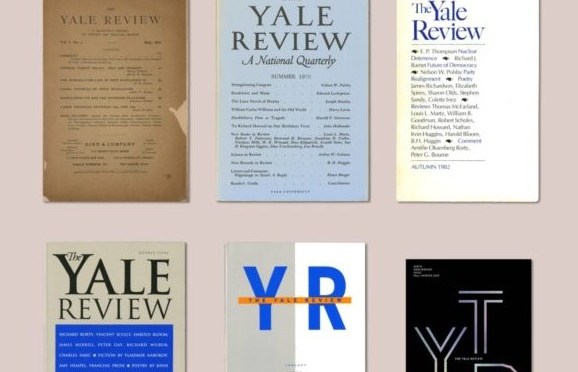
THE YALE REVIEW (March 11, 2025): The latest issue features a central folio, “What Was AI?,” exploring artificial intelligence through essays from Lauren Oyler, Christopher Sorrentino, and Melanie Mitchell. The issue also includes new memoirs and essays from Annie Ernaux and Namwali Serpell, alongside a visual portfolio by Vera Molnár.