THE PHILOSOPHER MAGAZINE: This collection of essays explores diverse philosophical inquiries into culture, ethics, and human experience. Chloe Romanis uses ectogestation to evaluate the inherent value of pregnancy, while Jorge Sanchez-Perez addresses the methodological challenges of diversifying the philosophical canon through pre-colonial Andean philosophy. Laura Cecile Moore clarifies the boundaries between art and craft. Meena Dhanda advocates using Wittgensteinian reminders against injustice, and Grace Theodoly explores how psychological ideas challenge cognitive neutrality. Finally, Aanuoluwapo F. Sunday applies Yoruba environmental ethics, Tanya de Villiers-Botha maps artificial intelligence ethics, and Helga Varden navigates the complexities of transforming the Kantian tradition from within.
“Thinkers Into Hinkers? Do AI Companies Want Philosophy, or Just Its Compliance?”
An essay by H. Mustafa Akyol
The recent trend of AI companies hiring philosophers has largely been celebrated as a vindication for the discipline. The Economist recently reported that American philosophy graduates now find work at higher rates than their computer science peers, and that leading AI laboratories are recruiting philosophers into senior roles -– not merely to sharpen a model’s chains of reasoning, but to draft the documents, such as Google’s published ‘AI Principles’, that are meant to govern how a system behaves. Where criticism of this trend exists, it has tended to focus on familiar concerns: ethics washing, the risk of philosophy becoming a public-relations exercise, and the migration of talent away from universities that Luciano Floridi has called a ‘haemorrhaging’. These concerns are real. But they may be missing a further, less visible risk, one that has nothing to do with where a philosopher’s paycheck comes from.
“Money”
An Essay by Stefan Eich
There is an old paradox at the heart of money: it seems to work best when left unexamined. When monetary trust holds, we barely notice it and rarely pause to ask what money is or what stands behind it. The moment we do – in monetary crises and periods of inflation – the very act of questioning can accelerate the unraveling. Money has a peculiarly oblique self-referential structure. Monetary systems depend on routine acceptance, on habits of trust that operate beneath conscious reflection. But as we shall see, this does not mean the right response is naïve ignorance or unreflective depoliticisation. Quite the contrary: for money to work reliably as institutionalised collective faith, it must remain anchored in shared social values and that requires the capacity for reflective, democratic engagement with questions of monetary power, who controls credit and, therefore, which futures are allowed to become possible.
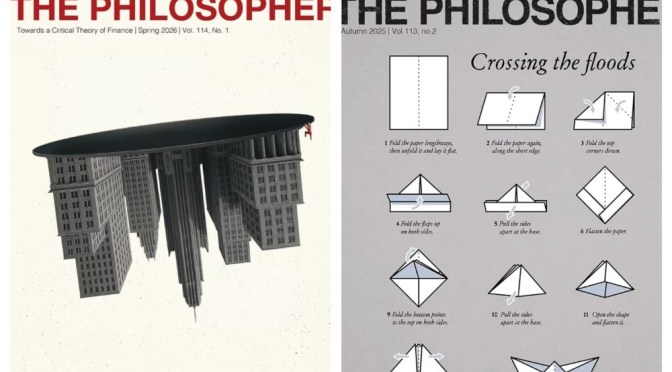
“Towards a Critical Theory of Finance”
An Essay by Paul North
I want to propose four ways to think about ‘finance,’ for those who want to critique it. Critics can think of finance as a parasite, as an organ, as an ongoing struggle, or as a decision. In what follows, I will explore these four different ways to think of finance, these different meanings, and the different possibilities they offer for mounting resistance to it.
Let’s divide talk about finance into two sides. Finance has meanings, but it also has a referent. Its referent is pretty evident to anyone who looks into it. Finance refers to economic functions that have to do with credit. The definition of credit is also pretty straightforward. Credit is value advanced on the promise of future increase. This makes it similar in structure to industrial capital, which is also value advanced on the promise of a future increase. The difference between capital and finance is production. Industrial capital receives its increase when value is invested in production. Say I am a capitalist. With my capital, however I obtained it, I found a company that produces microchips. As microchips roll off the line and are sold, the original value I advanced grows because workers work more than they are paid for and in the extra hours they make more microchips than I need in order to pay the costs.