Tag Archives: London Review of Books

LONDON REVIEW OF BOOKS – NOVEMBER 5, 2026 PREVIEW

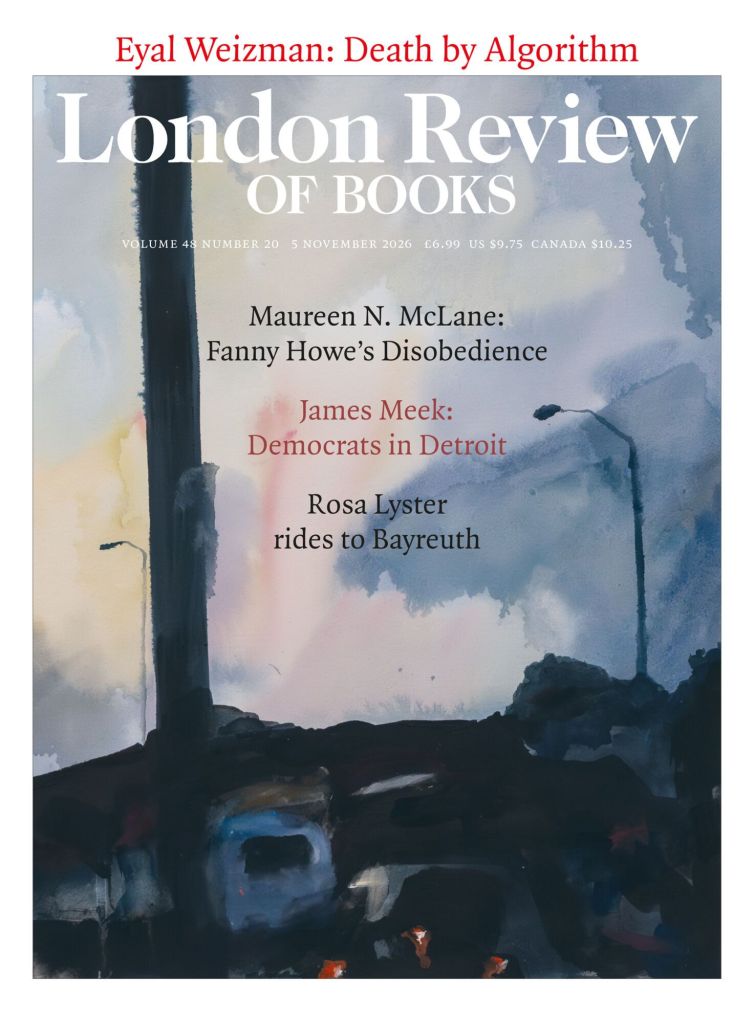
LONDON REVIEW OF BOOKS: The latest issue features  Fanny Howe’s Disobedience by Maureen N. McLane; Democrats in Detroit by James Meek; and Rosa Lyster rides to Bayreuth….

Democrats in Detroit

‘To win the Senate, the Democrats need to hold on to the one Michigan seat (out of two) that is up for grabs, and have chosen a new candidate, Abdul El-Sayed, a moderate leftist in European terms, a “communist loser who hates Jews and Israel” according to Trump, “very, very evil”, per J.D. Vance.’ By James Meek

Is curiosity good for us?

‘The superego – and its precursor, conscience – refers to the part of us that has no curiosity about ourselves. It’s the saboteur of curiosity about ourselves. And that part of us, like a narrow-minded fascist, has only one project: to destroy our pleasures in being alive by trying to kill our curiosity (or by making us frightened of our curiosity, which amounts to the same thing).’ By Adam Phillips

Death by Algorithm

Eyal Weizman on NAZA

‘Israel’s automated targeting system allows for the responsibility for “industrialised annihilation” to be shared between coders, operators, legal officers who pre-set the level of collateral damage, officers who approve the strike, officers who choose the bomb and the pilots or drone operators who launch it. “I am just a small screw in the system,” one of the interviewees says, quoting Eichmann’s defence during his trial in Jerusalem. The system that begins with a phone number being put into a computer system ends with an entire family crushed under the rubble.’
LONDON REVIEW OF BOOKS – OCTOBER 22, 2026 PREVIEW

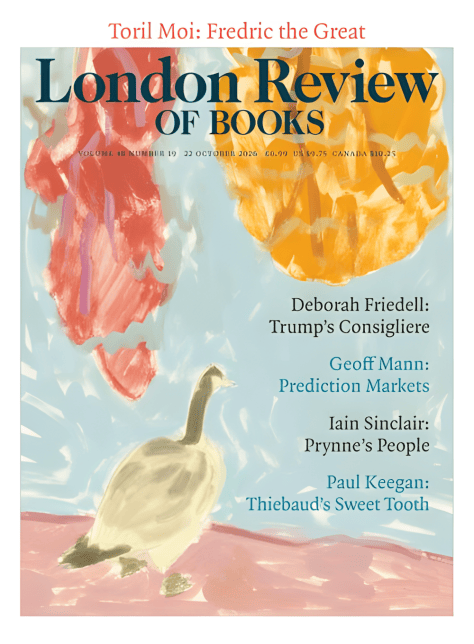
LONDON REVIEW OF BOOKS: The latest issue features  Fredric the Great by Toril Moi; Trump’s Consigliere by Deborah Friedell; Prediction Markets by Geoff Mann; Prynne’s People by Iain Sinclair; and Theibaud’s Sweet Tooth by Paul Keegan….

Fredric the Great

Toril Moi

Fredric Jameson seemed to me to have read absolutely everything. He was the very antithesis of the intellectual type I think of as an empty theoriser, by which I mean someone who endlessly conjectures without having a genuine command of any relevant archive. To look at Fred as a reader of literature is not to reduce the scope of his work, but rather to try to understand its origins.

LONDON REVIEW OF BOOKS – OCTOBER 8, 2026 PREVIEW

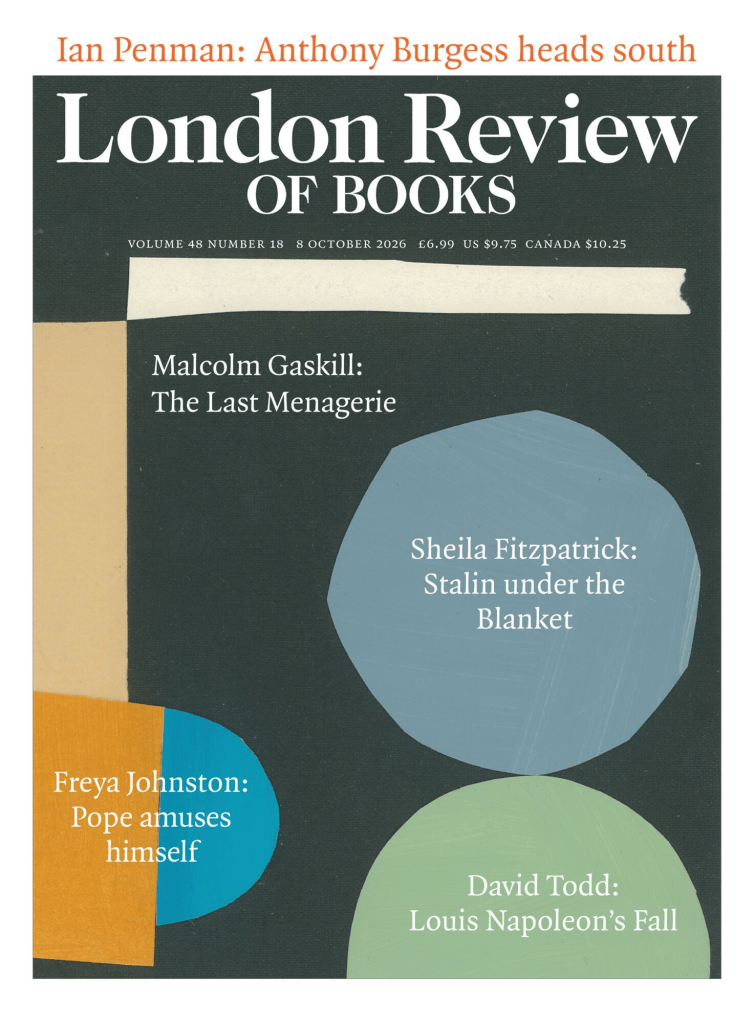
LONDON REVIEW OF BOOKS: The latest issue features major critical reviews and essays spanning Soviet history, geopolitical war gaming, 20th-century literary figures, and avant-garde art.

History & Geopolitics

  • Sheila Fitzpatrick on Stalinism: Fitzpatrick examines Irina Paperno’s Always under Siege: Olga Freidenberg’s Diary-Theory and the Everyday Terror of Stalinism, analyzing how classicist Olga Freidenberg’s secret writings framed the Siege of Leningrad and Soviet surveillance as a totalizing domestic regime.
  • Tom Stevenson on NATO and Russia: Stevenson reviews Carlo Masala’s If Russia Wins: A Scenario and Thomas Newman and John Pierson’s Atlantic Resolve: The War for Estonia, analyzing contemporary Western military simulations and anxieties regarding Baltic security.

Literary Studies & Biography

  • Edmund Gordon on William Golding: Reviewing William Golding: The Faber Letters edited by Tim Kendall, Gordon details the editorial tensions between Golding and Charles Monteith, focusing on substantial cuts to the original draft of Lord of the Flies.
  • Freya Johnston on Alexander Pope: Johnston explores Henry Power’s edition of Alexander Pope: The Major Works, charting the Augustan poet’s biting satire, anxieties, and self-fashioning.
  • Ian Penman on Anthony Burgess: Penman re-evaluates Burgess’s 1966 espionage satire Tremor of Intent, dissecting its baroque style and its uneasy relationship with James Bond.

Art & Culture

Columns and Short Cuts: Additional pieces include Peter Geoghegan on democratic funding reform and Blake Morrison on Luke Kennard’s poetry collection Black Bag.

Em Hogan on Hujar and Thek: Hogan reviews Andrew Durbin’s dual biography The Wonderful World that Almost Was: A Life of Peter Hujar and Paul Thek, profiling the turbulent lives of the photographer and artist against 1960s–1980s New York and the onset of the AIDS crisis.

Dexter Dalwood on Jasper Johns: Dalwood contributes a review of Johns’s exhibition at the Guggenheim Bilbao, evaluating his enduring postwar artistic motifs and printmaking legacy.

LONDON REVIEW OF BOOKS – SEPTEMBER 24, 2026 PREVIEW

LONDON REVIEW OF BOOKS: The latest issue features analyses on geopolitical tensions, national identities, and cultural retrospectives, including pieces on North Korea, English nationalism, Britain’s energy crisis, Italy’s neo-fascist cults, photographer Lisette Model, and a review of Marlon James’s novel.

Fallout: The Inside Story of America’s Failure to Disarm North Korea  by Joel S. Wit.

The West: The History of an Idea 
by Georgios Varouxakis

Twilight of the Dons: British Intellectuals from World War Two to Thatcherism by Colin Kidd

Polis: A New History of the Ancient Greek City-State from the Early Iron Age to the End of Antiquity by John Ma

Voltaire’s Workshop: The Sources of ‘Candide’ by Edward M. Langille

LONDON REVIEW OF BOOKS – SEPTEMBER 10, 2026 PREVIEW

LONDON REVIEW OF BOOKS: The latest issue features…

Good Weird or Bad Weird

By Colin Burrow

Inhabit the Poem: Last Essays by Helen Vendler.

What’s​ the point of literary criticism? In June the University of Exeter announced plans that might make roughly a third of its English department – one of the best in the country – redundant. Other institutions, including Canterbury Christ Church University, have stopped offering English degrees altogether. Most mainstream publishers now wouldn’t dream of publishing a work of literary criticism, as they happily did in the 1970s and 1980s. Even literary biography, literary criticism’s previously marketable stepsister, no longer brings a gleam to a publisher’s eye. The grassroots of the subject are also suffering badly. Since 2000 the number of people taking A-level English literature in England has dropped by around a third, to around 36,000, with an even higher drop among male students.


A Sicilian Man: 
Leonardo Sciascia, the Rise of the Mafia and the Struggle for Italy’s Soul by Caroline Moorehead


The Beast in the Clouds: 
The Roosevelt Brothers’ Deadly Quest to Find the Mythic Giant Panda by Nathalia Holt


The Twitnam Summer: 
Friendship, Satire and the Writing of ‘Gulliver’s Travels’ by Hester Grant

LONDON REVIEW OF BOOKS – AUGUST 13, 2026 PREVIEW

LONDON REVIEW OF BOOKS: The latest issue features…

An Uncomplicated Man – Emily Wilson

The Odyssey, directed by Christopher Nolan.

Christopher Nolan’s $250 million action movie version of Homer’s ancient Greek poem is an entertaining way to hide from the high temperatures for a few hours. Nolan’s trademark jumps and twists in the narrative structure are relatively easy to follow, and appropriate for The Odyssey, a narrative of tales nested in tales. My teenagers had a good time. Unlike some of Nolan’s other films, The Odyssey is not boring, thanks to the source material, which is impossible to mess up entirely. It’s a family-friendly audiovisual spectacle, like an elaborate Fourth of July fireworks display – and with about the same level of narrative and emotional depth.

Beloved Son Felix: Coming of Age in the Renaissance by Felix Platter, translated by Seán Jennett


The Northern Routes to Kingship: 
A History of Scandinavia AD 180-550 by Dagfinn Skre


The Boundless Deep: 
Young Tennyson, Science and the Crisis of Belief by Richard Holmes

The Future in Our Past: The General Strike, 1926-2026 by Callum Cant and Matthew Lee

The Edge of Revolution: The General Strike that Shook Britain by David Torrance

Nine Days in May: The General Strike of 1926 by Jonathan Schneer

Britain’s Revolutionary Summer: The General Strike of 1926 by Edd Mustill

LONDON REVIEW OF BOOKS – JUNE 25, 2026 PREVIEW

The Paper

LONDON REVIEW OF BOOKS: The latest issue features…

Collisions: A Physicist’s Journey from Hiroshima to the Death of the Dinosaurs by Alec Nevala-Lee
The First Fascist: The Life and Legacy of the Marquis de Morès by Sergio Luzzatto

Reminiscences of Tolstoy, Chekhov and Andreyev 
by Maxim Gorky, translated by Bryan Karetnyk


The Masquerade: 
A History of Extravagance and Intrigue by Meghan Kobza

LONDON REVIEW OF BOOKS – MAY 21, 2026 PREVIEW

LONDON REVIEW OF BOOKS: The latest issue features…

Lead Essays & Politics

  • “America’s Afghanistan Delusion” by Tom Stevenson: Stevenson examines the legacy of the War on Terror, arguing that the 2021 withdrawal from Kabul was viewed by the Western establishment as a “mistake” or “cautionary tale” rather than the “crime” he suggests it was. He traces the expansion of American power through “black sites” and military advisers across the globe.
  • “Short Cuts: Labour’s Failure” by James Butler: Butler analyzes the results of the English local elections (held on May 7). He criticizes Keir Starmer’s leadership style as “all injunction and no argument” and explores why national revulsion toward the Labour Party overshadowed local government issues.
  • “Where’s All the Cash?” by John Lanchester: A characteristically lucid investigation into modern economics, focusing on the circulation of physical currency and the shifting nature of wealth in a digital-first economy.

Literature & History

  • “On Marlen Haushofer” by Becca Rothfeld: A deep dive into the work of the Austrian writer, specifically her 1963 masterpiece The Wall. Rothfeld explores Haushofer’s recurring themes of entrapment and isolation, noting the paradoxical “joy” found in her most barricaded characters.
  • “Baltic Snake Cults” by Diarmaid MacCulloch: The eminent historian reviews the long survival of paganism and “serpent worship” in the Baltic regions, challenging the standard narrative of a monolithic Christian Europe during the Middle Ages.
  • “Should We Punish?” by Thomas Nagel: The philosopher engages with the ethics of the penal system, weighing the traditional justifications for punishment against contemporary moral and legal theories.

Other Features

“The Clearance of Aoineadh Mòr, 1824” by Tarn MacArthur: A historical account of the Highland Clearances, specifically focusing on the displacement of communities in Scotland.

At the Movies: Michael Wood provides his regular column of film criticism, likely focusing on current European or art-house releases.

Poetry & Correspondence: The issue also contains poems and a robust letters section, which in this period has been heavily occupied by debates over the Arctic (following Laleh Khalili’s piece in the previous issue) and the fallout of the UK local elections.

LONDON REVIEW OF BOOKS – MAY 7, 2026 PREVIEW

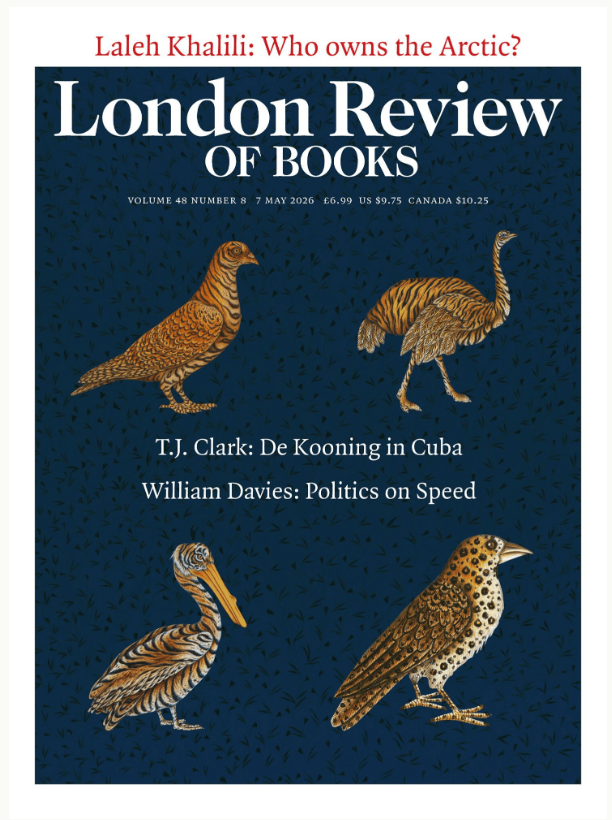
LONDON REVIEW OF BOOKS: The latest issue features ‘Who Owns The Arctic?’ by Laleh Khalili; De Kooning in Cuba by T.J. Clark; Politics on Speed by William Davies…

Who owns the Arctic?

Laleh Khalili

From the 16th century onwards, as European powers feverishly colonised the world, the possibility of a Northern Sea Route connecting the Atlantic to the Pacific, from Scandinavia to the Bering Strait, tantalised the Dutch and the British as an alternative to the southern routes to Asia and the Americas, which were dominated by Portugal and Spain. But the route only became a reality in the Soviet era, after investments in scientific, economic, industrial and military infrastructure in Siberia. 

Politics on Speed

William Davies

This is what distinguishes hyperpolitics from the mass democracy of the mid-20th century. Symbolic political gestures are now commonplace, but paid membership of organisations and parties has plummeted. The left has failed to find a replacement for trade unions as a basis for collective action in civil society. Political movements are easy to join, and just as easy to leave. 

De Kooning in Cuba

T.J. Clark

De Kooning’s Suburb in Havana is a counter-revolutionary painting. Well, of course. It is counter-revolutionary because it is counter everything, versus everything, lost in suburbia. It wants to show us how hard it had to work to get precisely nowhere. Why nowhere was where it wished to get to is a question it leaves to the viewer. 

Orbán’s Fall

Jan-Werner Müller

Can there be poetic justice in politics? Perhaps once in a lifetime. In 1989, a young Viktor Orbán bravely told the crowds in Budapest’s Heroes’ Square that it was time for the Russians to go home, just as protesters had demanded in 1956; almost four decades later, he was heckled on the campaign trail with the same words.

LONDON REVIEW OF BOOKS – APRIL 23, 2026 PREVIEW

LONDON REVIEW OF BOOKS: The latest issue features…

At the National Gallery: Holbein and Henry James

The Language Puzzle: How We Talked Our Way out of the Stone Age by Steven Mithen

Surf’s Up: Brian Wilson and the Beach Boys by Peter Doggett

Kingmaker: Pamela Churchill Harriman’s Astonishing Life of Seduction, Intrigue and Power by Sonia Purnell

Indira Gandhi and the Years that Transformed India by Srinath Raghavan