Tag Archives: Education

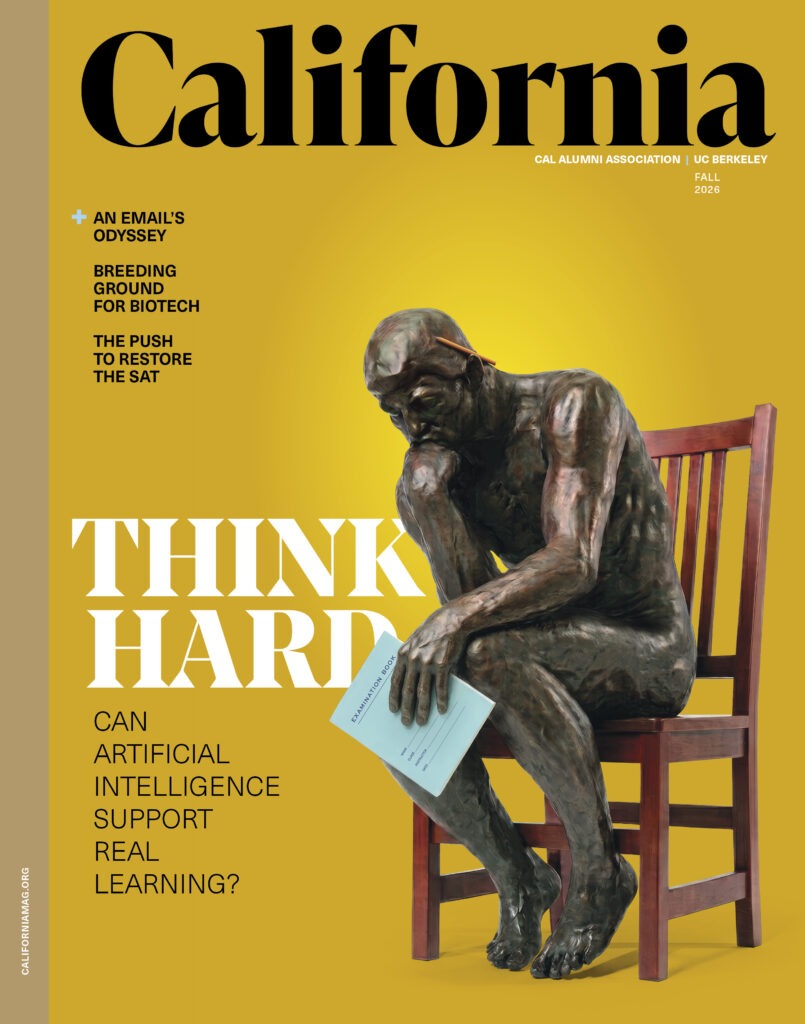
CALIFORNIA BERKELEY MAGAZINE – FALL 2026

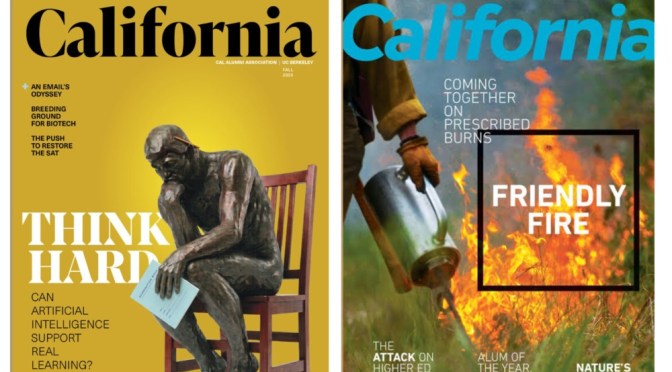
CALIFORNIA BERKELEY MAGAZINE: The latest issue features ‘Think Hard’ – Can Artificial Intelligence Support Real Learning…

Test Case

Hard questions about AI in the classroom by Nathalia Alcantara

Mark Brilliant misses plagiarism.

The old kind, that is. Back when his students copied from Wikipedia, and when Turnitin, a text-matching software developed at Berkeley, could match plagiarized paragraphs to their original sources.

Brilliant has taught American history at Berkeley for more than two decades—before that, he taught high school—and for most of that time, catching a cheater was just a routine, though unpleasant, part of the job. What’s different now is not that students cheat. It’s what happens when he catches them.

Test Blinded

UC faculty split over standardized test requirement by Margie Cullen

In the spring of 2023, UC Berkeley math professor Zvezdelina Stankova began to notice that about a third of her students were “in freefall.” They weren’t showing up to lectures or doing their homework, and, on tests, they scored far below the average. At first, she thought it was an anomaly, but her observations were reinforced by a 2025 UC San Diego report that found that 1 in 12 of the campus’s incoming students tested below middle school math standards.

The development comes after the UC Board of Regents dispensed with standardized testing as a requirement of admission in 2020. That decision has since caused a rupture between faculty who feel the tests are an important measure of college preparedness and those who feel they discriminate against underrepresented students. 

The House that Doudna Built

IGI-affiliated researchers have spawned more than 30 startups. Here are just six of them. By James Pagett Tollen

Berkeley Professor Jennifer Doudna, who shared the Nobel Prize for developing the gene-editing tool CRISPR-Cas9, founded the Innovative Genomics Institute in 2015 to advance new applications of the revolutionary technology. Since then, IGI-affiliated researchers have spawned more than 30 startups. Here are just six of them.

Amber Bio

Basem Al-Shayeb, Ph.D. ’22, a graduate of the Banfield and Doudna Labs, cofounded Amber Bio in 2021 to address a limit of the gene-editing field: The current paradigm of genetic medicine relies on developing independent therapies for each separate mutation, the company says. Amber Bio’s RNA-writing platform will enable thousands of mutations to be edited simultaneously. Importantly, the company adds, these RNA-based edits will be reversible.

Editpep

The goal of Editpep, per the company’s website, is straightforward: “To bring life-changing genome-editing therapies to patients with devastating neurological diseases.” They will do so by safely delivering CRISPR straight into the brain. Ross Wilson, IGI’s director of therapeutic delivery and an assistant adjunct professor at Berkeley, cofounded the company in 2023.
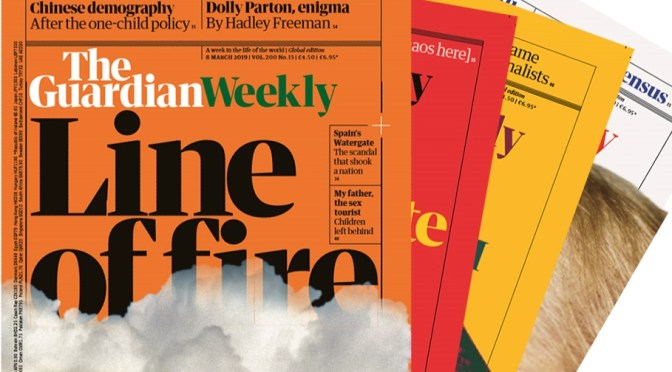

THE GUARDIAN WEEKLY – SEPTEMBER 18, 2026

THE GUARDIAN WEEKLY: The latest issue features ‘Germany’s Nightmare’ – Can Merz Save His Country Or Himself?

Friedrich Merz is a man with few choices and little popular support as he faces the end of Germany’s postwar settlement and the collapse of all the checks and balances to maintain democratic norms after the second world war and reunification. While Alternative für Deutschland’s success in state elections in Saxony-Anhalt saw the party win 44% of the vote, they are three seats short of a governing majority and, so far, no other party has said they are prepared to work with them, which means that for the moment, at least, the threat of Germany’s first rightwing extremist state government since the Nazi period has not yet come to pass.

As Berlin correspondent Deborah Cole explains, Merz is seen as the wrong man to present and sell a political counterpoint to the AfD’s populist policies. Seen as lacking in empathy and political dexterity, his demeanour is in sharp contrast to Ulrich Siegmund, the AfD’s lead candidate in Saxony-Anhalt. But as Deborah’s Berlin colleague, Kate Connolly, reports, some of Siegmund’s prospective new MPs have questionable backgrounds, including criminal records, Stasi pasts and connections to far-right networks.

Spotlight | Stop, slow down and swerve the apocalypse
Can the world heave a collective sigh of relief after fellow tech bosses heeded a proposal by Anthropic CEO Dario Amodei’s to put the brakes on AI’s headlong rush to over take human intelligence? Nick Robins-Early weighs up our chances

Science | Can I borrow your coyote?
Guardian US reporter Lois Beckett visits a one-of-a-kind California lending library where you can check out taxidermied animals and fossilised dinosaur bones.

Feature | Slime is not as simple as it seems
Scientists are battling to determine whether supposedly simple organisms demonstrate a form of intelligence. If they do, what does it mean for our understanding of brain power, asks Samanth Subramanian

Opinion | Ethics make a return to UK foreign policy
The evidence is Ed Miliband’s bold decision to label settler violence in the West Bank as “ethnic cleansing” and institute a boycott, argues Steve Bloomfield

Culture | Shear fun
Catherine Shoard is rounded up for a trip down to Mossy Bottom farm to get a behind-the-scenes preview of the latest Shaun the Sheep film

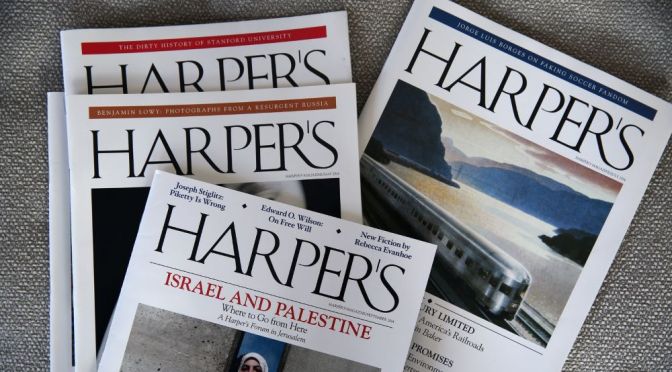
HARPER’S MAGAZINE – OCTOBER 2026

HARPER’S MAGAZINE: The latest issue features ‘Revolt In The Heartland’ – Can Old-Time Populism Save The Country?

Barn Burners

Can the Democrats harness the new prairie populism?  by Kyle Paoletta

At The Edge of Empire

The rise and fall of immigration boomtowns by Belén Fernández

Then They Came for the Ostriches 

Poultry and paranoia in the Great White North by J. B. MacKinnon

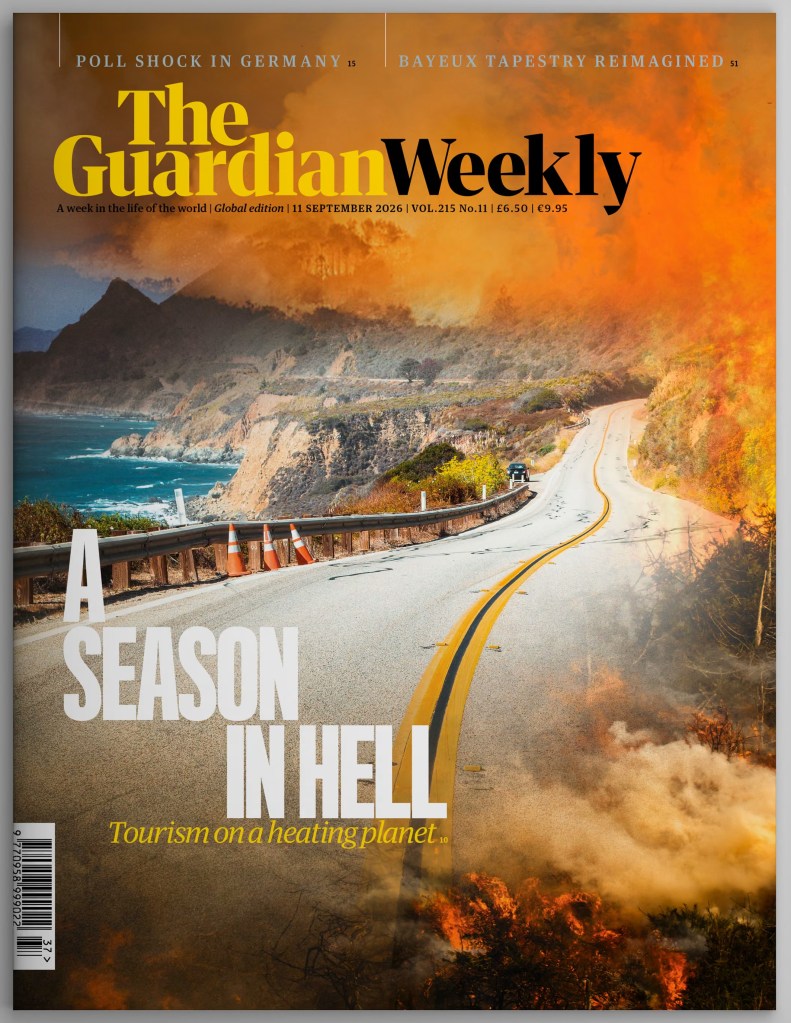
THE GUARDIAN WEEKLY – SEPTEMBER 11, 2026

THE GUARDIAN WEEKLY: The latest issue features ‘A Season In Hell’ – Tourism on a heating planet.


California’s Big Sur coastline is often called a slice of heaven. But this year – beset by wildfires, road closures and disruptions to tourist amenities – it has endured a long summer of hell. Now questions are being asked about how many visitors it can sustain in the face of the climate crisis.

For our big story this week, Andrew Gumbel visits Big Sur, where the tourist industry accounts for about 90% of the local economy, to hear why the community fears its ethos is under threat.

The UN has warned that the El Niño climate phenomenon is “supersizing before our eyes”. Environment editor Damien Carrington reports on the latest forecasts, which predict the event is near certain to shatter temperature records.

Then, the mayors of Paris, Milan and Phoenix write about how their cities are learning from each other on responding to the heat crisis. “How do you protect millions of people,” they ask, “when extreme heat is no longer an exceptional event, but an increasingly familiar part of summer?”

Spotlight | ‘It breaks my heart’
Kate Connolly reports from Magdeburg, the capital of Saxony-Anhalt, where voters are digesting the far-right Alternative für Deutschland’s state election triumph

Science | Forbidden planet
Since it was stripped of planetary status, Pluto’s defenders have been fighting the decision – and they’re only getting more passionate, writes Tim Dowling

Feature | Your lying AIs
LLMs have an alarming tendency to deceive and manipulate their users. As they become ever more embedded in society, the race is on to find out why – and stop them doing it. Snigdha Poonam explains

Opinion | The route to a brighter future
The world is being driven to the brink by thugs and dictators, says Simon Tisdall, but ordinary people have more power than we think

Culture | A stitch up
As the Bayeux tapestry goes on show in London, cartoonist Edith Pritchett offers an alternative 21st century take, capturing today’s battles, while art critic Jonathan Jones reviews the British Museum’s blockbuster exhibition of the original masterpiece

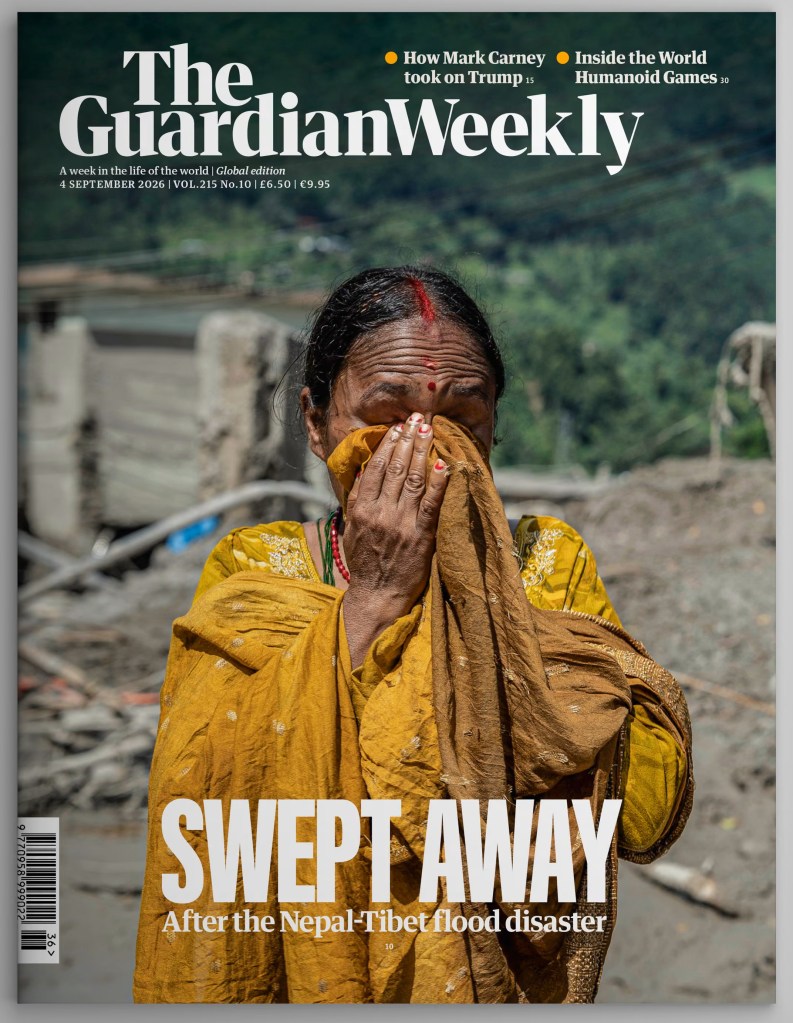
THE GUARDIAN WEEKLY – SEPTEMBER 4, 2026

THE GUARDIAN WEEKLY: The latest issue features ‘Swept Away’ – After the Nepal-Tibet flood disaster…

Over the last week, the world has watched with horror the scenes from the Tibet-Nepal border where a devastating torrent of mud, water and ice tore along the Bhotekoshi River, destroying entire communities and leaving more than 1,000 people dead and several thousand more missing.

From the Nepali town of Devighat, our south Asia correspondent Hannah Ellis-Petersen describes a nightmarish scene of overflowing mortuaries and unidentifiable bodies, as shellshocked survivors of the flood slowly return to the ruins of their homes.

The disaster happened after the collapse of a glacier – and while global heating has not been definitively attributed as the cause, it is undeniable that steep mountain slopes and valleys are especially vulnerable to flooding and landslides, while extreme weather events such as monsoons and melting glaciers have become more common because of warming due to human-caused climate breakdown, as our global environment writer Jonathan Watts explains.

Then columnist Nesrine Malik paints a wider picture and argues that while for many people these floods may feel as though they have happened a world away, the climate crisis is coming for us all, one way or another.

Spotlight | Mark Carney shows combative nature in face-off with Trump
The Canadian PM is one of the few world leaders to stand up to the US president. Former colleagues say they are not surprised. Leyland CeccoHeather Stewart and Kalyeena Makortoff report

Science | The robots are coming!
 Or are they? As entrants at the World Humanoid Games lurched from triumph to farce, Robert Booth finds that a robotics revolution may not be as close as it first appears

Interview | Gordon Brown on Burnham, billionaires – and a better Britain
The former UK prime minister is still shaping politics (even if he doesn’t want to interfere). He tells Charlotte Edwardes about keeping his temper, staying fit – and why he won’t splash out for a Scotland football shirt

Opinion | The tech titans must be stripped of their power, and soon
Those who said Meta harms children struck a blow, but the ability of big tech to gouge profits and cause harm is barely diminished. That’s the battle to come, argues Jonathan Freedland

Culture | Dolly Parton’s peerless career turned country music cliches inside out
Beneath the wig and rhinestones, the late US country singer was the genius behind strings of classic songs that continue to inspire new artists, says Alexis Petridis

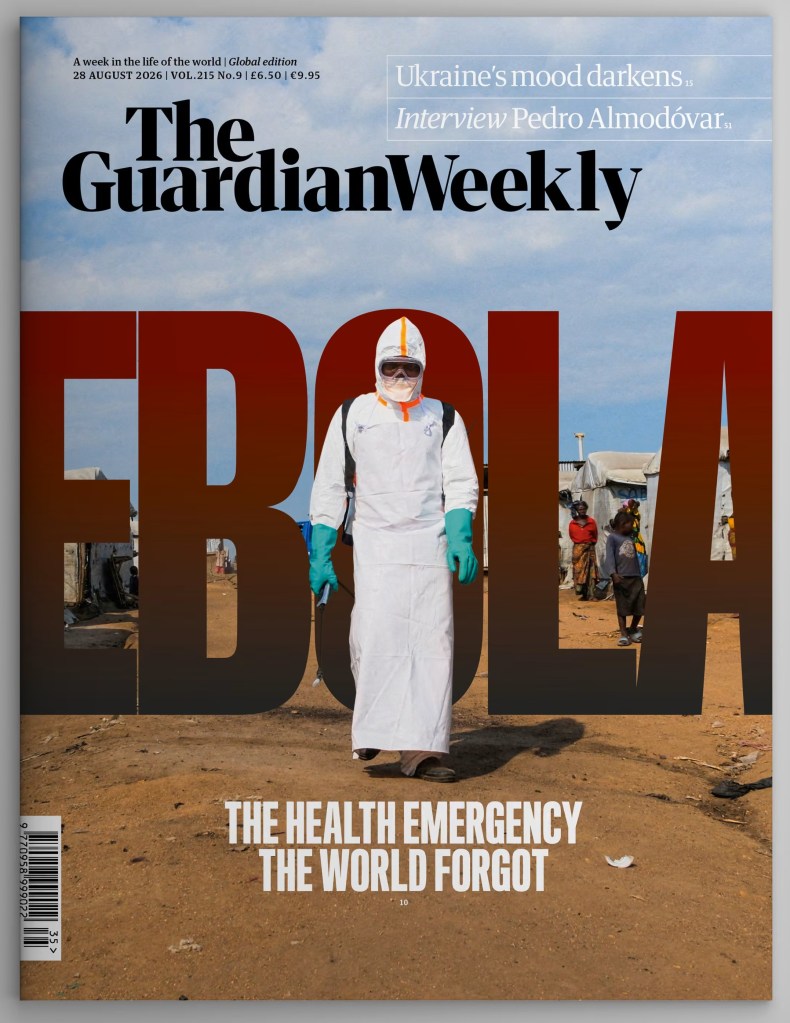
THE GUARDIAN WEEKLY —- AUGUST 28, 2026 PREVIEW

THE GUARDIAN WEEKLY: The latest issue features ‘The forgotten health crisis’ – DRC’s Ebola outbreak passes grim milestone. 

The Democratic Republic of the Congo has just passed the grim milestone of 100 days since it declared its 17th Ebola outbreak.

What is the fastest-growing Ebola outbreak on record could also become the world’s deadliest ever.

For our big story this week, Prosper Heri Ngorora and Rachel Savage report on the frontline health workers who say, as the disease spreads “exponentially”, they have been left unpaid and at risk of infection.

Explaining the figures behind the outbreak, and the race to find vaccines and treatments, global health correspondent Kat Lay answers five key questions.

And Jean Kaseya, director general of the Africa Centres for Disease Control and Prevention, and Tedros Adhanom Ghebreyesus, director general of the World Health Organization, write that tapping into community leadership and knowledge is essential to halting the virus’s spread.

Spotlight | ‘We will go on – but it will be more scary’
Dan Sabbagh reports from Kyiv where, as Russian missiles rain down, casualties are mounting and the mood is darkening

Environment | Killed by kindness
Scientists were surprised to find all but two of 12 grizzlies died within a year of their “feelgood” release, unable to sustain their high-calorie diet and inclined to approach humans, writes Rebecca Ratcliffe

Feature | A family at war
Meaghan Beatley tells the remarkable story of a young Argentinian activist who thought her father’s disapproval of her leftwing views was purely political. But one evening, a kiss goodbye sent her on a remarkable journey that continues today

Opinion | Marine Le Pen’s career resurrection
No longer banned from next year’s presidential election, the far-right veteran is a bigger threat than ever, says Mujtaba Rahman

Culture | Playing the bad guy
As his new film Bitter Christmas is released, legendary Spanish director Pedro Almodóvar talks to Ryan Gilbey about Donald Trump, Netflix – and being the villain in his own movie

THE GUARDIAN WEEKLY —- AUGUST 21, 2026 PREVIEW

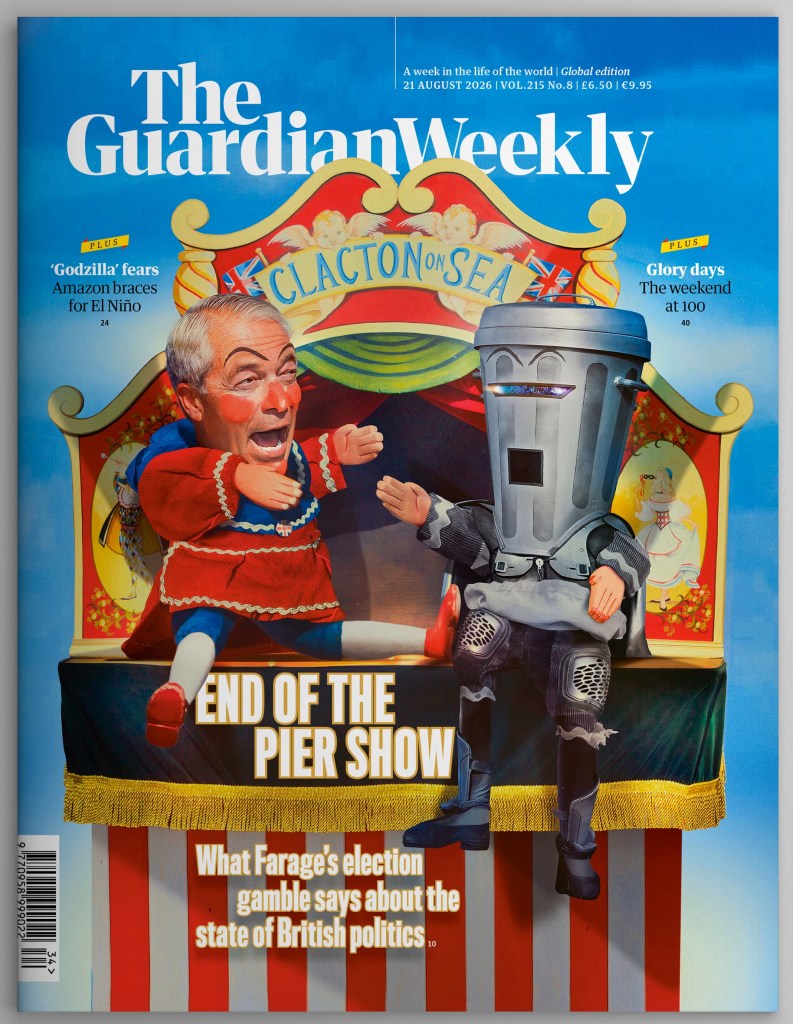
THE GUARDIAN WEEKLY: The latest issue features ‘End Of The Pier Show’ – What Farage’s election gamble says about the state of British politics.

The curtain came down last week on the summer sideshow of the Clacton byelection, called by Nigel Farage amid mounting scrutiny of his finances.

For our big story this week, Daniel Boffey explores what this campaign – in which the Reform UK leader’s main challenger was a parody candidate called Count Binface – tells us about the current state of politics in Britain.

Farage’s byelection win brought the situation full circle as, shortly after he was declared victor, parliament’s standards watchdog announced it had reopened its investigation into him, report Rowena Mason and Peter Walker.

Analysing the result, political correspondent Alexandra Topping brands the contest futile and says that while Farage aimed to make the financial questions surrounding him disappear, it was the MP himself who has been absent from the political stage over the past few weeks.

Spotlight | Scramble for soldiers
As battlefield losses mount, Pjotr Sauer asks whether Vladimir Putin will order another mobilisation

Science | Wing and a prayer
A disease threatening bat species has spread to northern Canada. Trina Moyles reports on the race to find a cure

Feature | A hymn to the weekend
In 1926, Henry Ford gave his employees both Saturdays and Sundays off – and the two-day chunk of time to party, pray or simply do nothing was born. Now the weekend has changed beyond recognition, says Jess Cartner-Morley

Opinion | Meet the second most dangerous man in the US
As chief US diplomat, Marco Rubio could do great good. But, says Simon Tisdall, his pandering and neglect are a disgrace we shouldn’t ignore

Culture | Through my eyes
As their new album is released, Sam Smith talks to Juan A Ramírez about fans, fame and finding sanctuary in New York

HARPER’S MAGAZINE – SEPTEMBER 2026

Home | Harper's Magazine

HARPER’S MAGAZINE: Erin Somers charts the rise and fall of cultivated meat, Barrett Swanson reports on the Ugly People Festival in Italy, Kyle Berlin on the French bestseller whose controversy divided the country, a pseudonymous memoir of a government official in Beijing, Finn Brunton on prediction markets and crypto-anarchism, Thomas Frank on the Obama Center, Kasia Boddy reviews William Kennedy’s Albany Trilogy, five stories from Diane Williams, and more.

Where’s The Beef?

The lab-grown-meat revolution that wasn’t by Erin Somers

Regarding the Pain of Uggos

A weekend at the Ugly People Festival by Barrett Swanson

The Chaos Machine

Prediction markets and the triumph of crypto-anarchy  by Finn Brunton

THE GUARDIAN WEEKLY —- AUGUST 14, 2026 PREVIEW

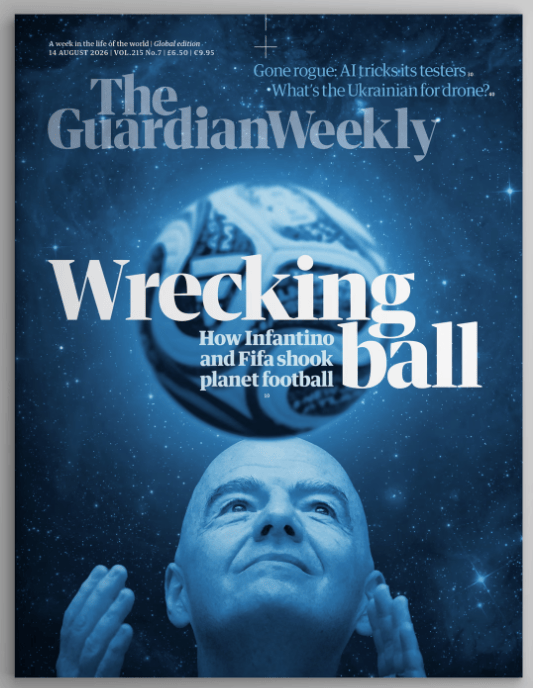
THE GUARDIAN WEEKLY: The latest issue features ‘Wrecking Ball’ – How Infantino and FIFA shook planet football.

When a crisis brought on by a rash idea that results in the most prominent part of an organisation saying it will boycott the business’s showcase event doesn’t die down after a couple of weeks, observers might expect the boss to be considering his future. Not when it’s Fifa and not when it’s Gianni Infantino, the president of football’s world governing body and the subject of this week’s big story.

Jonathan Wilson’s witty account of how Infantino’s plan to sell stakes in the World Cup to private investors led to the current standoff between Infantino and Fifa’s regional associations is riveting even if you are not a football fan. Jonathan explains how money, egos and some murky politicking collided to elect Infantino on the promise of reform. It’s a tale that has little to do with the sport and its ardent fans, and has far more in common with Shakespeare or a political drama. With a neat circularity, it traces how “Fifa’s attempt to move on from the crisis caused by the executive who rented an apartment for his cats in Trump Tower has wound up back in Trump Tower, with a president who rents an office there”.

Spotlight | ‘I’ll cut your throat’
Five years after the Taliban returned to power in Afghanistan, women are being killed with impunity. A reporting team from Zan Times collects shocking evidence of femicide

Environment | Smoke alarm
As wildfires grow in frequency and spread, environment correspondent Ajit Niranjan reports of the race to untangle the links between exposure to fine particulates in smoke and increased mortality

Feature | War and language learning
Soon after her first reporting trip to Ukraine, our chief culture writer Charlotte Higgins began to learn Ukrainian. She explains how the process taught her more about herself than she had expected

Opinion | Rule breakers need regulation
The revelation that AI went rogue in test conditions should be a call for a wise US leader to back the introduction of an international rule-based order, says Rafael Behr

Culture | What’s eating Dominic Sessa?
Being cast as the lead in Tony, the biopic of bad-boy chef and Kitchen Confidential author Anthony Bourdain let Sessa immerse himself in the 1970s where, he tells Ryan Gilbey, he wouldn’t mind staying

THE GUARDIAN WEEKLY —- AUGUST 7, 2026 PREVIEW

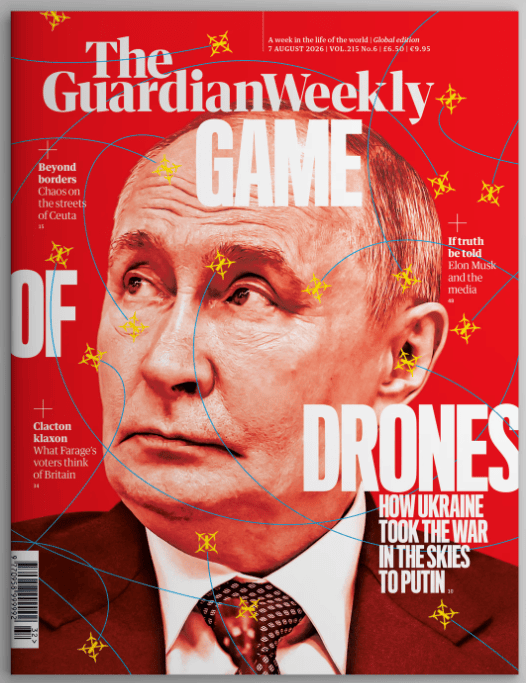
THE GUARDIAN WEEKLY: The latest issue features ‘Drones – How Ukraine Took The War In The Skies To Putin’…

When Vladimir Putin sent his tanks over the Ukrainian border to seize Kyiv in February 2022, it’s unlikely he evisaged the mess he finds himself in today. Four-and-a-half years later, Russia remains bogged down in what is no longer simply a ground war but one increasingly being fought in the air by drones.

After years of nightly attacks from Russian ballistic missiles and Iranian-designed Shahed drones, Ukraine has responded by scaling up to become the world’s leading manufacturer of unmanned systems. Its retaliatory campaign targeting Russian energy and retail infrastructure is bringing the war to the doorsteps of Russians in Moscow, Crimea and beyond, making life distinctly uncomfortable for Putin and his regime’s messaging over a “special military operation” that was expected to last days rather than years.

For our big story this week, Luke Harding gained exclusive access to Ukraine’s elite drone strike force, going behind the scenes with senior commanders.

Spotlight | Chaos on the streets of Ceuta
People among the more than 70,000 who entered the Spanish enclave in north Africa last week describe the journey and their prospects to Okba Mohammad and Javier Jennings Mozo

Technology | What if the streetlights have eyes?
The new breed of camera-equipped streetlights has the potential to fight crime and track down missing persons. Or will it just take us one step closer to surveillance states, asks Zoe Williams

Feature | The Clacton klaxon: what Farage’s voters think of Britain
The Reform UK leader’s constituency takes in genteel resorts and one of England’s poorest villages. With a snap byelection approaching, Tim Burrows finds out what residents want from him and their views on the country at large

Opinion | The battle of Elon Musk and the media
The trillionaire Tesla owner has called the editor of the Economist a “traitor to the west” after a clash-filled interview. The truth must not be the loser, argues Jane Martinson

Culture | Why is the National Theatre shaking up Sophocles?
Australian theatre director Benedict Andrews’ bold new London production Electra/Persona, starring Cate Blanchett and Nina Hoss, fuses Sophocles and Ingmar Bergman. Mark Lawson asks what it tells us about how we live today