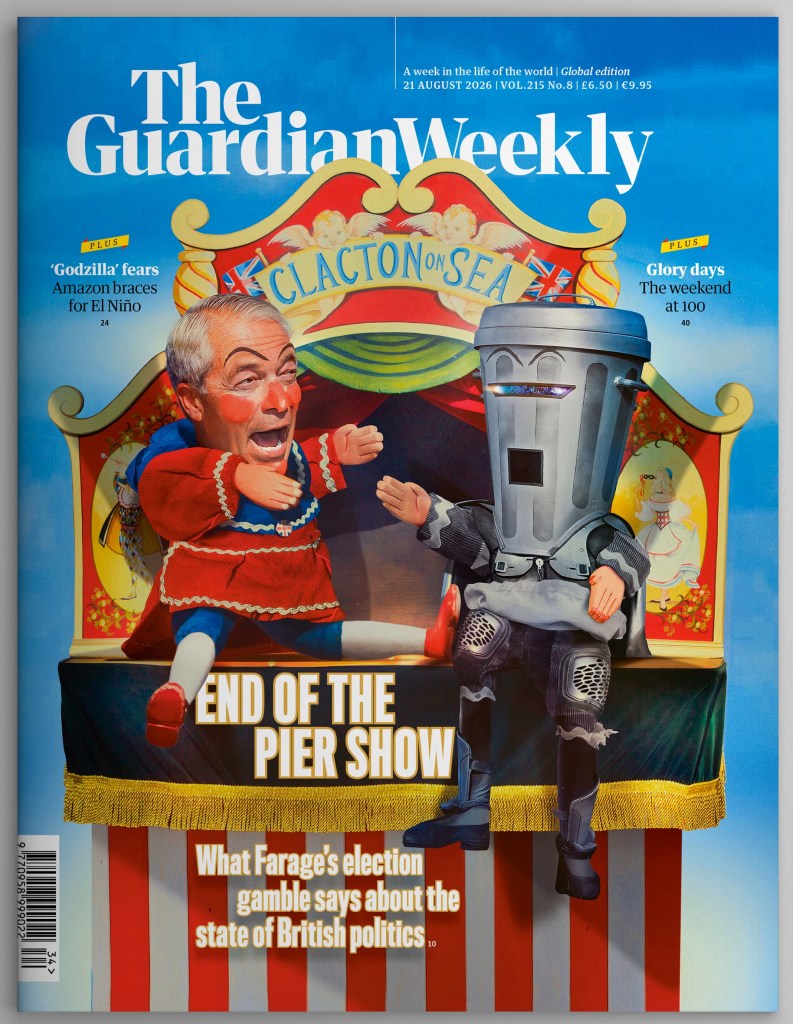
The curtain came down last week on the summer sideshow of the Clacton byelection, called by Nigel Farage amid mounting scrutiny of his finances.
For our big story this week, Daniel Boffey explores what this campaign – in which the Reform UK leader’s main challenger was a parody candidate called Count Binface – tells us about the current state of politics in Britain.
Farage’s byelection win brought the situation full circle as, shortly after he was declared victor, parliament’s standards watchdog announced it had reopened its investigation into him, report Rowena Mason and Peter Walker.
Analysing the result, political correspondent Alexandra Topping brands the contest futile and says that while Farage aimed to make the financial questions surrounding him disappear, it was the MP himself who has been absent from the political stage over the past few weeks.
Spotlight | Scramble for soldiers As battlefield losses mount, Pjotr Sauer asks whether Vladimir Putin will order another mobilisation
Science | Wing and a prayer A disease threatening bat species has spread to northern Canada. Trina Moyles reports on the race to find a cure
Feature | A hymn to the weekend In 1926, Henry Ford gave his employees both Saturdays and Sundays off – and the two-day chunk of time to party, pray or simply do nothing was born. Now the weekend has changed beyond recognition, says Jess Cartner-Morley
Opinion | Meet the second most dangerous man in the US As chief US diplomat, Marco Rubio could do great good. But, says Simon Tisdall, his pandering and neglect are a disgrace we shouldn’t ignore
Culture | Through my eyes As their new album is released, Sam Smith talks to Juan A Ramírez about fans, fame and finding sanctuary in New York
On September 20, 2001, President George W. Bush gave a major speech to Congress and the country in which he outlined the coming U.S. response to al-Qaeda’s 9/11 attack. He said, “Our war on terror begins with al-Qaeda, but it does not end there. It will not end until every terrorist group of global reach has been found, stopped, and defeated.” Thus began what would soon be known as the “Global War on Terror,” or GWOT, in its unlovely acronym
It’s a confusing time to be a man. For decades, the cultural left has insisted that “toxic masculinity” is roaming the land, threatening women’s safety and rights.
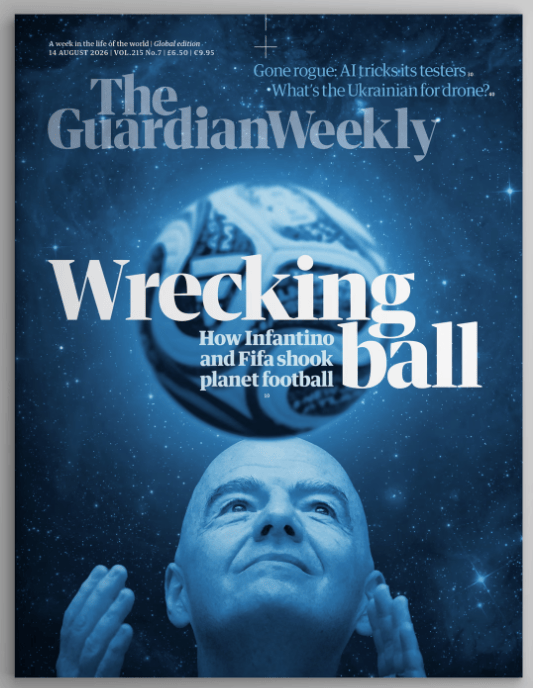
When a crisis brought on by a rash idea that results in the most prominent part of an organisation saying it will boycott the business’s showcase event doesn’t die down after a couple of weeks, observers might expect the boss to be considering his future. Not when it’s Fifa and not when it’s Gianni Infantino, the president of football’s world governing body and the subject of this week’s big story.
Jonathan Wilson’s witty account of how Infantino’s plan to sell stakes in the World Cup to private investors led to the current standoff between Infantino and Fifa’s regional associations is riveting even if you are not a football fan. Jonathan explains how money, egos and some murky politicking collided to elect Infantino on the promise of reform. It’s a tale that has little to do with the sport and its ardent fans, and has far more in common with Shakespeare or a political drama. With a neat circularity, it traces how “Fifa’s attempt to move on from the crisis caused by the executive who rented an apartment for his cats in Trump Tower has wound up back in Trump Tower, with a president who rents an office there”.
Spotlight | ‘I’ll cut your throat’ Five years after the Taliban returned to power in Afghanistan, women are being killed with impunity. A reporting team from Zan Times collects shocking evidence of femicide
Environment | Smoke alarm As wildfires grow in frequency and spread, environment correspondent Ajit Niranjan reports of the race to untangle the links between exposure to fine particulates in smoke and increased mortality
Feature | War and language learning Soon after her first reporting trip to Ukraine, our chief culture writer Charlotte Higgins began to learn Ukrainian. She explains how the process taught her more about herself than she had expected
Opinion | Rule breakers need regulation The revelation that AI went rogue in test conditions should be a call for a wise US leader to back the introduction of an international rule-based order, says Rafael Behr
Culture | What’s eating Dominic Sessa? Being cast as the lead in Tony, the biopic of bad-boy chef and Kitchen Confidential author Anthony Bourdain let Sessa immerse himself in the 1970s where, he tells Ryan Gilbey, he wouldn’t mind staying
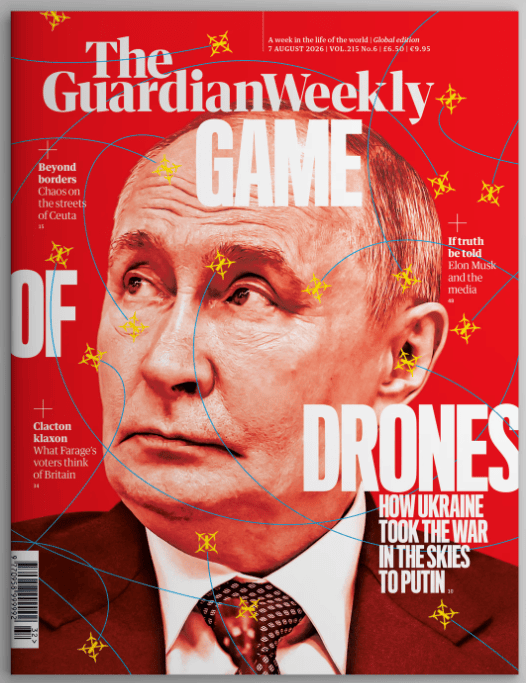
When Vladimir Putin sent his tanks over the Ukrainian border to seize Kyiv in February 2022, it’s unlikely he evisaged the mess he finds himself in today. Four-and-a-half years later, Russia remains bogged down in what is no longer simply a ground war but one increasingly being fought in the air by drones.
After years of nightly attacks from Russian ballistic missiles and Iranian-designed Shahed drones, Ukraine has responded by scaling up to become the world’s leading manufacturer of unmanned systems. Its retaliatory campaign targeting Russian energy and retail infrastructure is bringing the war to the doorsteps of Russians in Moscow, Crimea and beyond, making life distinctly uncomfortable for Putin and his regime’s messaging over a “special military operation” that was expected to last days rather than years.
For our big story this week, Luke Harding gained exclusive access to Ukraine’s elite drone strike force, going behind the scenes with senior commanders.
Spotlight | Chaos on the streets of Ceuta People among the more than 70,000 who entered the Spanish enclave in north Africa last week describe the journey and their prospects to Okba MohammadandJavier Jennings Mozo
Technology | What if the streetlights have eyes? The new breed of camera-equipped streetlights has the potential to fight crime and track down missing persons. Or will it just take us one step closer to surveillance states, asks Zoe Williams
Feature | The Clacton klaxon: what Farage’s voters think of Britain The Reform UK leader’s constituency takes in genteel resorts and one of England’s poorest villages. With a snap byelection approaching, Tim Burrows finds out what residents want from him and their views on the country at large
Opinion | The battle of Elon Musk and the media The trillionaire Tesla owner has called the editor of the Economist a “traitor to the west” after a clash-filled interview. The truth must not be the loser, argues Jane Martinson
Culture | Why is the National Theatre shaking up Sophocles? Australian theatre director Benedict Andrews’ bold new London production Electra/Persona, starring Cate Blanchett and Nina Hoss, fuses Sophocles and Ingmar Bergman. Mark Lawson asks what it tells us about how we live today
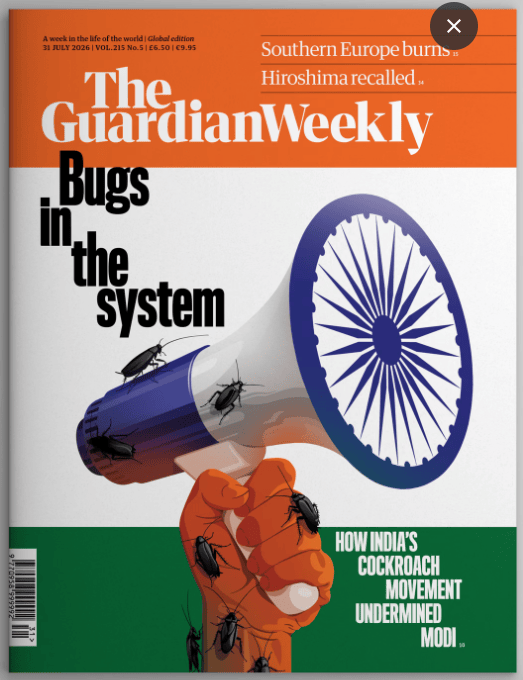
The news agenda has been so dominated for many months by a few big stories about perennial global hotspots and the biggest figures on the international stage, that one could accuse journalists of missing what was happening outside the US, Middle East or Ukraine. But as our south-east Asia correspondent, Hannah Ellis-Petersen, explains for this week’s big story, the rapid rise and sudden explosion on to the streets of India’s Cockroach Janta party took everyone – especially Narendra Modi’s government – by surprise.
What began as a satirical protest when the chief justice of India compared the country’s unemployed youth to cockroaches has damaged prime minister Modi’s image as a “strongman” leader and loosened his grip over the media. But as Hannah explains, it’s not just that the joke has “legs” and strong visuals; young people want a viable future and change.
Spotlight | ‘Smoke covered the sun’ Angelique Chrisafis hears from people evacuated from France’s Gironde region near Bordeaux as southern Europe battles wildfires, the spread and ferocity of which have shocked everyone
Spotlight | Blue horizons for Gaza’s children Sea pools made out of sandbags and rubble are part of Amjed Tantesh’s project to give traumatised children a brief respite from war, reports his niece and our Gaza reporter Seham Tantesh
Feature | A Hiroshima journey from anger to peace Simon Hattenstone meets Koko Kondo, who survived the dropping of the atom bomb on Hiroshima and hears about the publication of her father’s long-forgotten diary written in the aftermath of that horrific day in 1945
Opinion | Andy Burnham’s ticket to major change The UK prime minister’s first policy announcement on cut-price bus fares signals more than a cheap gimmick, says Jonathan Freedland
Culture | John Carpenter interview The uncompromising film director talks to Steve Rose about his shock and horror Hollywood career and his new music album






 Intellicurious