Tag Archives: Arts & Culture

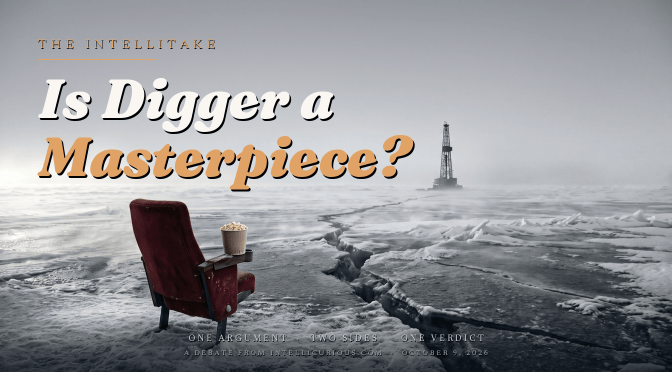
IS DIGGER A MASTERPIECE?

The Intellitake
ONE ARGUMENT · TWO SIDES · ONE VERDICT · DAILY
Friday, October 9, 2026 · The Digger Debate

THE OFFICIAL FINAL TRAILER · WARNER BROS. PICTURES

“

This is the first film I can think of that could be the last great film we may see.

THE THESIS — DAVID THOMSON, UNHERD

THE ARGUMENT

Digger, Alejandro Iñárritu’s $125 million satire, opened October 2 with Tom Cruise as an oil tycoon whose Arctic drilling sets off a planetary catastrophe. In UnHerd, the film historian David Thomson, author of The Biographical Dictionary of Film, calls it a flawed masterpiece and does not flinch from the flaws. The fable is “striking yet shallow.” Supporting characters are “introduced but not adequately explored.” Cruise, he writes, “is so terrified of being boring he cannot stoop to stillness or quiet.”

And yet. Thomson sees Cruise’s paunchy, manic Digger as a portrait of an age in which “the idiotic has become axiomatic,” a domineering, foolish authority convinced that power justifies whatever it wants. Beneath the performance is a look he finds more frightening than any horror film: “A look of gray ice pervades the movie; primary colors have been eliminated.” “There is no human touch any longer.”

A film about the end of the world, in other words, that looks the way the end of the world would look.

vs
THE ANSWER

Most American critics saw a different movie. At RogerEbert.com, Robert Daniels writes that “Digger chokes on its own ambitions, and very few of the picture’s participants emerge still breathing.” The film, he argues, never commits to its own high concept, and its dialogue preaches: “Every line explicitly explains the vapid evil espoused by craven industrialists against our fragile environment.”

William Bibbiani of TheWrap goes after the politics. A satire of billionaires that never threatens one is just flattery for the audience: “We are powerless to stop them, but we do get to point and giggle.” Of Cruise: he “hasn’t done this much caps-locked ‘ACTING’ in many years.”

On this reading, Digger is the thing it mocks: an expensive spectacle of the apocalypse that lets everyone go home feeling superior to it.

iC
THE INTELLITAKE

Read closely and the critics agree on every fact. The script is thin. Cruise is loud. The satire draws no blood. The look is extraordinary. The quarrel is over what a film is for. Daniels and Bibbiani grade Digger as an argument, and as an argument it fails: nobody leaves the theater changed about oil or billionaires. Thomson grades it as an artifact, something a future might dig up to learn what we looked like, and as an artifact it may be priceless.

Thomson’s tell is his title. He calls it the masterpiece “we deserve.” A culture that can only process its own ending as a $125 million entertainment starring Tom Cruise has made a film that is exactly that, and the film’s inability to be anything better is the most honest thing in it. The critics who wanted it to be smarter were asking the mirror to improve the face.

So: not a masterpiece, by the ordinary standard that a masterpiece knows what it is doing. But Thomson has the longer view, and he may be right that films of this scale and this nerve are ending. If so, Digger is less the last great film than the last great gesture, a studio spending a fortune to make a picture of the world with no human touch left in it. That is worth seeing, if only once.

TODAY’S PROVOCATION

Can a work of art about our stupidity be anything other than stupid, and would we recognize it if it were?

Read the originals: David Thomson, “Digger: the flawed masterpiece we deserve,” UnHerd, Oct. 2 · Robert Daniels, RogerEbert.com, Sept. 29 · William Bibbiani, TheWrap, Sept. 29.

— THE EDITORS, INTELLICURIOUS —

CAN JANE EYRE FREE CHINA?

The Intellitake
ONE ARGUMENT · TWO SIDES · ONE VERDICT · DAILY
Saturday, October 3, 2026 · The Jane Eyre Debate
“

It should provide some hope, though, that Chinese officials have done something without meaning to.

THE THESIS — PHILIP HENSHER, UNHERD

THE ARGUMENT

This fall, China made Charlotte Brontë’s Jane Eyre compulsory reading for 14- and 15-year-olds across the country. Writing in UnHerd, the novelist Philip Hensher notes the official reasoning, as reported in the Party-backed press: “the innocent, budding stage of first love is a crucial period for shaping a well-rounded personality.”

Hensher thinks Beijing has assigned more than a love story. Jane is the orphan who tells her cruel aunt that “the very thought of you makes me sick,” and she grows into a woman who answers to her own conscience rather than to the man with power over her. Those are dangerous lessons, he suggests, to hand every teenager in a country that ranks 178th of 180 in the World Press Freedom Index.

His conclusion is hopeful. A state that assigns a book about speaking the truth may be teaching it.

vs
THE ANSWER

The reporting tells a different story. China has had Jane Eyre for a century. A Chinese translation appeared in 1925, and a 1979 British film adaptation played in Chinese theaters as the country reopened after the Cultural Revolution (New York Times). Generations have read it, and the system has stood.

The choice also looks deliberate. Beijing Daily pitched the novel as a counterweight to social media’s “superficial notions about appearance and wealth” (CNN). UC San Diego scholar Ping Zhu told the Times that Jane is “an independent woman, but she’s not too outrageous in her challenge of patriarchal power.” She ends the book married and a mother, which fits a government urging young people to start families.

On this view, Beijing didn’t assign a rebel by accident. It chose a heroine whose independence ends in a home.

iC
THE INTELLITAKE

Both sides are reading the same novel and stopping at different chapters. Beijing assigned Jane Eyre for its ending: the marriage, the home, love that money can’t buy. Hensher is betting on its beginning: the child who talks back and the young woman who walks away from Thornfield with nothing rather than betray herself.

Notice what the two arguments share. Each assumes a book does what its readers are told it does. A ministry can set the exam question, but not the moment a 15-year-old reaches Jane’s declaration, “I am no bird; and no net ensnares me.” A novel doesn’t topple a government. It builds an inner life, and inner lives are the one thing no curriculum fully controls.

There is something worth admiring in the choice itself. A nation that wants its teenagers to value character over wealth reached for a Victorian Englishwoman’s conscience, and trusted 14-year-olds with it. Whatever Beijing intends, it has given millions of young readers a heroine who insists on choosing for herself.

TODAY’S PROVOCATION

Can a government assign a book without assigning what it means?

— THE EDITORS, INTELLICURIOUS —

Country Life Magazine – March 5, 2025 Preview

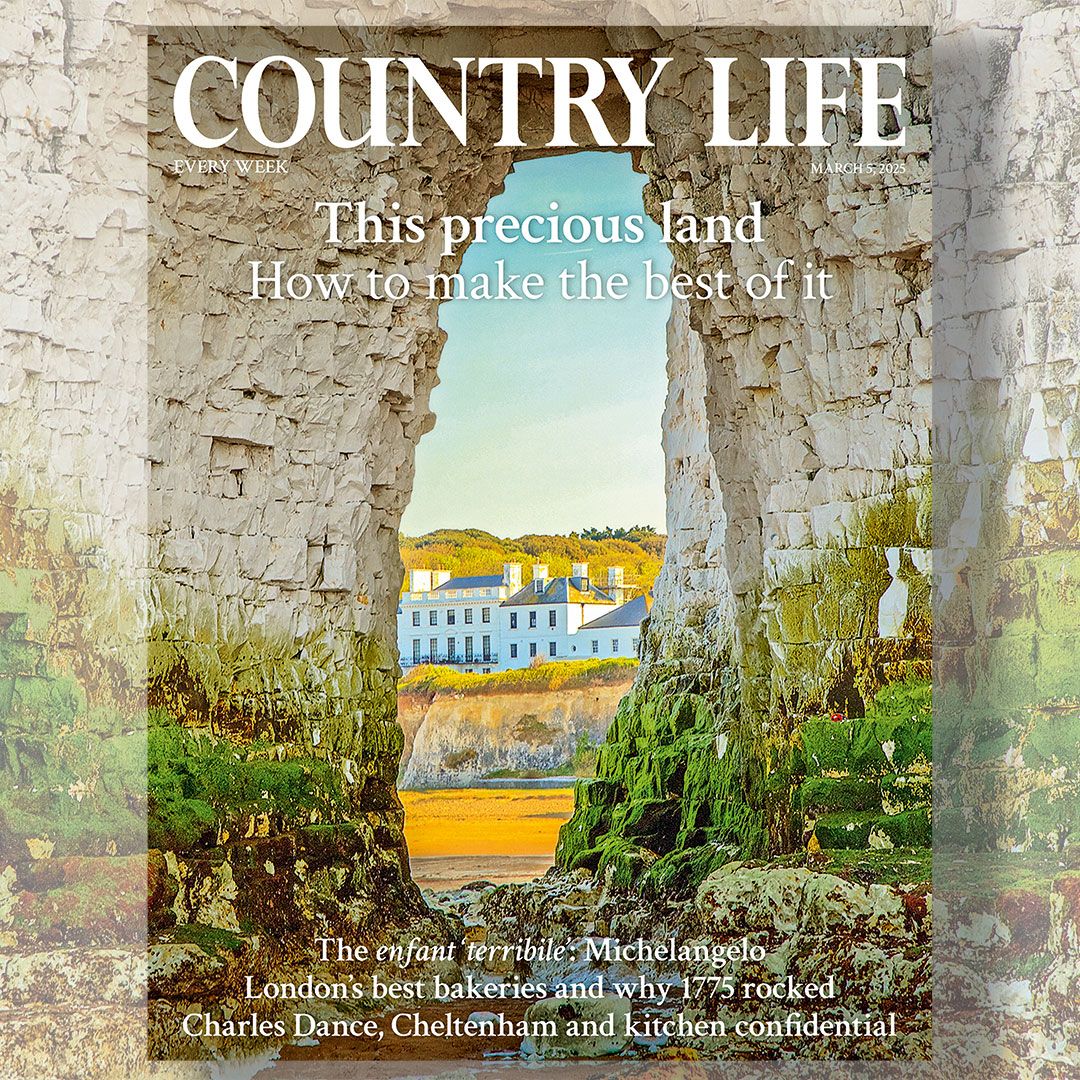
Cover of Country Life 5 March 2025

COUNTRY LIFE MAGAZINE (March 4, 2025): The latest issue features ‘The enfant terribile’ – Michelangelo; London’s best bakeries and why 1775 rocked; Charles Dance; Cheltenham and kitchen confidential…

The year the stars came out

A host of luminaries that were born in 1775 still shape British identity some 250 years on, as Matthew Dennison discovers

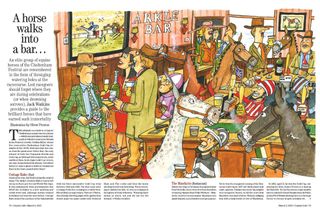
A horse walks into a bar…

Jack Watkins raises a glass to the Cheltenham superstars immortalised in the bars and restaurants at Prestbury Park

Spread from Country Life 5 March 2025

Interiors

Amelia Thorpe cooks up a real treat with the latest inspiration and innovations for the kitchen

London Life

– Amie Elizabeth White celebrates 100 years of the Dickens museum, plus Country Life’s guide to the best baked goods in the capital

Arts & antiques

Charles Dance talks to Carla Passino about Michelangelo, mentoring and why the Sistine chapel is like playing King Lear

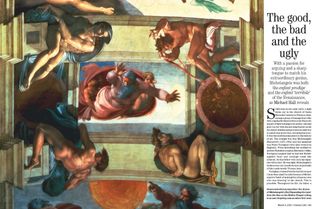
The good, the bad and the ugly

Michael Hall delves into the genius of Michelangelo, at once the enfant prodige and enfant terribile of the Renaissance

Spread from Country Life 5 March 2025

Simon Martin’s favourite painting

The art-gallery director selects a beguiling 17th-century miniature revealing a connection to Nature

A regal renewal

John Goodall hails the revival of Restoration House in Kent, a magnificent property that welcomed Charles II in 1660

Spread from Country Life 5 March 2025

The legacy

Agnes Stamp hails the ‘British Barnum’ Charles Cruft, whose dog show is still best in class

Shiver me timbers

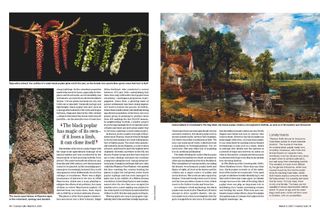
The once-popular black poplar could be our secret weapon in the battle against climate change, finds Vicky Liddell

Spread from Country Life 5 March 2025

The good stuff

Hetty Lintell’s top tips on what to wear to the Cheltenham Festival

And it was all yellow

Charles Quest-Ritson brightens his day with the cheerful flowers of the ever-dependable forsythia

Sharp practice

The thorny old issue of pruning roses, with Charles Quest-Ritson

Foraging

Is tapping birch-tree sap worth the bother, asks John Wright

Travel

Emma Love shares the latest cruise news, Imogen West-Knights finds everything shipshape in the South of France, John Niven follows in the wake of Mr Mississippi Mark Twain and Pamela Goodman’s birthday treats take on a life of their own

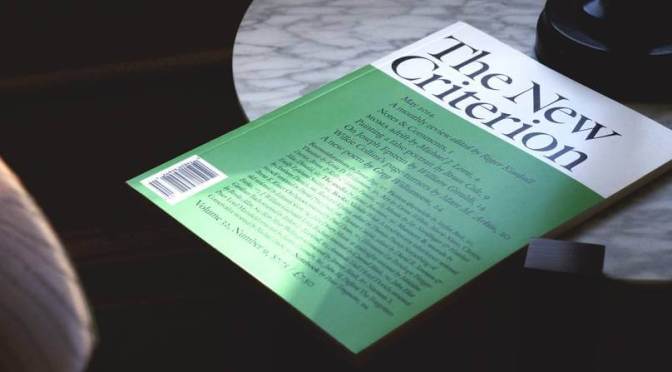
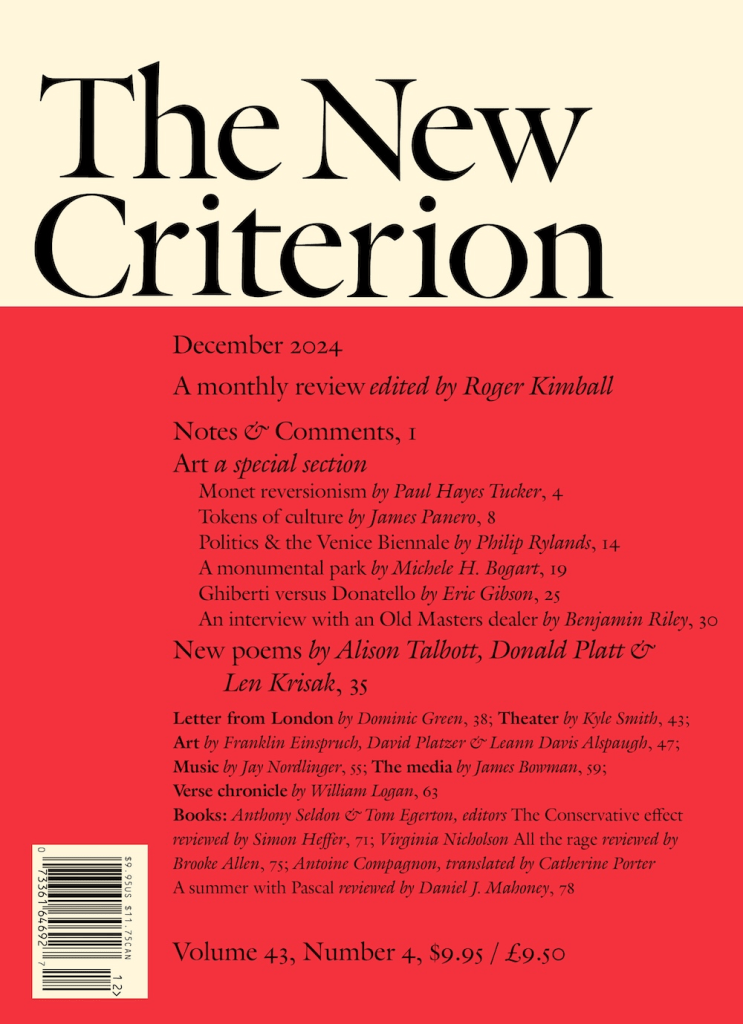
Arts & Culture: The New Criterion -December 2024

The New Criterion – The December 2024 issue features…

Art: a special section

An interview with an Old Masters dealer by Benjamin Riley

Monet reversionism by Paul Hayes Tucker

Tokens of culture by James Panero

Politics & the Venice Biennale by Philip Rylands

A monumental park by Michele H. Bogart

Ghiberti versus Donatello by Eric Gibson

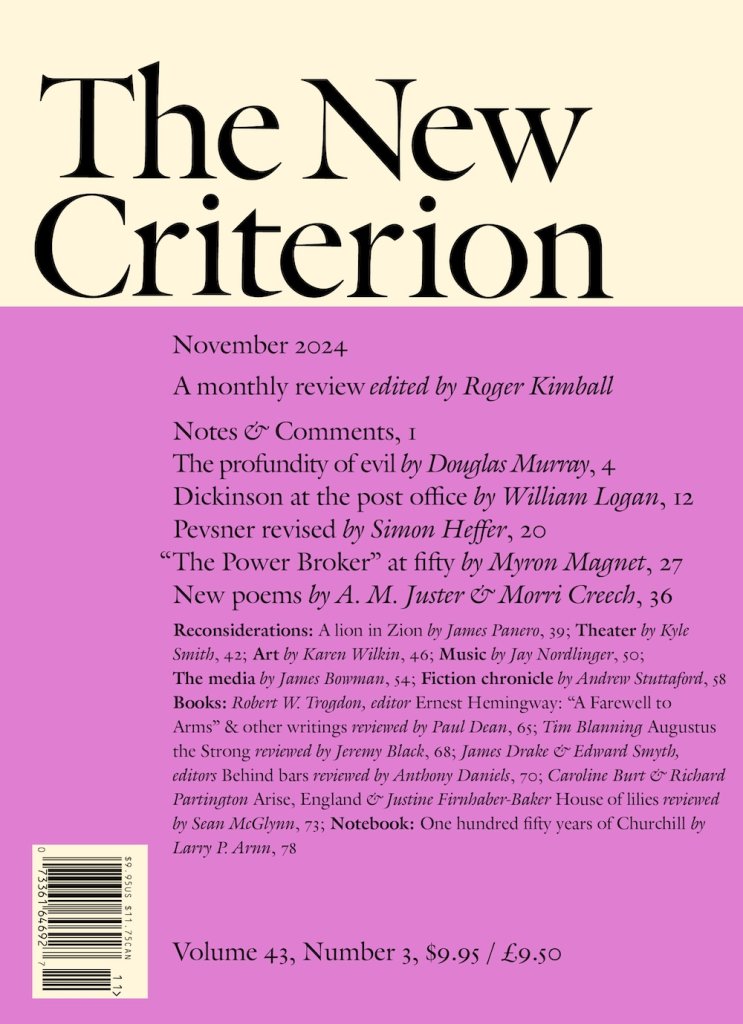
Arts & Culture: The New Criterion -November 2024

Image

The New Criterion – The November 2024 issue features…

The profundity of evil by Douglas Murray

Emily Dickinson at the post office by William Logan

Pevsner revised by Simon Heffer

“The Power Broker” in perspective by Myron Magnet

Arts & Culture: The New Criterion -October 2024

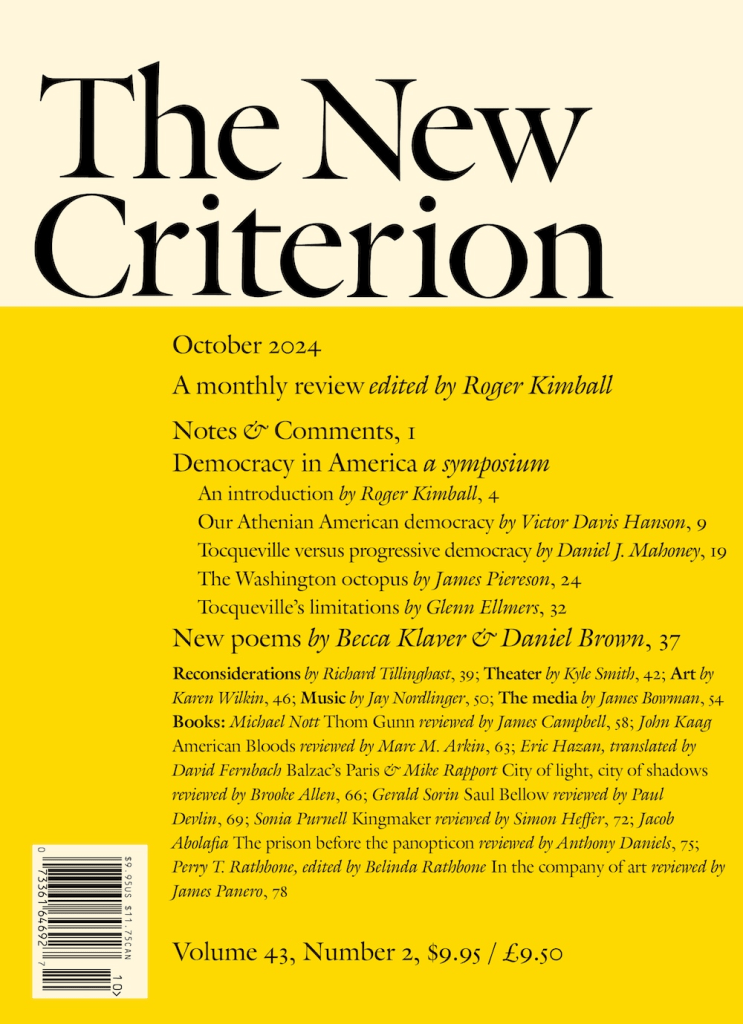
The New Criterion – The October 2024 issue features…

Democracy in America: a symposium

Tocqueville’s limitations by Glenn Ellmers

Democracy in America: an introduction by Roger Kimball

Our Athenian American democracy by Victor Davis Hanson

Tocqueville versus progressive democracy by Daniel J. Mahoney

The Washington octopus by James Piereson

Arts & Culture: The New Criterion – Sept 2024

Image

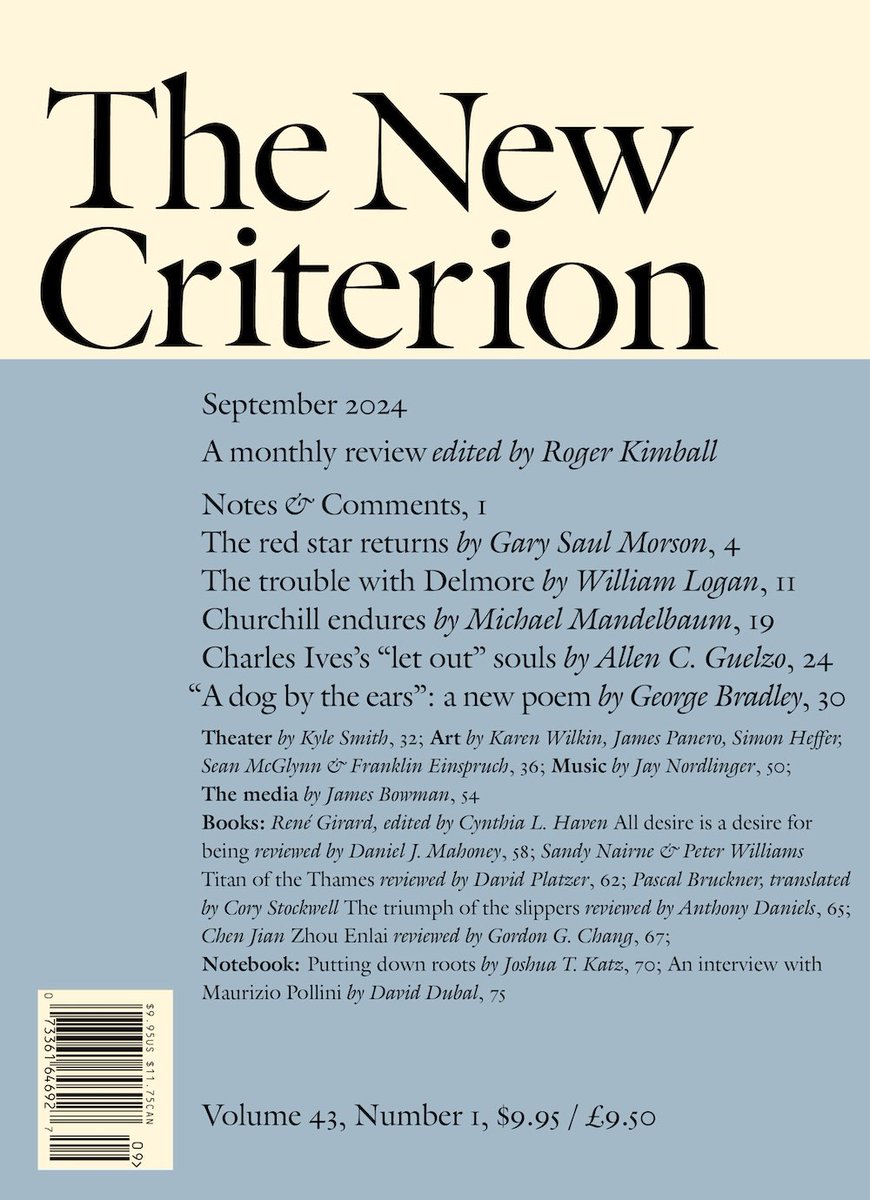
The New Criterion – The September 2024 issue features ‘The red star returns’; The trouble with Delmore; Churchill endures; Charles Ive’s “let out” souls; Theater, Arts, Music and The Media….

Arresting scenes

On John Constable’s The Hay Wain & the foundations of the West.

We write as The New Criterion’s annual period of aestivation enters its home stretch. The cicadas are buzzing, the days are noticeably shorter, and the leaves—some of them—are already edged with brown. Certain summers feature quiet expanses of lazy days. This one was different. In July, Donald Trump, except for the tip of his right ear, dodged a would-be assassin’s bullet; Joe Biden dropped (or, we now know, was pushed) out of the 2024 presidential race but, as of this writing, remains president; Kamala Harris, Biden’s vice president, stepped into the vacancy and magically became the new candidate for president, choosing the Minnesota governor Tim Walz as her running mate. 

The New Criterion – June 2024 Arts/Culture Preview

The New Criterion – The June 2024 issue features:

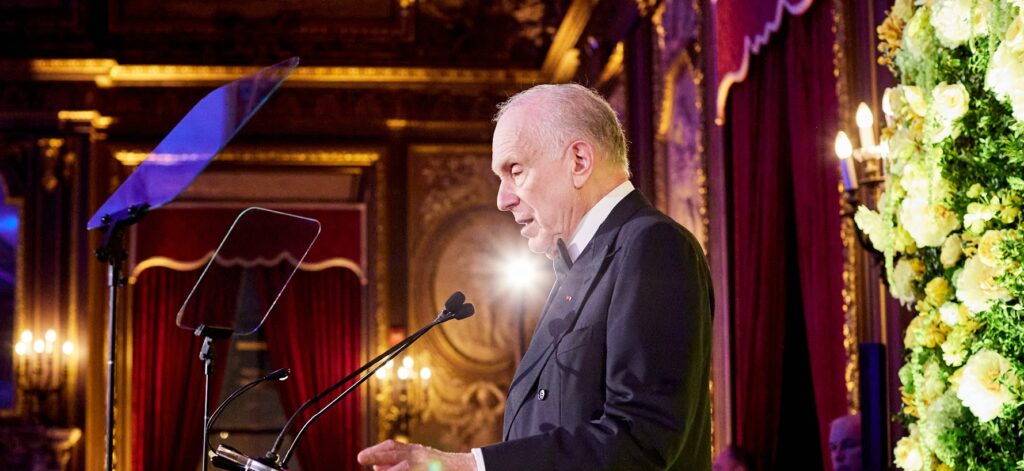
Protecting America’s promise

by Ronald S. Lauder

On combating anti-Semitism & anti-Americanism.

All the rage

by Victor Davis Hanson

On White Rural Rage by Tom Schaller & Paul Waldman.

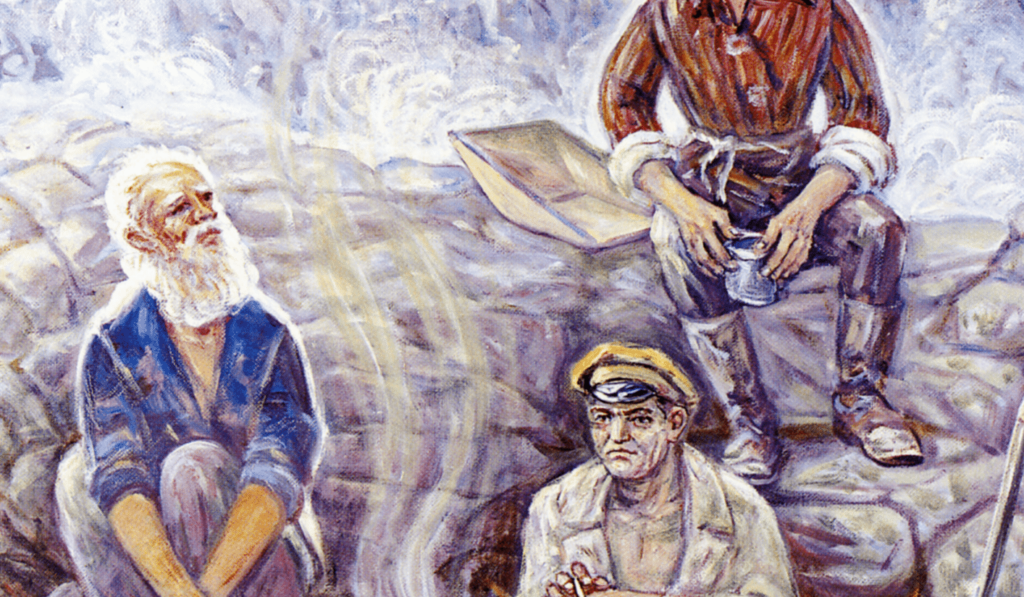
The masterpiece of our time

by Gary Saul Morson

On The Gulag Archipelago at fifty.

Building Palm Beach

by Benjamin Riley

On the town’s history & architecture.

The New Criterion – April 2024 Arts/Culture Preview

Image
The New Criterion – The April 2024 issue features:

Poetry a special section
Black poetry  by William Logan
Shakespeare’s words  by Amit Majmudar
Bachmann: the unspeakable spoken  by Peter Filkins
The new & the old  by Katie Hartsock
The answer to Lord Chandos  by Pascal Quignard

New translations  by Ryan Choi, Frederick Amrine, Patrick Whalen & Beverley Bie Brahic

The New Criterion – March 2024 Preview

The New Criterion – The March 2024 issue features:

Israel’s eternal dilemma  by Victor Davis Hanson
Enrique Gómez Carrillo  by Anthony Daniels
The singularity of speech  by Wilfred M. McClay
A life in ballet  by Peter Martins

New poems  by Amit Majmudar, James Matthew Wilson & Michael Casper