
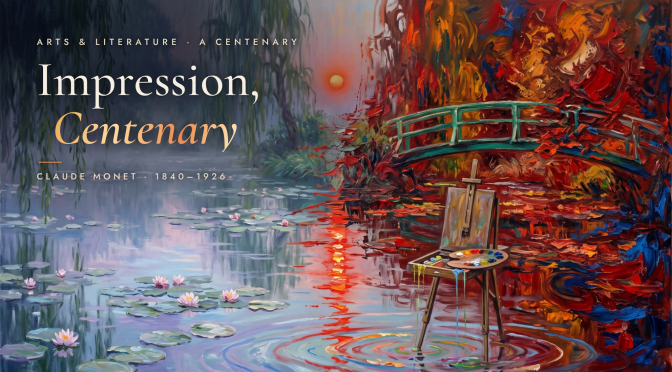
Twelve paintings, one century, and the man who painted time

On 5 December 1926, Claude Monet died at Giverny, aged 86, in the house where he had lived for more than forty years. A century later, the twelve paintings in our gallery show how one man taught the world to look at light instead of things.
It begins with a sunrise. In 1872 Monet painted the harbour at Le Havre in quick strokes: grey-blue mist, ghostly cranes and a small orange sun that seems to burn through the canvas. When he showed Impression, Sunrise at the first independent exhibition in 1874, the critic Louis Leroy mocked it in a review headlined “Exhibition of the Impressionists.” The insult stuck, and a movement had its name.
Earlier still, in The Magpie, he had painted snow in blue, violet and cream. The Salon jury rejected it in 1869. Then came the sunlit years at Argenteuil. In Poppy Field and Woman with a Parasol, the figures are his wife Camille and their son Jean, painted so quickly that the wind seems to move through the brushwork. In The Gare Saint-Lazare, Monet turned modern Paris into weather, making locomotive steam as beautiful as clouds.
In the 1890s he made his boldest discovery: the subject hardly mattered. He painted stacks of wheat near his home at every hour and season, then more than thirty views of Rouen Cathedral’s façade, its stone dissolving from dawn grey to noon gold. In London, working from St Thomas’ Hospital across the Thames, he painted Parliament as a dark silhouette against a burning sky. A building, a field or a river was only the occasion. The true subject was time.
At Giverny he built his own subject. He diverted a stream, dug a pond, planted water lilies and crossed it all with a Japanese bridge, then painted that garden for the rest of his life, some 250 canvases of lilies in all. On 12 November 1918, the day after the Armistice, he wrote to his friend Georges Clemenceau offering the nation water-lily paintings as a monument to peace. They were installed at the Musée de l’Orangerie in May 1927, five months after his death, in two oval rooms that surround visitors with water and sky.
The true subject was time.
The final picture in our gallery is the strangest. Cataracts had clouded Monet’s sight, and in The Japanese Footbridge, painted around 1920–22, the bridge almost disappears into blazes of red, ochre and blue. Critics once dismissed these late works as the failings of an old man. In the 1950s, as Abstract Expressionism rose in New York, they were rediscovered as visions of the future. Joan Mitchell later spent her last decades in Vétheuil, in a house overlooking the one Monet had rented in the late 1870s.
Paris is marking the centenary. Monet: Painting Time is at the Orangerie through January 25, and From Monet to Hockney is at the Musée Marmottan Monet, home of Impression, Sunrise, through January 31. Take the gallery above as an invitation. A hundred years on, Monet’s light has not finished changing.
The Gallery
- Impression, Sunrise, 1872 · Musée Marmottan Monet, Paris
- The Magpie, 1868–69 · Musée d’Orsay, Paris
- Poppy Field, 1873 · Musée d’Orsay, Paris
- Woman with a Parasol – Madame Monet and Her Son, 1875 · National Gallery of Art, Washington
- The Gare Saint-Lazare, 1877 · Musée d’Orsay, Paris
- Stacks of Wheat (End of Summer), 1890–91 · Art Institute of Chicago
- Rouen Cathedral, 1894 · One of more than thirty views of the façade
- Bridge over a Pond of Water Lilies, 1899 · The Metropolitan Museum of Art, New York
- The Houses of Parliament, Sunset, 1903 · National Gallery of Art, Washington
- Water Lilies, 1906 · Art Institute of Chicago
- Water Lilies, 1914–26 · Musée de l’Orangerie, Paris
- The Japanese Footbridge, c. 1920–22 · The Museum of Modern Art, New York
See it in Paris
Monet: Painting Time · Musée de l’Orangerie · through January 25, 2027
From Monet to Hockney · Musée Marmottan Monet · through January 31, 2027
— The Editors, Intellicurious —

