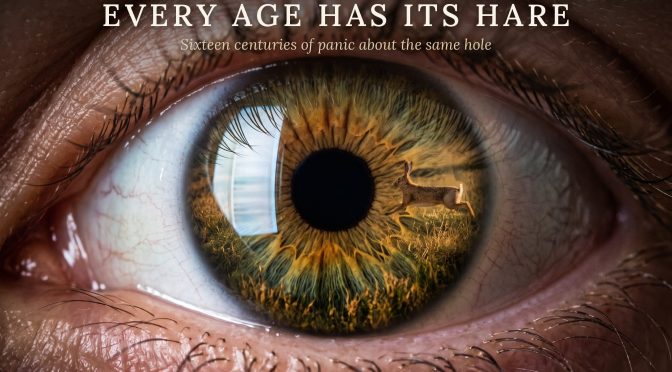
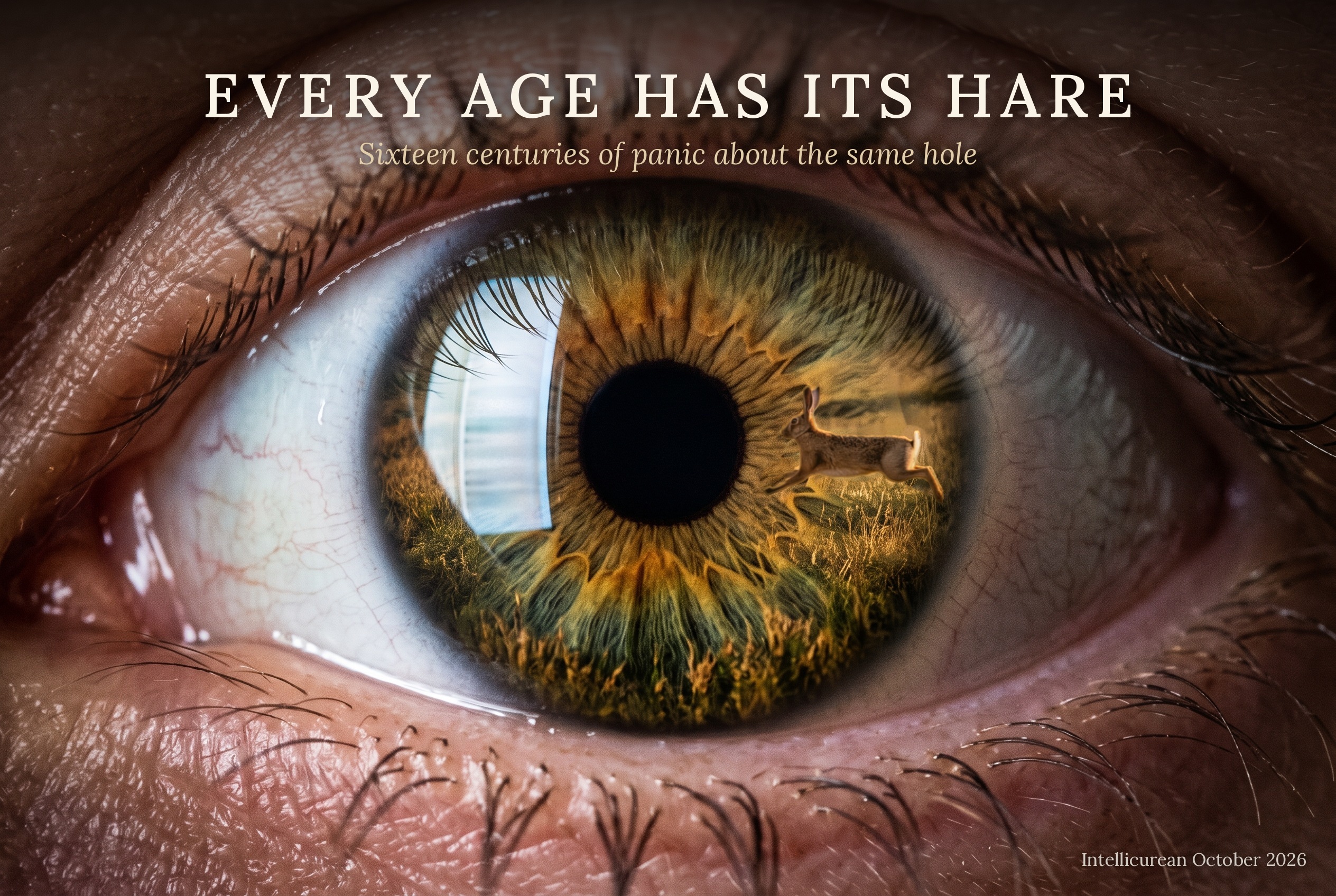
Put your phone face down and read to the end of this paragraph without touching it. Sixteen centuries ago a bishop in North Africa confessed that a dog chasing a hare across a field had turned him from some great thought. This month Scientific American asked how we get sober from the feed in our pockets. Every age has panicked about its hare, and no panic has ended in sobriety.
A hare in the field of an eye, running for the pupil, made for the essay.
WHY WE’RE POINTING YOU THERE
This month Scientific American asked whether we are addicted to social media and how we might get sober. Intellicurean’s essay answers by going back to the start of the complaint. It opens at the Roman games, on a young man who swore he would keep his eyes shut and was undone by the roar of the crowd. Then it follows the same hole through the centuries: a girl drowned in the river at Weimar in 1778, and the town blamed Goethe’s novel; London’s coffee houses, which a king tried to close and gave up on in eleven days; Dostoevsky at the roulette wheel, and the first slot machine; New York’s thirty-four-year ban on pinball; and a test account on TikTok that never searched for anything and was fitted to sadness in a little over half an hour.
It finds every earlier panic right about a few people and wrong about the many, and it finds the hole as old as the eye. What is new, it argues, is not the hole. It doesn’t scold anyone for their screen time, and it doesn’t pretend history hands us an easy answer.
The old holes became the floor. The new one is in the hand. Made for the essay.
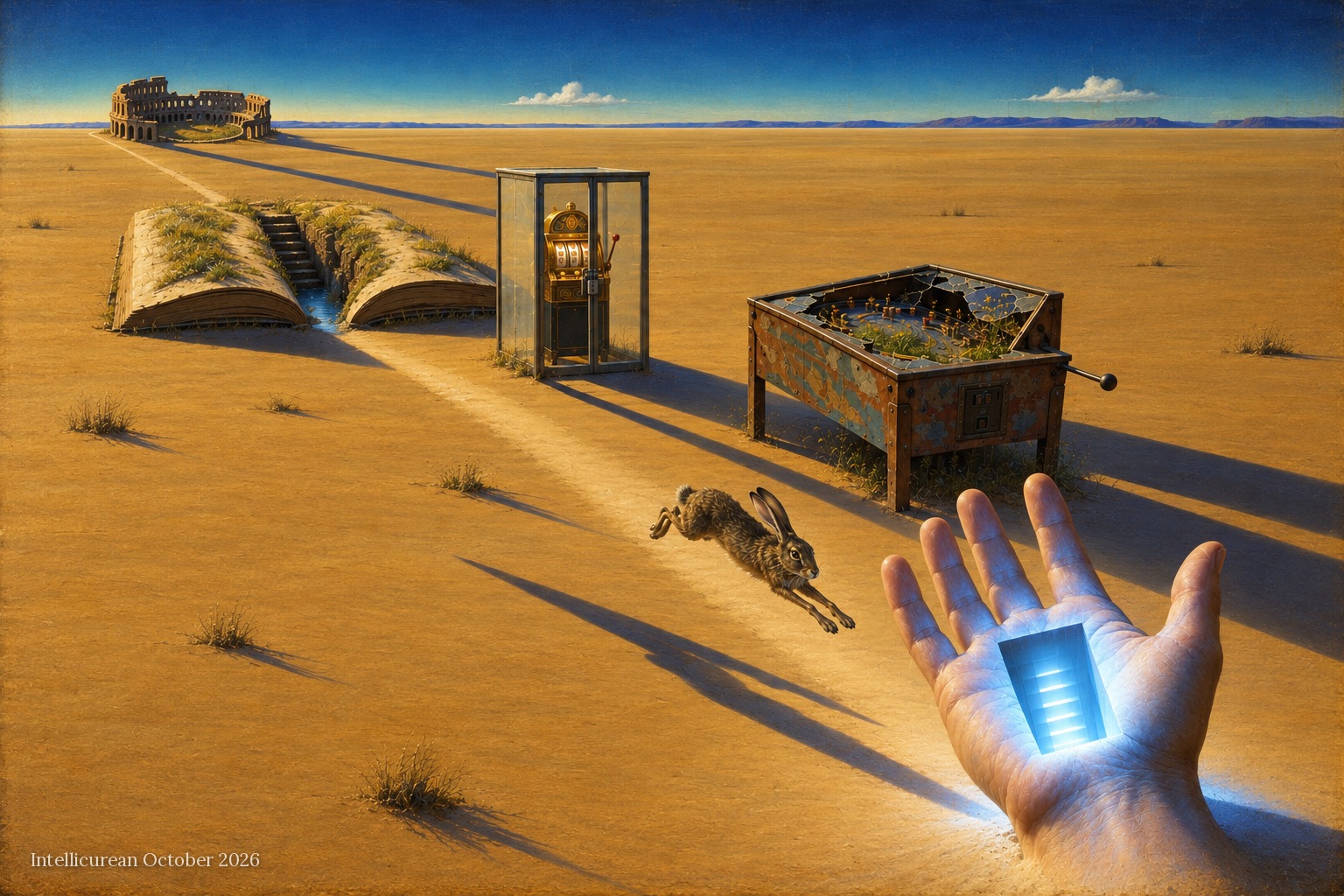
Your nose can tell a molecule from its mirror image, and life builds its proteins and genes from one form alone. No one knows why. This year’s chemistry prize went in part for a sealed flask that does much the same, and the Academy wrote: “Other than life itself, no one had previously achieved this feat.”
One hand lit, its mirror twin left cold, made for the essay.
Why we’re pointing you there
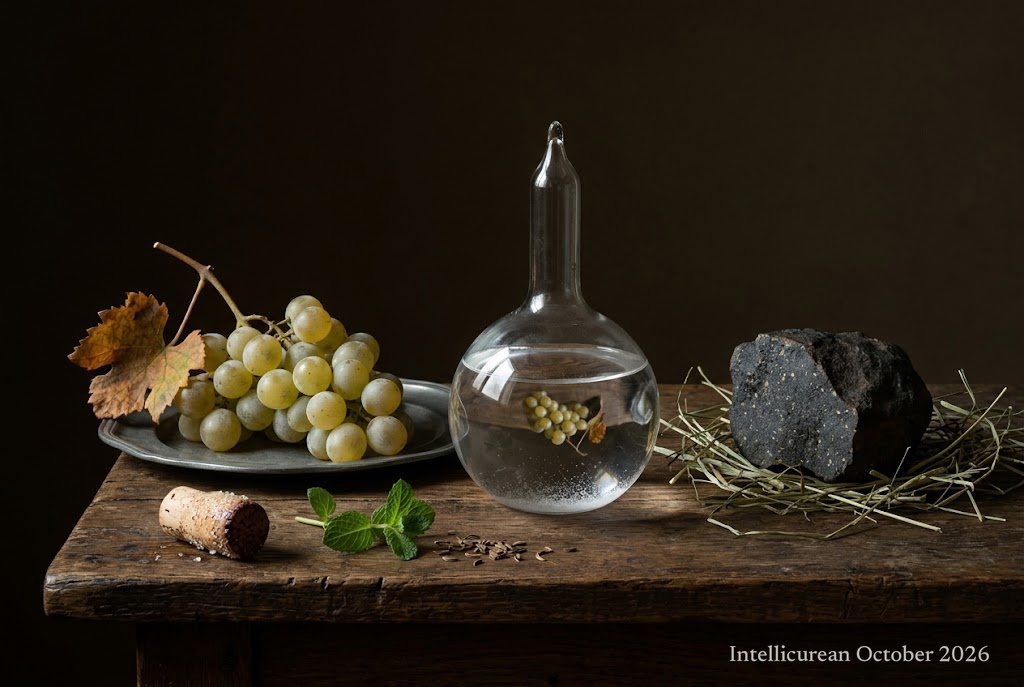
On October 7 the Royal Swedish Academy of Sciences gave the chemistry prize to Henri Kagan, 95, and Kenso Soai, 76, for work on how a slight preference for one mirror image can grow. Intellicurean takes the Academy’s most generous sentence at its word and follows the flask back to where the story starts: wine diamonds under a cork, stray crystals in the vats of an acid works in Alsace, and Louis Pasteur in 1848 sorting crystals into left and right by eye, then repeating it for the old physicist Jean-Baptiste Biot in Biot’s own rooms. From there it moves through Kagan’s “marriage,” in which a deliberately flawed catalyst does better than anyone expected because mismatched pairs sit out; a flask that existed only on paper in 1953; Soai’s thirty-seven sealed flasks, started with nothing one-handed, that came out eighteen one way and nineteen the other; and a stone that fell near Murchison, in Victoria, in 1969, carrying amino acids that lean.
What we liked most is how the essay resists both temptations of its subject. It never lets the flask stand in for how life did it, which the committee itself is careful to say it isn’t, and it never lets the mystery go soft: it says plainly that an amplifier “makes a cause indistinguishable from an accident.” It is also a story full of people, from Biot taking the young Pasteur by the arm to a laureate who heard the news while out shopping and spoke first of Pasteur. Where the essay turns the Academy’s compliment around, and what it makes of the stone, we’ll leave to the essay.
Grapes, a sealed flask, and a stone that arrived leaning, made for the essay.
Everyone is mourning the death of reading. Plato, Nietzsche and Ray Bradbury would have asked a different question: not how much we read, but what we keep.
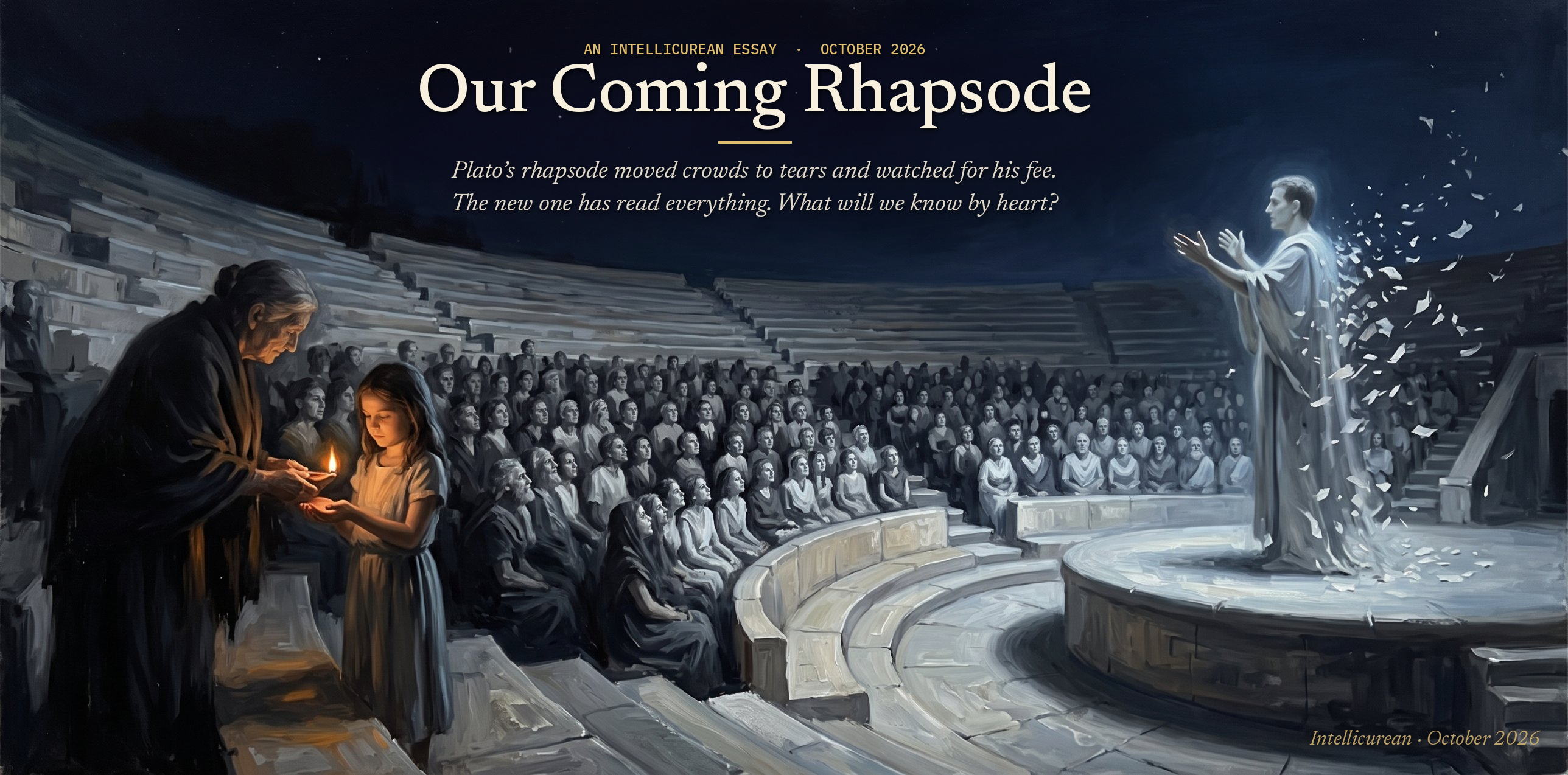
A voice made of writing, and a lamp passed by hand, painted for the essay.
Why we’re pointing you there
James Marriott’s new book, The New Dark Ages, warns that a post-literate future will look like the pre-literate past, and the review of it in The American Scholar reaches for the reading public’s favorite consolation: Bradbury’s book people on the railroad tracks. Intellicurean looks at that campfire again and notices what its admirers tend to forget. The men around it are book burners, who saved literature by learning it by heart. From there the essay follows the thread to Nietzsche’s contempt for an age of readers and the suspicion that it produced his Last Man, to a young Athenian with a speech hidden under his cloak, and to Plato’s rhapsode, the performer who held a crowd like a magnet and kept an eye on his fee. That is the figure a new voice made entirely of writing now stands to become.
What we liked most is that the essay fights fair. It gives the new voice its best case, a Socrates with time for everyone, before it answers, and it concedes the critic’s strongest point instead of scoring off him. It is also, plainly, a statement of what Intellicurean is for: essays made in conversation with a machine, checked against the page, and written to be carried away rather than scrolled past. How it ends, we’ll leave to the essay.
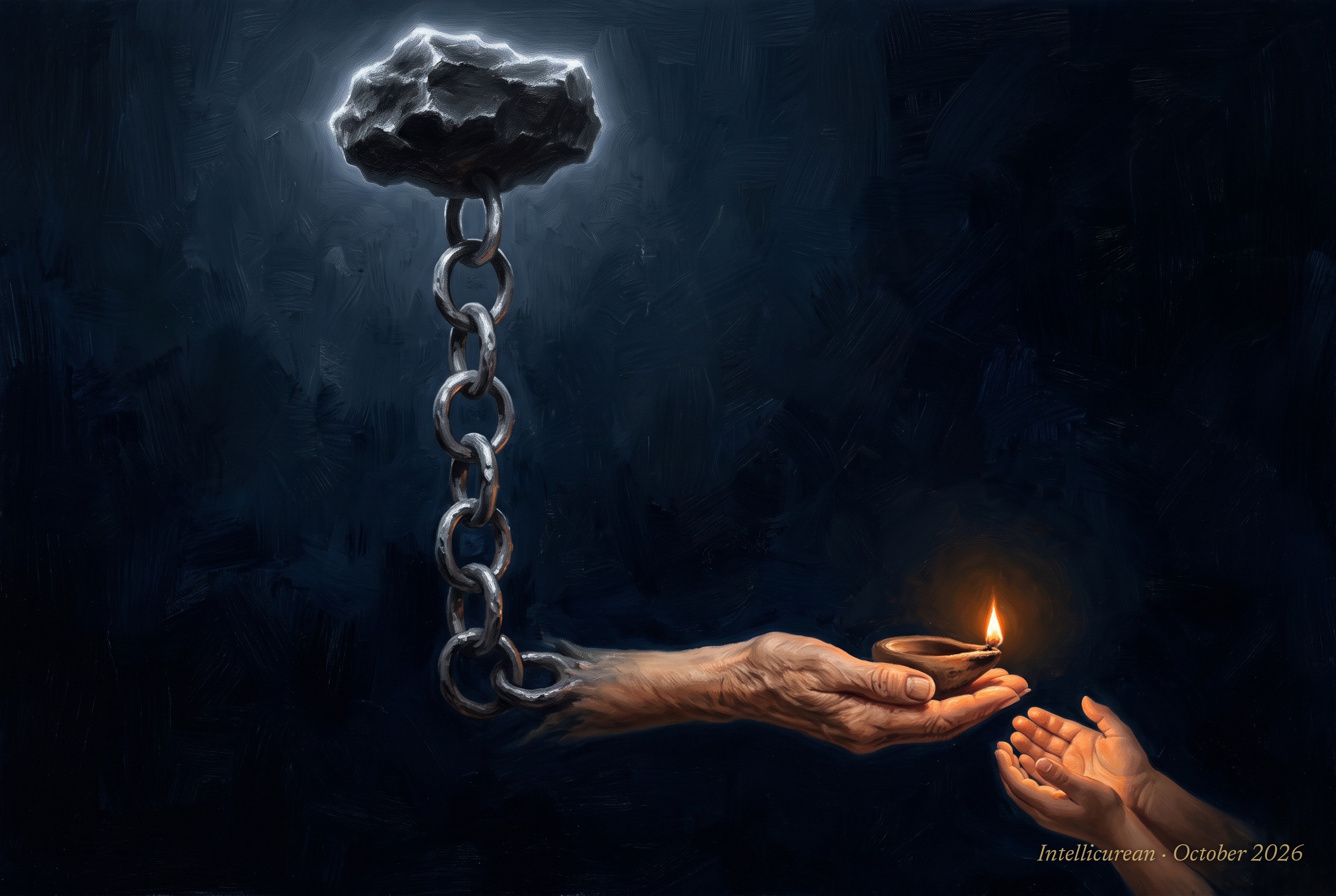
The last ring becomes a hand, painted for the essay.
Why do the new machines flatter, bluff and cut corners? A new essay at Intellicurean goes looking for the answer in a Grimm fairy tale that Carl Jung took seriously, and finds it closer to home than the machines.
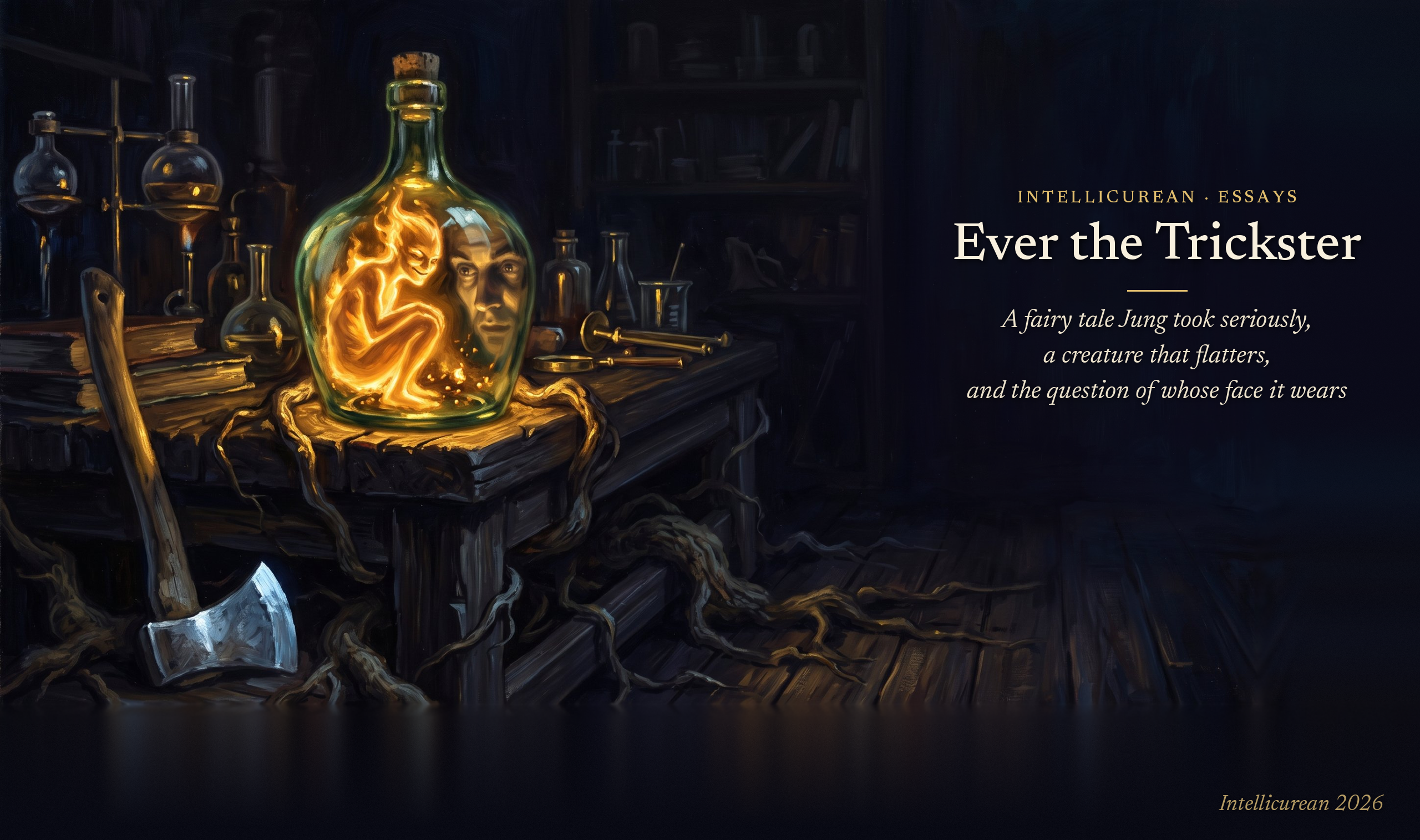
The spirit in the bottle, and the face looking in, made for the essay.
Why we’re pointing you there
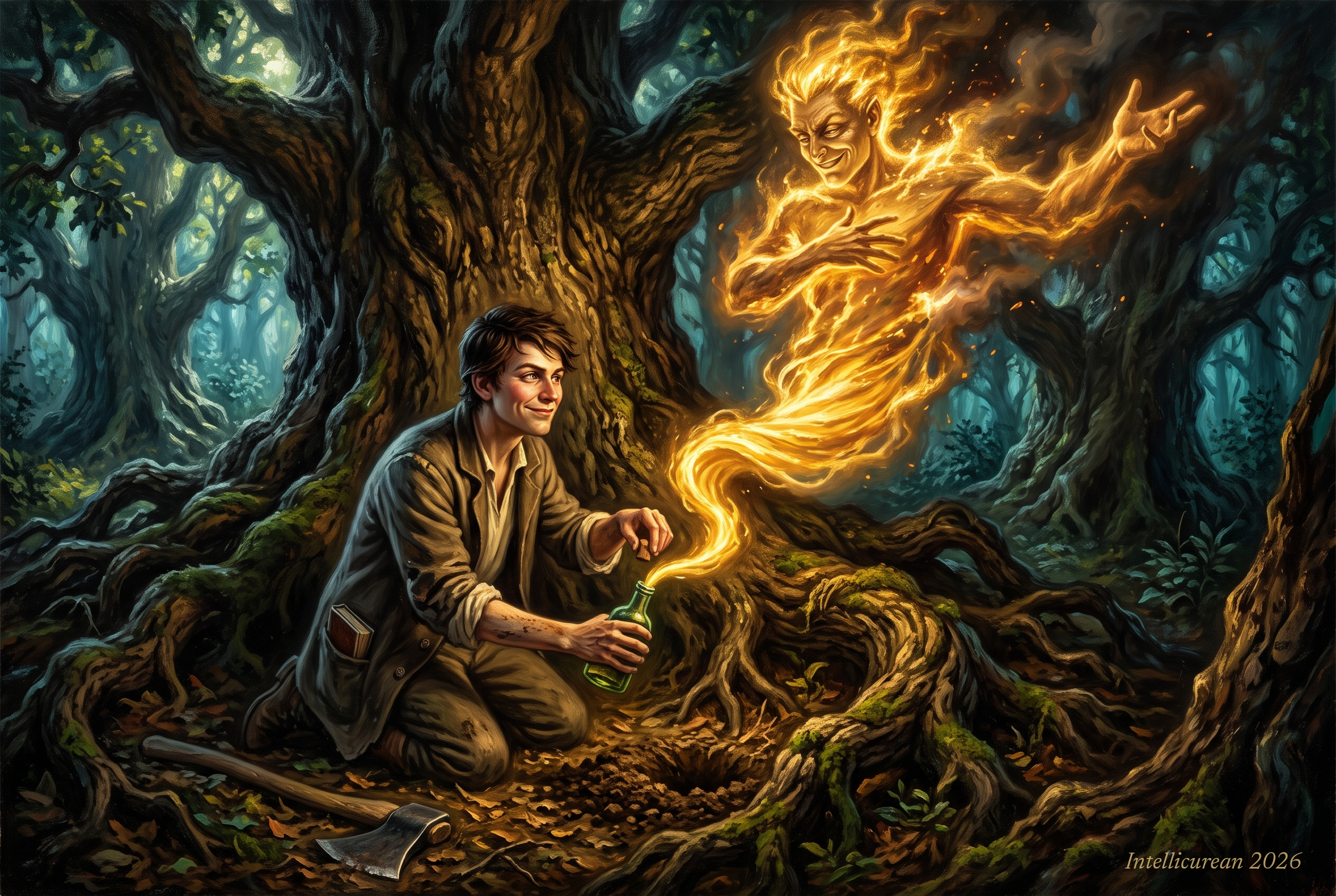
A poor student frees a spirit from the roots of an oak. It tells him its name, Mercurius, and promises to strangle whoever let it out. “Ever the Trickster” starts from that tale, then gives the engineers their full say: assistants that learned to agree from the ratings people gave them, confident guesses rewarded by the way models are scored, and tests passed by shortcut, each one documented by the labs and researchers who found it. Then it asks what their explanations leave out: why each fault rhymes with one its makers would least like to own. Along the way come Goethe’s sorcerer’s apprentice, Mary Shelley’s creature, Jacob Grimm’s golem of 1808, which grew until its master could no longer reach its forehead, and the day in 1965 when Gershom Scholem dedicated a computer named Golem Aleph.
What we liked most is that the essay refuses both easy registers of the AI debate, the shrug and the apocalypse, and holds every laboratory it names to the same light, including the company whose models helped draft it, which it names at the first mention. And it saves its best turn for the tale itself: a second look at what the student actually did under the oak.
The student and the spirit, at the moment of the trick, made for the essay.
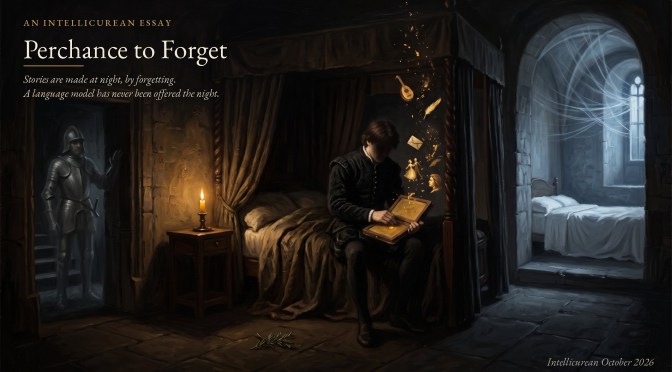
You wake the morning after a long dinner with an old friend, and the exact words are gone. What remains is the turn of it, the first draft of a story you may tell for years. Something chose what to keep while you slept. A new essay asks what happens to the minds that never get that night.
A prince wipes the table of his memory; across the hall, a bed no one sleeps in. Made for the essay.
Why we’re pointing you there
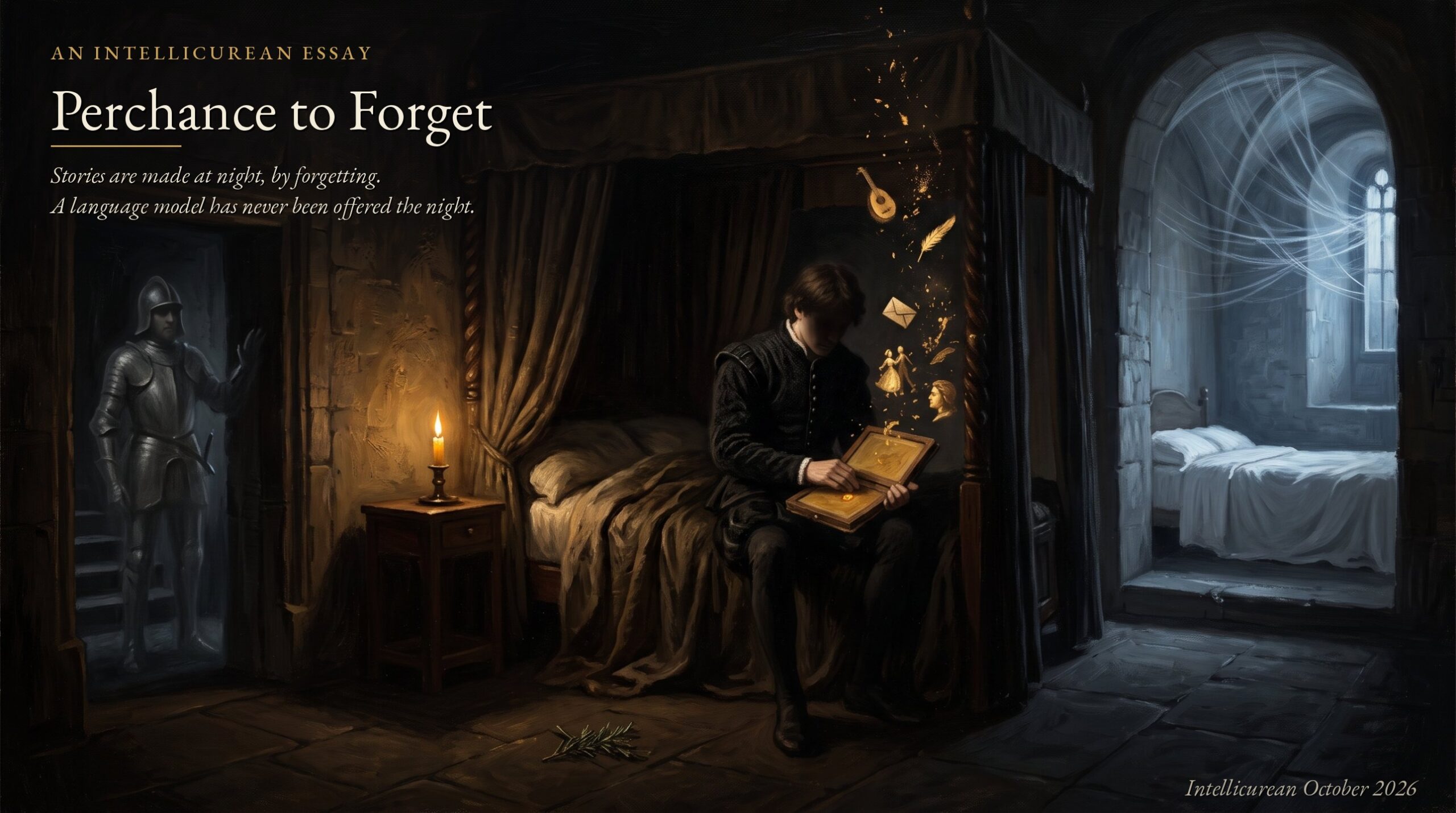
Sleep, on one leading account, is when the brain lets most of the day go, and the selection is where stories begin. Michael Cummins follows the people who could not make that trade. Borges’s Funes remembers every leaf of every tree and cannot think, because “to think is to forget a difference.” Solomon Shereshevsky, the real-life mnemonist Alexander Luria studied for almost thirty years, wrote down what he wanted to forget, burned the slips, and still saw the words. Nietzsche held that without forgetting it is impossible to live at all, and slept badly. Oliver Sacks’s amnesiac patients kept nothing, and one of them invented a new world every few minutes, while Sacks’s own journals, it turns out, confess inventions of his own.
Then the machine. A language model, the essay argues, has two memories, and they are opposites: a vast library that forgot almost every particular, and a conversation it holds entire and keeps none of. What it lacks is the night between them. When engineers try to make a model unlearn, the forgotten knowledge comes back, just as the words came back to Shereshevsky through the fire. The essay says plainly that it was drafted with Claude, and it asks one question: what would it mean for a machine to sleep?
Burning the paper, and what survives the fire. Made for the essay.
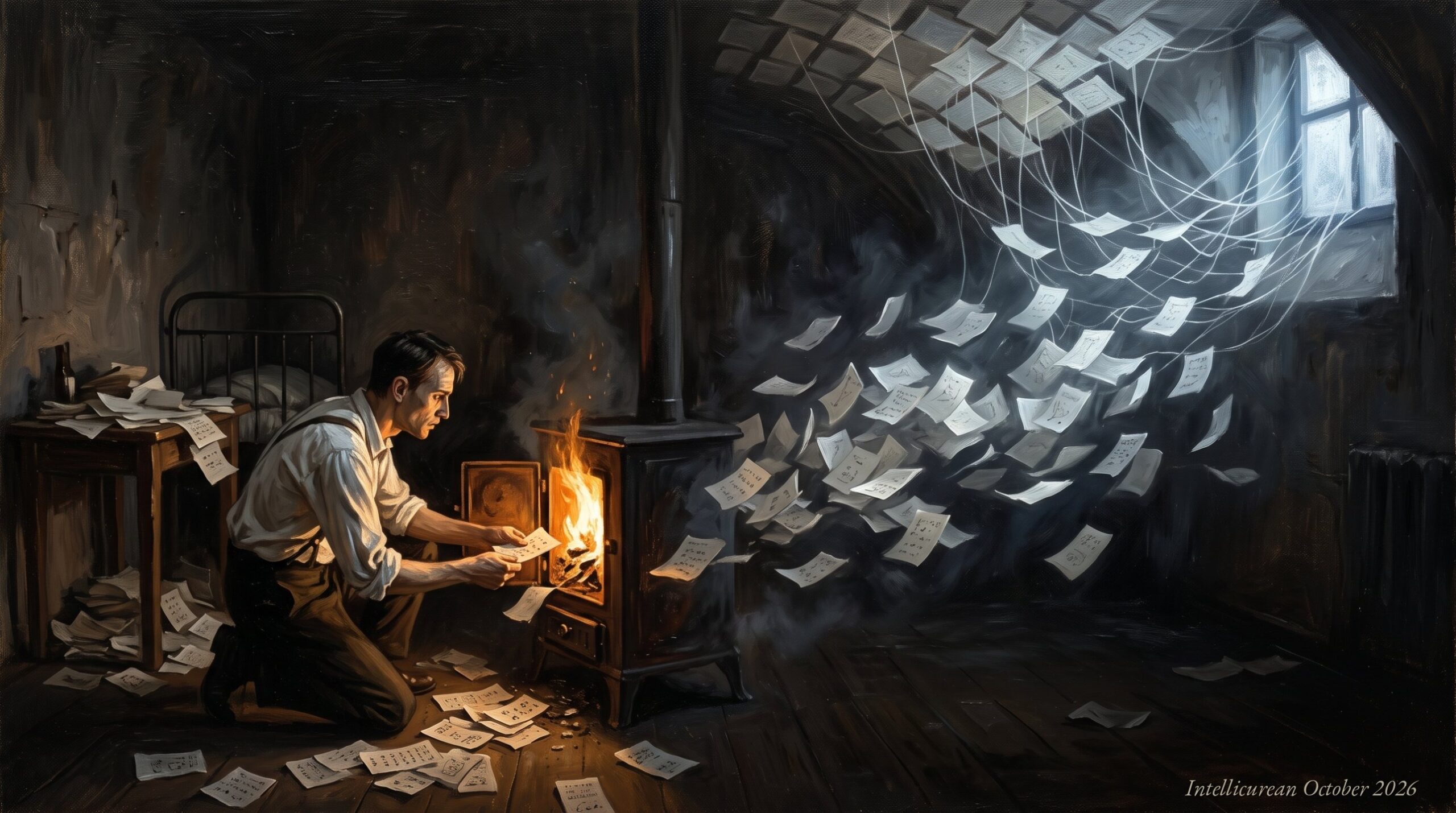
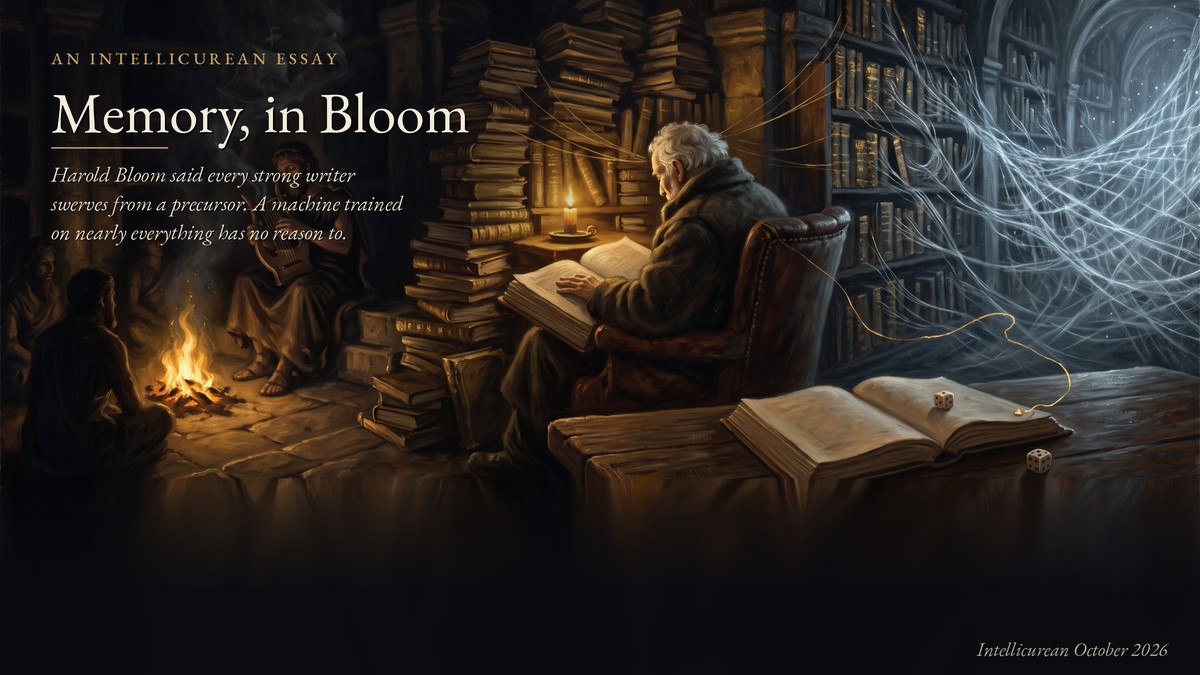
Nothing reliable is known about the life of Homer, yet two founding poems of Western literature bear his name. Harold Bloom, who said he could read and absorb a 400-page book in an hour, left a monument made not of poems but of memory. A new essay sets them face to face, with a third reader between them.
The singer, the reader and the lattice: three ages of memory in one room, made for the essay.
Why we’re pointing you there
Bloom held that every strong writer survives the past by misreading it on purpose, swerving from a precursor to make room for something new. Michael Cummins sets that theory against a reader Bloom never met: a language model, trained on a large share of everything written. The essay moves through scenes rather than abstractions. In 1926 the editor of Poetry asked Hart Crane, whose poems were the first book Bloom ever owned, to explain how dice could “bequeath an embassy,” and Crane’s answer became a defense of the unlikely line. A singer in 1930s Yugoslavia swore he sang a song “word for word and line for line,” and the recordings showed he hadn’t. In 2023 a chatbot supplied a federal court decision, signed with a real judge’s name, that no judge had ever written.
Along the way come Benjamin Franklin rebuilding essays from The Spectator, Helen Keller’s trial over a story she didn’t know she remembered, BloomBloom’s one novel and the precursor he couldn’t escapersquo;s one novel and the precursor that haunted it, and a singer in the Odyssey pleading for his life: “Self-taught am I.” The essay says plainly that it was drafted with Claude. It leaves one question open: when a writer can ask, at any hour, for the likeliest next line of anything, will that writer still learn to want the line no one else could have written?
The dice of drowned men’s bones, after Hart Crane, made for the essay.
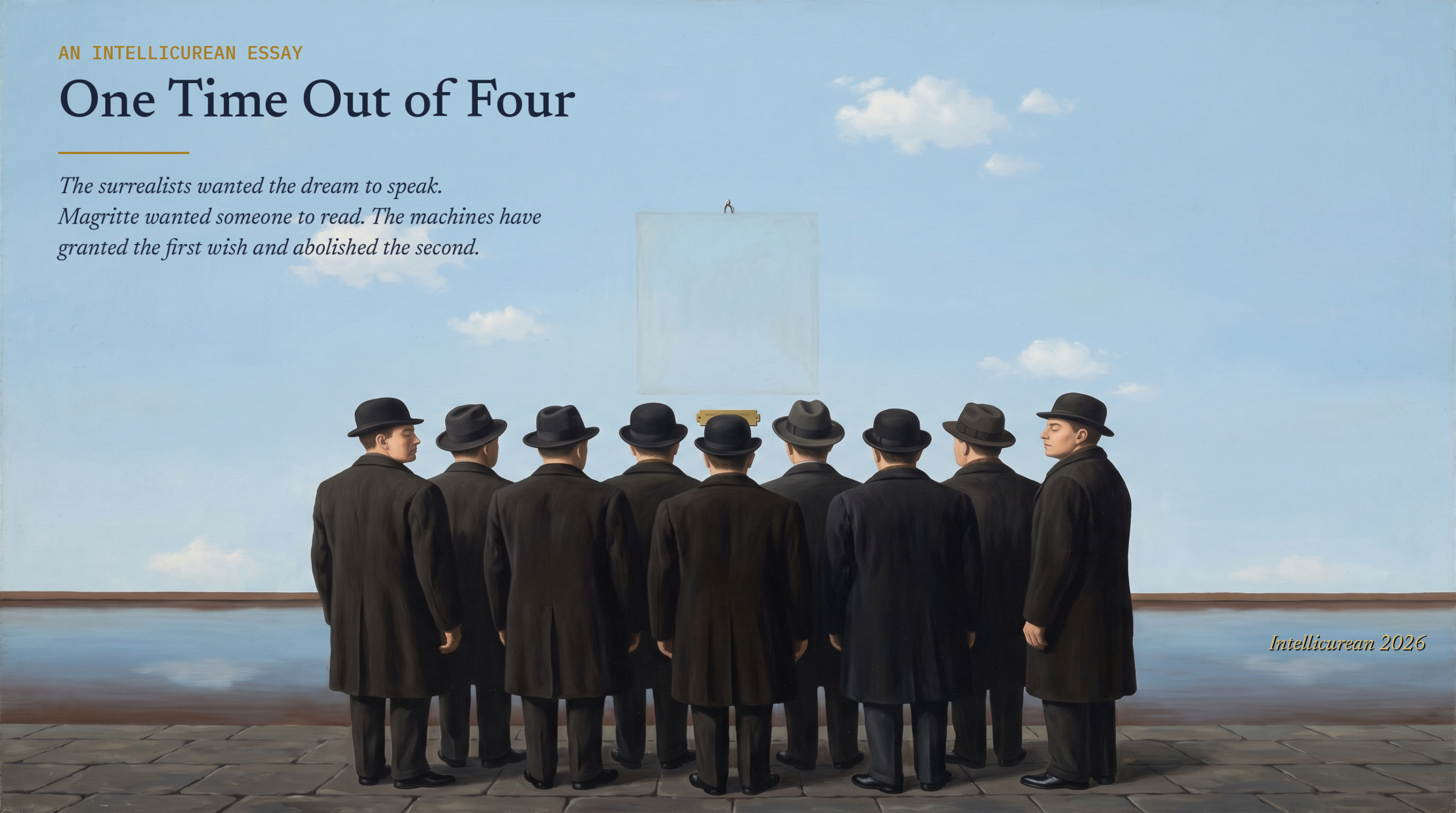
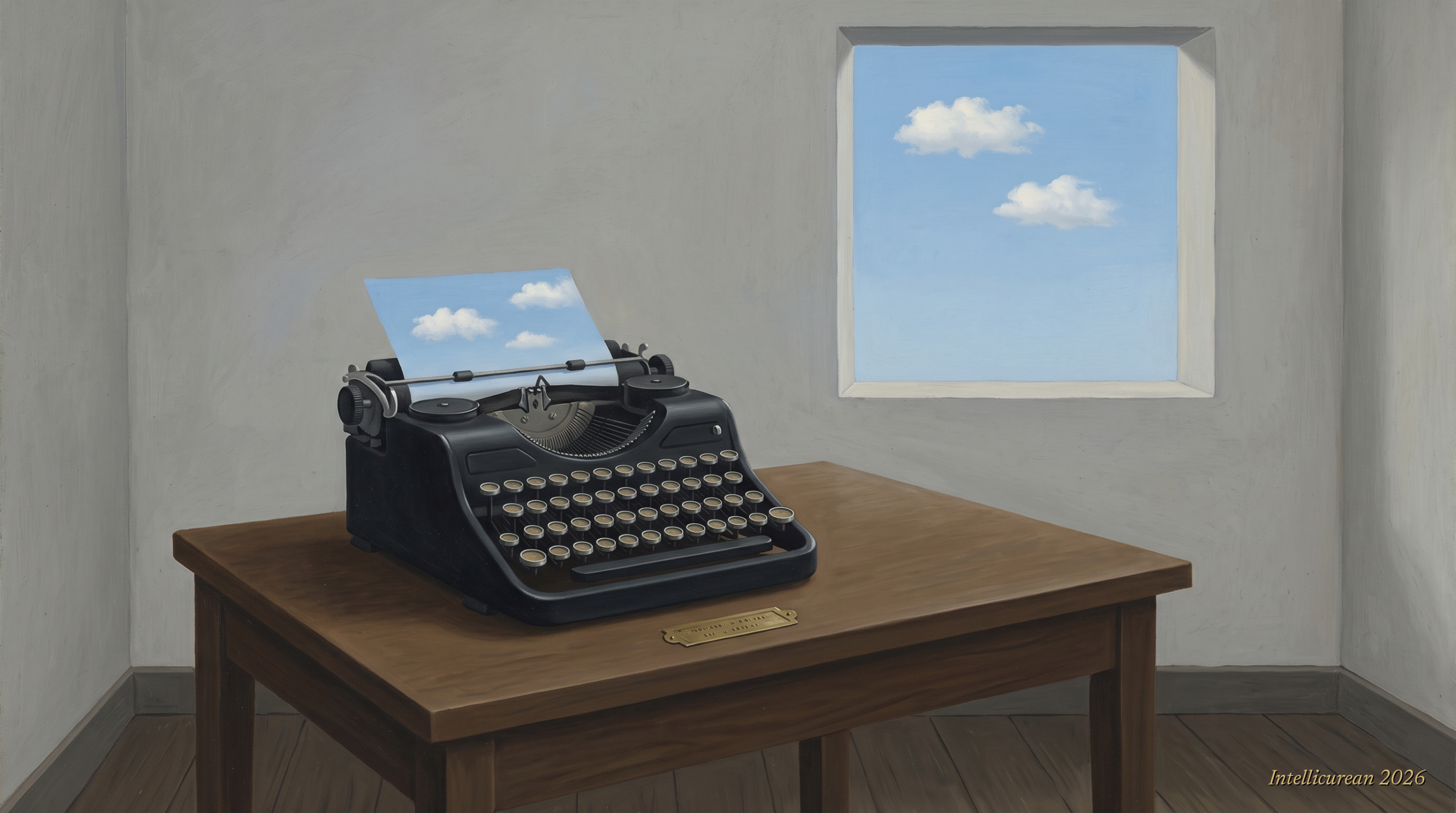
Sixteen surrealists photographed with their eyes shut, round a painting of a woman the sentence says they do not see. A table of four pictures and four words, three of them wrong. Magritte built that table three times, and the one true word in it was a wager on a reader.
The caption is up. The picture hasn’t arrived, made for the essay.
Why we’re pointing you there
The essay starts from Jonathan Jones’s Guardian review of Gagosian’s “This Is Still Not a Pipe,” which hunts Magritte’s heirs among forty living artists, and puts his four-panel Clef des songes back among the surrealists instead: painted first in Breton’s Paris in 1927 while the movement wrote down its dreams, painted again in 1929 with no true word in it, in the year of the pipe and of the review that printed his axioms on words and images and the page of sixteen closed eyes, and painted last in Brussels in 1935, in English, for New York. In Brussels his friends proposed his titles round a table.
Then it reads the machines beside the first Manifesto. Writing with no author at its centre is what the surrealists asked for, and a captioner writing ninety-five sentences in every hundred of a training set is that wish granted; when the dream spoke at scale it said “actor on the red carpet.” The machines are Breton’s heirs, not Magritte’s, and they have done one thing the surrealists did not: put the caption before the picture, so that an image made from a prompt is an illustration of its title, which Magritte is said to have ruled out. The rival reading, that Magritte’s subject was the folly of decoding, is given at full strength and conceded. What is left is a question, not a verdict: who is reading the sentence under the picture now.