
Tag Archives: Surrealism

ONE TIME OUT OF FOUR

Intellicurean Essays on Intellicurious

Sixteen surrealists photographed with their eyes shut, round a painting of a woman the sentence says they do not see. A table of four pictures and four words, three of them wrong. Magritte built that table three times, and the one true word in it was a wager on a reader.
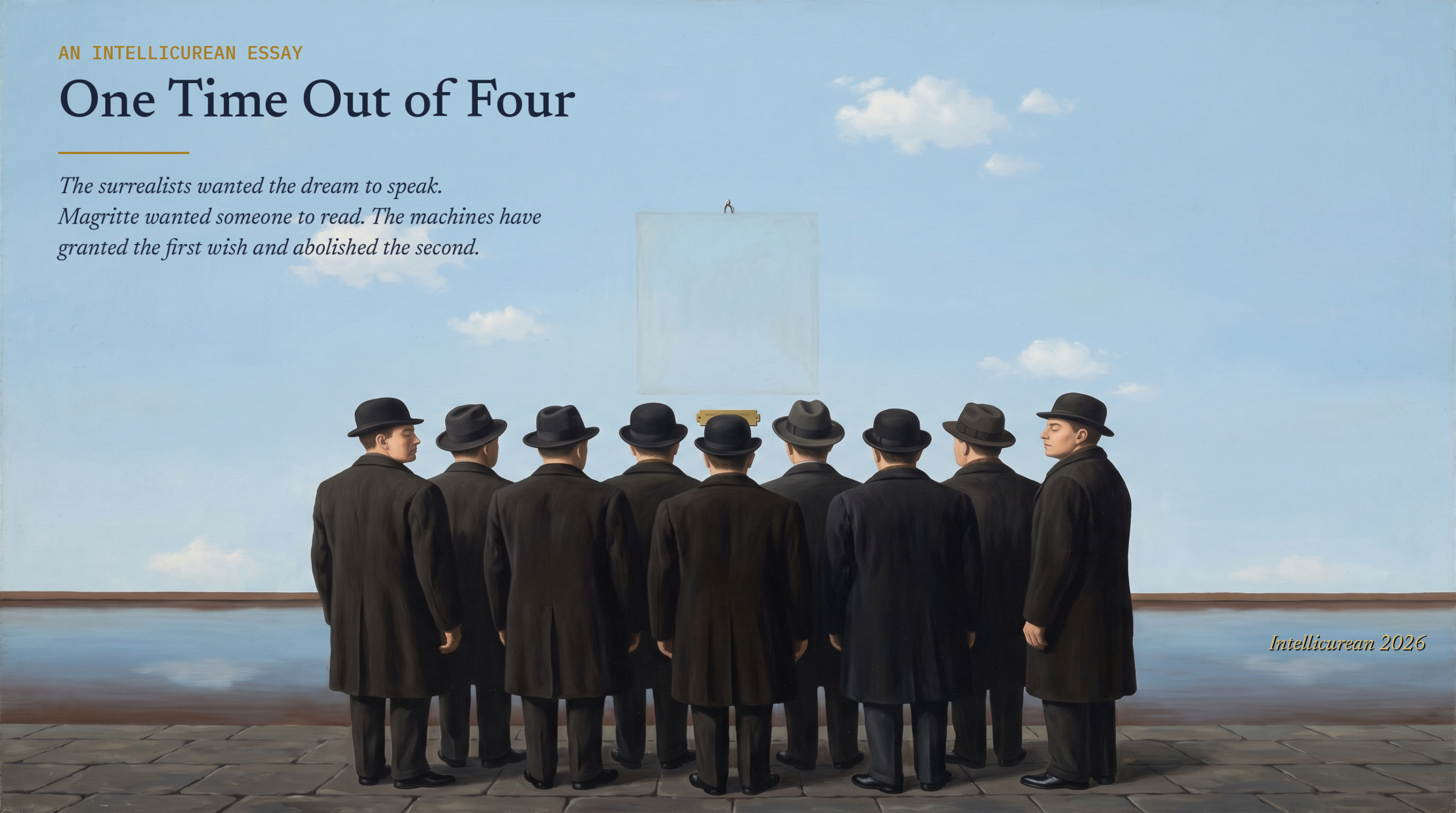
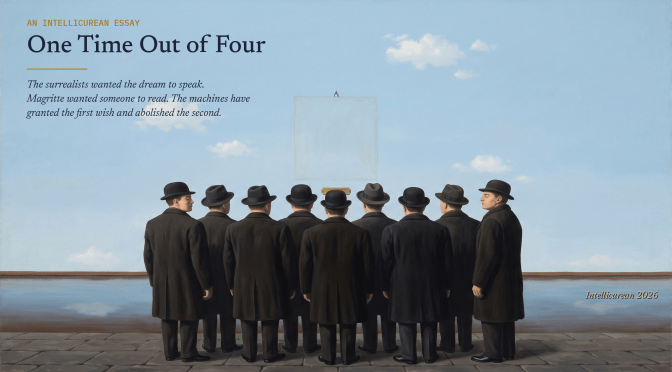
One Time Out of Four — nine men in 1930s hats and overcoats, seen from behind, stand before a blank canvas hanging in a blue sky with a brass plate beneath it
The caption is up. The picture hasn’t arrived, made for the essay.

Why we’re pointing you there

The essay starts from Jonathan Jones’s Guardian review of Gagosian’s “This Is Still Not a Pipe,” which hunts Magritte’s heirs among forty living artists, and puts his four-panel Clef des songes back among the surrealists instead: painted first in Breton’s Paris in 1927 while the movement wrote down its dreams, painted again in 1929 with no true word in it, in the year of the pipe and of the review that printed his axioms on words and images and the page of sixteen closed eyes, and painted last in Brussels in 1935, in English, for New York. In Brussels his friends proposed his titles round a table.

Then it reads the machines beside the first Manifesto. Writing with no author at its centre is what the surrealists asked for, and a captioner writing ninety-five sentences in every hundred of a training set is that wish granted; when the dream spoke at scale it said “actor on the red carpet.” The machines are Breton’s heirs, not Magritte’s, and they have done one thing the surrealists did not: put the caption before the picture, so that an image made from a prompt is an illustration of its title, which Magritte is said to have ruled out. The rival reading, that Magritte’s subject was the folly of decoding, is given at full strength and conceded. What is left is a question, not a verdict: who is reading the sentence under the picture now.
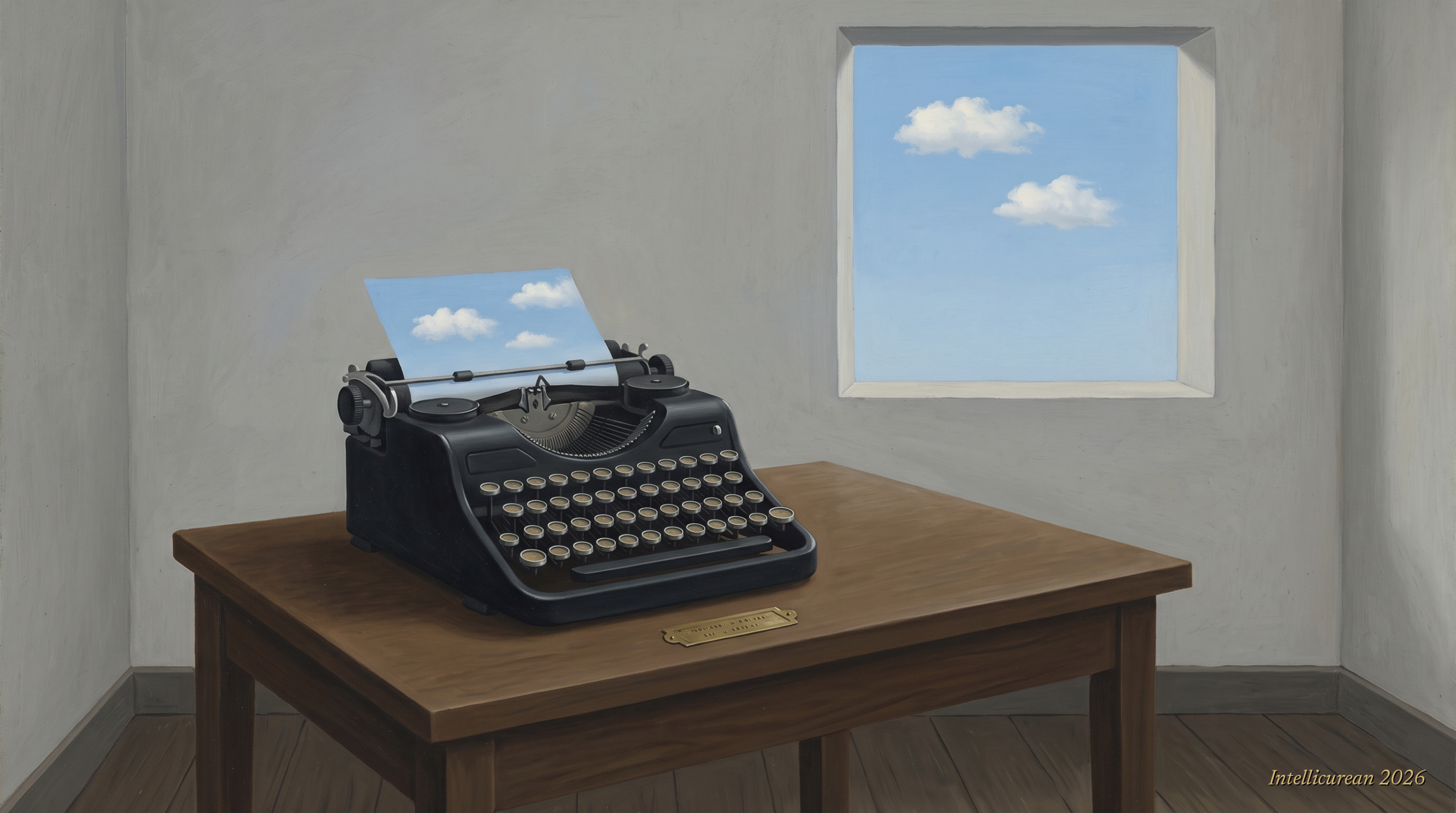
A bare room with a 1930s typewriter on a wooden table; the sheet rising from it is a small painted sky with clouds, and a window behind shows the same sky
The caption goes in first, made for the essay.

Read the full essay at Intellicurean →

Essays & Reviews for the Intellectually Curious
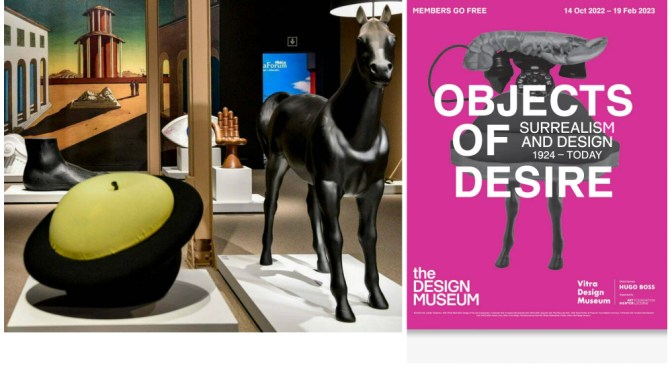
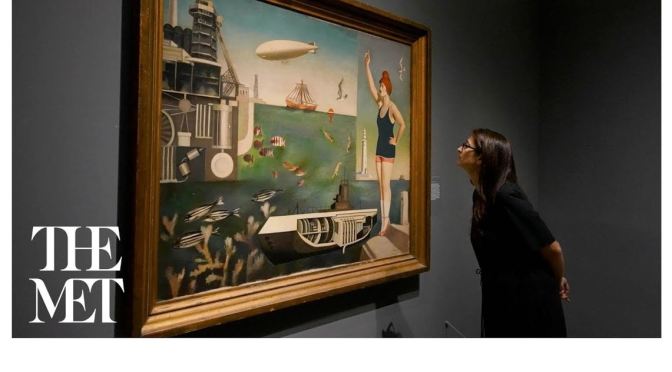
Museum Exhibits: ‘Objects Of Desire – Surrealism And Design 1924 – Today’ (2022)

Dezeen – Curator Kathryn Johnson explains the story behind surrealism and its impact on design in this video Dezeen produced for the Design Museum about its latest exhibition.

Titled Objects of Desire: Surrealism and Design 1924 – Today, the exhibition features almost 350 surrealist objects spanning fashion, furniture and film. The exhibition, which was curated by Johnson, explores the conception of the surrealist movement in the 1920s and the impact it has had on the design world ever since. It features some of the most recognised surrealist paintings and sculptures, including pieces by Salvador Dalí, Man Ray and Leonora Carrington, as well as work from contemporary artists and designers such as Dior and Björk.

the Design Museum – “Surrealism was born out of the horrors of the first world war, in a period of conflict and uncertainty, and it was a creative response to that chaos,” Johnson said in the video.

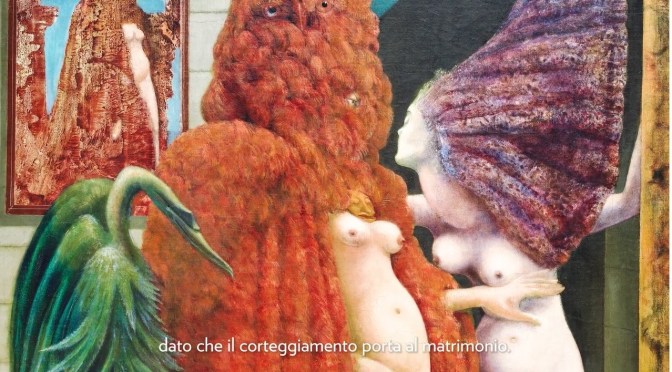
Surrealist Art: Max Ernst’s ‘Attirement Of The Bride’

Attirement of the Bride is an example of Max Ernst’s veristic or illusionistic Surrealism, in which a traditional technique is applied to an incongruous or unsettling subject. The theatrical, evocative scene has roots in late nineteenth-century Symbolist painting, especially that of Gustave Moreau. It also echoes the settings and motifs of sixteenth-century German art. The willowy, swollen-bellied figure types recall those of Lucas Cranach the Elder in particular. The architectural backdrop with its strong contrast of light and shadow and its inconsistent perspective shows the additional influence of Giorgio de Chirico, whose work had overwhelmed Ernst when he first saw it in 1919.

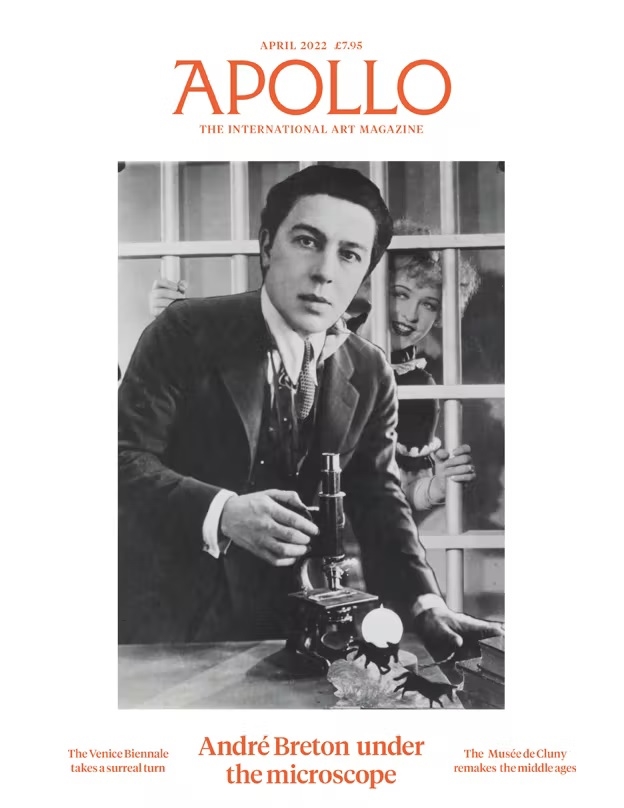
International Art: Apollo Magazine – April 2022

• What was really behind Surrealism?

• An interview with Cecilia Alemani, Artistic Director of the Venice Biennale

• Revealing the mystery of Bassano’s Quails

• The Venice Pavilions you must see

Plus: Beyond the Biennale, greenwashing in museums, what we’re losing with Bastion House

Read more

Exhibit Tours: ‘Surrealism Beyond Borders’ – The Met

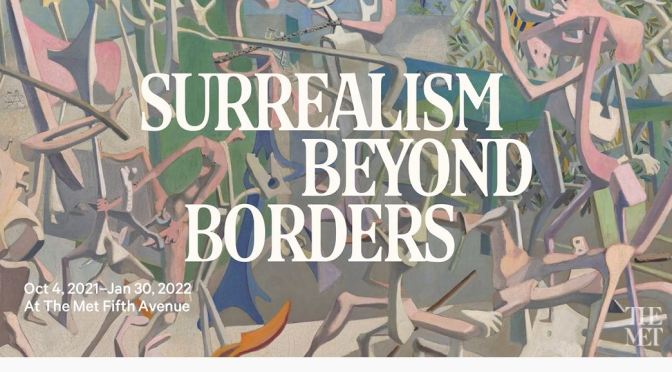
Nearly from its inception, Surrealism has had an international scope, but knowledge of the movement has been formed primarily through a Western European focus. Join Stephanie D’Alessandro, the Leonard A. Lauder Curator of Modern Art and Senior Research Coordinator in the Department of Modern and Contemporary Art at The Met, and explore this exhibition, which reconsiders the true “movement” of Surrealism beyond boundaries of geography and chronology—and within networks that span Eastern Europe to the Caribbean, Asia to North Africa, and Australia to Latin America. Including examples from almost eight decades and produced across at least 45 countries, Surrealism Beyond Borders offers a fresh appraisal of some of the collective concerns and exchanges—as well as historical, national, and local distinctions—that will recast appreciation of this most revolutionary and globe-spanning movement. Learn more about the exhibition at https://www.metmuseum.org/surrealism

Exhibitions: ‘Surrealism Beyond Borders’ – The Metropolitan Museum

Watch a video preview of the exhibition, “Surrealism Beyond Borders,” on view at The Met from October 11, 2021–January 30, 2022. Nearly from its inception, Surrealism has had an international scope, but knowledge of the movement has been formed primarily through a Western European focus. This exhibition reconsiders the true “movement” of Surrealism across boundaries of geography and chronology—and within networks that span Eastern Europe to the Caribbean, Asia to North Africa, and Australia to Latin America. Including almost eight decades of work produced by artists from over 45 countries, “Surrealism Beyond Borders” offers a fresh appraisal of these collective concerns and exchanges—as well as historical, national, and local distinctions—that recasts appreciation of this most revolutionary and globe-spanning movement. Learn more about the exhibition: https://www.metmuseum.org/exhibitions…

Art: Chilean Abstract Impressionist Roberto Matta – ‘Prince Of Blood’

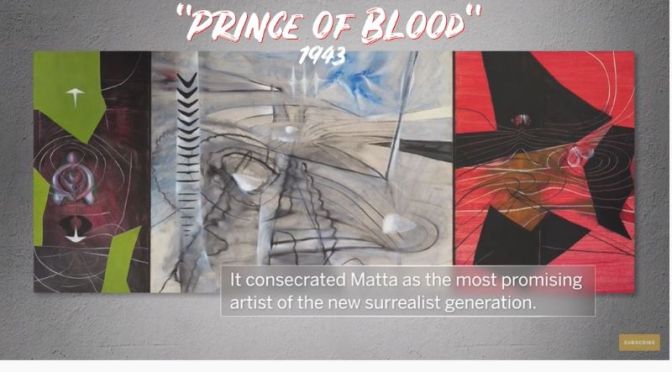
Roberto Matta’s Prince of Blood (triptych) was not only the painter’s first contribution to Surrealism, it was also the first artistic attempt to visualize Einstein’s theory of space-time. In this episode of Anatomy of an Artwork, discover how Matta was inspired by Marcel Duchamp to create a work that gives visual form to a world in flux and contradictions.

Roberto Sebastián Antonio Matta Echaurren, better known as Roberto Matta, was one of Chile’s best-known painters and a seminal figure in 20th century abstract expressionist and surrealist art. 

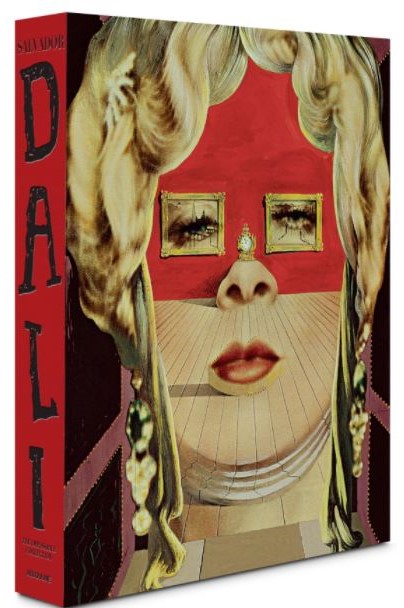
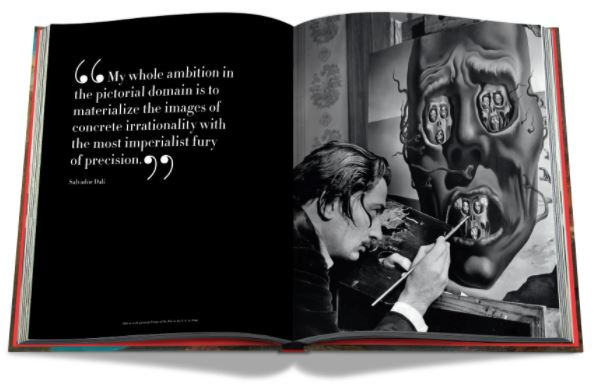
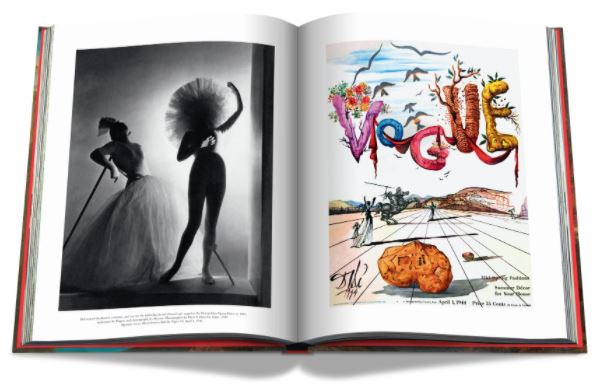
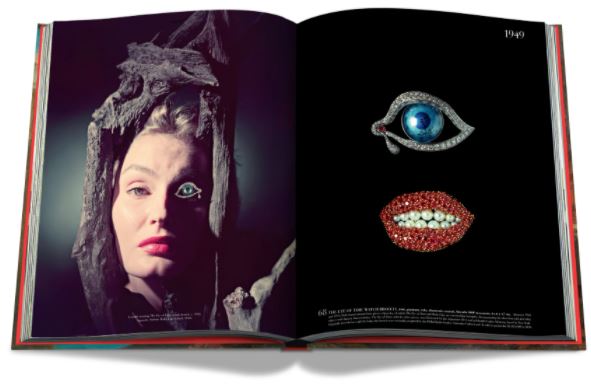
Top New Art Books: ‘Salvador Dalí : The Impossible Collection’

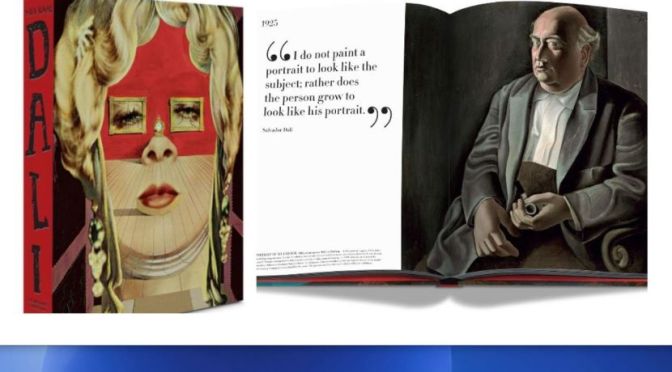
In the popular imagination, possibly no other artist’s work is more recognizable than that of Salvador Dalí. Indeed, for many he is the ultimate mad artist, whose singular vision remorselessly probed his own psychological depths. His nightmarish visions and bizarre landscapes express the angst and turbulence of the twentieth century.

Dalí’s creativity embraced many different modes of expression and was never constrained by any one style. Over eight decades, the prodigious range of Dalí’s activity spanned every conceivable medium, from painting and drawing to sculpture, film, furniture, books, stage design and jewelry, not to mention his highly eccentric public persona, which could be considered an art form in itself.

Selected by curator and art historian Paul Moorhouse, Assouline presents Salvador Dalí: The Impossible Collection, spotlighting 100 works by this extraordinary creative mind, exploring Dalí’s inspirations and array of influences, from Old Masters to realism, Impressionism, Fauvism and Cubism as well as experimental approaches that delved into his obsessions with religion, science and stereoscopy.

Paul Moorhouse is a London-based art historian and curator. Currently chief executive of the Anthony Caro Studio, he was senior curator and head of displays at the National Portrait Gallery, London (2005–17) and senior curator at the Tate (1985–2005), where he was closely involved with the creation of Tate Modern and Tate Britain. He has curated numerous exhibitions internationally and published extensively, with books and exhibition catalogues on major modern and contemporary artists, including Anthony Caro, Salvador Dalí, Alberto Giacometti, Howard Hodgkin, Hans Hofmann, Richard Long, Gerhard Richter, Bridget Riley, Cindy Sherman and Andy Warhol.

Read more

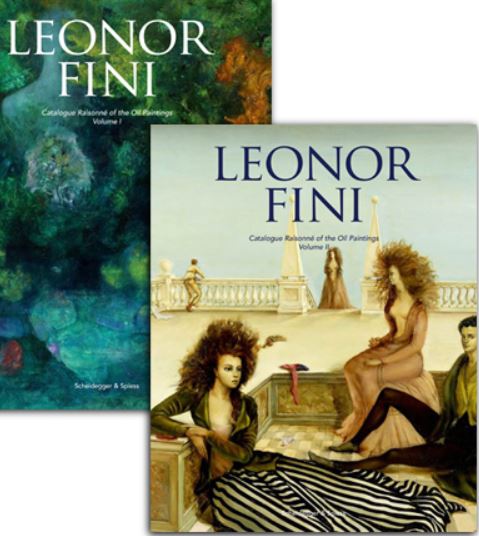
Top Upcoming Art Books: “Leonor Fini – Catalogue Raisonné of Oil Paintings”

Leonor Fini - Catalogue Raisonné of the Oil Paintings 2020Leonor Fini (1907–96) is one of the most important artists and personalities of the twentieth century. Her work came to prominence as part of the 1936 exhibition Fantastic Art, Dada and Surrealism at New York’s Museum of Modern Art, where her paintings were widely celebrated for their uniquely female approach to surrealism—although Fini never joined the surrealist movement.

0826a7ee73c580dba81b75756d38f812Self-made and self-taught, she preferred to work on her own and was known for her fierce independence and provocative panache. A prolific painter, Fini also wrote, worked extensively in book illustration and printmaking, and designed for plays, ballets, operas, and film.
Presenting the definitive catalogue raisonné of Leonor Fini’s more than 1,100 oil paintings, this book brings together more than one thousand color illustrations and essays on her work by Fini experts Richard Overstreet and Neil Zukerman and a concise, up-to-date biography by British art historian Peter Webb.

Richard Overstreet is an American artist and photographer. In 1998, he founded the Leonor Fini Archives in Paris.

Neil Zukerman is the owner of the CFM Gallery in New York. He is an expert of Leonor Fini’s work and author of several books about her.

Peter Webb is an art historian and has published extensively on art and artists of the 20th century. He formerly taught at the Coventry College of Art, the Hornsey College of Art and the Middlesex University in London.

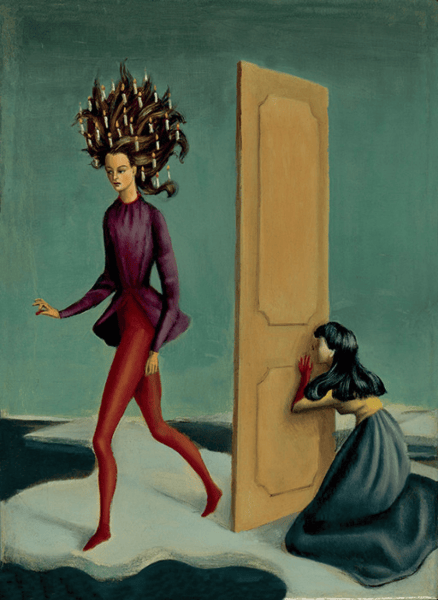
Leonor Fini (1907- 1996) was an Argentinian surrealist painter, designer, illustrator, and author, known for her depictions of powerful women.

Read more 

Art & Design: “Surrealist Home Interiors” Of Italian Designer Cristina Lello

From Visual Pleasure Magazine (April 19, 2020):

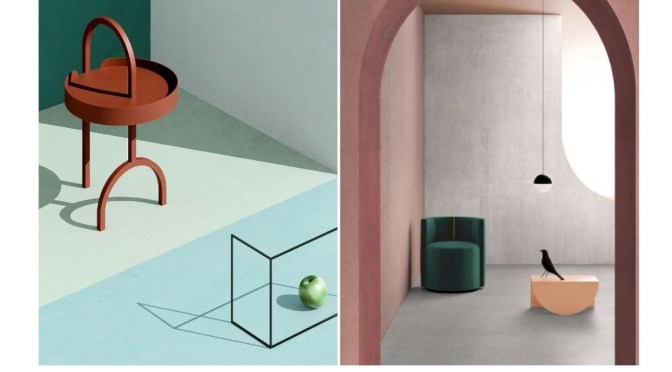
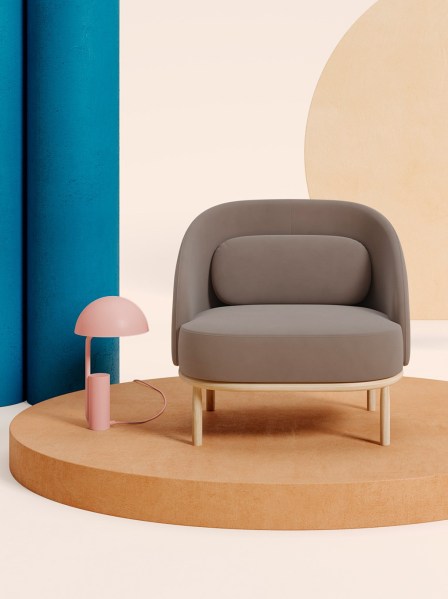
I often find myself observing classic paintings that can inspire compositions, or fashion that can inspire the choice of a color palette. At a certain point everything Cristina Lello Sunset Skene 2019is united in a very natural way in a creative concept. My artistic research is a constant blend between the worlds of architecture, painting, photography, graphic design, and fashion. At the base of my work, then, there is an artistic background very much linked to the Gestalt principles of visual perception. I try to avoid looking for inspiration only within the confines of my sector: I find that this often leads to a flattening of the creative result.

Website

Having always been fascinated with sensational spaces, Cristina Lello now visualizes the most striking scenes that tell a clear story. As she describes herself, her studio “creates high-impact images from the intersection of interior styling, set design and 3D art.” After graduating with honors in Set Design at the Academy of Fine Arts of Venice, she also started a Master’s degree in Interactive Media for Interior Design while working for Elisa Ossino Studio.

Read full article