
Tag Archives: René Magritte

ONE TIME OUT OF FOUR

Intellicurean Essays on Intellicurious

Sixteen surrealists photographed with their eyes shut, round a painting of a woman the sentence says they do not see. A table of four pictures and four words, three of them wrong. Magritte built that table three times, and the one true word in it was a wager on a reader.
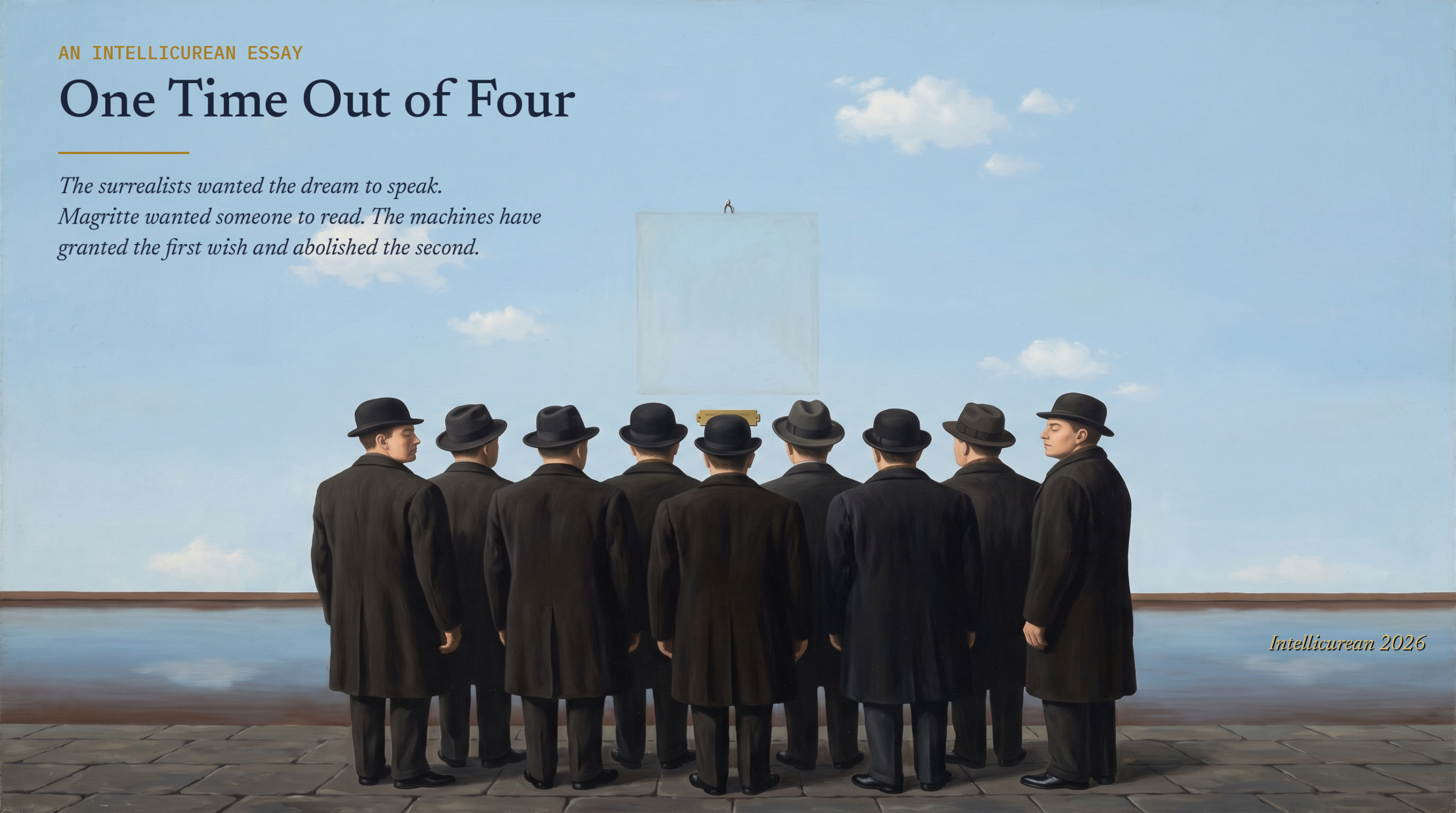
One Time Out of Four — nine men in 1930s hats and overcoats, seen from behind, stand before a blank canvas hanging in a blue sky with a brass plate beneath it
The caption is up. The picture hasn’t arrived, made for the essay.

Why we’re pointing you there

The essay starts from Jonathan Jones’s Guardian review of Gagosian’s “This Is Still Not a Pipe,” which hunts Magritte’s heirs among forty living artists, and puts his four-panel Clef des songes back among the surrealists instead: painted first in Breton’s Paris in 1927 while the movement wrote down its dreams, painted again in 1929 with no true word in it, in the year of the pipe and of the review that printed his axioms on words and images and the page of sixteen closed eyes, and painted last in Brussels in 1935, in English, for New York. In Brussels his friends proposed his titles round a table.

Then it reads the machines beside the first Manifesto. Writing with no author at its centre is what the surrealists asked for, and a captioner writing ninety-five sentences in every hundred of a training set is that wish granted; when the dream spoke at scale it said “actor on the red carpet.” The machines are Breton’s heirs, not Magritte’s, and they have done one thing the surrealists did not: put the caption before the picture, so that an image made from a prompt is an illustration of its title, which Magritte is said to have ruled out. The rival reading, that Magritte’s subject was the folly of decoding, is given at full strength and conceded. What is left is a question, not a verdict: who is reading the sentence under the picture now.
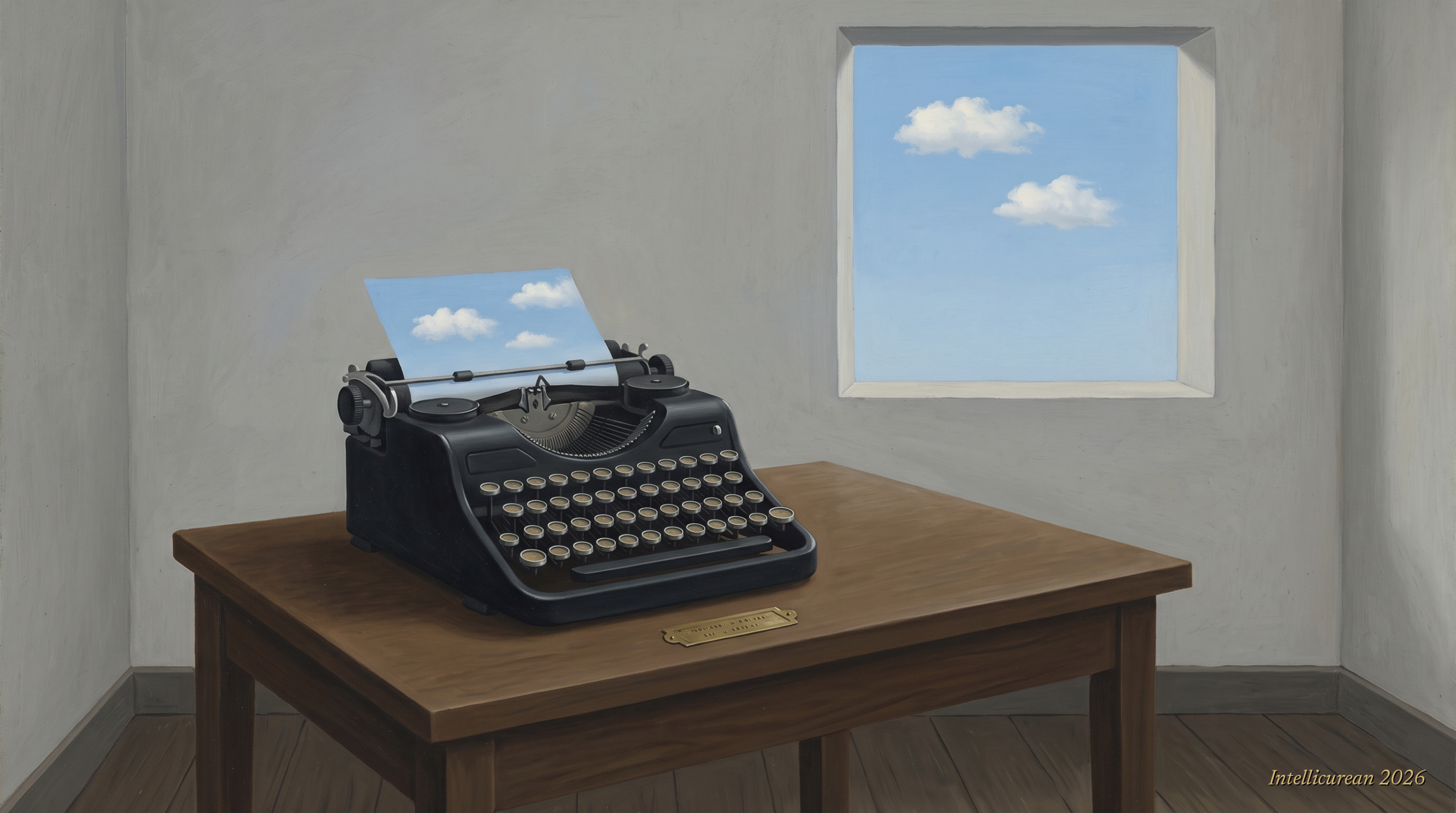
A bare room with a 1930s typewriter on a wooden table; the sheet rising from it is a small painted sky with clouds, and a window behind shows the same sky
The caption goes in first, made for the essay.

Read the full essay at Intellicurean →

Essays & Reviews for the Intellectually Curious

Travel & Surrealism: “Jungle Xanadu – The Story Of Las Pozas” (2020)

Filmed, Edited and Written by: Bob Krist

Narrated by: Fabiola Stevenson

Jungle Xanadu - The Story of Las Pozas Short Film by Bob Krist March 26 2020

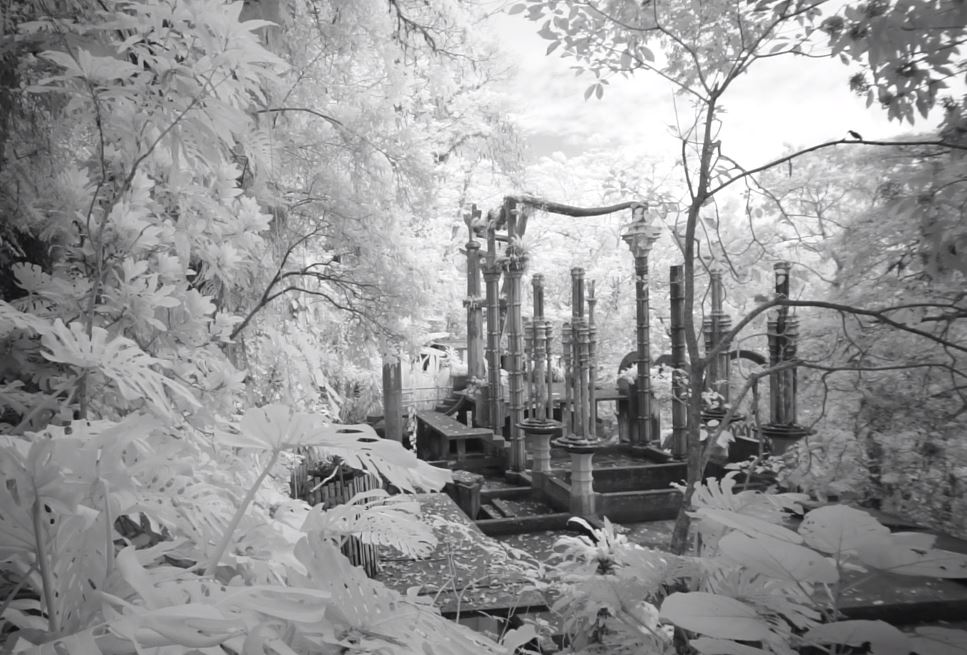
Edward James, a rich eccentric and patron of artists Salvador Dali and Rene Magritte, built a surreal sculpture park in the jungles of the Sierra Gorda in Xilitla, Mexico. The project took 35 years, spreads over 80 acres, and is accessible to the public. This piece is filmed in black & white infrared, a technique that reacts to heat as well as visible light.

Website

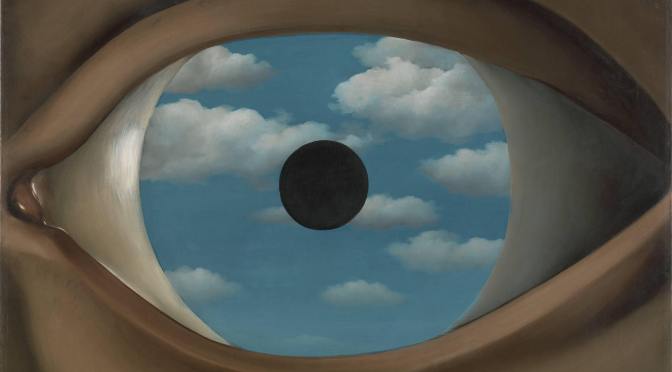
Artists: Belgian Surrealist Painter René Magritte Linked “Consciousness And The External World”

From a Christies.com online article:

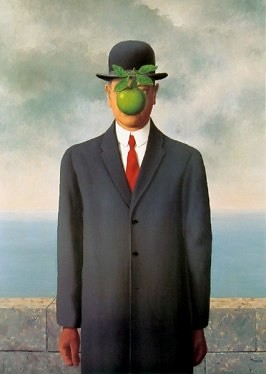
René Magritte, The Son of Man, 1964

‘The creation of new objects, the transformation of known objects; a change of substance in the case of certain objects: a wooden sky, for instance; the use of words in association with images; the misnaming of an object… the use of certain visions glimpsed between sleeping and waking, such in general were the means devised to force objects out of the ordinary, to become sensational, and so establish a profound link between consciousness and the external world.’

René François Ghislain Magritte (1898-1967) was born in Lessines, Belgium. His father was a tailor and textile merchant; his mother committed suicide in 1912, drowning herself in the River Sambre.

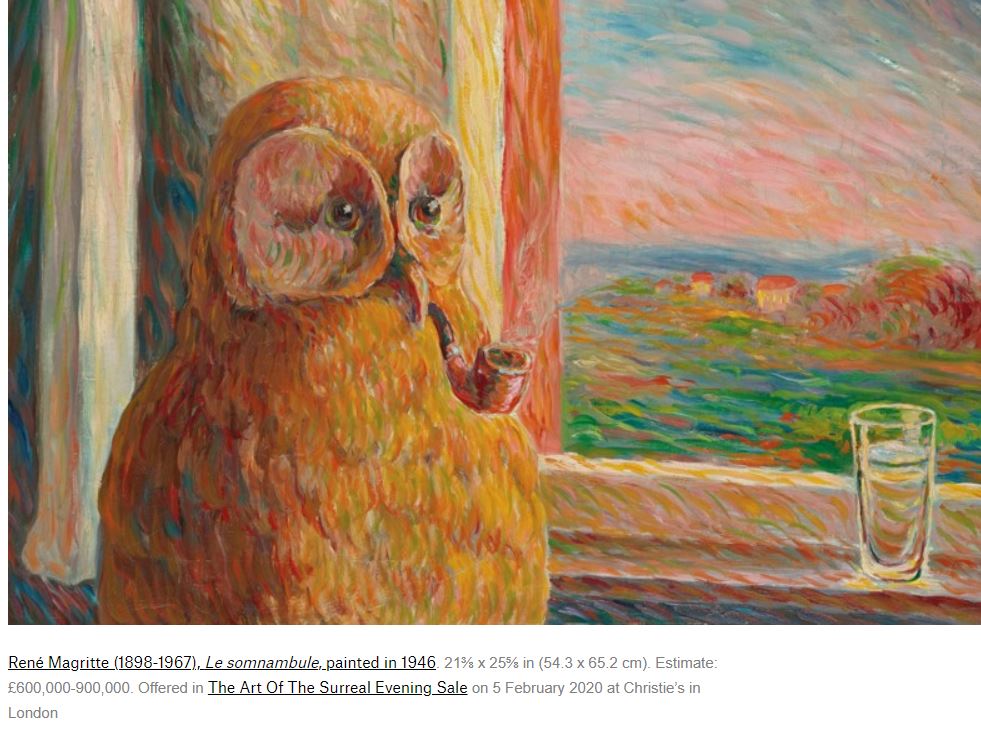
René Magritte 1898 - 1967 Le Somnambule 1946

From the 1930s, Magritte sought to find ‘solutions’ to particular ‘problems’ posed by different types of objects, a method that enabled him to challenge and reconfigure the most ubiquitous and commonplace elements of everyday life. These problems obsessed him until he was able to conceive of an image to solve them.

This philosophical method had come to him after waking from a dream in 1932. In his semi-conscious state, he looked over at a birdcage that was in his room but saw not the bird that inhabited the cage, but instead an egg. This ‘splendid misapprehension’ allowed him to grasp, in his own words, ‘a new and astonishing poetic secret.’

Read full article