Tag Archives: Memory

MEMORY, IN BLOOM

Intellicurean Essays· on Intellicurious

Nothing reliable is known about the life of Homer, yet two founding poems of Western literature bear his name. Harold Bloom, who said he could read and absorb a 400-page book in an hour, left a monument made not of poems but of memory. A new essay sets them face to face, with a third reader between them.
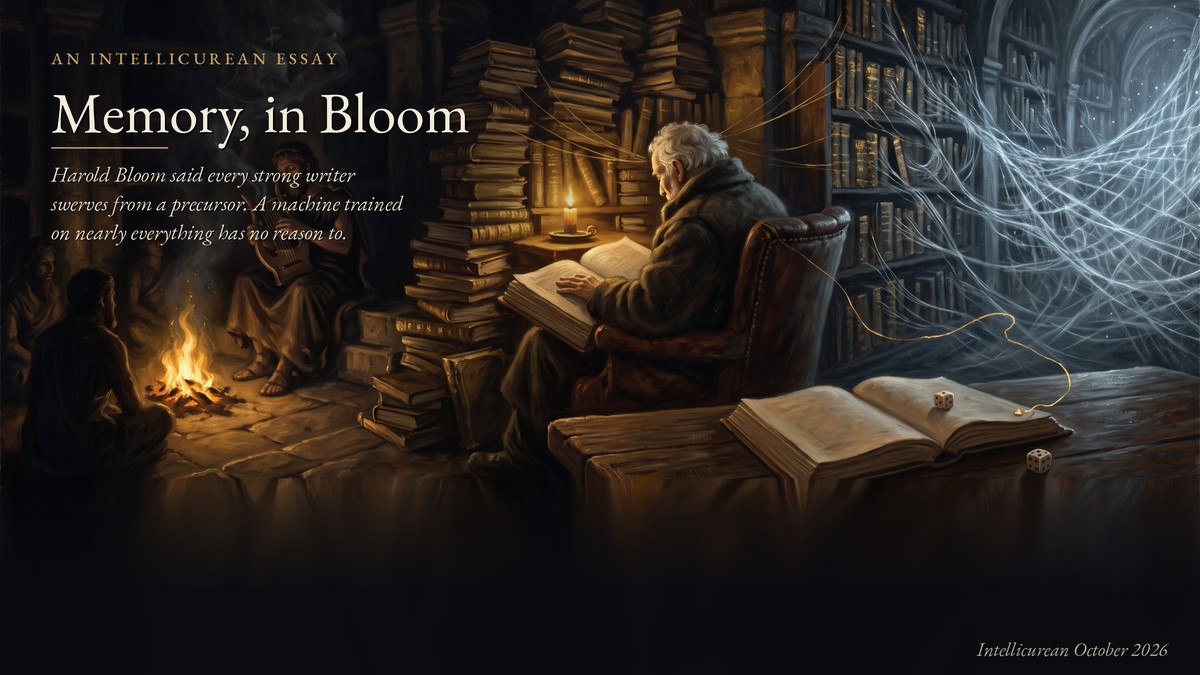

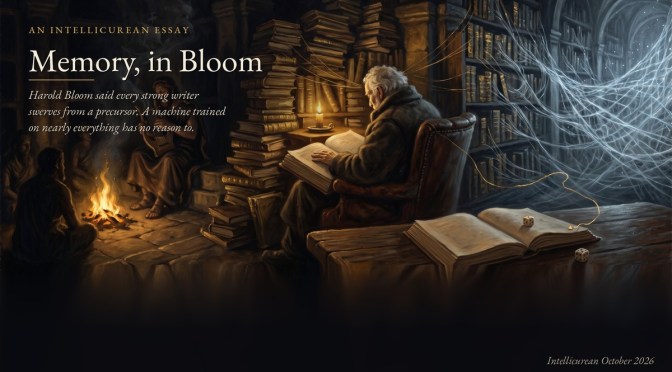
Memory, in Bloom: a vast night library in three parts. At left a Greek bard plays a lyre by a fire, smoke rising into the shapes of ships. At center an old white-haired reader in a leather armchair rests his hand on an open book among towering stacks, gold threads running from the books to his head. At right the shelves dissolve into a lattice of cold blue-white light. Two bone dice lie on a table in the foreground.
The singer, the reader and the lattice: three ages of memory in one room, made for the essay.

Why we’re pointing you there

Bloom held that every strong writer survives the past by misreading it on purpose, swerving from a precursor to make room for something new. Michael Cummins sets that theory against a reader Bloom never met: a language model, trained on a large share of everything written. The essay moves through scenes rather than abstractions. In 1926 the editor of Poetry asked Hart Crane, whose poems were the first book Bloom ever owned, to explain how dice could “bequeath an embassy,” and Crane’s answer became a defense of the unlikely line. A singer in 1930s Yugoslavia swore he sang a song “word for word and line for line,” and the recordings showed he hadn’t. In 2023 a chatbot supplied a federal court decision, signed with a real judge’s name, that no judge had ever written.

Along the way come Benjamin Franklin rebuilding essays from The Spectator, Helen Keller’s trial over a story she didn’t know she remembered, BloomBloom’s one novel and the precursor he couldn’t escapersquo;s one novel and the precursor that haunted it, and a singer in the Odyssey pleading for his life: “Self-taught am I.” The essay says plainly that it was drafted with Claude. It leaves one question open: when a writer can ask, at any hour, for the likeliest next line of anything, will that writer still learn to want the line no one else could have written?
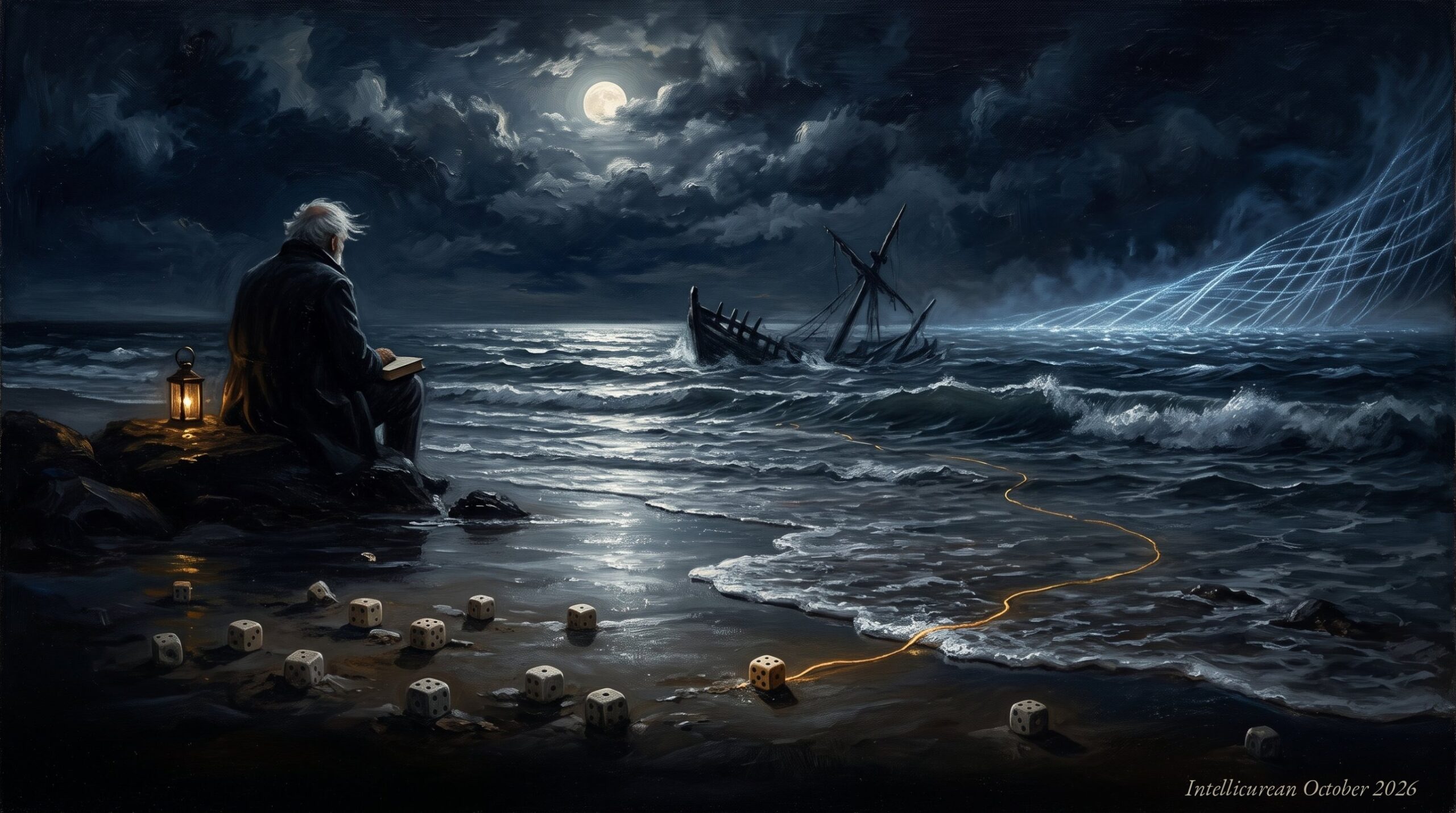
A moonlit shore at night. Small bone dice lie scattered on the wet sand; one, lit by a nearby lantern, trails a thin gold thread through the surf toward a wrecked sailing ship. On a rock at left an old man sits with his back to us, a closed book on his knee, watching the sea. Far off on the right, the moonlight breaks into a lattice of cold blue-white light.
The dice of drowned men’s bones, after Hart Crane, made for the essay.
Read the full essay at Intellicurean →

Essays & Reviews for the Intellectually Curious
HATS AND CLOAKS

Intellicurean Essays on Intellicurious

Prague, February 1948. A photograph of the new Communist leader on a balcony, a fur hat on his head, a comrade at his shoulder. Four years later the comrade is hanged and painted out of the picture. Milan Kundera built the most famous opening in Czech literature on what was left: the hat. A scholar has since checked the print, and the story is not quite what the photograph shows.

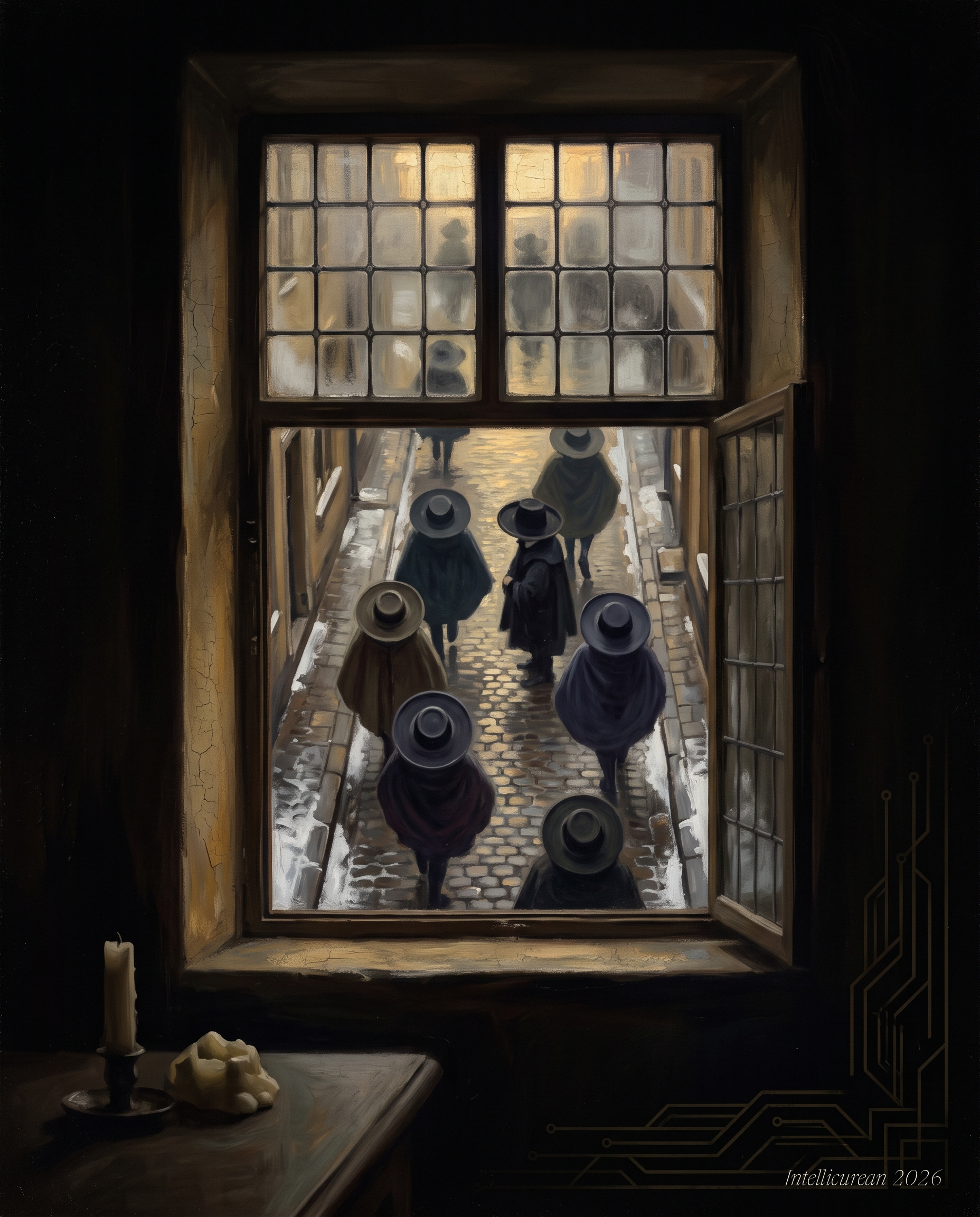
A painting of a dark study looking down through a leaded window at a snowy street, where walkers are seen from above as hats and cloaks only
Descartes’s window, painted for the essay: hats and cloaks in the street, and the men supplied by judgment.

Why we’re pointing you there

Everyone quotes Kundera’s line about memory and forgetting. Michael Cummins reads the page it’s on, and finds that Kundera gave the line to a character who is busy trying to erase his own past, and knew exactly what he was doing. From there the essay follows one fur hat through four sets of hands: the state’s, the novelist’s, Kundera’s own on his early work, and Nietzsche’s sister’s on her brother’s notebooks. Descartes supplies the frame, from a window in 1641: we see hats and cloaks in the street, and the men beneath them are something we judge, not something we see.

The hardest section concerns a half-page police report from 1950 that surfaced in 2008 with Kundera’s name on it. The essay lays out what the document says, what is contested, who the witnesses are related to, and decides nothing, which is the only honest thing to do with it. It makes exactly one guess about Kundera, labels it as a guess, and gives its grade. Read it for the ending, where the record does something the novel never mentions.

Read the full essay at Intellicurean →

Essays & Reviews for the Intellectually Curious

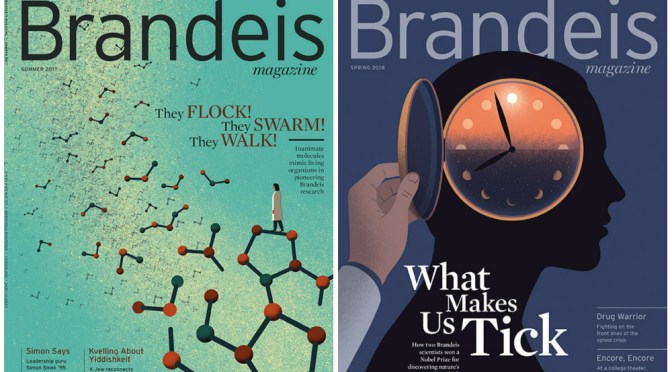
Arts & Culture: Brandeis Magazine – Winter 2023

Read the Winter issue of Brandeis Magazine | BrandeisNOW

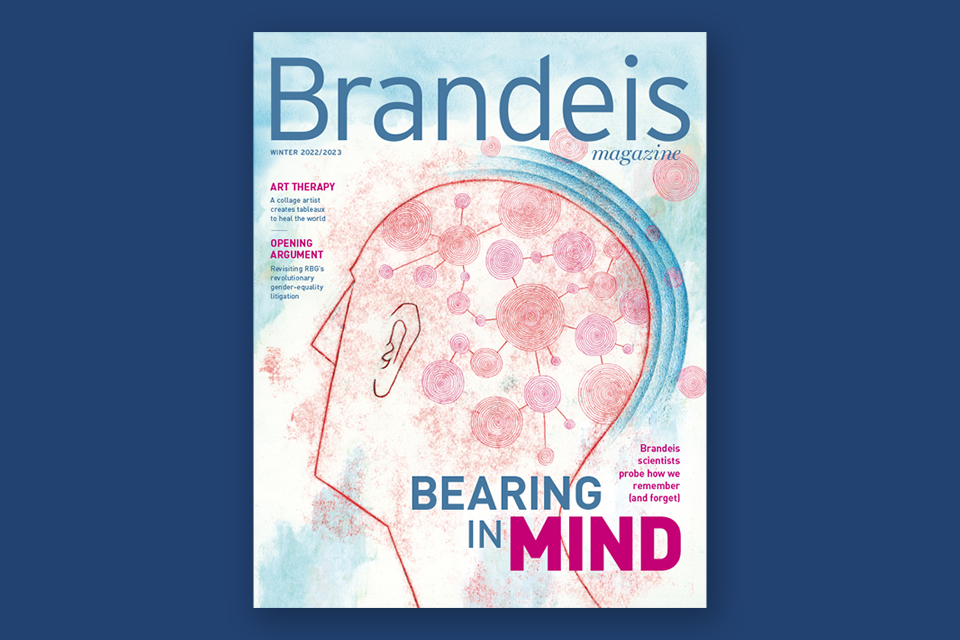
Brandeis Magazine (Winter 2022/2023):

The Amber of Our Thoughts

How are memories created and preserved? Brandeis scientists are studying the brain to find out — and, ultimately, untangle disorders like Alzheimer’s and dementia.

A ‘Notorious’ Champion of Women

In the 1970s, lawyer Ruth Bader Ginsburg developed an unusually successful strategy for fighting sex discrimination.

The Age of Invention

An analysis of patent data offers a window into human creativity.

Science: 890 Million-Year-Old Sponge, Caffeinated Bees, Greenland Glaciers

Researchers debate whether an ancient fossil is the oldest animal yet discovered, and a new way to eavesdrop on glaciers.

In this episode:

01:04 Early sponge

This week in Nature, a researcher claims to have found a fossil sponge from 890-million-years-ago. If confirmed, this would be more than 300-million-years older than the earliest uncontested animal fossils but not all palaeontologists are convinced.

Research Article: Turner

10:13 Research Highlights

A caffeine buzz appears to improve bees’ memory, and reconstructing an Iron Age man’s final meal.

Research Highlight: A caffeine buzz gives bees flower power

Research Highlight: The guts of a ‘bog body’ reveal sacrificed man’s final meal

12:34 Eavesdropping on a glacier’s base

We hear about one researcher’s unorthodox attempt to listen in to the seismic-whisper at the foot of a Greenland glacier – a method that might reveal more about conditions under these enormous blocks of ice.

Research Article: Podolskiy et al.

The Brain: ‘Learning & Memory’ – Neuroscience & Disease Research (Video)

Neuroscience Professor Seth Tomchik, PhD, focuses on two major research areas, the neuroscience of learning and memory, and diseases that affect learning and memory, including neurofibromatosis type one. Neuroscience is now the largest department on the Florida campus of Scripps Research.

The department’s faculty and staff, together with graduate students enrolled in the institute’s Skaggs Graduate School, push the boundaries of scientific knowledge to benefit humanity. Watch all 11 videos in this series to see their work in more detail. Scripps Research is an independent, nonprofit biomedical research institute ranked the most influential in the world for its impact on innovation. With campuses in La Jolla, California, and Jupiter, Florida, the institute advances human health through profound discoveries that address pressing medical concerns around the globe. Scripps Research also trains the next generation of leading scientists at the Skaggs Graduate School, consistently named among the top 10 U.S. programs for chemistry and biological sciences. Learn more at http://www.scripps.edu.

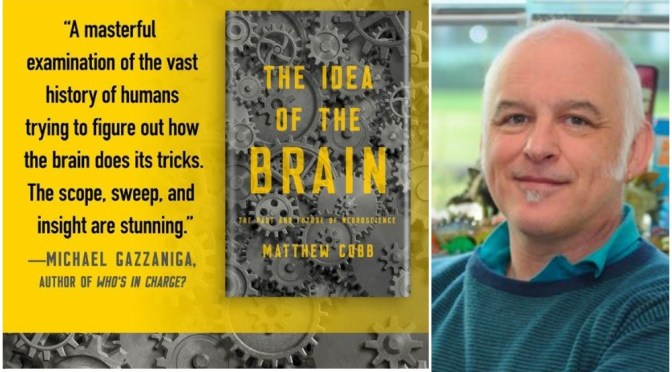
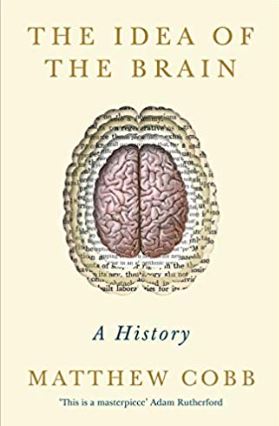
Top New Books: “The Idea Of The Brain” By Matthew Cobb – “A Supercomputer”

The Idea of the Brain - Matthew Cobb - April 2020Although it might seem to be a story of ever-increasing knowledge of biology, Cobb shows how our ideas about the brain have been shaped by each era’s most significant technologies. Today we might think the brain is like a supercomputer. In the past, it has been compared to a telegraph, a telephone exchange, or some kind of hydraulic system. What will we think the brain is like tomorrow, when new technology arises?
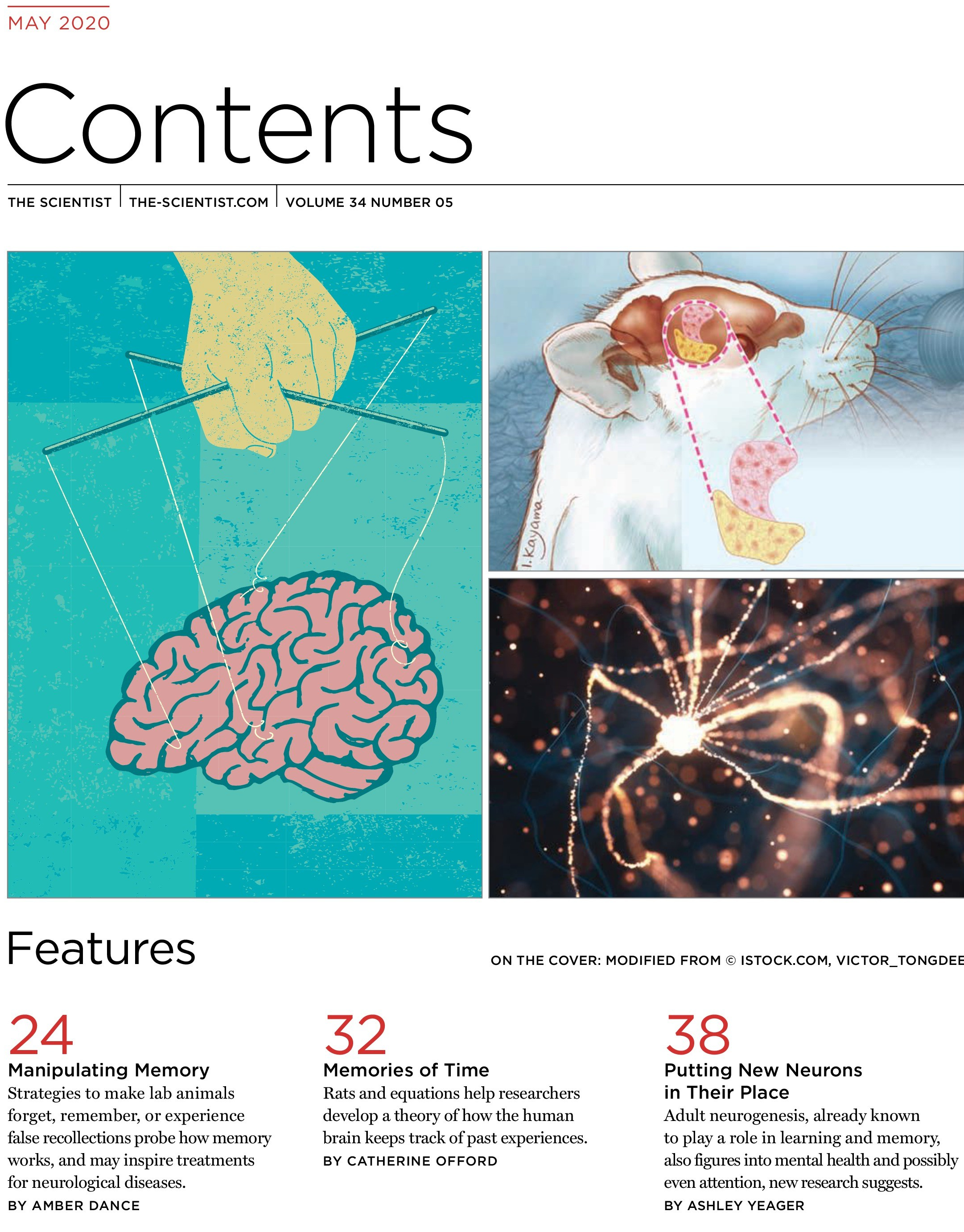
For thousands of years, thinkers and scientists have tried to understand what the brain does. Yet, despite the astonishing discoveries of science, we still have only the vaguest idea of how the brain works. In The Idea of the Brain, scientist and historian Matthew Cobb traces how our conception of the brain has evolved over the centuries.

READ EXCERPT OF FIRST 30 PAGES

The result is an essential read for anyone interested in the complex processes that drive science and the forces that have shaped our marvelous brains.

Matthew Cobb is Professor of Zoology at the University of Manchester. His previous books include Life’s Greatest Secret:The Race to Discover the Genetic Code, which was shortlisted for the the Royal Society Winton Book Prize, and the acclaimed histories The Resistance and Eleven Days in August. He is also the award-winning translator of books on the history of molecular biology, on Darwin’s ideas and on the nature of life.

Read more or purchase

The Elderly & Dementia: “Managing Daily Activities & Fall Prevention” (UCSF)

Presented by Sarah Dulaney, RN, CNS, a nurse at the UCSF Memory and Aging Center, and Helen Medsger, a family caregiver and LBD support group leader, as part of the Lewy Body Dementia Caregiver Webinar Series supported by the UCSF Memory and Aging Center and the Administration for Community Living.

Top New Science Podcasts: Musical Memory, Ancient Artifacts Along Europe’s Shores (ScienceMag.org)

science-magazine-podcastsOn this week’s show, host Joel Goldberg talks with science journalist Andrew Curry about archaeological finds from thousands of years ago along the shores of Northern Europe. Curry outlines the rich history of the region that scientists, citizen scientists, and energy companies have helped dredge up.

Also this week, from a recording made at this year’s AAAS annual meeting in Seattle, host Meagan Cantwell speaks with Elizabeth Margulis, a professor at Princeton University, about musical memory. Margulis explains what research tells us about how our brains process music, and dives into her own study on how Western and non-Western audiences interpret the same song differently.