For thirty years we have pictured Nietzsche’s last man as a creature of comfort, blinking contentedly at the end of history. Read the page again and he is doing something else entirely. He is smirking. What if the people who want the least are the proudest people of all?
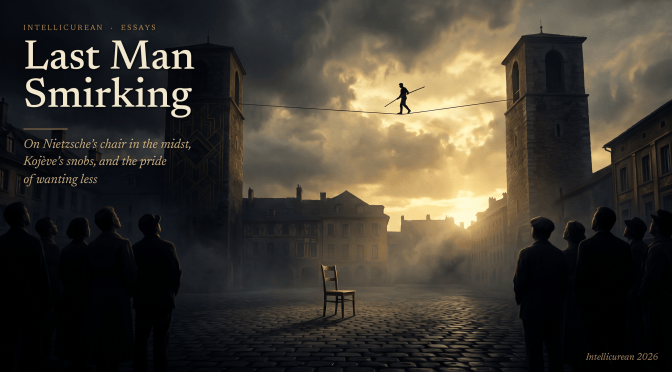
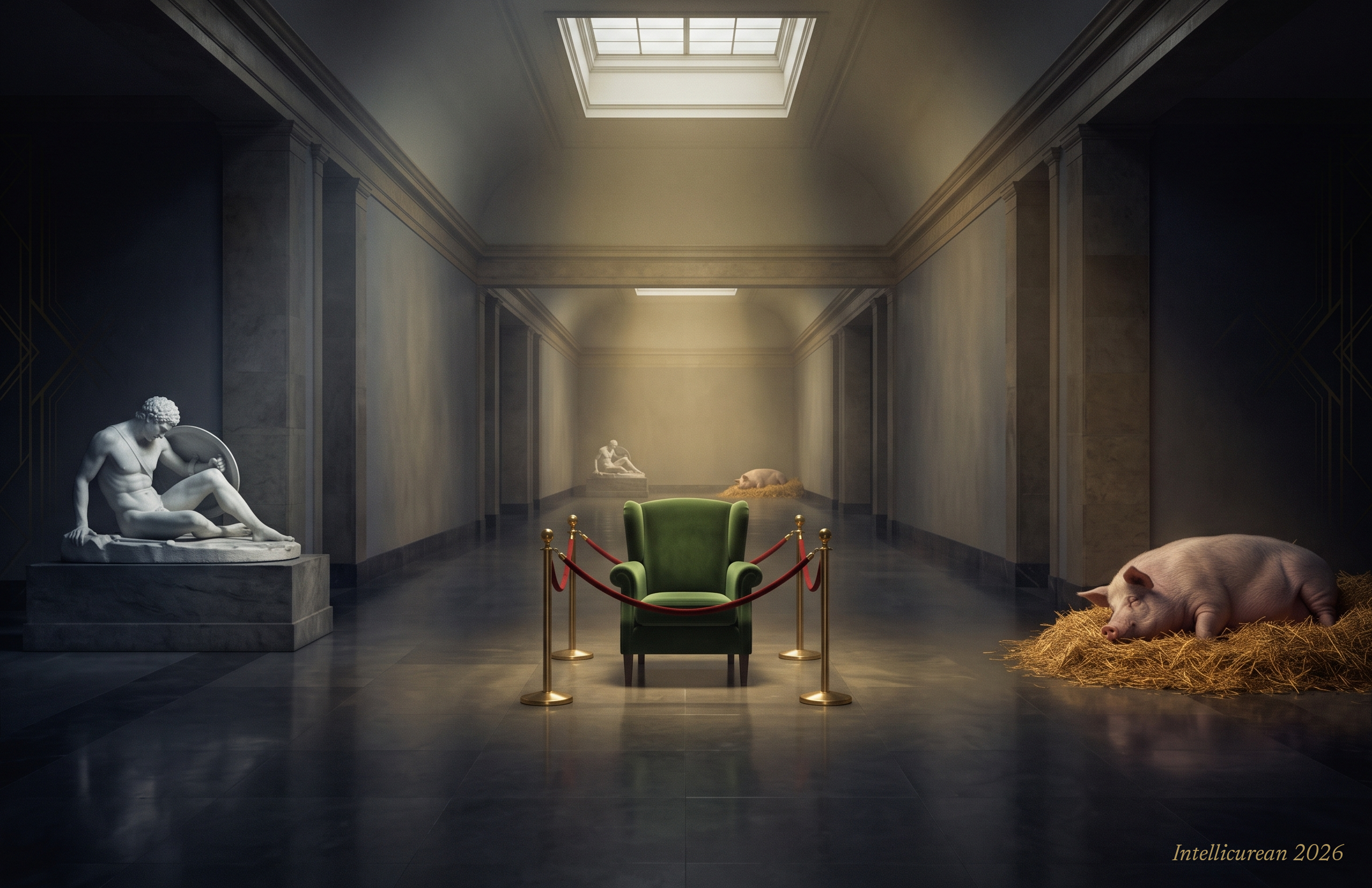
The chair in the midst, painted for the essay. An invention, and captioned as one there.
Why we’re pointing you there
Francis Fukuyama made the last man famous in 1992, and in a new memoir he says we now live in the last man’s world. Michael Cummins agrees about the world and argues that Fukuyama has had the man wrong from the start. Fukuyama imagined someone who had lost the old hunger to be thought better than others. Cummins goes back to Zarathustra and finds a crowd vain about its culture, and a passage in which the small people boast of sitting precisely halfway between the gladiator and the pig. The hunger never left. It learned to pass for modesty.
What we liked most is that the essay won’t let anyone off. It uses Fukuyama’s own pages to explain why a democracy drives ambition into hiding, borrows Kojève’s discovery of Japanese snobbery and turns it inside out, and then gives Nietzsche’s rival snobbery of the heights its due, along with Fukuyama’s warning about the bored crowds of August 1914. It ends at Niagara, with a French acrobat and a chair, and the best last line we have run this year.
Prague, February 1948. A photograph of the new Communist leader on a balcony, a fur hat on his head, a comrade at his shoulder. Four years later the comrade is hanged and painted out of the picture. Milan Kundera built the most famous opening in Czech literature on what was left: the hat. A scholar has since checked the print, and the story is not quite what the photograph shows.
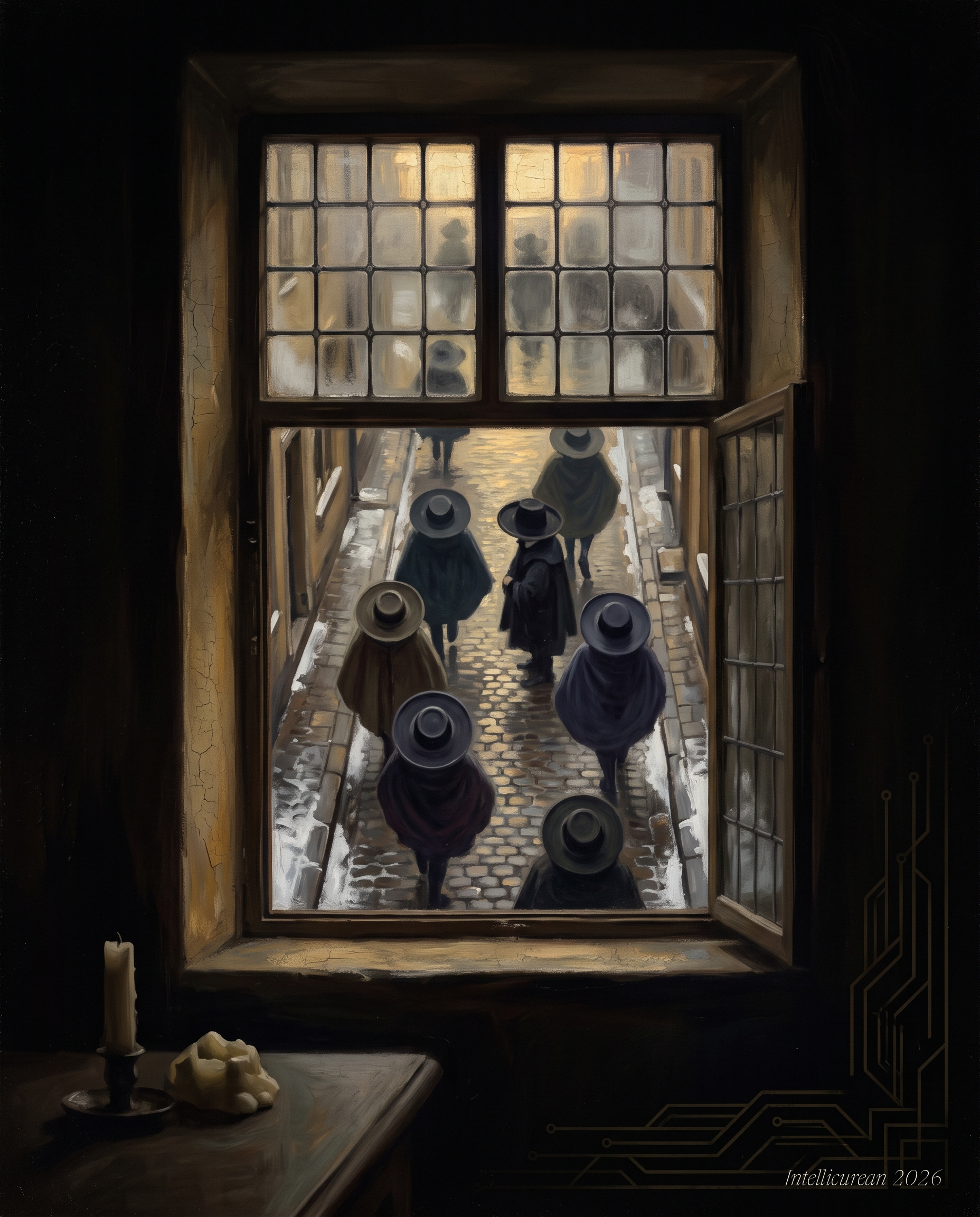
Descartes’s window, painted for the essay: hats and cloaks in the street, and the men supplied by judgment.
Why we’re pointing you there
Everyone quotes Kundera’s line about memory and forgetting. Michael Cummins reads the page it’s on, and finds that Kundera gave the line to a character who is busy trying to erase his own past, and knew exactly what he was doing. From there the essay follows one fur hat through four sets of hands: the state’s, the novelist’s, Kundera’s own on his early work, and Nietzsche’s sister’s on her brother’s notebooks. Descartes supplies the frame, from a window in 1641: we see hats and cloaks in the street, and the men beneath them are something we judge, not something we see.
The hardest section concerns a half-page police report from 1950 that surfaced in 2008 with Kundera’s name on it. The essay lays out what the document says, what is contested, who the witnesses are related to, and decides nothing, which is the only honest thing to do with it. It makes exactly one guess about Kundera, labels it as a guess, and gives its grade. Read it for the ending, where the record does something the novel never mentions.