

Tag Archives: AI Collaboration

HATS AND CLOAKS

Intellicurean Essays on Intellicurious

Prague, February 1948. A photograph of the new Communist leader on a balcony, a fur hat on his head, a comrade at his shoulder. Four years later the comrade is hanged and painted out of the picture. Milan Kundera built the most famous opening in Czech literature on what was left: the hat. A scholar has since checked the print, and the story is not quite what the photograph shows.
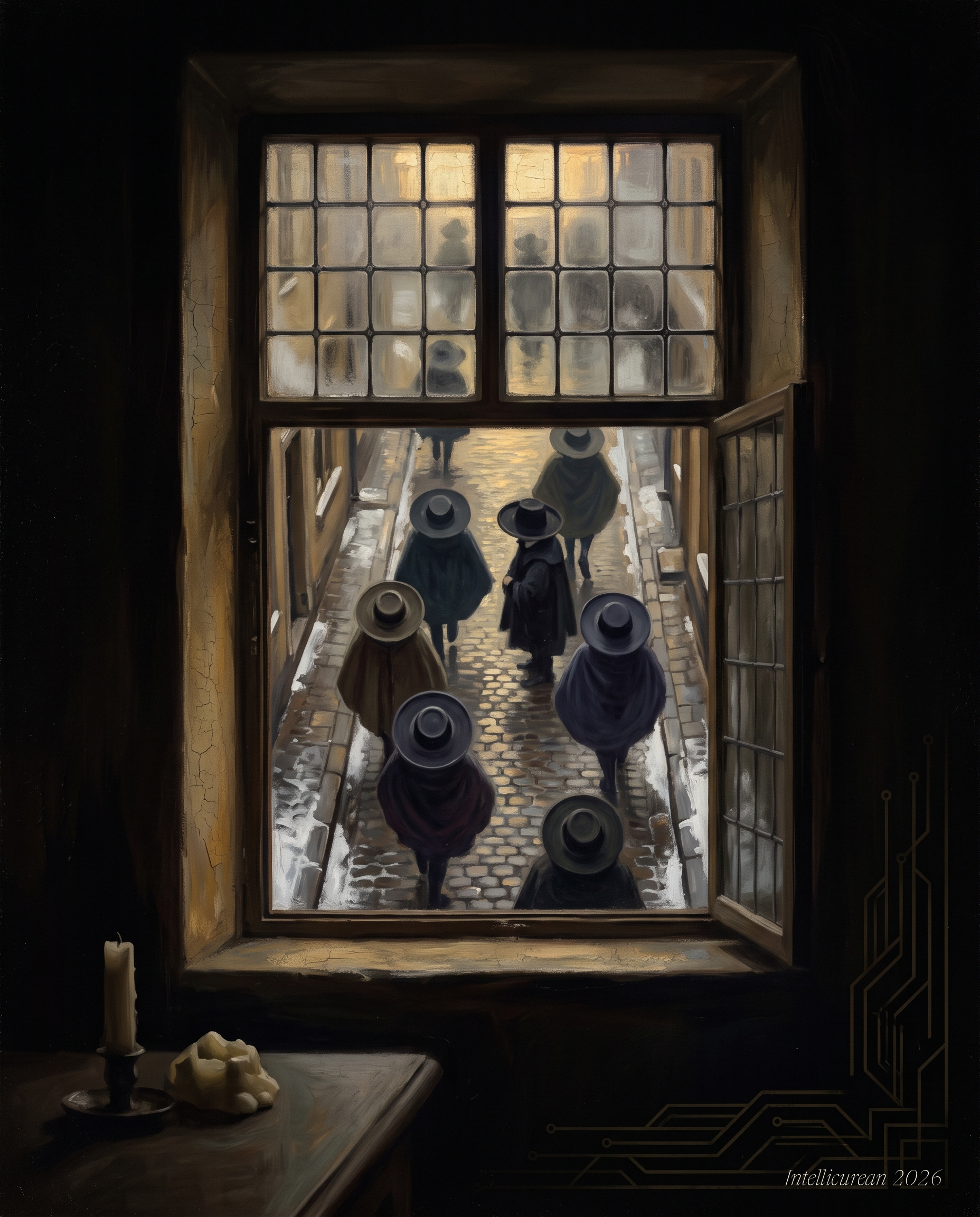
A painting of a dark study looking down through a leaded window at a snowy street, where walkers are seen from above as hats and cloaks only
Descartes’s window, painted for the essay: hats and cloaks in the street, and the men supplied by judgment.

Why we’re pointing you there

Everyone quotes Kundera’s line about memory and forgetting. Michael Cummins reads the page it’s on, and finds that Kundera gave the line to a character who is busy trying to erase his own past, and knew exactly what he was doing. From there the essay follows one fur hat through four sets of hands: the state’s, the novelist’s, Kundera’s own on his early work, and Nietzsche’s sister’s on her brother’s notebooks. Descartes supplies the frame, from a window in 1641: we see hats and cloaks in the street, and the men beneath them are something we judge, not something we see.

The hardest section concerns a half-page police report from 1950 that surfaced in 2008 with Kundera’s name on it. The essay lays out what the document says, what is contested, who the witnesses are related to, and decides nothing, which is the only honest thing to do with it. It makes exactly one guess about Kundera, labels it as a guess, and gives its grade. Read it for the ending, where the record does something the novel never mentions.

Read the full essay at Intellicurean →

Essays & Reviews for the Intellectually Curious
THE FIRST DRAFT

Intellicurean Essays, on Intellicurious
Above the publisher’s desk at The New York Times hangs an engraving of Manhattan in 1851 — cobblestones, low buildings, a harbor full of sails, a church spire the tallest thing on the island. Someone stood there and looked. That, it turns out, is the whole question.

Why we’re pointing you there

The Times marked its 175th anniversary this week with an essay on fifteen million “first drafts of history.” The same week, an investigation exposed a company buying real online publications, firing the writers, and filling them with machine-written articles — bylined to experts who were never born, and overseen by an editor whose age dropped from 77 to 75 in the space of three days. Intellicurean sets the two side by side and asks what a first draft is worth when no one was there to draft it.

The answer turns on a name the Times left out: Earl Caldwell, the only reporter at the Lorraine Motel when King was shot, who said afterward that you don’t see everything — you get a sliver of what came past you, and that sliver is the basis for everything. A machine can generate a flawless eyewitness account of any event. It can never have been there. This is the fourth in Intellicurean’s series on what the machine lacks — and the one with the strongest floor beneath it.

Read the full essay at Intellicurean → Essays & Reviews for the Intellectually Curious