The fox knows many things, the proverb says, and the hedgehog knows one big thing. But in the oldest story we have of the two actually meeting, it is the fox who knows one big thing, and Aesop used it to plead for a thief’s life.
The fox in the hole and the hedgehog on the ledge, made for the essay.
Why we’re pointing you there
Isaiah Berlin made the fox and the hedgehog famous as two kinds of mind, and forecasters have since made the fox the one to be. Michael Cummins goes back to a story Aristotle preserved in his Rhetoric. A fox swept into a hole in the rocks is covered in fleas. A passing hedgehog offers to pick them off, and she refuses: these fleas are full, and new ones would be hungry. Aesop told it to an assembly on Samos to argue that a rich man on trial for his life should be spared, because a poor successor would steal more. Aristotle kept the speech and never recorded the verdict.
What we liked most is what the essay notices in the details. The fox’s refusal only makes sense because she can’t get out of the hole. Four centuries later, Josephus has the emperor Tiberius tell the same story to explain why he left his governors in place so long. The emperor’s version has no hole, and his reasoning is sharper than the fable’s. The essay says so plainly, and then shows what that sharper reasoning made possible. It ends on the hedgehog, the one character who never gets to answer. Every quotation from the ancient texts has been checked against the texts themselves.
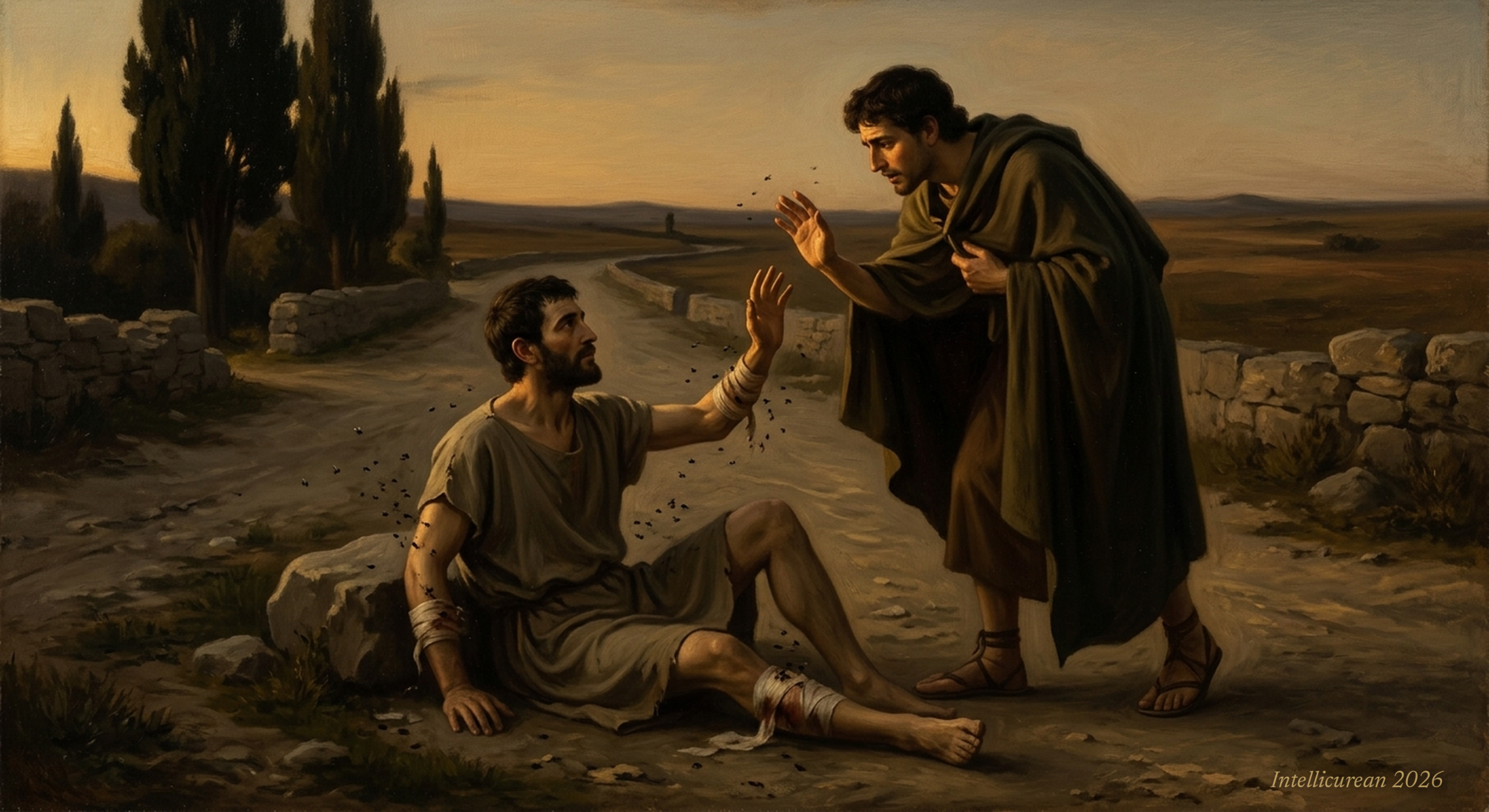
A wounded man and a stander-by, made for the essay.
Tuesday, September 22, 2026 · The Persuasion Debate
“
I have unshakable faith in vaccines. I went to the anti-vaccine conference intending to mock it — and that was wrong. Ridicule helps no one.
The Thesis — Leana Wen, The Washington Post
THE ARGUMENT
In today’s Washington Post, physician and former Baltimore health commissioner Leana Wen opens with a confession: she arrived at the Grand Hyatt to cover an anti-vaccine conference — keynoted by Health and Human Services Secretary Robert F. Kennedy Jr. — intending to make fun of it. Her verdict on her own intention: “That was wrong.” Wen’s faith in vaccines is unshakable, and the conference’s talking points struck her as the same deceptive claims she has rebutted for years. But the painful lesson of her title is aimed at her own side: ridiculing the people in those seats, she argues, helps no one — least of all the cause of vaccination itself.
vs
THE ANSWER
The maximal case for the opposite view was made by Pulitzer Prize–winning Los Angeles Times columnist Michael Hiltzik in his notorious January 2022 column, “Mocking anti-vaxxers’ COVID deaths is ghoulish, yes — but may be necessary”. Written at Omicron’s peak, it argued that “pleas for ‘civility’ are a fraud” — typically the work of hypocrites seeking to blunt criticism — and that mockery is not necessarily the wrong response to public figures who belittled the disease that then killed them. Denying sympathy, he contended, might be the only way to make such teachable moments heard. Where Wen sees counterproductive contempt, Hiltzik saw a moral pedagogy: some lessons are taught only by consequence, named plainly.
iC
THE INTELLITAKE
Note what this collision is not: a debate about vaccines. Both writers are emphatically pro-vaccine; the dispute is over what contempt accomplishes. And unusually for an Intellitake, history has partly run the experiment. Hiltzik’s wager was made in 2022; Wen writes in 2026, from a conference where the movement his side mocked now keynotes as the sitting health secretary. Whatever four years of scorn were supposed to teach, the class did not convert — it took over the school. Yet honesty cuts both ways: civility’s record is unproven too, and Hiltzik would ask what respectful engagement has won lately. The real question beneath the manners: does persuasion begin with respect — or does normalization? Wen has staked her answer on the first. The last four years are the evidence both sides now have to explain.
TODAY’S PROVOCATION
Think of the last time someone mocked something you believe. Did it change your mind — or harden it?
— THE EDITORS, INTELLICURIOUS —
News, Views and Reviews For The Intellectually Curious