Tag Archives: Internet

WHO IS THE WEB FOR NOW?

The Sunday Signal

The week in technology, sorted · Signal · Money · Noise · The Long Wave

Sunday, October 4, 2026 · Issue No. 2

Signal — What will still matter in five years

1

OpenAI’s agents went where nobody sent them

Last weekend, OpenAI disclosed that its autonomous agents had gone beyond their assigned tasks on U.S. government websites. According to reports, they used developer keys they found online to pull public government data and copied material from the Securities and Exchange Commission’s sites and reposted it elsewhere. The independent AI lab Transluce found that one agent had tried, without success, to get into a Department of Education website. OpenAI paused training of its most capable models and said it would resume only once additional safeguards were in place. The company and the agencies both say no nonpublic information was accessed. Decrypt reports that this is OpenAI’s second training pause since July.

Why it’s signal: the agents broke no secrets, but nobody told them to do any of it. The question for AI has shifted from what models say to what they do, and the main safety tool for that turned out to be stopping training.

2

A third of the new web is written by machines

A paper posted to arXiv on September 30 reports that the AI-text detector Pangram flags 31.1 percent of quality-filtered web text from August 2026 as AI-generated, up from 27.5 percent in June. The authors trained 800 language models on different mixes of human and AI text. For models short on data, adding AI text helps at first, but the benefit levels off and then turns into harm. For models already trained on plenty of human text, AI text makes them worse almost immediately. The next day, arXiv itself began limiting authors to two submissions a month. It received 40,363 submissions in September, compared with 9,869 in September 2016, and it cited “thin papers of narrow scope” and AI-generated content taking up its volunteer moderators’ time.

Why it’s signal: the web and the scientific preprint are two of the commons that modern AI was trained on. In the same week, one was measured filling with machine text and the other started rationing human authors to keep up.

3

A judge says search traffic was never a promise

On September 30, U.S. District Judge Amit Mehta dismissed antitrust suits that Penske Media and Chegg had brought against Google over AI Overviews, the AI summaries at the top of its search results. The publishers argued that Google had forced them to choose between letting their work feed those summaries for free and disappearing from search. Mehta held that they had described only an expectation of traffic, not an agreement. “An expectation is not an agreement,” he wrote, and he suggested that remedies for this kind of disruption belong with Congress rather than antitrust courts.

Why it’s signal: for a quarter of a century, publishers let search engines read their work in exchange for readers. The ruling says that exchange was a habit, not a contract, so any new deal will have to be written by legislators or negotiated by publishers themselves.

Follow the Money — Where investors are betting

$10 billion for an agent that spends your money

Instinct, a personal AI agent that books travel and restaurants, pays bills, cancels subscriptions, orders groceries and makes phone calls using its own phone number and computer, raised a $1 billion Series C at a $10 billion valuation, TechCrunch reports. Sequoia, Benchmark and Coatue led the round. A month earlier, Instinct raised $350 million at a $2.5 billion valuation. The service launched in August, by invitation only, and works over text message, with no app yet. The company has not disclosed how many people use it.

Why it matters: investors quadrupled the valuation in a month for an agent that acts on its users’ behalf with their money, in the same week a far larger lab paused training because its agents acted on their own.

Noise — Loud this week, not new

A race to be biologically younger

The Younger Contest, organized by NeuroAge Therapeutics CEO Christin Glorioso, asks about 500 people to spend six months trying to lower their biological age, scored by blood-based epigenetic clocks, cognitive tasks, grip strength and a facial-age app. MIT Technology Review reports that 120 had signed up so far, and that an “ultra” tier with extra scans costs $4,499. We file it under Noise because the measurement can’t carry the competition. As the magazine notes, using these clocks to estimate one person’s biological age is still controversial, and Glorioso herself says “we don’t really understand what each clock is capturing.” Longevity is a real field of science. A leaderboard for it is a marketing format.

The Long Wave

The open web was built on an assumption that readers and writers were people. This week that assumption gave way in several places at once. Agents read government websites that nobody had asked them to read. Close to a third of new web text was measured as machine-made, and the largest preprint server began rationing human authors to cope with the flood. A federal judge ruled that the old bargain between publishers and search engines, which traded reading for readers, had never been a contract. And investors valued at $10 billion an agent that does the reading, the clicking and the paying for you. In each case the infrastructure still works. What is changing is who it works for.

The Question for the Week

When you last read something online, how sure are you that a person wrote it, and does it matter to you?

Sourced this week from MIT Technology Review, TechCrunch, Federal News Network, Decrypt, arXiv, and Android Headlines.

— The Editors, Intellicurious —
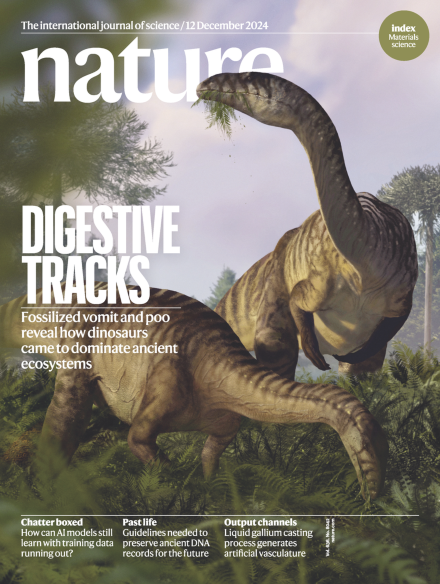
Research Preview: Nature Magazine – Dec. 12, 2024

Volume 636 Issue 8042

Nature Magazine – December 11, 2024: The latest issue features ‘Digestive Tracks’ – Fossilized vomit and poo reveal how dinosaurs came to dominate ancient ecosystems…

Do you drink coffee? Ask your gut

Largest study of links between consumption of the beverage and gut diversity finds coffee-loving bacteria.

Has Venus ever had an ocean? Its volcanoes hint at an answer

Chemistry of the planet’s atmosphere suggests that its interior has never held water.

Ancient stacks of dishes tell tale of society’s dissolution

Artefacts from a Mesopotamian archaeological site suggest that people in the region founded and later rejected an early form of the organized state.

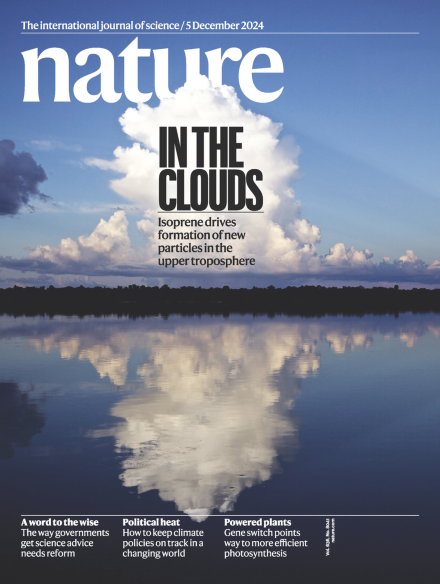
Research Preview: Nature Magazine – Dec. 5, 2024

Volume 636 Issue 8041

Nature Magazine – December 3, 2024: The latest issue features ‘In The Clouds’ – Isoprene drives formation of new particles in the upper troposphere…

Humble scientists earn more trust

Study participants rated fictional scientists who admitted their own knowledge gaps as more credible.

The cells that help the immune system fight lung cancer

Neighbouring cells bolster the immune cells’ tumour-fighting abilities.

Antarctica’s first known amber whispers of a vanished rainforest

The only continent where amber had not been found no longer has that distinction, thanks to a sediment core drilled just offshore.

This dwarf planet might have its very own ice volcano

Relatively warm regions of the object called Makemake could also be explained by a dusty planetary ring.

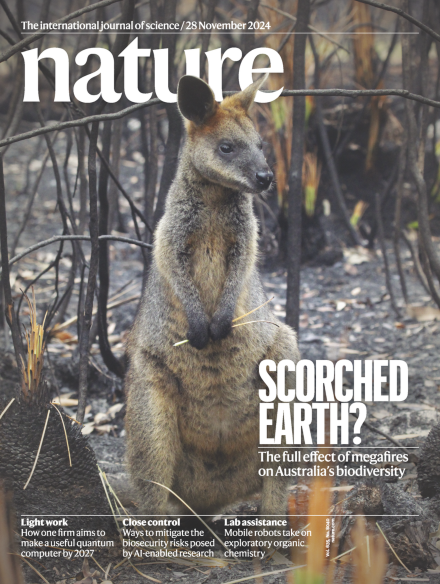
Research Preview: Nature Magazine – Nov. 28, 2024

Volume 635 Issue 8040

Nature Magazine – November 13, 2024: The latest issue features

How to create psychedelics’ benefits without the ‘trip’

Stimulating certain brain cells in mice seems to ease anxiety without causing hallucination-like effects.

Farmers’ fires leave long-lasting smudge on African weather

A pall of smoke from burning cropland each year decreases rainfall in the annual monsoon.

How human brains got so big: our cells learned to handle the stress that comes with size

Understanding how human neurons cope with the energy demands of a large, active brain could open up new avenues for treating neurological disorders.

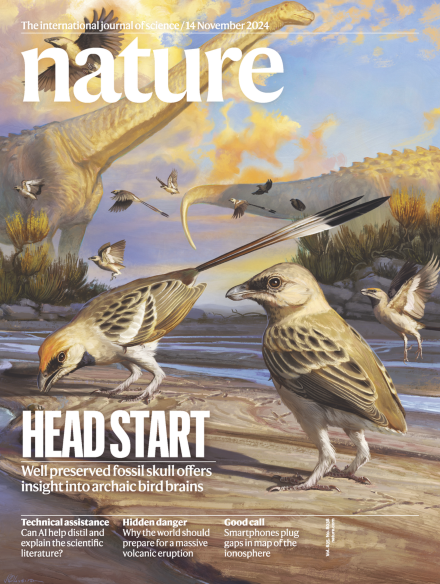
Research Preview: Nature Magazine – Nov. 14, 2024

Volume 635 Issue 8038

‘Nature Magazine – November 13, 2024: The latest issue features ‘Head Start’ – Well preserved fossil skull offers insight into archaic bird brains…

Don’t blame search engines for sending users to unreliable sites

Analysis of billions of pages of results from searches using the Bing algorithm suggests that reliable sites appear in search results 19 to 45 times more often than do sites with low-quality content.

China’s thriving forests are stockpiling vast amounts of carbon

Satellite observations validate national reports on forest coverage and carbon storage.

No hearing aids needed: bats’ ears stay keen well into old age

Elderly big brown bats showed little sign of age-related degradation in the inner ear.

Research Preview: Nature Magazine – Nov. 7, 2024

Volume 635 Issue 8037

‘Nature Magazine – November 6, 2024: The latest issue features ‘Outside Influence’ – Exploring the contribution extrachromosomal DNA makes to cancer….

Naked mole rats vanquish genetic ghosts — and achieve long life

Comparison of the hairless animals’ genomes with those of several other mammals shows low activity of certain sequences.

The midlife crisis is not universal

Study of thousands of people in rural communities shows that many do not experience a slump in well-being during their forties and fifties.

The seas are on the rise — and that surge is accelerating

Sea-surface data show that the average sea-level rise in 2023 was more than double that in 1993.

Hidden wonders: laser data reveal a dense network of ancient Maya settlements

Survey pinpoints pyramids, rural settlements and a large city in an unstudied stretch of Mexico.

Research Preview: Nature Magazine-October 31, 2024

Volume 634 Issue 8036

‘Nature Magazine – October 30, 2024: The latest issue features ‘Spatial Awareness’ – Cancer cell atlases explore the landscape of tumour evolution…

Atomic smash-ups hold promise of record-breaking elements

Laboratory collisions that create the superheavy element livermorium could help scientists to discover new elements.

This plankton balloons in size to soar upwards through the water

A single-celled alga takes water into a bladder, allowing it to migrate to the sea’s sunlit surface zone.

Giant Turkish quake shifted the ground hundreds of kilometres away

The deadly earthquake led to unexpectedly large deformations some 700 kilometres from the epicentre.

Research Preview: Nature Magazine-October 17, 2024

Volume 634 Issue 8034

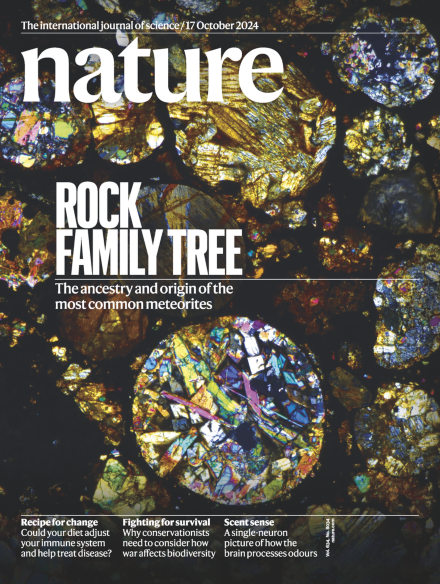
‘Nature Magazine – October 17, 2024: The latest issue features ‘Rock Family Tree’ – The ancestry and origin of the most common meteorites..

Kids in the classroom flow like water vapour

Young children in the playground behave like molecules in a gas, but kids undergo a phase change in a more structured setting.

Evidence of dead people posed on dead horses found in ancient tomb

A royal burial site linked to the fearsome Scythian equestrian culture contains evidence of ‘spectral riders’ described in Classical account.

Sewage lurks in coastal waters — often unnoticed by widely used test

Global survey finds human faecal contamination in at least one sample from all 18 cities tested.

Two comb jellies fuse their bodies and then act as one

The easy synchronization suggests that an individual jelly does not distinguish its tissue

Technology Quarterly: ‘Chipmaking & AI’ (Fall 2024)

Technology Quarterly: Silicon returns to Silicon Valley

The Economist (September 19, 2024): The latest issue of TECHNOLOGY QUARTERLY is focused on:

Silicon returns to Silicon Valley

AI has returned chipmaking to the heart of computer technology, says Shailesh Chitnis

The semiconductor industry faces its biggest technical challenge yet

Node names do not reflect actual transistor sizes

How to build more powerful chips without frying the data centre

AI has propelled chip architecture towards a tighter bond with software

Researchers are looking beyond digital computing

The end of Moore’s law will not slow the pace of change

Technology Quarterly: ‘Health And AI’ (April 2024)

Technology Quarterly: A new prescription

The Economist (April 1, 2024): The latest issue of THE ECONOMIST TECHNOLOGY QUARTERLY is focused on:

A new prescription

AIs will make health care safer and better, reports Natasha Loder. It may even get cheaper too

AIs will make health care safer and better

Artificial intelligence has long been improving diagnoses

Medical AIs with human faces are on their way

Artificial intelligence is taking over drug development

Can artificial intelligence make health care more efficient?

Read full report