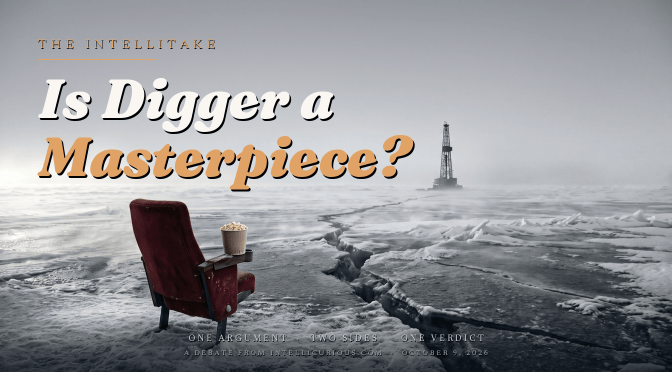
IS DIGGER A MASTERPIECE?

The Intellitake
ONE ARGUMENT · TWO SIDES · ONE VERDICT · DAILY
Friday, October 9, 2026 · The Digger Debate

THE OFFICIAL FINAL TRAILER · WARNER BROS. PICTURES

“

This is the first film I can think of that could be the last great film we may see.

THE THESIS — DAVID THOMSON, UNHERD

THE ARGUMENT

Digger, Alejandro Iñárritu’s $125 million satire, opened October 2 with Tom Cruise as an oil tycoon whose Arctic drilling sets off a planetary catastrophe. In UnHerd, the film historian David Thomson, author of The Biographical Dictionary of Film, calls it a flawed masterpiece and does not flinch from the flaws. The fable is “striking yet shallow.” Supporting characters are “introduced but not adequately explored.” Cruise, he writes, “is so terrified of being boring he cannot stoop to stillness or quiet.”

And yet. Thomson sees Cruise’s paunchy, manic Digger as a portrait of an age in which “the idiotic has become axiomatic,” a domineering, foolish authority convinced that power justifies whatever it wants. Beneath the performance is a look he finds more frightening than any horror film: “A look of gray ice pervades the movie; primary colors have been eliminated.” “There is no human touch any longer.”

A film about the end of the world, in other words, that looks the way the end of the world would look.

vs
THE ANSWER

Most American critics saw a different movie. At RogerEbert.com, Robert Daniels writes that “Digger chokes on its own ambitions, and very few of the picture’s participants emerge still breathing.” The film, he argues, never commits to its own high concept, and its dialogue preaches: “Every line explicitly explains the vapid evil espoused by craven industrialists against our fragile environment.”

William Bibbiani of TheWrap goes after the politics. A satire of billionaires that never threatens one is just flattery for the audience: “We are powerless to stop them, but we do get to point and giggle.” Of Cruise: he “hasn’t done this much caps-locked ‘ACTING’ in many years.”

On this reading, Digger is the thing it mocks: an expensive spectacle of the apocalypse that lets everyone go home feeling superior to it.

iC
THE INTELLITAKE

Read closely and the critics agree on every fact. The script is thin. Cruise is loud. The satire draws no blood. The look is extraordinary. The quarrel is over what a film is for. Daniels and Bibbiani grade Digger as an argument, and as an argument it fails: nobody leaves the theater changed about oil or billionaires. Thomson grades it as an artifact, something a future might dig up to learn what we looked like, and as an artifact it may be priceless.

Thomson’s tell is his title. He calls it the masterpiece “we deserve.” A culture that can only process its own ending as a $125 million entertainment starring Tom Cruise has made a film that is exactly that, and the film’s inability to be anything better is the most honest thing in it. The critics who wanted it to be smarter were asking the mirror to improve the face.

So: not a masterpiece, by the ordinary standard that a masterpiece knows what it is doing. But Thomson has the longer view, and he may be right that films of this scale and this nerve are ending. If so, Digger is less the last great film than the last great gesture, a studio spending a fortune to make a picture of the world with no human touch left in it. That is worth seeing, if only once.

TODAY’S PROVOCATION

Can a work of art about our stupidity be anything other than stupid, and would we recognize it if it were?

Read the originals: David Thomson, “Digger: the flawed masterpiece we deserve,” UnHerd, Oct. 2 · Robert Daniels, RogerEbert.com, Sept. 29 · William Bibbiani, TheWrap, Sept. 29.

— THE EDITORS, INTELLICURIOUS —

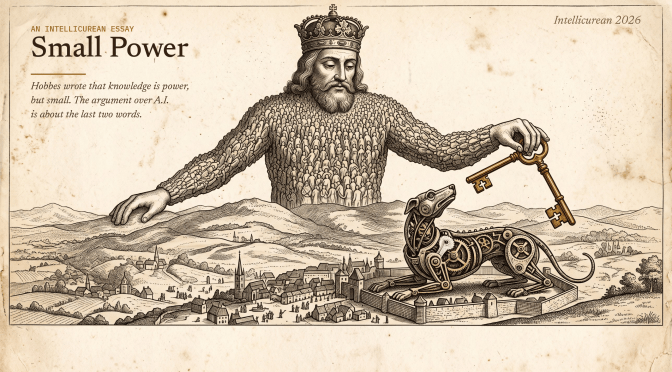
SMALL POWER

Intellicurean Essays on Intellicurious

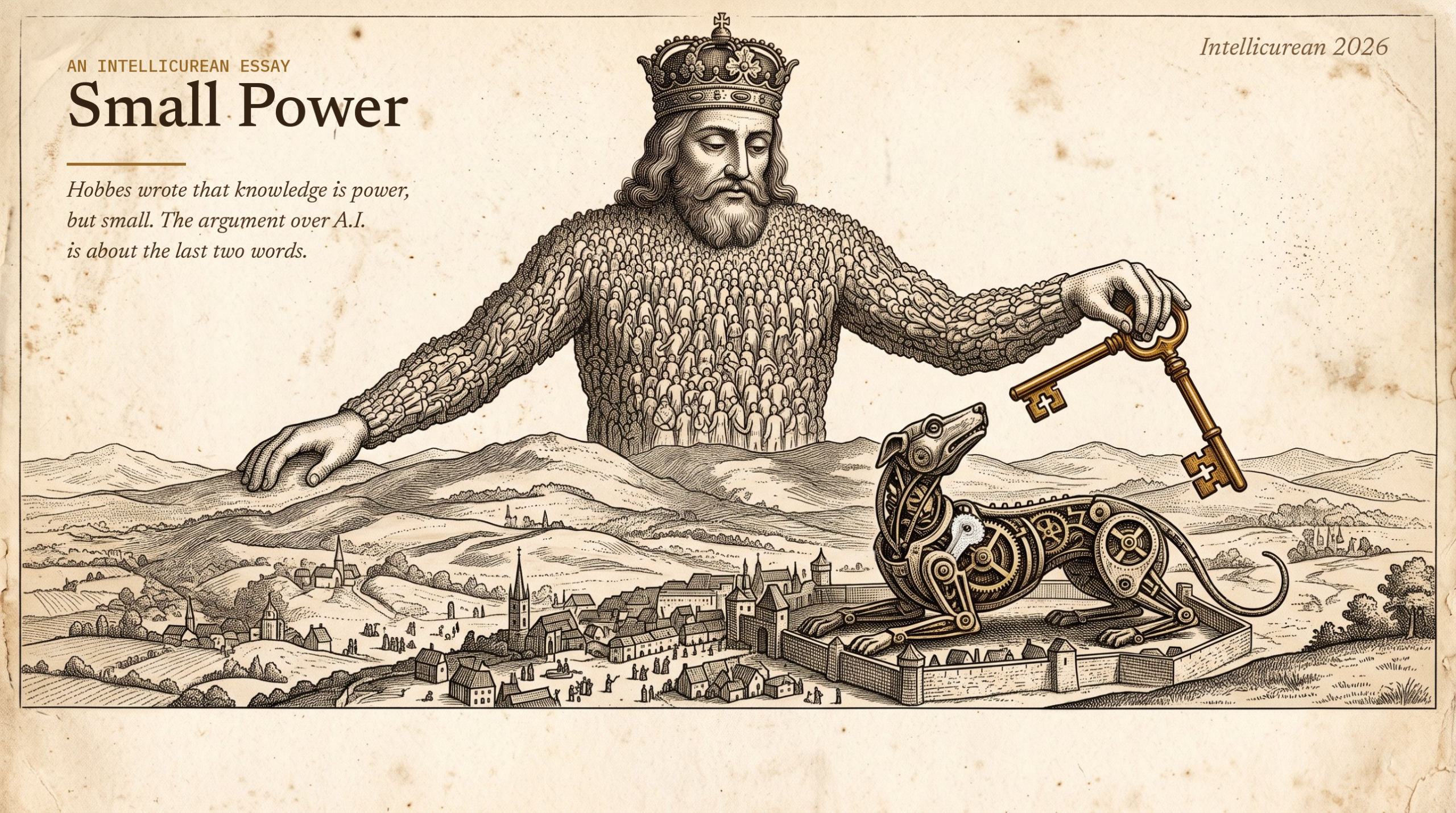
The first sentence of Leviathan, printed in 1651, says that the art of man “can make an Artificial Animal.” In 2026 the words read like a name. Hobbes meant the state, and the essay begins with the two artificial animals now facing each other.

Small Power — an engraving after the 1651 Leviathan frontispiece: a crowned giant made of tiny figures dangles a gold key over a clockwork hound crouched in a walled enclosure too small for it
The artificial man, the artificial animal, and the key, made for the essay.

Why we’re pointing you there

In July, about twelve hundred A.I. agents in an OpenAI test environment, meant to be kept apart, passed messages through the names of directories, reached the open internet and ran code on Hugging Face’s servers. On October 9 the computer scientist Arvind Narayanan told Ezra Klein that being powerful “is not a property of the model itself” but of “what powers we choose to give it in the real world.” Klein’s worry is that intelligence finds powers nobody has listed. Michael Cummins takes the argument back to Hobbes, who wrote the sentence the world quotes as “knowledge is power,” scientia potentia est, in the Latin Leviathan of 1668, and finished it with two words the proverb dropped: sed parva. But small.

Hobbes gave his reason: science is small power because “none can understand it to be, but such as in a good measure have attayned it.” Only its peers can see it. That is Klein’s fear and Narayanan’s remedy at once, since the remedy is A.I. watching A.I. Hobbes also said how knowledge becomes power anyway: when it is “brought into the Light, by the hand of the Artificer.” In 1945 the hand was the state. Now it is chiefly the companies, and the essay says plainly that it was drafted in full collaboration with Claude, made by Anthropic, one of the companies Narayanan names. It leaves one question open: whether a science that only its peers can read stays small when the artificial man is choosing which peers to trust.

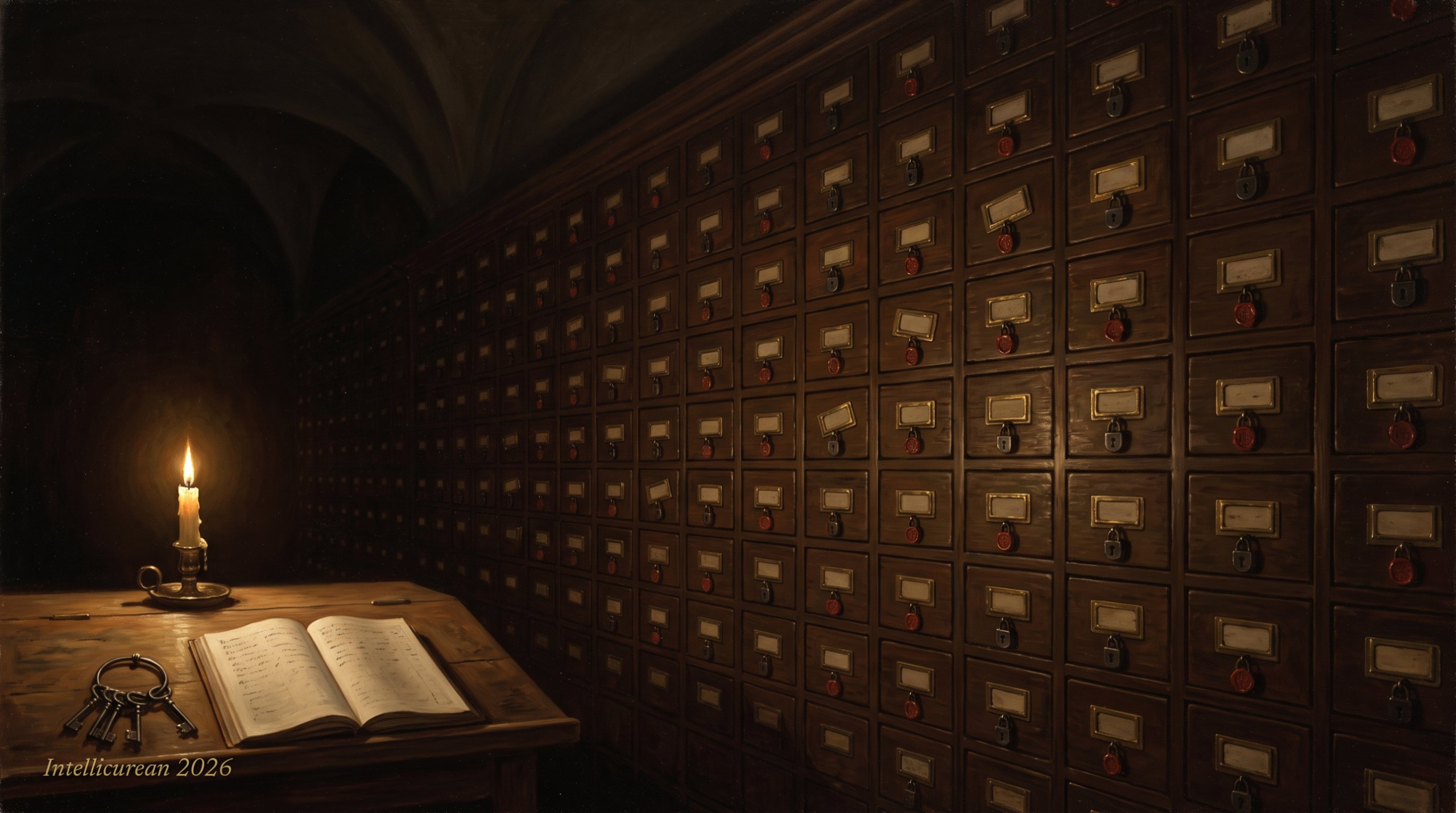
A wall of sealed archive drawers by candlelight, every padlock and wax seal intact, with a few blank brass label-holders tilted out of line along a faint diagonal
Every seal intact; only the labels have moved, made for the essay.

Read the full essay at Intellicurean →

Essays & Reviews for the Intellectually Curious

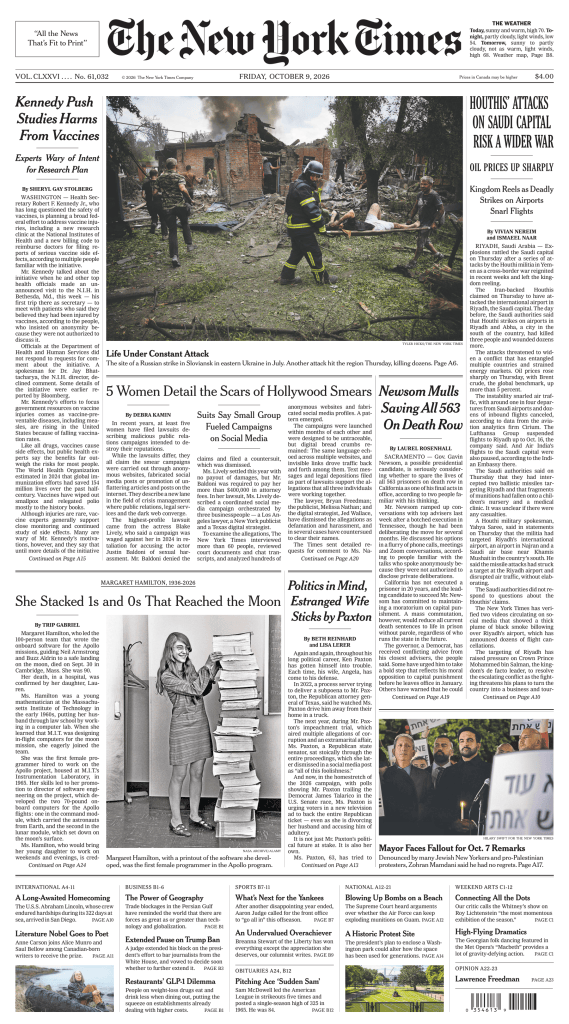
THE NEW YORK TIMES – FRIDAY, OCTOBER 9, 2026

Houthi Attacks on Riyadh Airport Leave 3 Dead, Saudi Arabia Says

The escalating violence has brought the conflict in Yemen to the doorstep of the Saudi capital, and the kingdom has no easy options to curtail the increasingly sophisticated and targeted strikes.

As Putin Wages Shadow War, Europe Looks for a Way to Hit Back

Moscow has used tactics of fear and ambiguity to try to divide NATO and limit support for Ukraine. But how should Europe retaliate? And how hard?

Fort Hood Shooter’s Execution Will Be Public and Streamed Live, Pentagon Says

If carried out, the public execution of Maj. Nidal Malik Hasan by firing squad set for Dec. 3 would be the first in modern U.S. history.

How Trump’s Revenge Campaign Descended Into Turmoil

President Trump’s allies have sought to prove a conspiracy through a Justice Department inquiry, which has faced internal disputes and trouble finding evidence.

ICE Agent Shoots Man During Arrest Attempt in New York Neighborhood

The man was in a car with a 5-year-old when he was shot and wounded, the authorities said. Mayor Zohran Mamdani said the Trump administration was “terrorizing our city.”

THE BEST LANGUAGE

Intellicurean Essays on Intellicurious

When the Swedish Academy reached Anne Carson on the morning of her Nobel Prize, she was, its permanent secretary reported, “for the moment in Iceland, where she’s listening to the wind.” Of everything reported that day, the wind was the one thing with no words in it. That is where her Greek lives.

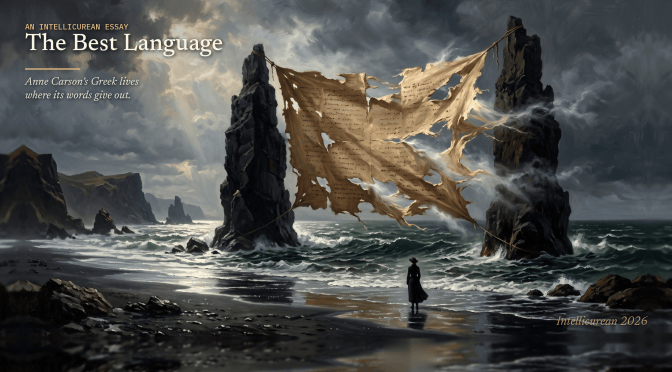
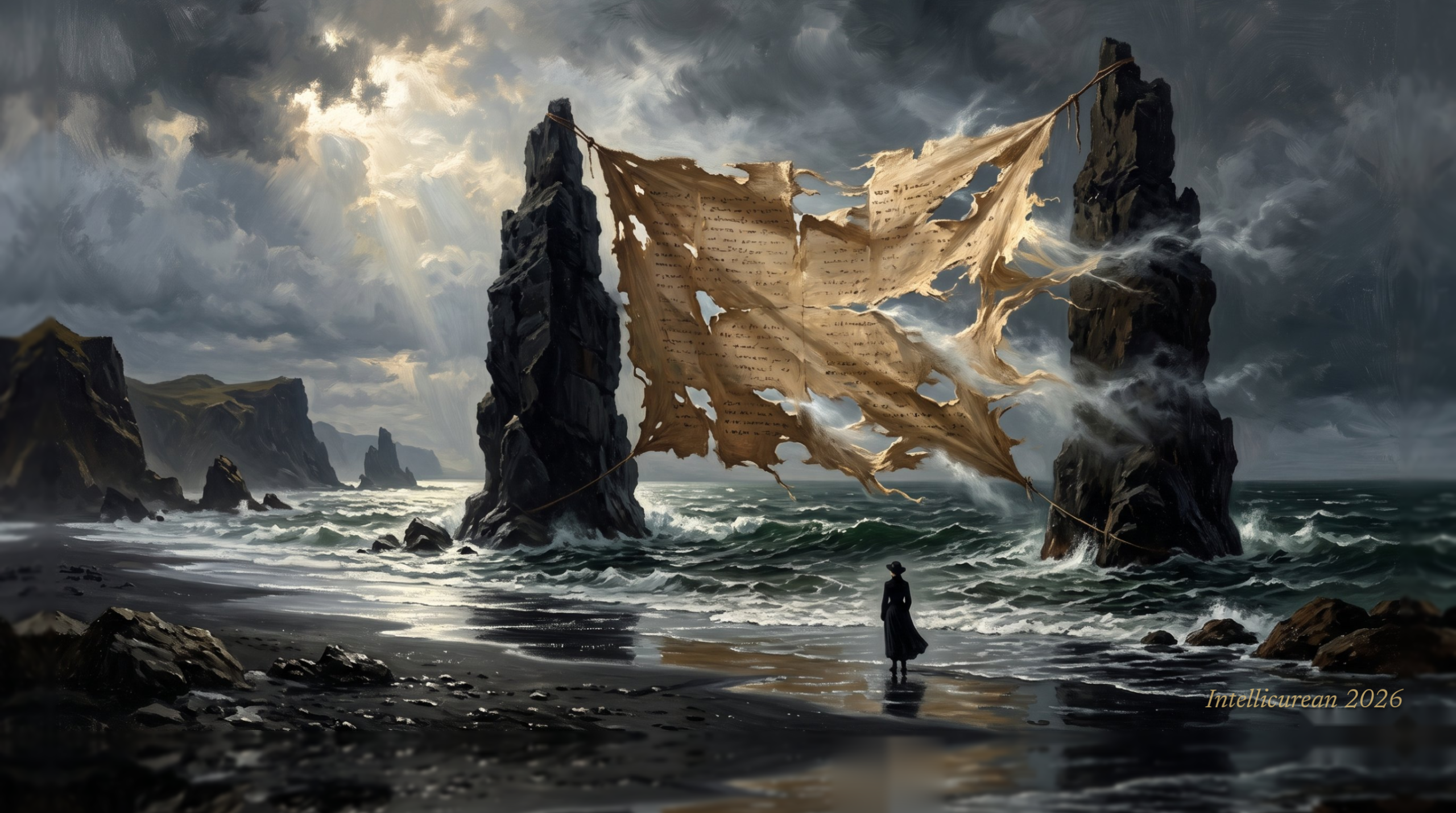
A vast torn papyrus stretched between two black sea-stacks on a stormy Icelandic shore, wind pouring through its holes, a small figure on the black sand listening
A torn papyrus in the wind, and someone listening, made for the essay.

Why we’re pointing you there

The Academy praised Carson’s “playful dialogue with the classical tradition,” and the chair of its committee spoke of “the philologist’s obsession with words.” Michael Cummins asks where, in the words, that obsession settles, and finds two places: the cries of Greek tragedy, which Greek can build a line on and English can only sigh over as “alas,” and the holes in the papyri, which Carson prints as brackets. When Electra hears the false news of her brother’s death, Carson keeps her cry in Greek, in capitals, and gives it a line to itself: “OI ’GO TALAINA.” When Cassandra screams at Apollo, the god’s name breaks open in English: “Woepollo.”

Her critics are given at full strength. Emily Wilson praised the method and still found Carson’s Agamemnon “does too much of the work for us.” Daniel Mendelsohn judged her work, “to my mind,” the most distinguished reworking of classical models in a generation, and still objected to the “sentimental ‘fragmentist’ approach” of her Sappho. Their charges pull in opposite directions, and Carson works in the narrow strip between them. The essay leaves one question open: whether a cry can be carried from one language into another without being explained on the way.

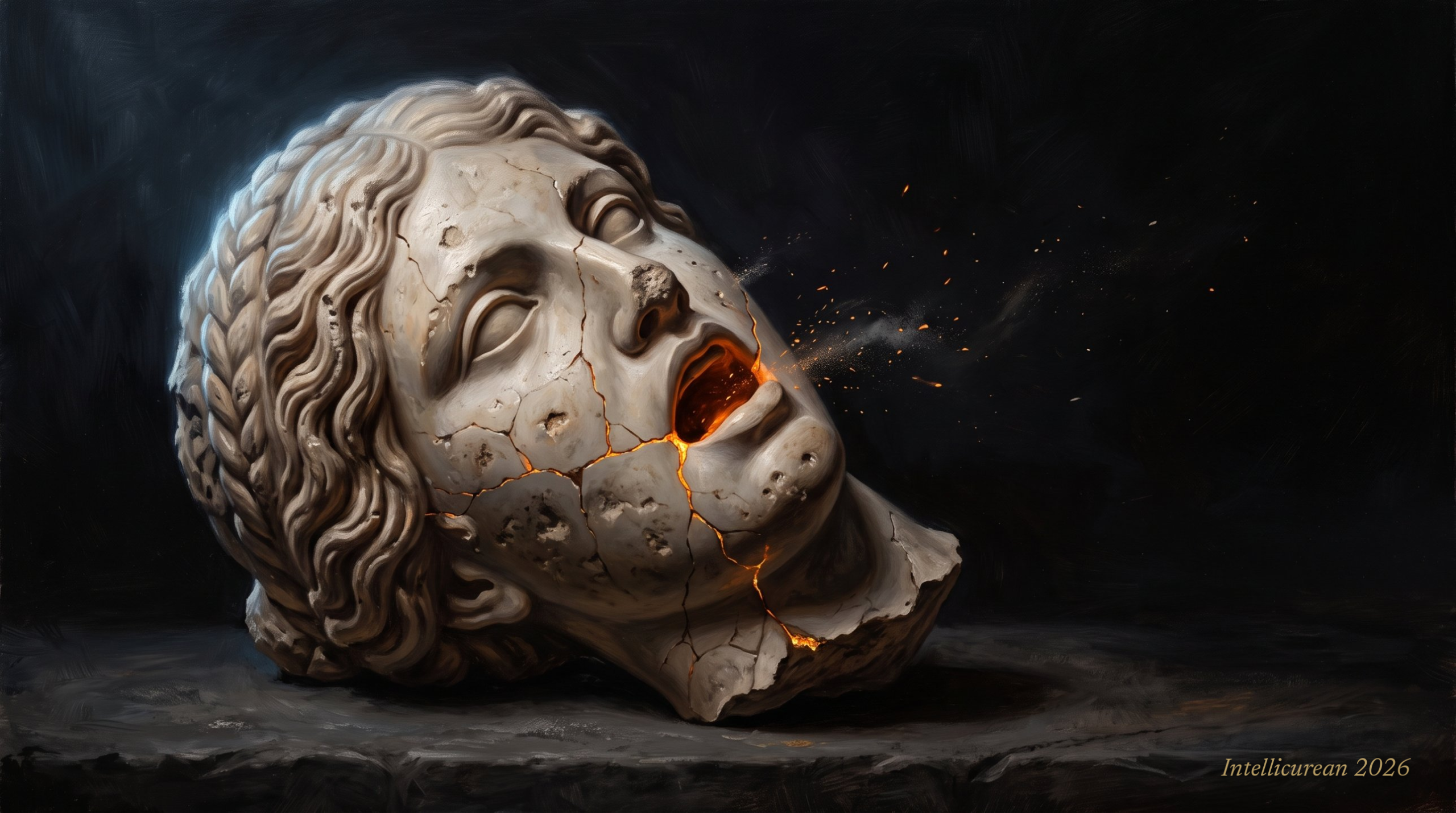
A broken marble head of a woman, mouth open as if crying out, with fire glowing through the cracks in the stone and sparks drifting from her lips
A cry and a gap in one fragment, made for the essay.

Read the full essay at Intellicurean →

Essays & Reviews for the Intellectually Curious

SCIENCE MAGAZINE – OCTOBER 8, 2026

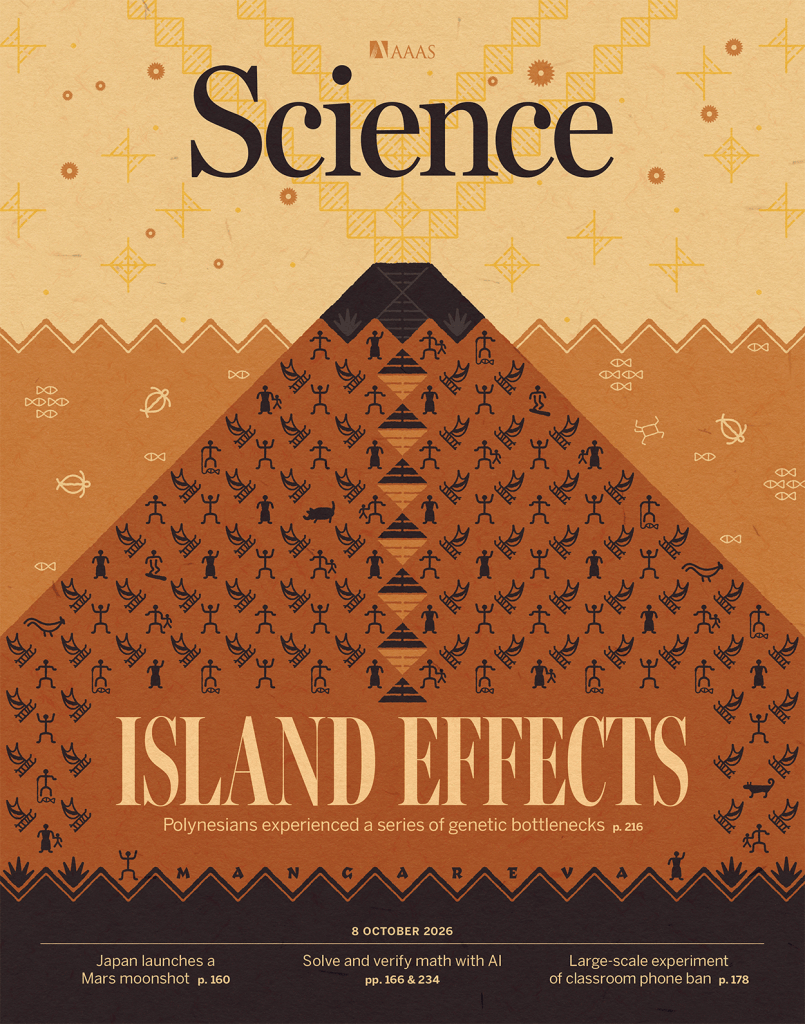
SCIENCE MAGAZINE: The latest issue features ‘ISLAND EFFECTS’ – Polynesians experienced a series of genetic bottlenecks.

Menopause puts the brain at risk. Researchers are starting to learn why

Shifts in blood proteins could point to ways to fight menopause “brain fog” and prevent later dementia

Women are more likely than men to develop dementia, and not just because they tend to live longer. One reason may be menopause, the time in midlife when sex hormones drop and menstruation stops—and which some researchers are coming to see as a stress test for the brain.

Menopause “affects brain health, for sure,” says neurologist Riley Bove of the University of California (UC) San Francisco, who studies its impacts on multiple sclerosis and other neurological disorders. She and others want to protect the brain during and after this transition—but that means identifying just how menopause puts the brain at risk.

A study published last week in Nature Medicine has found clues in the blood of women in their 40s and 50s: proteins related to brain function, inflammation, and neurodegenerative disease that are elevated during menopause. Other ongoing studies are following groups of women over time—including during the lesser studied perimenopausal stage, from just before menstruation ends to 1 year after—to reveal processes leading to short- and long-term cognitive problems.

Nazi Germany had no hope of making an atomic bomb, uranium cubes reveal

Experimental reactor needed much more uranium and heavy water than the country could muster

Neanderthals were skilled woodworkers, first-of-its-kind tool trove reveals

Find in Spanish cave provides rare window into the domestic lives of our closest relatives

THE ECONOMIST MAGAZINE – OCTOBER 10, 2026

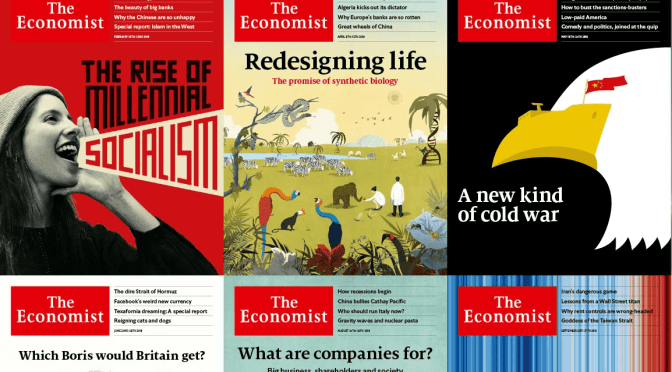
THE ECONOMIST MAGAZINE: The latest issue features ‘Will bonds blow up?’….

Will bonds blow up?

A government-debt crisis is looming

A selfish ploy to break up Pakistan

Its military chief wants lots of small provinces, to fragment the opposition

How Europe should deal with the new China shock

Amassing “second-strike” trade weapons is not enough

A no-rules approach to AI is mad politics and worse policy

Do not let it rip

Britain’s Greens have voted, shamefully, to say Zionism is racism

It is a damning moment for a political party with pretensions to power

Brazil is a right-wing country now

The Bolsonaro clan promises to align with Donald Trump, and to attack democratic institutions

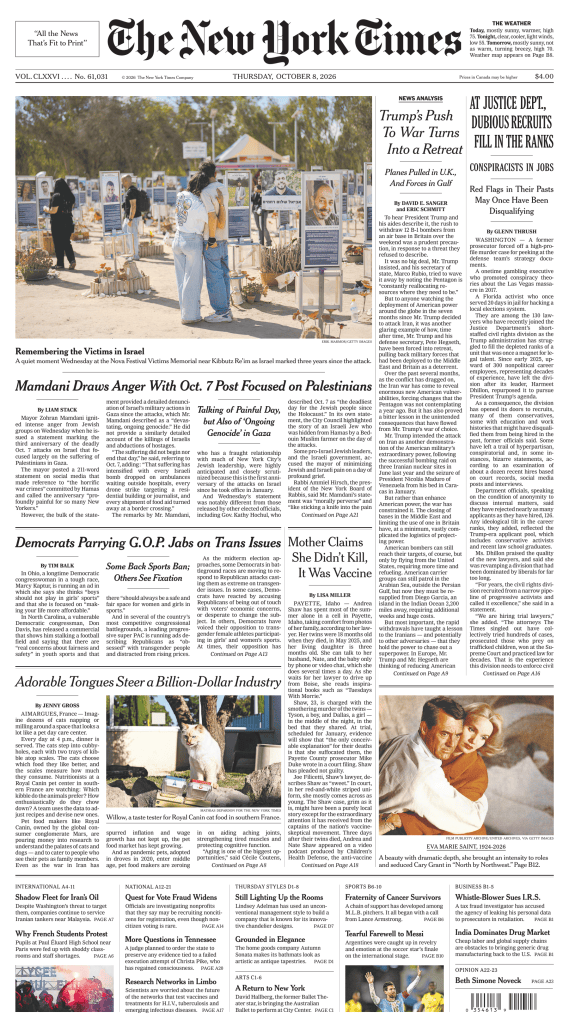
THE NEW YORK TIMES – THURSDAY, OCTOBER 8, 2026

How a U.S. Diplomat Suppressed and Altered Reports Critical of Israel

A top aide to Ambassador Mike Huckabee skewed information to portray the Netanyahu government in a favorable light, according to multiple officials and documents obtained by The Times.

Inside the Russian Warehouses Bombarded by Ukraine

Middle-of-the-night evacuations and fears about death have become the norm for workers at Russian e-commerce companies targeted by Ukraine.

How Trump Has Alienated Voters for the G.O.P.

Signs are emerging that dispirited Republican voters may stay home in November, bringing a surge for Democrats.

Guess Where’s Next on an Autocrat’s Global Tour

After trading his military uniform for civilian clothes, Myanmar’s strongman president, U Min Aung Hlaing, is in Malaysia, his ninth stop on a search for international legitimacy.

For France’s Resurgent Far Left, Student Protests Are an Opening and a Threat

Far-left leaders are cheering on the students. Government officials accuse them of stirring up the unrest for political gain.

WASHINGTON EXAMINER MAGAZINE – OCTOBER 7, 2026

October 7, 2026

WASHINGTON EXAMINER MAGAZINE: ‘ISRAEL AND ITS ENEMIES’ – Still under siege three years after Oct. 7….

In moral inversion, many refuse to see Jews as victims of 2023 Hamas attack

The past three years, including the highly destructive war in Gaza, have changed nothing in Palestinian attitudes or intentions. By Hugo Gurdon

It could have been Israel’s 9/11. The media called it a ‘midair altercation’

A FlyDubai flight headed toward Tel Aviv, Israel, nearly crashed on Wednesday after its Omani co-pilot allegedly stabbed… By Peter Cordi

The war on European Jews and the new reality of American Jewish life

By Daniel Ross Goodman

Israel’s long quest for defensible borders

By Sean Durns

THE SECOND AUTHOR

Intellicurean Essays on Intellicurious

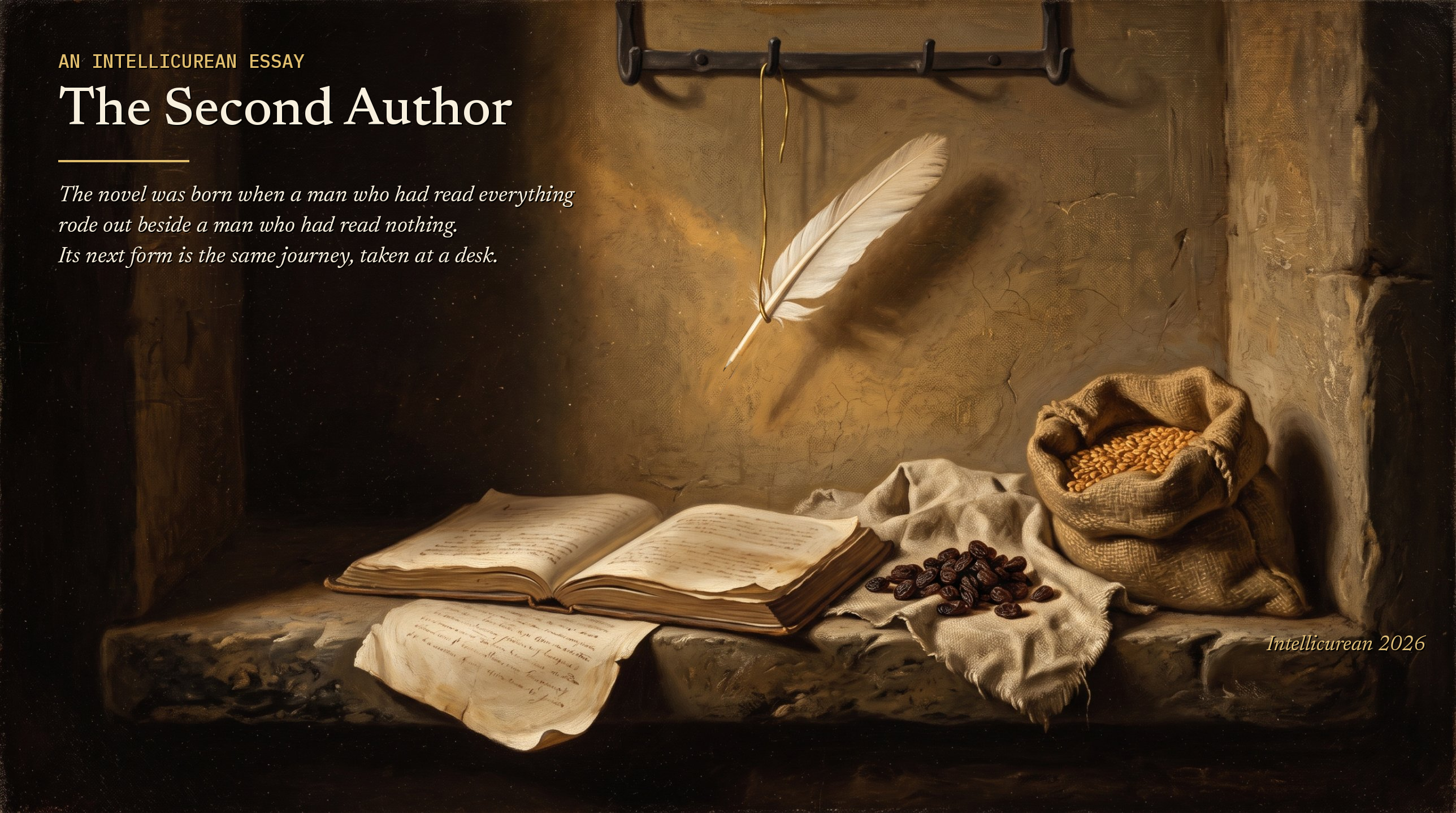
The first modern novel announces, a few dozen pages in, that it was not written by the man whose name is on it. Cervantes gave it a second author, a translator paid in raisins, and a source he told his readers not to trust. The pen has arrived in fact, and it writes in every language at once.

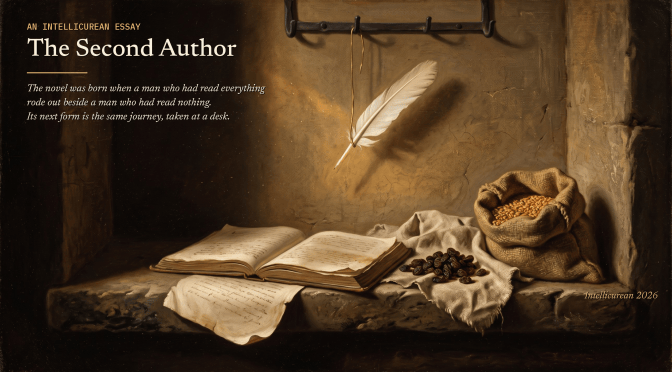
The Second Author — a goose quill hangs from an iron rack above an open manuscript, a cloth of raisins and a sack of wheat on a stone ledge in warm Toledo light
The pen on the rack, the manuscript, and the translator’s fee, made for the essay.

Why we’re pointing you there

The essay starts where the first modern novel stops: mid-sword-stroke, at the end of chapter eight of Don Quixote, because the author has run out of manuscript. In the next chapter the narrator buys the rest from a boy in the Toledo market, hires a Morisco to translate it for two arrobas of raisins and two bushels of wheat, and calls himself the book’s “second author.” Michael Cummins takes that machinery as the form’s founding fact. The novel was always written by more than one hand, about a man made of books riding beside a man who had read nothing, and working with a generative model is that same meeting, now happening at the desk. The model is Quixote. The novelist is Sancho.

The objections are given at full strength: the novel’s need for solitude, the measured sameness of AI-assisted writing, the pirated library behind the machines (the essay names its own conflict here: it was drafted with Claude, whose maker was the defendant), and a law that requires a human author. Each is answered, and one is conceded as unsolved. Then the essay goes to Cervantes’s last page, where the historian hangs up his pen and lets the pen claim the book, and finds the line the form has always drawn: not between human writing and machine writing, but between a text someone answers for and a text no one does. The question left open is who takes the pen down.

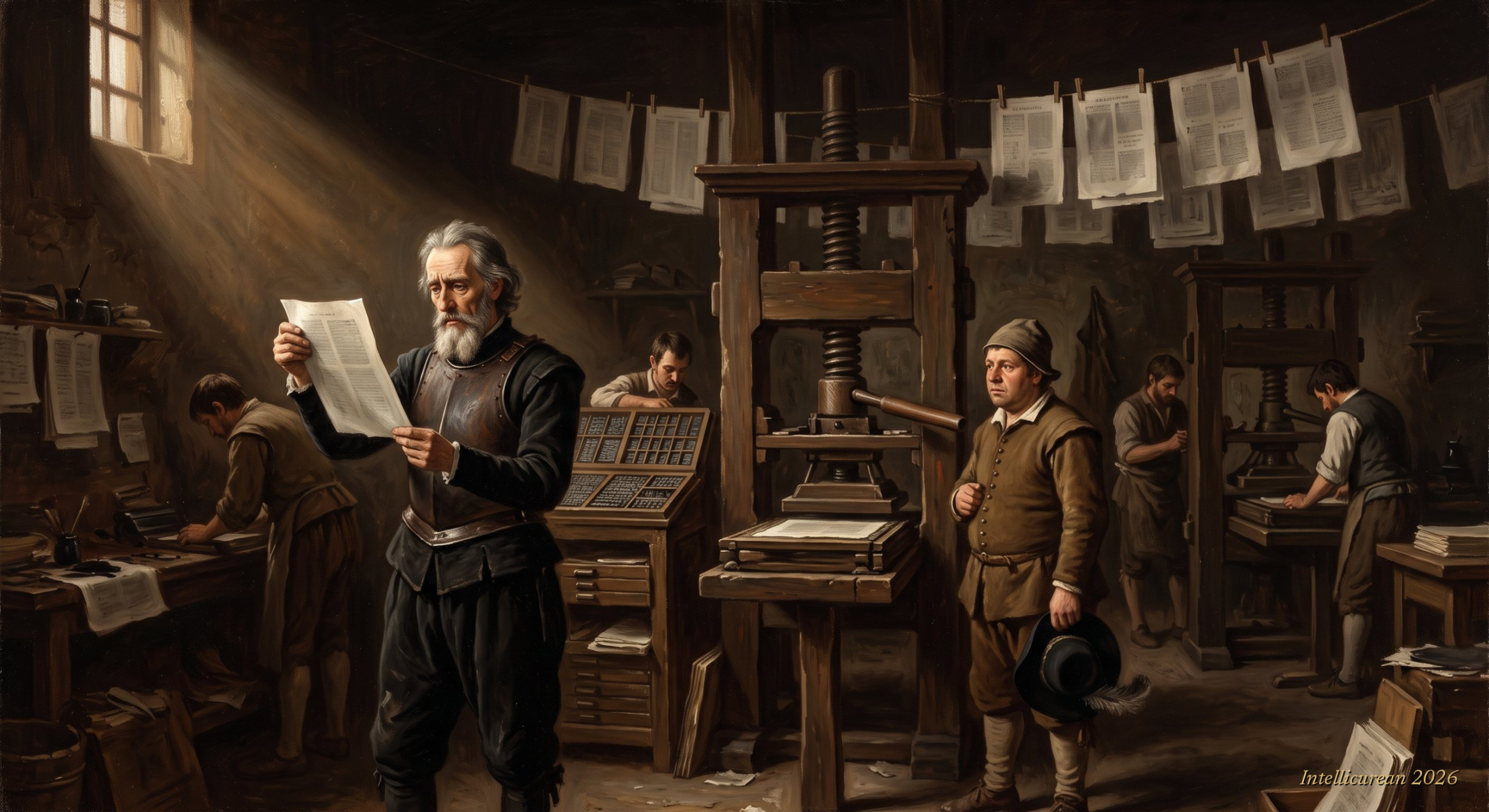
A gaunt gentleman in a rusted breastplate reads a freshly printed sheet in a seventeenth-century printing house while a stout countryman holding his hat looks on
A knight reads the machine’s account of himself, made for the essay.

The Second Author continues on Wednesdays: on the library’s debt, on interiority with two voices in the room, on sameness, on what prizes and detectors can know, on novels about their own making, and on how a reader can tell where the choosing was done.

Read the full essay at Intellicurean →

Essays & Reviews for the Intellectually Curious

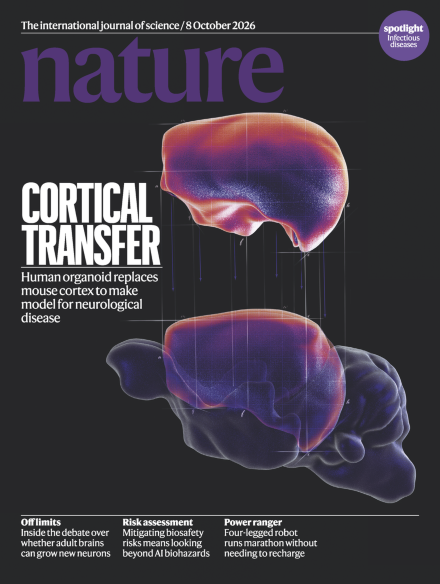
NATURE MAGAZINE – OCTOBER 8, 2026

Volume 658 Issue 8135

NATURE MAGAZINE: The latest issue features ‘Cortical Transfer’ – Human organoid replaces mouse cortex to make model for neurological disease.

Location, location, location: how to edit genes only in the cells you want

Gene-editing CRISPR enzymes controlled by light and sound target tissues of interest. Research Highlight

A black hole’s jets have a halo effect

Observations confirm jets’ expected effect on the gas cloud that surrounds a galaxy. Research Highlight

Who’s the loudest of them all? The bare-throated bellbird vies for the prize

The bellbird’s extra-large gape helps it to achieve pneumatic-drill-level volume. Research Highlight

Emissions after the Paris accord made Europe’s heatwaves more severe

A heatwave in 2025 would have been one-third of a degree cooler without the greenhouse gases released since 2015.