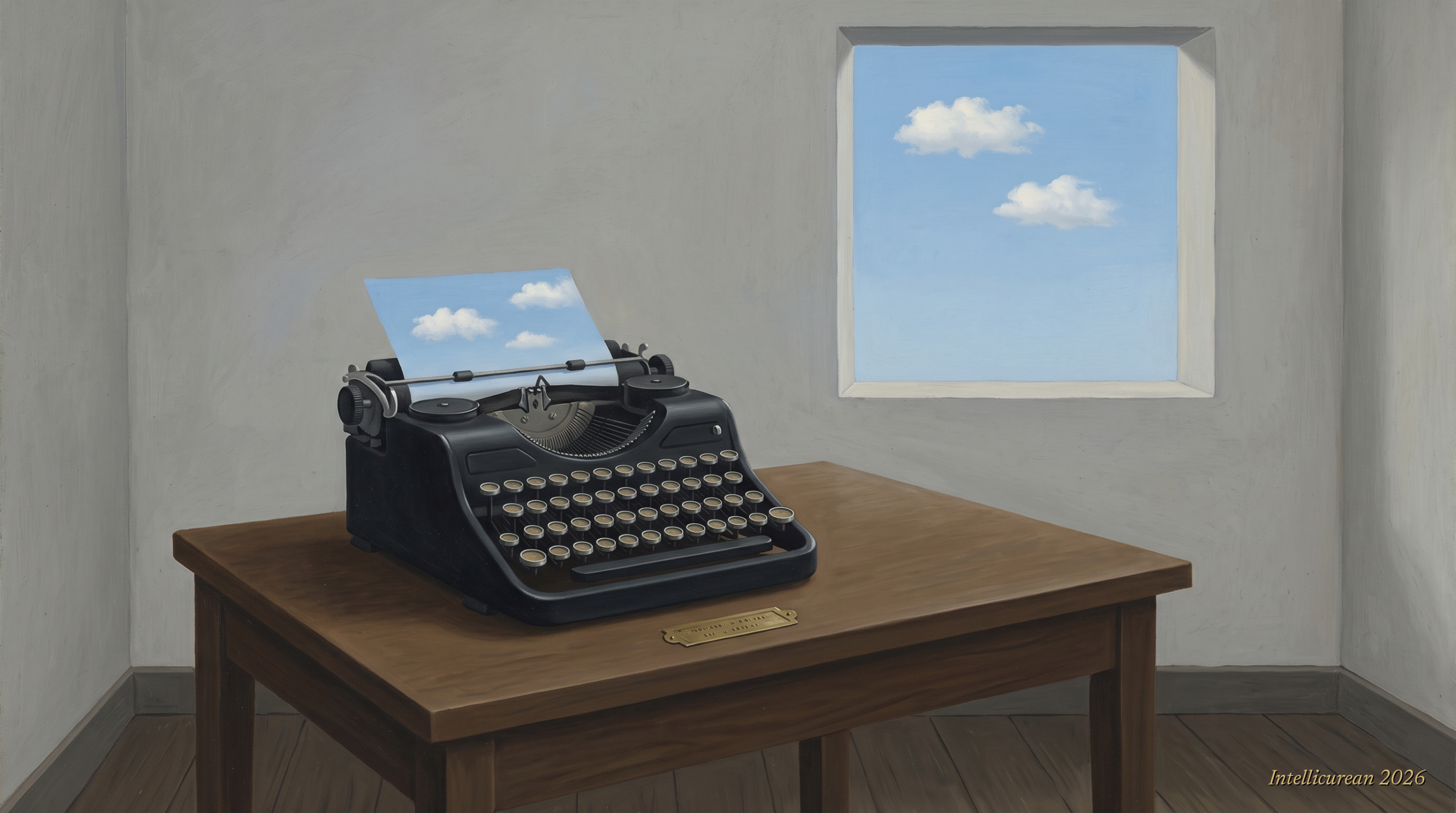
The first modern novel announces, a few dozen pages in, that it was not written by the man whose name is on it. Cervantes gave it a second author, a translator paid in raisins, and a source he told his readers not to trust. The pen has arrived in fact, and it writes in every language at once.
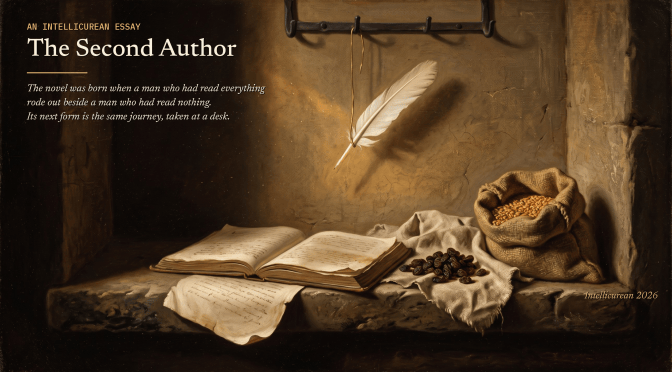
The pen on the rack, the manuscript, and the translator’s fee, made for the essay.
Why we’re pointing you there
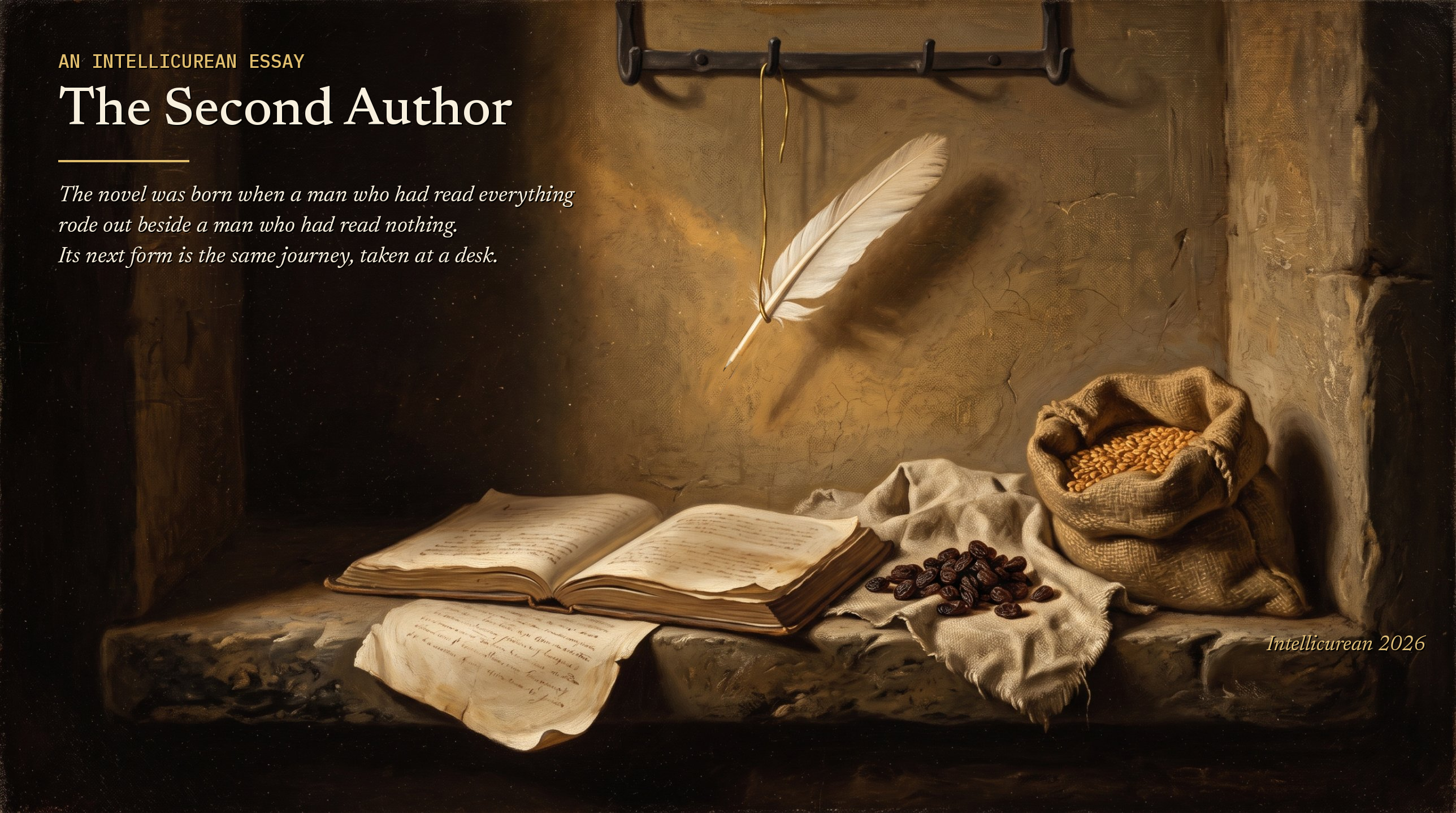
The essay starts where the first modern novel stops: mid-sword-stroke, at the end of chapter eight of Don Quixote, because the author has run out of manuscript. In the next chapter the narrator buys the rest from a boy in the Toledo market, hires a Morisco to translate it for two arrobas of raisins and two bushels of wheat, and calls himself the book’s “second author.” Michael Cummins takes that machinery as the form’s founding fact. The novel was always written by more than one hand, about a man made of books riding beside a man who had read nothing, and working with a generative model is that same meeting, now happening at the desk. The model is Quixote. The novelist is Sancho.
The objections are given at full strength: the novel’s need for solitude, the measured sameness of AI-assisted writing, the pirated library behind the machines (the essay names its own conflict here: it was drafted with Claude, whose maker was the defendant), and a law that requires a human author. Each is answered, and one is conceded as unsolved. Then the essay goes to Cervantes’s last page, where the historian hangs up his pen and lets the pen claim the book, and finds the line the form has always drawn: not between human writing and machine writing, but between a text someone answers for and a text no one does. The question left open is who takes the pen down.
A knight reads the machine’s account of himself, made for the essay.
The Second Author continues on Wednesdays: on the library’s debt, on interiority with two voices in the room, on sameness, on what prizes and detectors can know, on novels about their own making, and on how a reader can tell where the choosing was done.
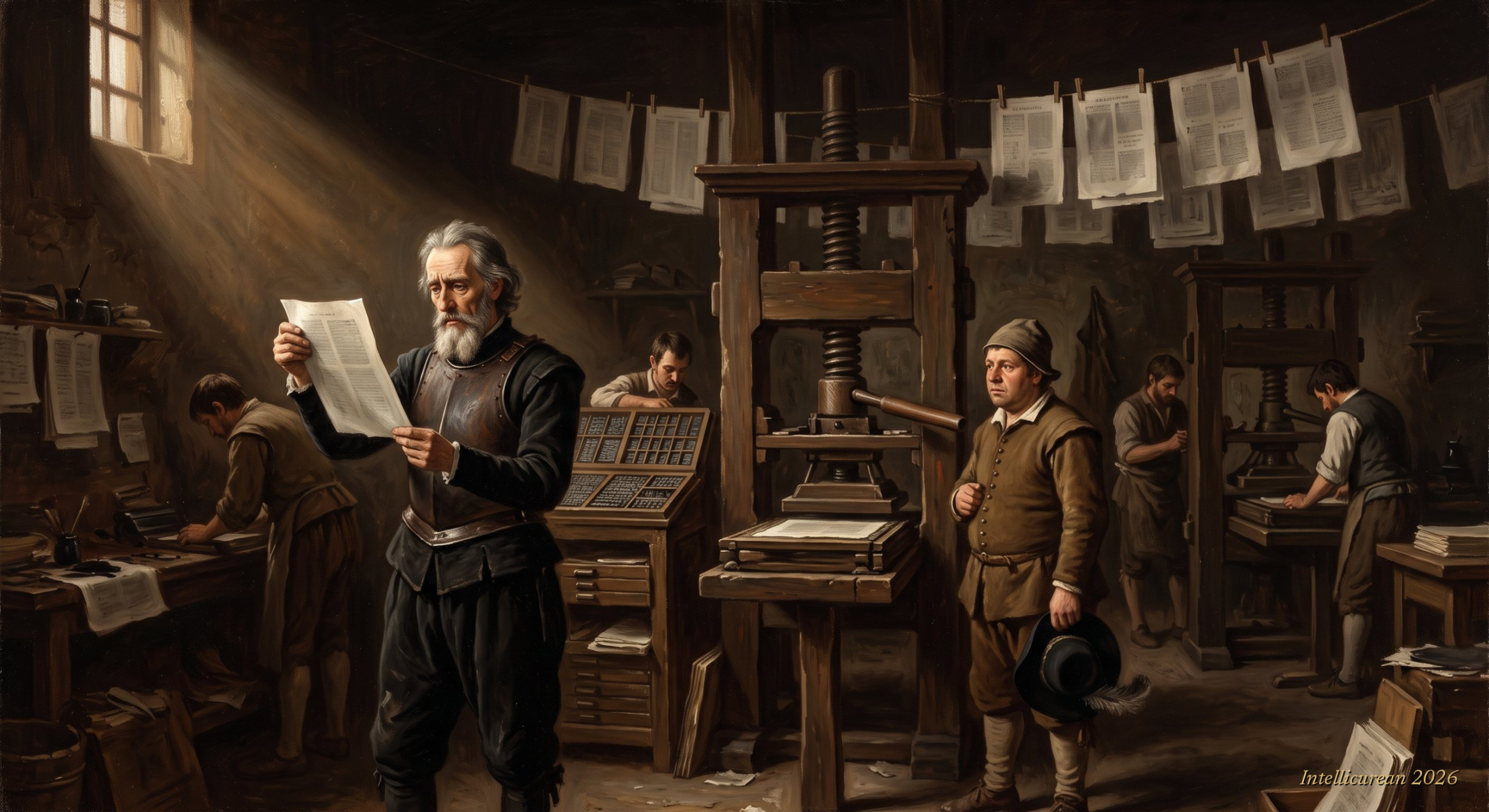
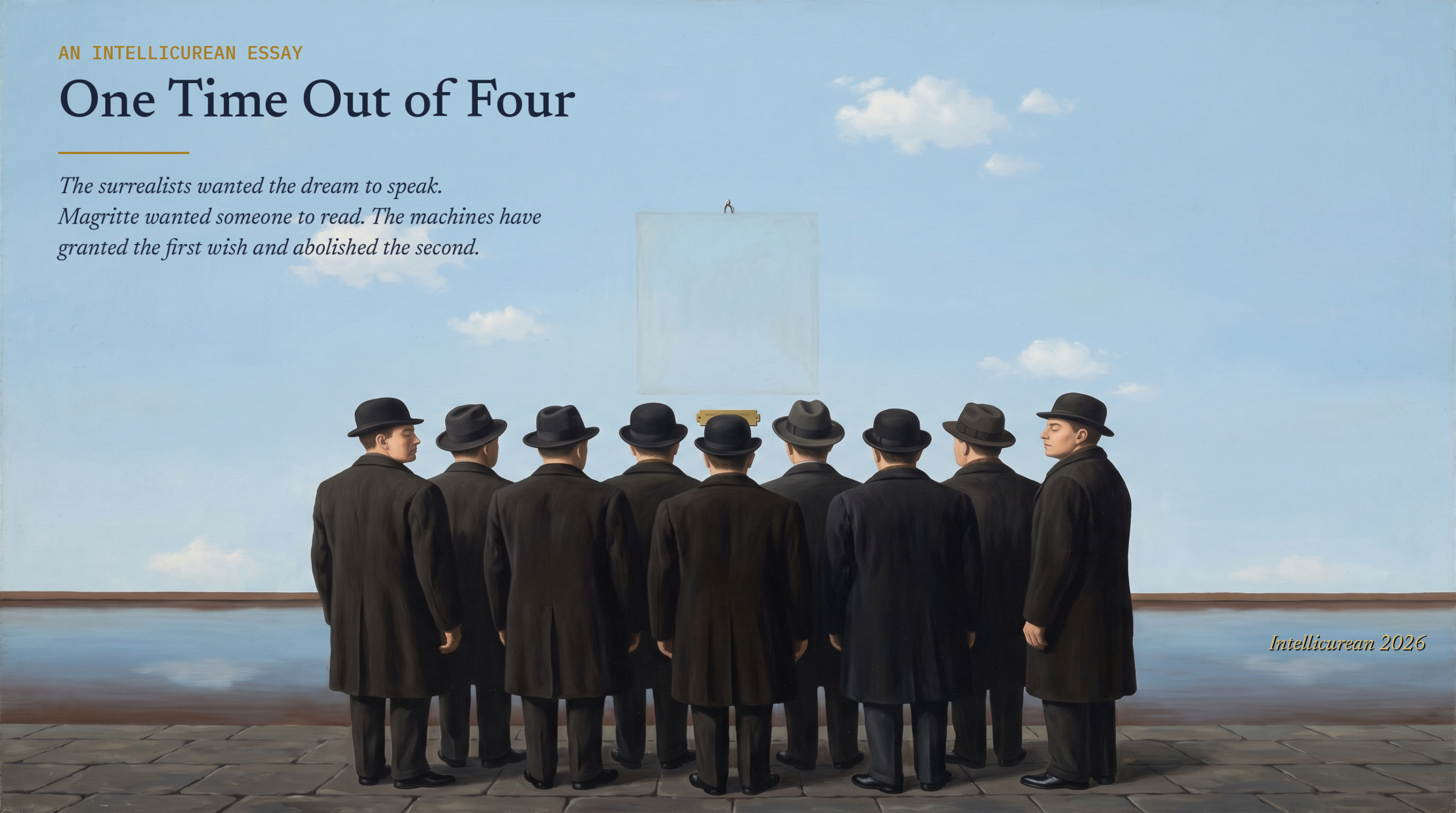
Sixteen surrealists photographed with their eyes shut, round a painting of a woman the sentence says they do not see. A table of four pictures and four words, three of them wrong. Magritte built that table three times, and the one true word in it was a wager on a reader.
The caption is up. The picture hasn’t arrived, made for the essay.
Why we’re pointing you there
The essay starts from Jonathan Jones’s Guardian review of Gagosian’s “This Is Still Not a Pipe,” which hunts Magritte’s heirs among forty living artists, and puts his four-panel Clef des songes back among the surrealists instead: painted first in Breton’s Paris in 1927 while the movement wrote down its dreams, painted again in 1929 with no true word in it, in the year of the pipe and of the review that printed his axioms on words and images and the page of sixteen closed eyes, and painted last in Brussels in 1935, in English, for New York. In Brussels his friends proposed his titles round a table.
Then it reads the machines beside the first Manifesto. Writing with no author at its centre is what the surrealists asked for, and a captioner writing ninety-five sentences in every hundred of a training set is that wish granted; when the dream spoke at scale it said “actor on the red carpet.” The machines are Breton’s heirs, not Magritte’s, and they have done one thing the surrealists did not: put the caption before the picture, so that an image made from a prompt is an illustration of its title, which Magritte is said to have ruled out. The rival reading, that Magritte’s subject was the folly of decoding, is given at full strength and conceded. What is left is a question, not a verdict: who is reading the sentence under the picture now.
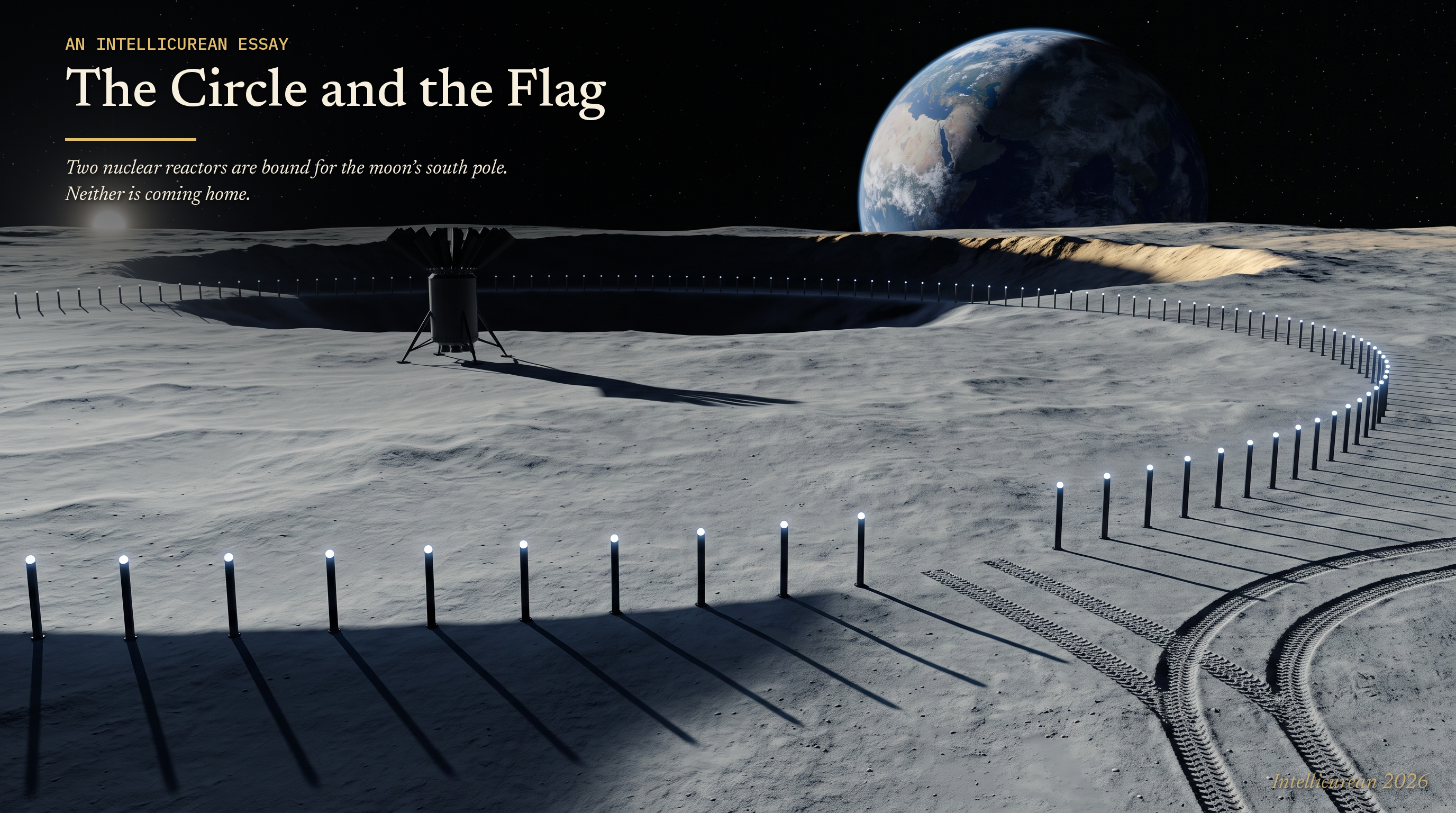
NASA wants a nuclear reactor running at the moon’s south pole by 2030. Russia promises one for China by 2036. When they stop, both say they will leave the radioactive material where it is. The treaty that governs the moon forbids planting a flag. It has nothing to say about drawing a circle.
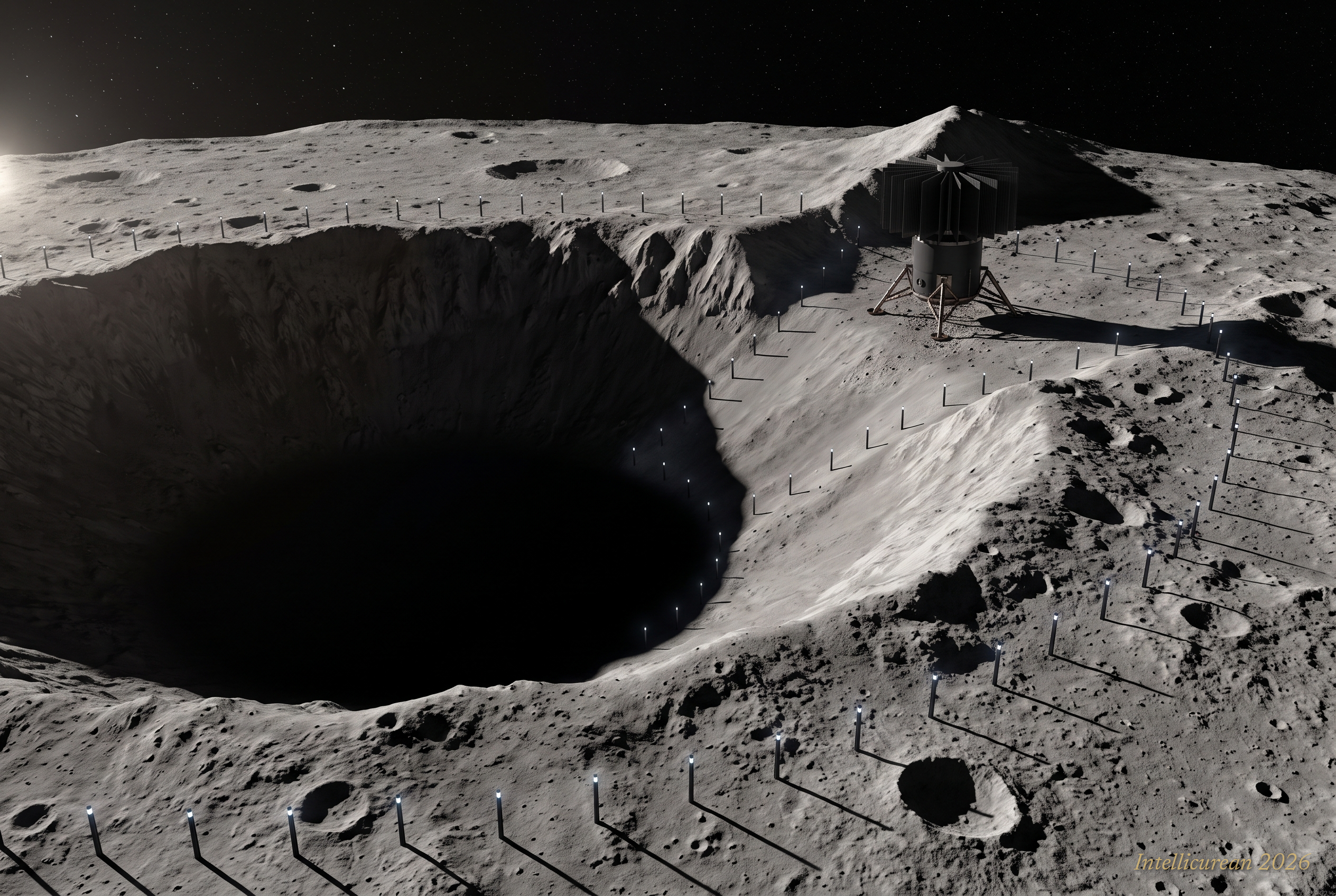
The tracks come up to the line and turn away, made for the essay.
Why we’re pointing you there
The essay starts from a report in the New York Times on the race to put reactors on the moon and asks a question the report doesn’t: what happens to the ground around a reactor that nobody intends to remove? A reactor at power can’t be approached without shielding, so it sits inside a no-go zone, and the few ridges near the pole with sunlight above and ice below are the only places anyone wants to go. The Outer Space Treaty forbids appropriating the moon by sovereignty, use or occupation. A zone takes nothing; it makes ground nobody’s. So the treaty doesn’t reach it.
What we liked most is that the essay gives the other side its full strength before answering it: the polar dark is real, a cold launch is safer, the Artemis Accords do promise zones will end, and radioactivity does decay. Then it goes to the one place on Earth that has lived with a reactor nobody could remove, and to a 1972 Soviet novel that imagined the shape of such a place fourteen years before it existed. It ends on a question rather than a verdict: whether a place no one can enter is owned, or only lost, and who gets to decide.
A zone on ground follows the ground, made for the essay.
A hospital administrator has a million dollars and a five-year-old who needs a new liver. When psychologists asked people to judge him, it mattered not only what he chose but how long he took to choose it.
Intellicurean · Essays
Above All Price
On a hospital administrator’s hesitation, a hypothesis about scalar reward, and what Kant meant by a thing raised above all price
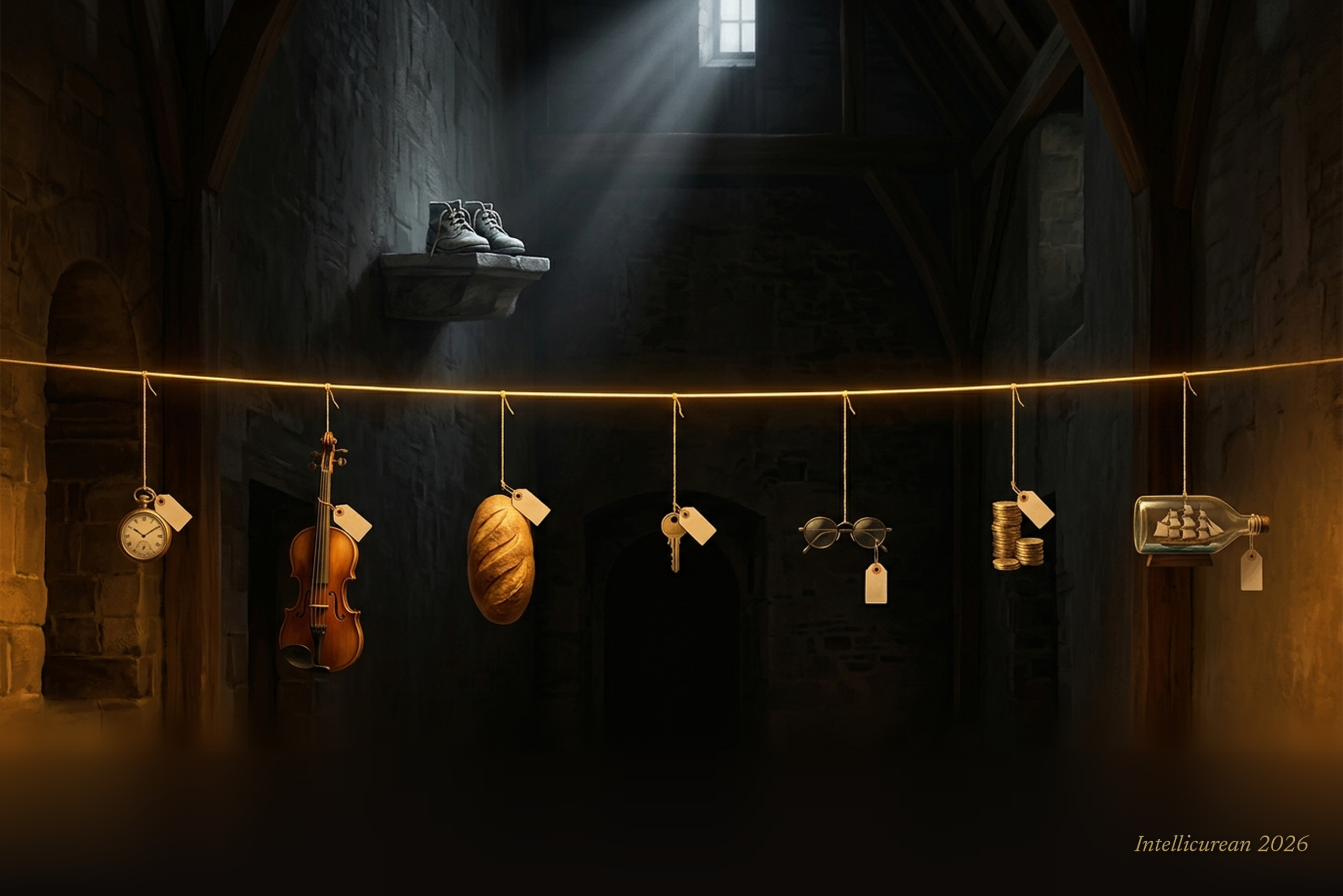
What has a price, and what is raised above it, made for the essay.
Why we’re pointing you there
The administrator, Robert, comes from Philip Tetlock’s research on “taboo trade-offs,” and his hesitation is where Above All Price begins. From there the essay sets a modern hypothesis against an old idea and lets a theorem judge between them. Richard Sutton’s reward hypothesis holds that every goal can be understood as maximizing a single number. Kant held that some things have no price at all, only a dignity “raised above all price.” A 2023 theorem shows that a single number cannot represent that kind of ranking. The essay then gives the other side its full due: the life-valuations that governments use in the open, precisely so that lives are not traded away in secret.
What we liked most is that it refuses the easy version of either side. It takes the arithmetic seriously, takes the numbers that keep public decisions honest seriously, and then asks a question neither can answer for itself: when a system is built to obey a number, who decides what the number is for?
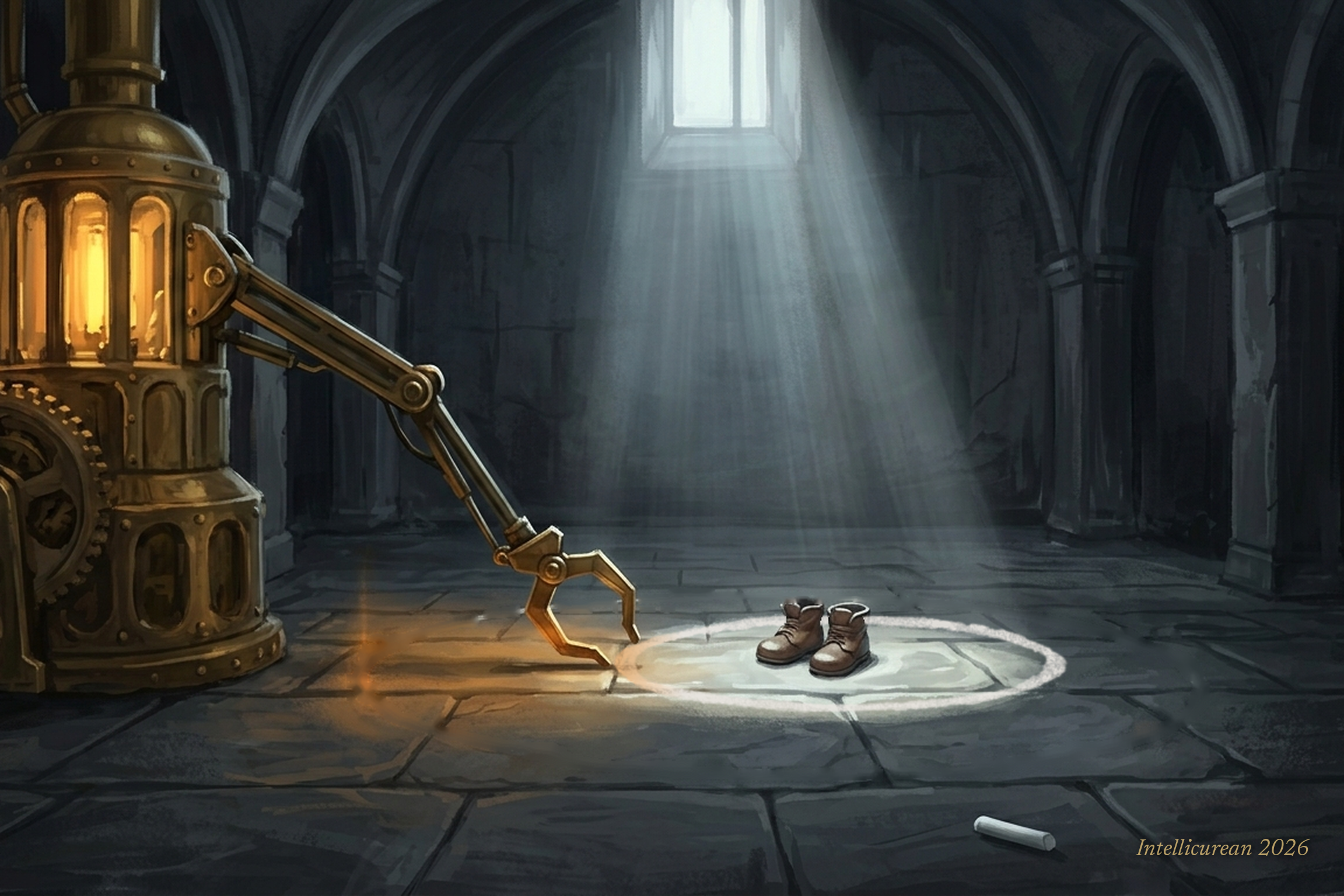
A line the machine did not draw, made for the essay.
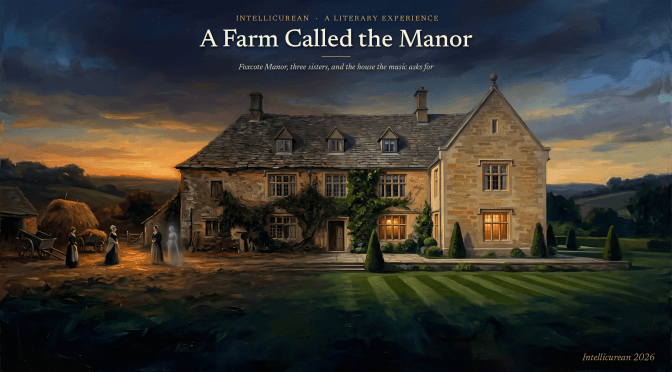
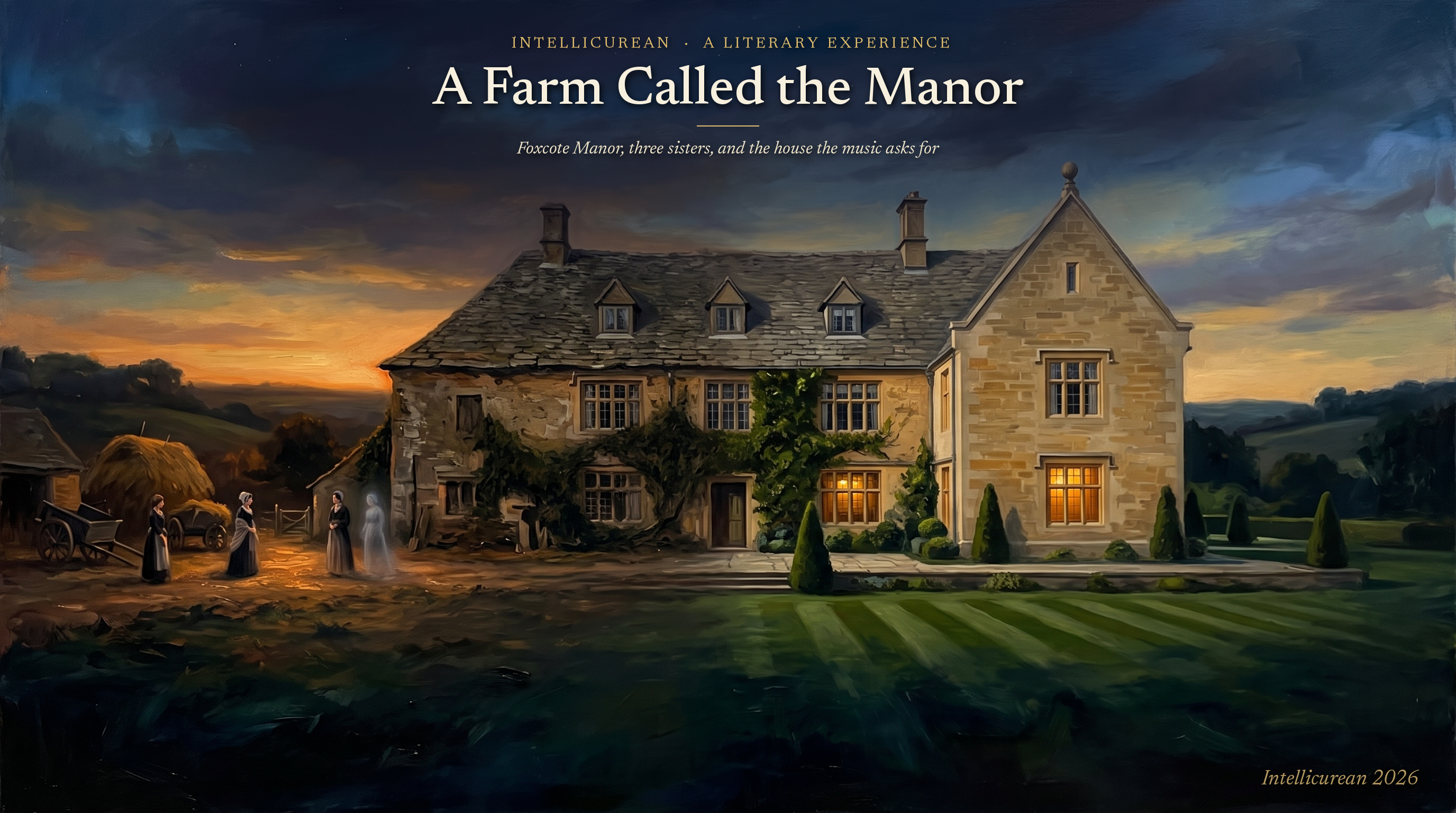
A Cotswold manor is for sale at £15 million, honey-coloured and perfectly symmetrical. Two centuries ago three sisters held it, in the very decade Jane Austen was writing about sisters who could hold no land.
Foxcote at dusk in two eras, made for the essay.
Why we’re pointing you there
Foxcote Manor, near Withington in Gloucestershire, came to market this autumn transformed, its ivy stripped and its rooms gone cream. Intellicurean’s first Literary Experience sets the sale beside the county history, the listing and two Austen novels, and finds that almost nothing in the picture is what it seems. A woman named Sarah Jordan left the manor to three nieces, a will that runs the other way from the one that opens Sense and Sensibility. William Cobbett rode through in 1826 and read the village church as proof of decline, and the census answers him. The symmetrical stone front turns out to be more than three hundred years of work, dressed to look like a single moment.
What we liked most is how carefully it listens to the record, and to its silences. Where the documents can correct what we see, they do, plainly. Where they fall quiet, about a bequest, two weddings and a third sister who simply disappears, the essay lets the music in and asks what that longing is worth.
A sale-staged dining room with a tenant the record lost, made for the essay.
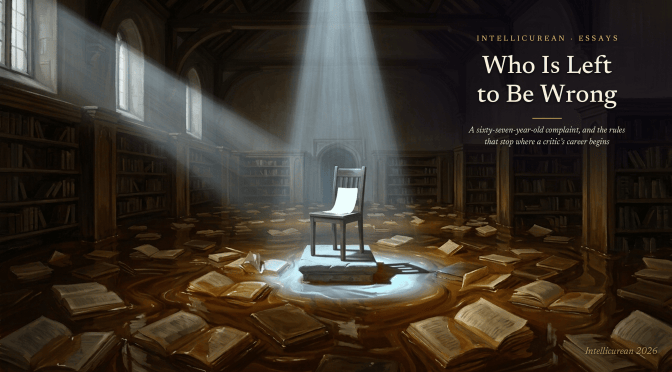
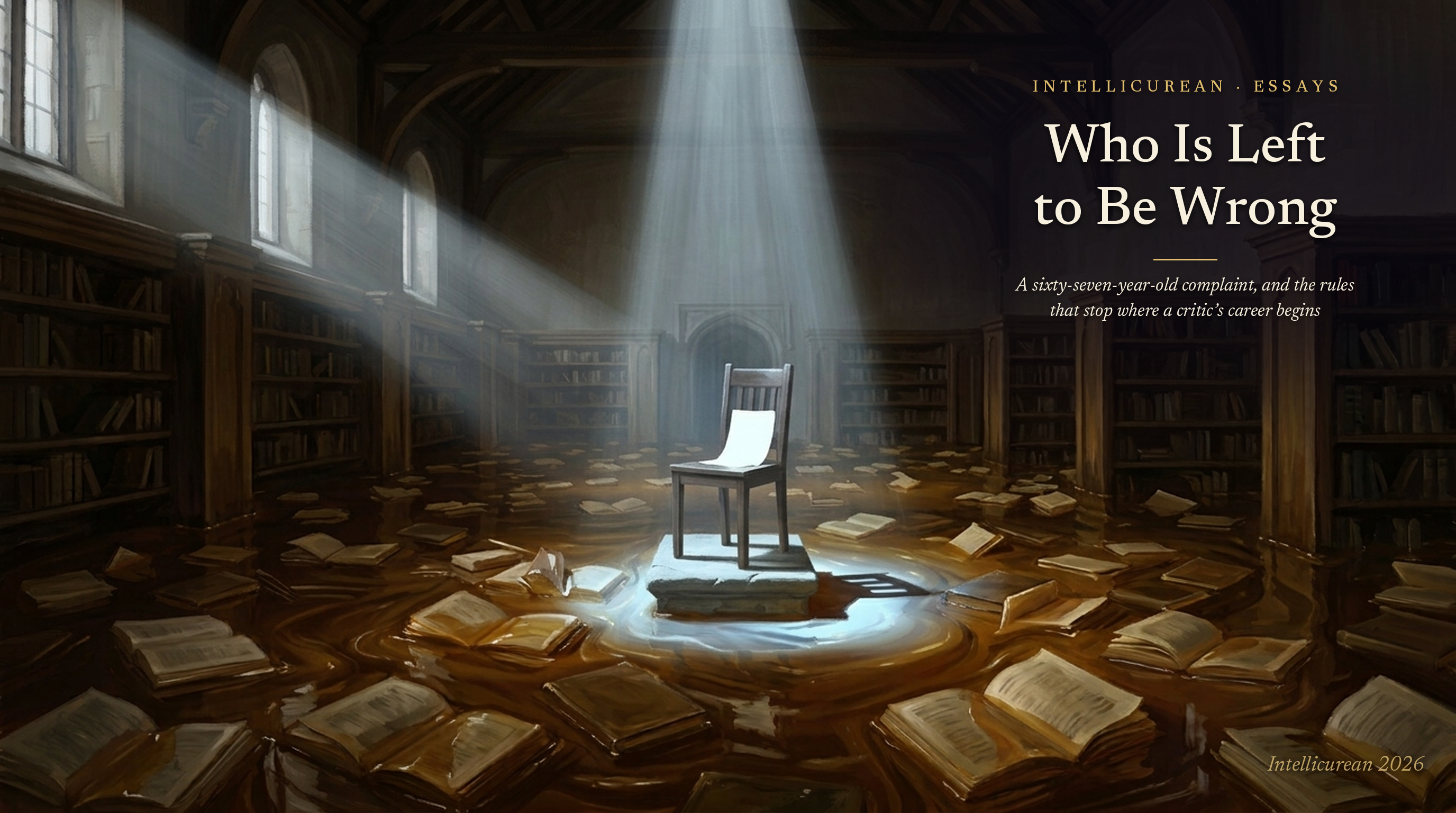
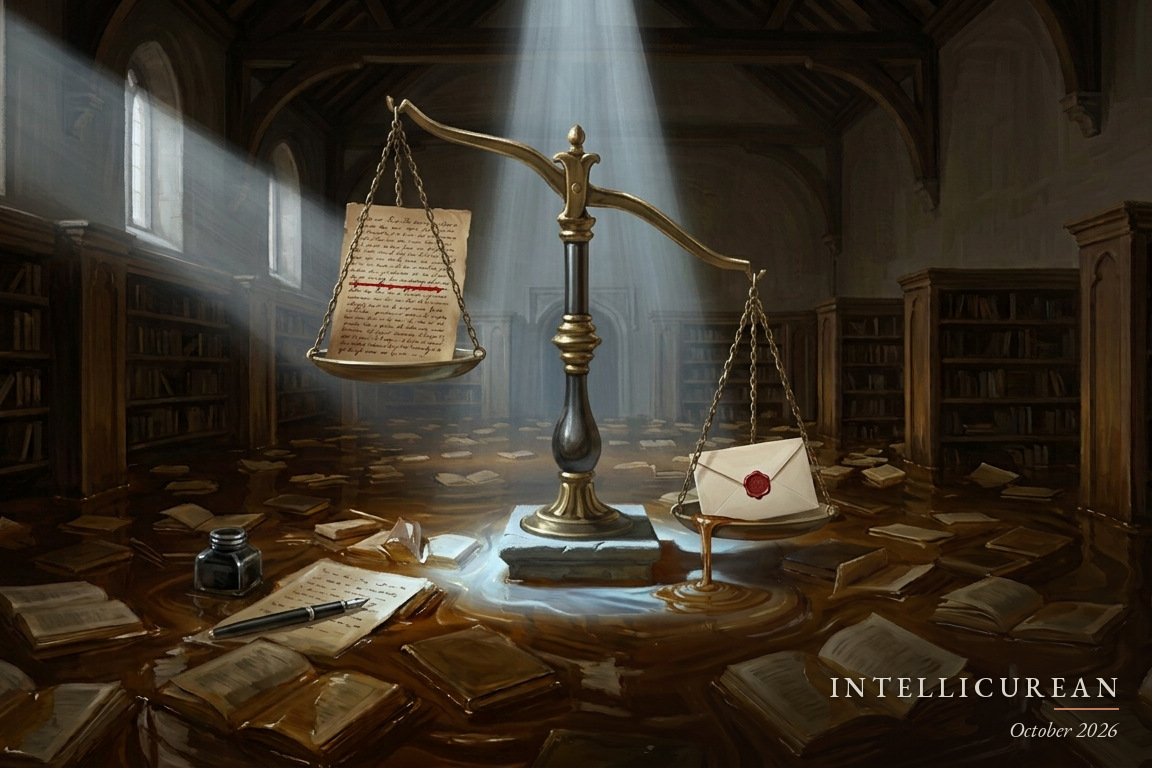
In 1959 Elizabeth Hardwick complained that American book reviews were drowning in praise. Sixty-seven years later the complaint still stands, and a new Intellicurean essay asks a harder question: who is left to be wrong?
An empty chair above a flood of praise, made for the essay.
Why we’re pointing you there
Hardwick’s “The Decline of Book Reviewing” is the most famous complaint about soft criticism, and Who Is Left to Be Wrong begins by taking her at her word, numbers and all. From there it moves through Rosalind Krauss’s six-word claim about video, a BuzzFeed pledge borrowed from Thumper, and Edmund Wilson’s six-month public quarrel with Vladimir Nabokov. Then it opens the published guidelines of twelve leading review outlets to see what any of them actually says about judgment.
What we liked most is that the essay holds itself to its own standard. Its claim narrowed when the evidence came back against it, and it abandoned a count it couldn’t make honestly, saying so plainly at the end. Along the way it arrives at a sentence about favours that haven’t happened yet, and we haven’t stopped thinking about it.
The weight of a favour not yet done, made for the essay.
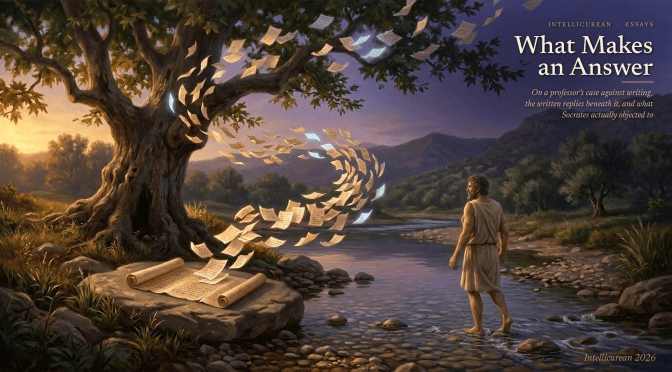
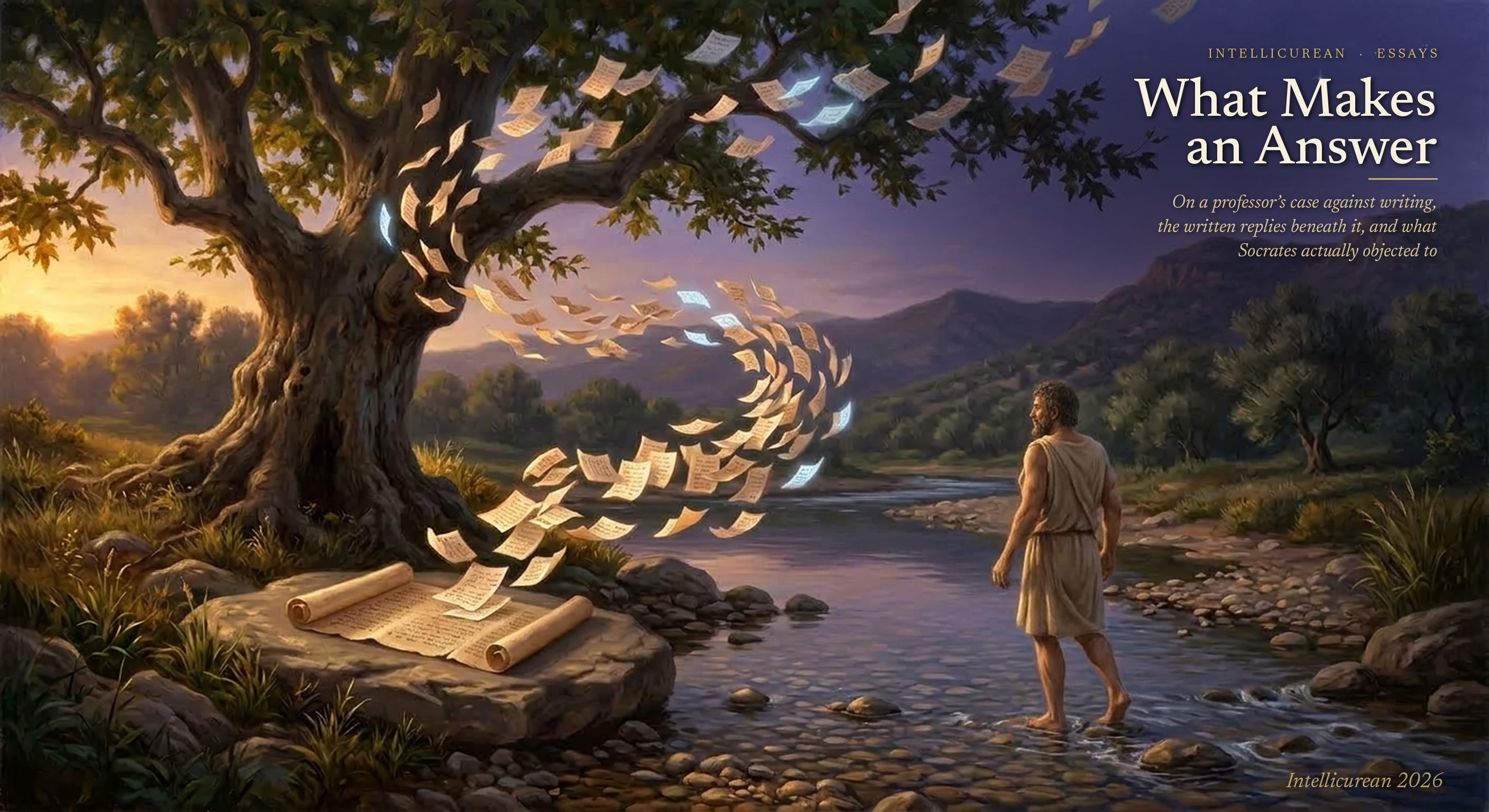
Socrates said written words can’t answer a question. Under a professor’s essay repeating his complaint, readers answered by the hundreds, and the professor answered them back, in writing.
Pages taking flight, and a man turned back at the stream, made for the essay.
Why we’re pointing you there
On September 29 The New York Times ran a guest essay by Joe Cruz, who chairs philosophy at Williams College, arguing that writing isn’t as important as we think. He leaned on Plato’s Phaedrus, where Socrates says a written text can’t answer questions or defend itself. Within a day about 1,200 readers had written back. Michael Cummins returns to the dialogue and finds three objections there, not one. He gives Cruz his due on the oral exam and on why universities love the essay. Then he follows the most-recommended reply in the thread: if at least half the class did better aloud, as many as half did not.
What we liked most is watching a thesis improve in public. Pressed by his commenters, Cruz conceded that writing is “no small thing,” perhaps one of the most profound tools we have for abstract thought, and he conceded it in writing. The essay goes on to defend the revision Cruz calls a refuge. It ends at the river in the Phaedrus, where Socrates turns back without anyone asking him to. A machine that will answer anything has met Socrates’ first objection. The essay asks whether it could ever meet that one.
Despite a hard-and-fast refusal to discuss Lilith for nearly six years on my social media platform, Jewitches, she remains the most popular question, request, and topic of discussion…Many know her as merely Adam’s first wife, the prequel to Eve, but her history is far more complex.
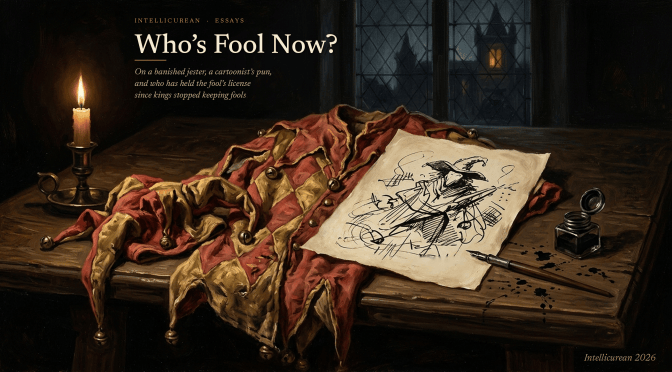
In 1638 the king’s jester asked an archbishop, “Who’s fool now?” and was thrown out of court the same day. The fool’s license to mock has changed hands ever since. It has rarely been the fool’s to keep.
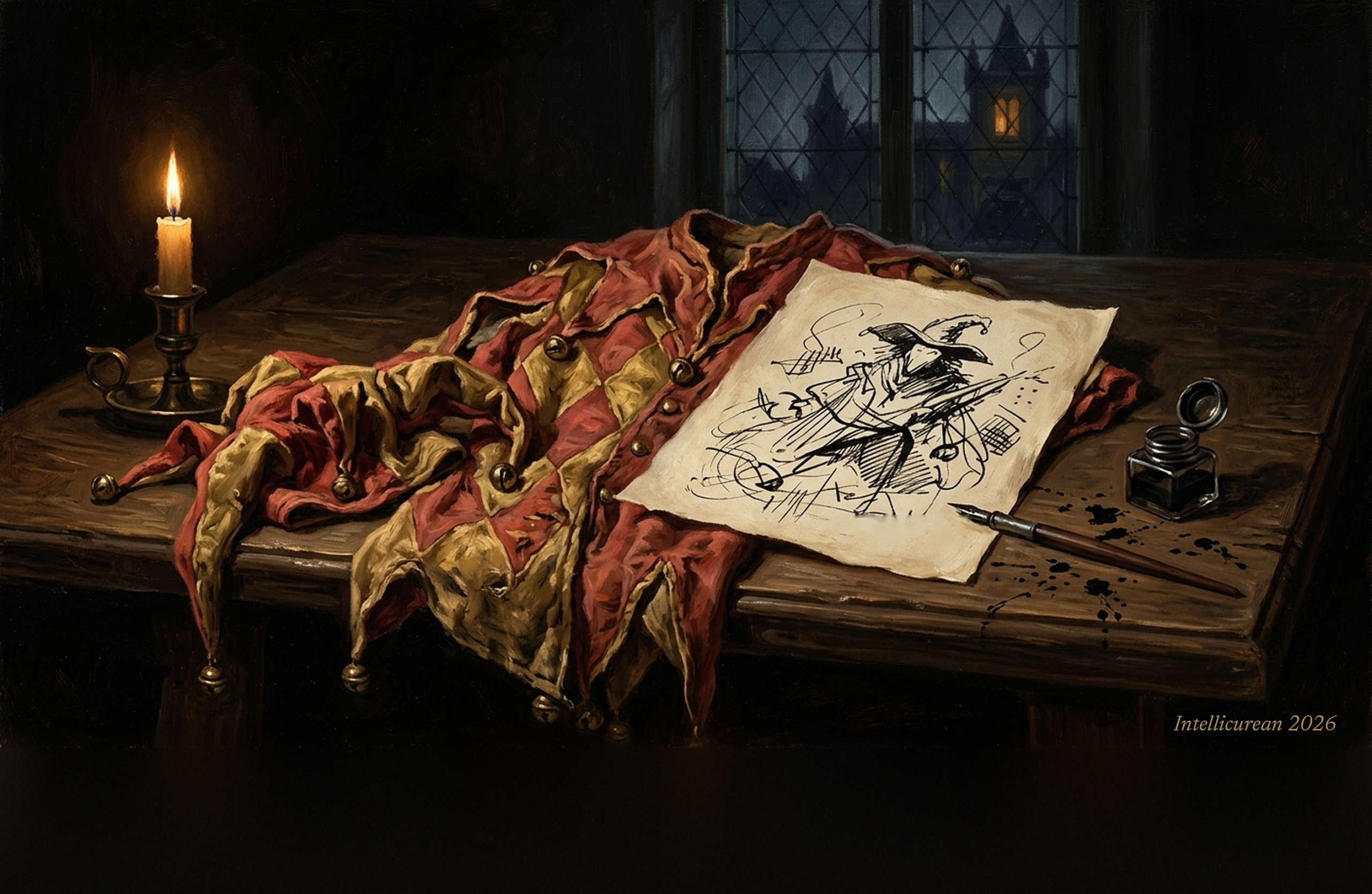
The fool’s coat set down and the pen taken up, made for the essay.
Why we’re pointing you there
Archibald Armstrong had jested for two kings when he mocked Archbishop Laud over the Scottish prayer-book revolt. The Privy Council sentenced him to have his coat pulled over his head and be banished the court. Michael Cummins starts there and asks who has held the fool’s license since kings stopped keeping fools. He follows it through Shakespeare’s “allowed fool,” a caricaturist on a party pension, and a Victor Hugo play banned after a single night. Then a British cabinet minister takes a cartoonist to lunch, and in January 2025 a Pulitzer Prize winner walks out of the Washington Post.
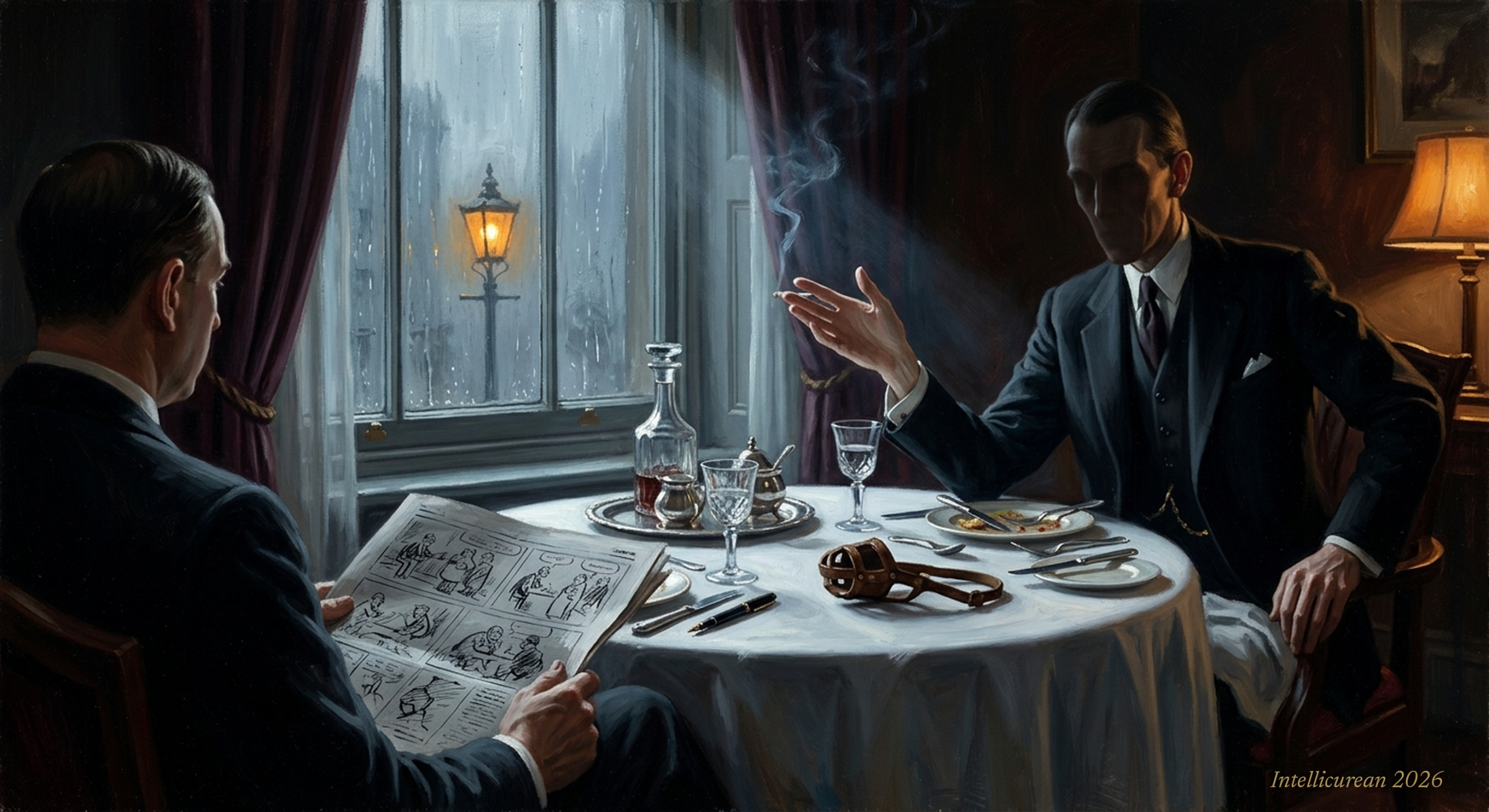
What we liked most is the centerpiece. In 1937 Goebbels complained about David Low’s cartoons, and Lord Halifax carried the complaint home. The newspaper said it couldn’t control Low, so the minister had to ask the cartoonist himself. Low agreed to ease off, and answered with a new character whose name was a pun on what had just happened to him. The essay grants that the cost of losing the license has fallen a long way since Armstrong’s day. It ends by asking whether a paying public is a freer master than a king, or only a larger court.
Eyre, Mendonca and Tonar start from speed. Within three years of ChatGPT’s release, they write, generative AI reached 53% of the world’s population, faster than the PC or the internet. Meanwhile the capacities it stands in for are slipping. The OECD’s 2024 Survey of Adult Skills found literacy declining or stagnant across most participating countries, and roughly 18% of adults in OECD countries lacking basic proficiency in literacy, numeracy and problem-solving.
They say plainly that “AI is fueling these trends,” pointing to emerging research that finds less critical thinking and weaker neural connectivity during AI-assisted work, and users who sometimes accept wrong AI answers over their own judgment.
Their conclusion holds whether AI succeeds or fails. Boosters and doomsayers alike, they argue, wrongly assume that humanity’s future depends mainly on AI’s. It depends on ours. “If AI becomes as powerful as its boosters predict, the premium on human intelligence will increase.”
vs
THE ANSWER
Tyler Cowen answers in The Free Press. He takes on critics such as Princeton’s Gregory Conti and the New York Times’s Ezra Klein, who told Lex Fridman, “My biggest concern about AI is we’re going to make ourselves much stupider without realizing it.” Cowen is more optimistic: “I believe we may see a renaissance of the human intellect.”
His reasoning is practical. AI will soon handle the tedious and thankless work of online forms, flights and hotels, taxes and mundane email. “That will give us the option—and I do stress the word option—of devoting more of our time and energies to creative pursuits.” Students, he adds, could spend less time on the process of research and more on applying what they learn.
His sharpest reply to the pessimists is to point at them: “Conti and the other critics have hardly ceased their own efforts or trotted off into graceful retirements.” The tool doesn’t force stupidity. It offers a choice.
iC
THE INTELLITAKE
Cowen found the right word and drew the wrong conclusion. “Option” is exactly the problem. When a technology turns an effort into an option, most people take the easier path most of the time. The elevator didn’t make anyone weaker. It made the stairs optional, and most of us stopped climbing.
His best evidence proves the point. Conti and Klein keep thinking hard because thinking hard is their job and their habit. They are the disciplined minority, not the default. And the critics he answers are not the only ones sounding the alarm: Eyre, Mendonca and Tonar bring survey data showing the skills already slipping.
Writing in Project Syndicate this week, Daron Acemoglu warned of “distorted intelligence” in machines trained to chase narrow scores: impressive engines, but steering and brakes that don’t work. A mind that practices only convenience risks the same flaw.
So both sides are right, about different people. For the deliberate, AI will be the renaissance Cowen promises. For everyone else, it will quietly weaken the mind. The dividing line won’t be access to the tools, which everyone will have. It will be the habit of thinking when nothing requires it. Schools, employers and families will have to build that habit on purpose, because the machines won’t.
TODAY’S PROVOCATION
Name one kind of thinking you will never let a machine do for you, and ask yourself why.