
Category Archives: Essays

THE FOX KNEW ONE THING

Intellicurean Essays on Intellicurious

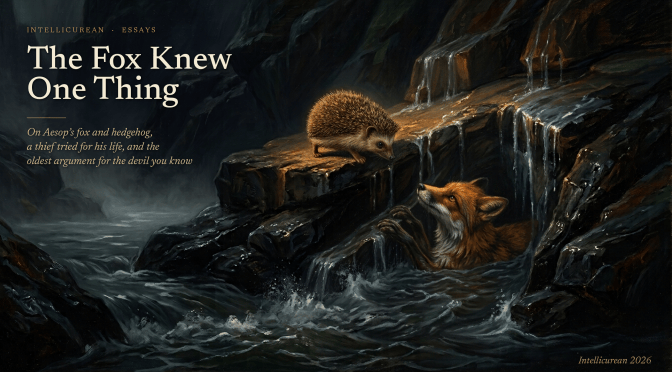
The fox knows many things, the proverb says, and the hedgehog knows one big thing. But in the oldest story we have of the two actually meeting, it is the fox who knows one big thing, and Aesop used it to plead for a thief’s life.
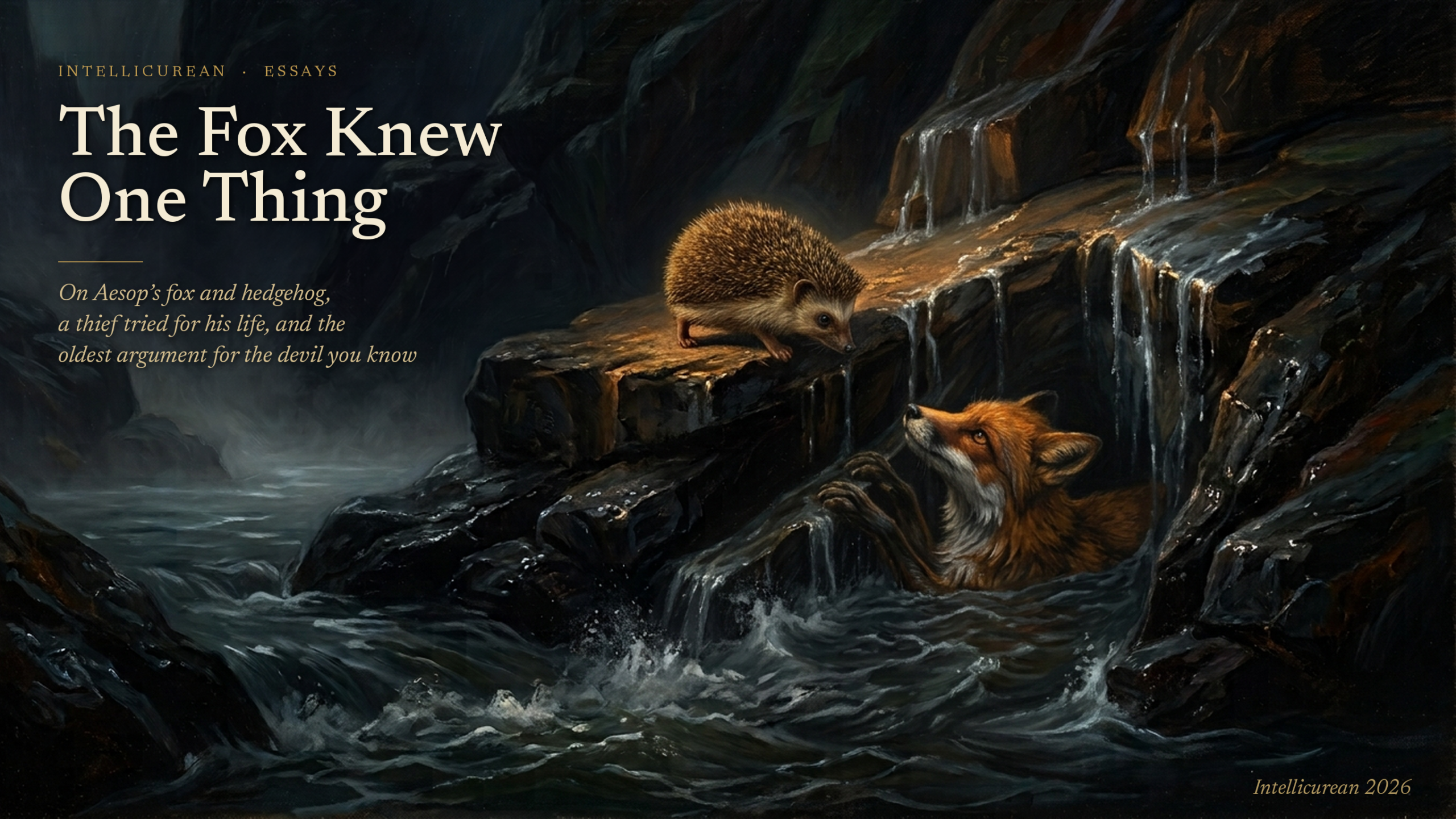
A soaked red fox trapped chest-deep in a hole in dark river rocks looks up at a hedgehog on the lit ledge above her
The fox in the hole and the hedgehog on the ledge, made for the essay.

Why we’re pointing you there

Isaiah Berlin made the fox and the hedgehog famous as two kinds of mind, and forecasters have since made the fox the one to be. Michael Cummins goes back to a story Aristotle preserved in his Rhetoric. A fox swept into a hole in the rocks is covered in fleas. A passing hedgehog offers to pick them off, and she refuses: these fleas are full, and new ones would be hungry. Aesop told it to an assembly on Samos to argue that a rich man on trial for his life should be spared, because a poor successor would steal more. Aristotle kept the speech and never recorded the verdict.

What we liked most is what the essay notices in the details. The fox’s refusal only makes sense because she can’t get out of the hole. Four centuries later, Josephus has the emperor Tiberius tell the same story to explain why he left his governors in place so long. The emperor’s version has no hole, and his reasoning is sharper than the fable’s. The essay says so plainly, and then shows what that sharper reasoning made possible. It ends on the hedgehog, the one character who never gets to answer. Every quotation from the ancient texts has been checked against the texts themselves.
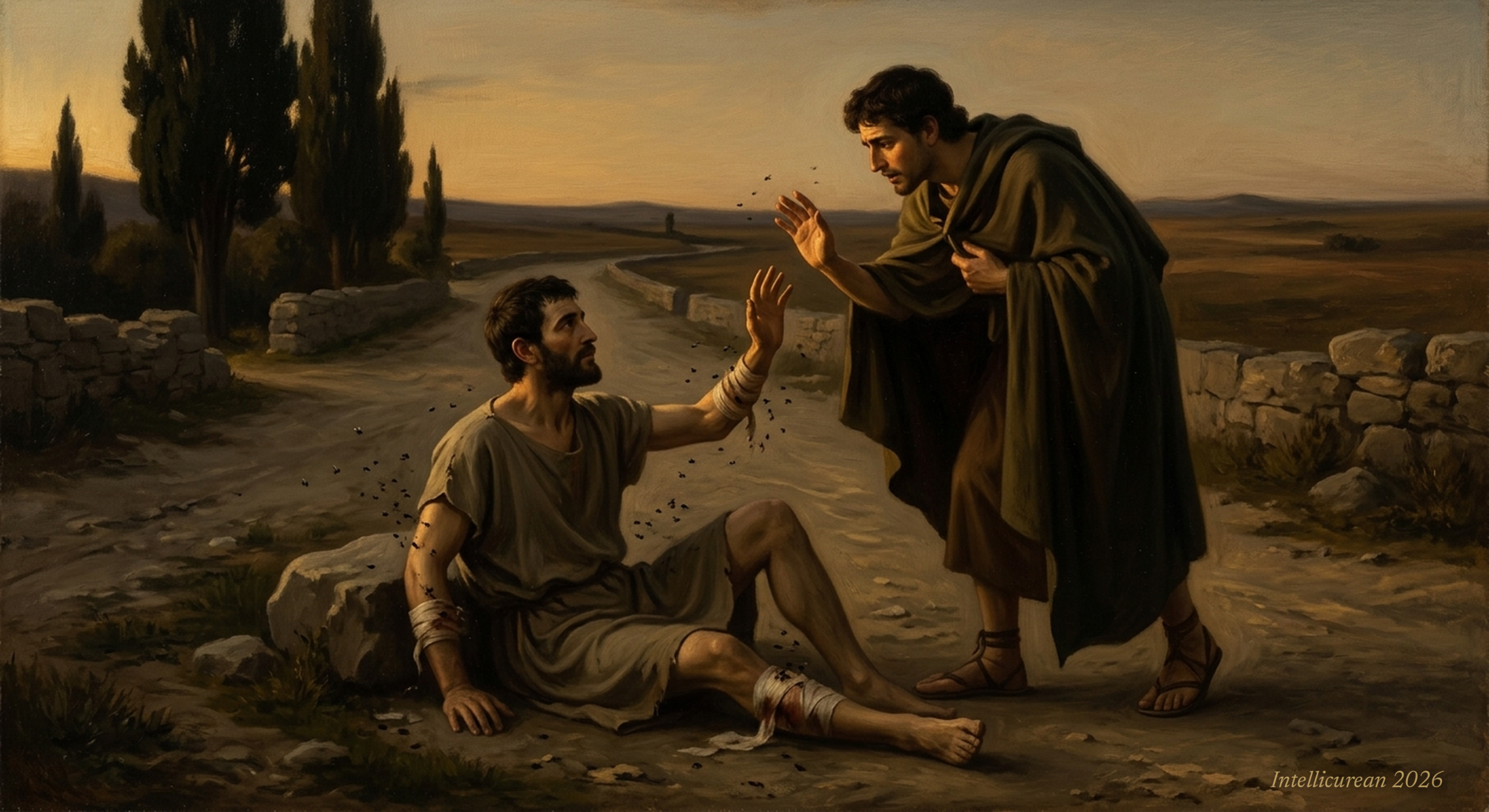
On an open country road at dusk, a wounded man sitting against a roadside stone raises his hand to stop a cloaked passer-by from waving away the flies around his bandages
A wounded man and a stander-by, made for the essay.

Read the full essay at Intellicurean →

Essays & Reviews for the Intellectually Curious

THE COST OF NOTHING – AN INTELLICUREAN ESSAY

Intellicurean Essays on Intellicurious

What nothing can cost: for thirty years Japan’s money was almost free to borrow, its young were told they had risen above wanting things, and the rest of the world quietly built on both. Now the tide is coming back in.

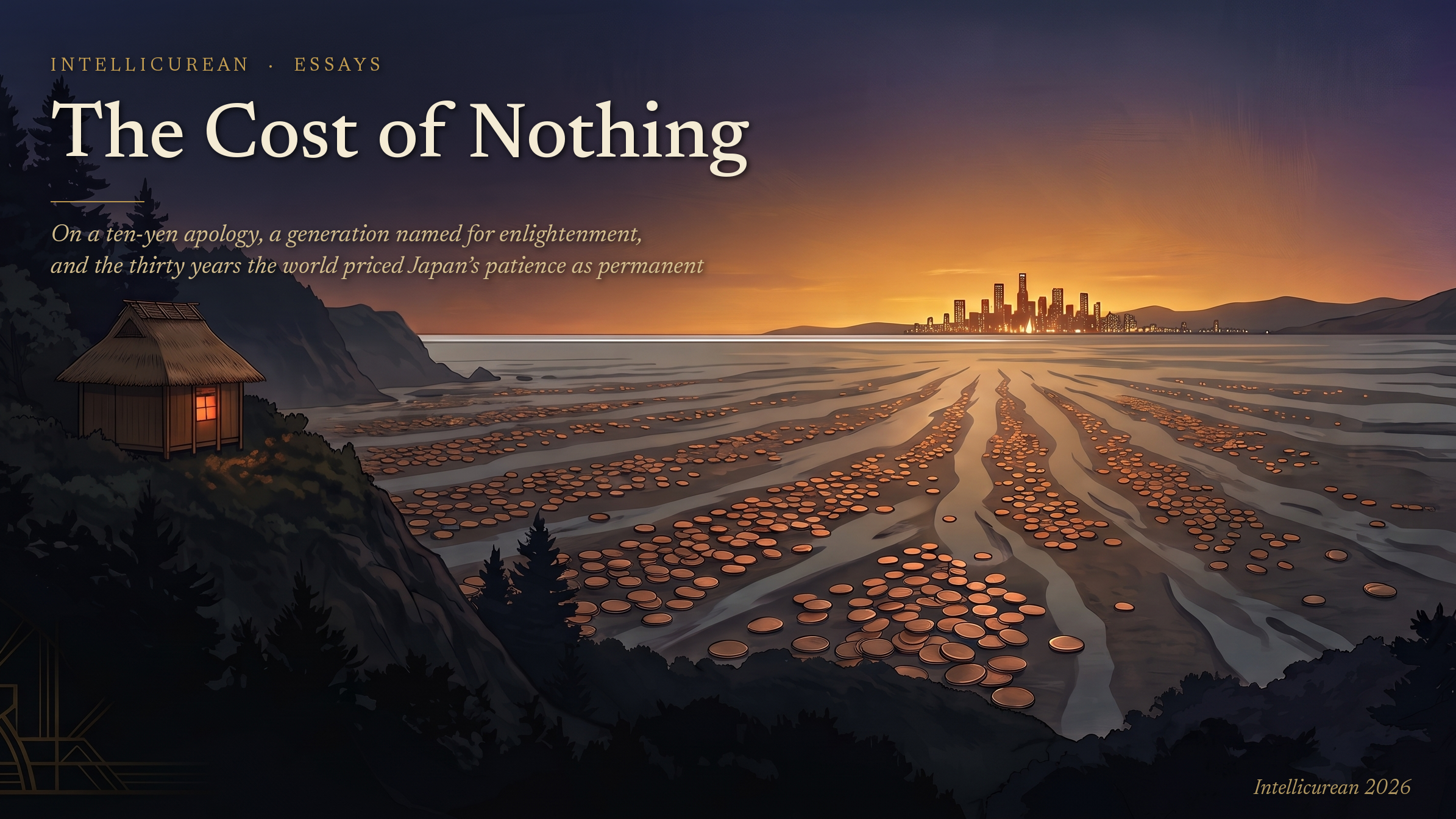
A tiny thatched hut with one lit window on a dark hillside, above a sea that has drawn far out, its bed covered in bronze coins leading to a distant glowing city
The hut, the coins and the city, painted for the essay. An invention, and disclosed as one there.

Why we’re pointing you there

A New York Times column this week warned that Japanese money, abroad for three decades, is starting to go home. Michael Cummins takes that market story and finds a second one underneath it. The same years that made yen the cheapest money on earth also produced a nickname for a whole generation: the satori sedai, the enlightened ones, young people said to want nothing. The essay is careful to keep the two apart. A central bank made the cheap money; a joke on an anonymous message board made the name. But the name was how the stillness got told, and the world priced it as if it would last forever.

What we liked most is how far back it reaches for its measure. It opens on an ice-pop company bowing on television to apologize for a ten-yen price rise, and it ends in a ten-foot hut built by a monk in 1212, who praised his reduced life and then, at the very end, doubted it. Between them come a young Natsume Sōseki translating that monk into English, a Texas hedge-fund manager ruined by being right too early, and one number about who owns Japan’s debt that explains three decades in a sentence. Both Japanese sources are translated fresh for the piece.

A lone figure in a dark suit bows deeply under a single spotlight, on a dark floor scattered with plain bronze coins
A bow over small change, painted for the essay.

Read the full essay at Intellicurean →

Essays & Reviews for the Intellectually Curious
THE CHRONICLE OF HIGHER EDUCATION – OCTOBER 2026

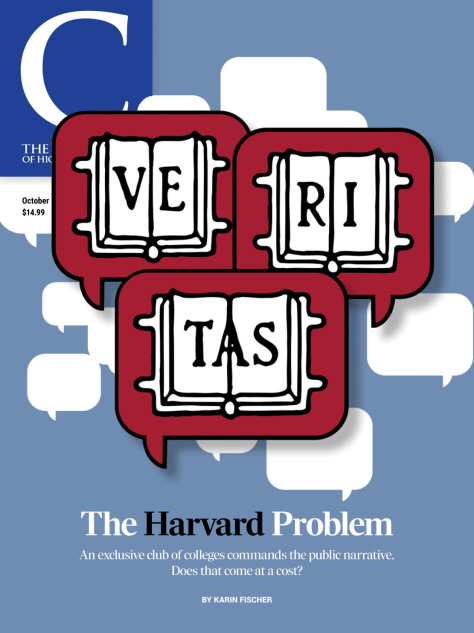
THE CHRONICLE OF HIGHER EDUCATION: The latest issue features ‘The Harvard Problem’ – An exclusive club of colleges commands the public narrative. Does that come at a cost?

Higher Ed’s Harvard Problem

An exclusive club of colleges commands the public narrative. Does that come at a cost? By Karin Fischer

The Face-Time Ultimatum

When faculty are required to be on campus, even to teach online, they may just quit. By Adrienne Lu

Colleges Need Students. They’re Trying to Find Them in Texas.

The Lone Star State is teeming with students — and with college recruiters fighting to win them over. By Taylor Swaak

Neil Gross Knows What Broke College

How political polarization became the organizing logic of academic life. By Evan Goldstein, Len Gutkin

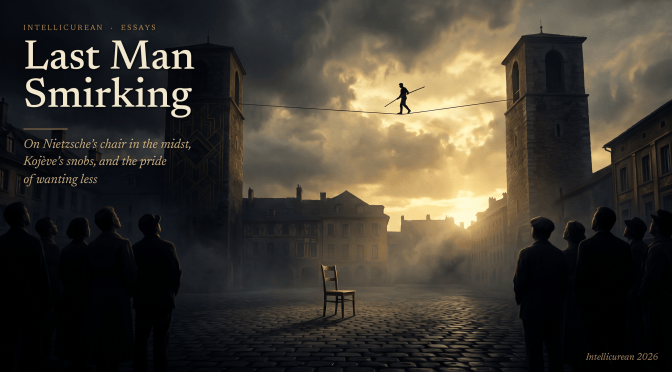
LAST MAN SMIRKING

Intellicurean Essays on Intellicurious

For thirty years we have pictured Nietzsche’s last man as a creature of comfort, blinking contentedly at the end of history. Read the page again and he is doing something else entirely. He is smirking. What if the people who want the least are the proudest people of all?

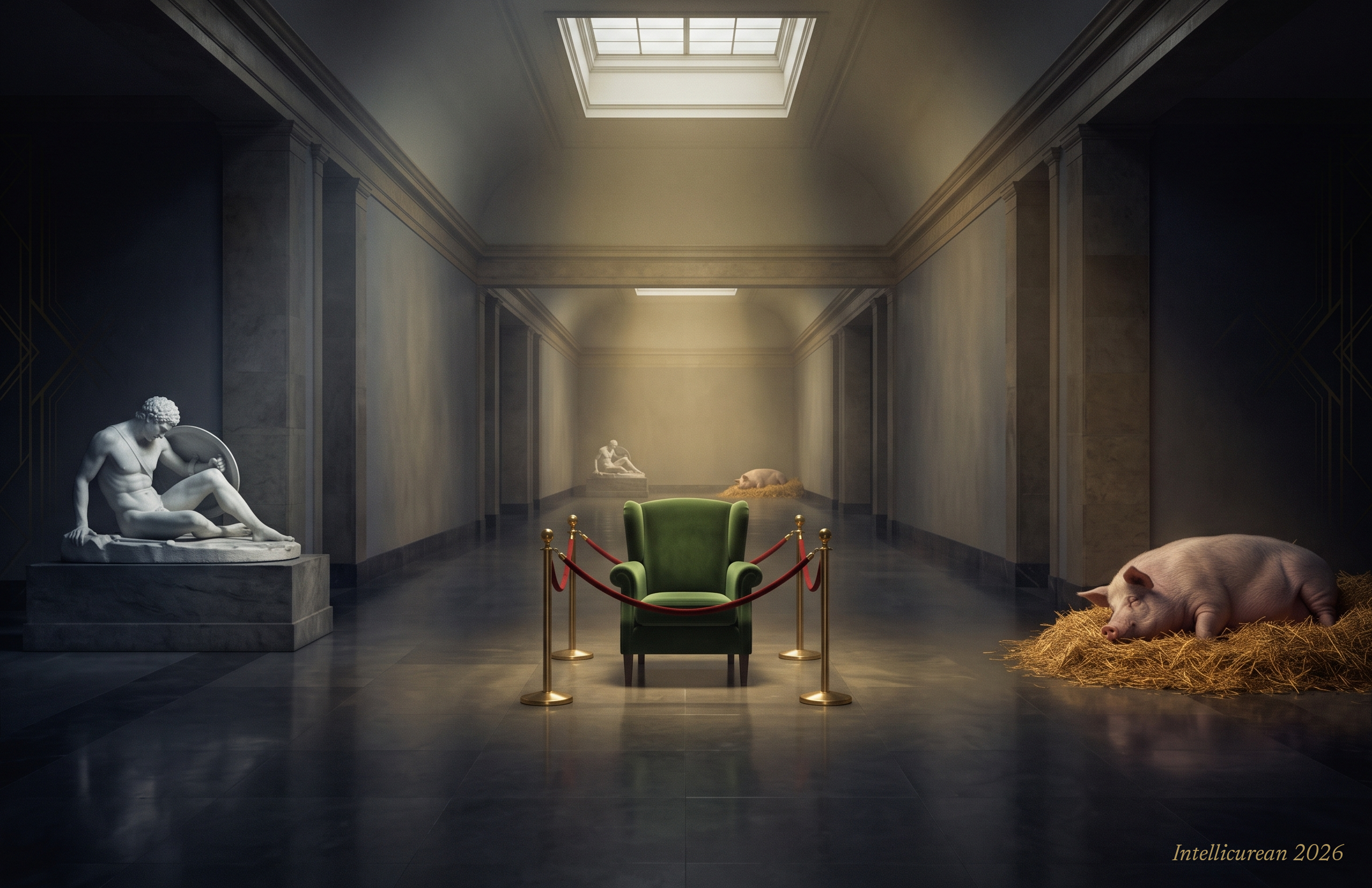
An empty velvet armchair roped off beneath a skylight, exactly midway between a marble statue of a gladiator and a sleeping pig in a museum gallery
The chair in the midst, painted for the essay. An invention, and captioned as one there.

Why we’re pointing you there

Francis Fukuyama made the last man famous in 1992, and in a new memoir he says we now live in the last man’s world. Michael Cummins agrees about the world and argues that Fukuyama has had the man wrong from the start. Fukuyama imagined someone who had lost the old hunger to be thought better than others. Cummins goes back to Zarathustra and finds a crowd vain about its culture, and a passage in which the small people boast of sitting precisely halfway between the gladiator and the pig. The hunger never left. It learned to pass for modesty.

What we liked most is that the essay won’t let anyone off. It uses Fukuyama’s own pages to explain why a democracy drives ambition into hiding, borrows Kojève’s discovery of Japanese snobbery and turns it inside out, and then gives Nietzsche’s rival snobbery of the heights its due, along with Fukuyama’s warning about the bored crowds of August 1914. It ends at Niagara, with a French acrobat and a chair, and the best last line we have run this year.

Read the full essay at Intellicurean →

Essays & Reviews for the Intellectually Curious

SHE READ TACITUS

Intellicurean Essays

New on Intellicurean

She Read Tacitus

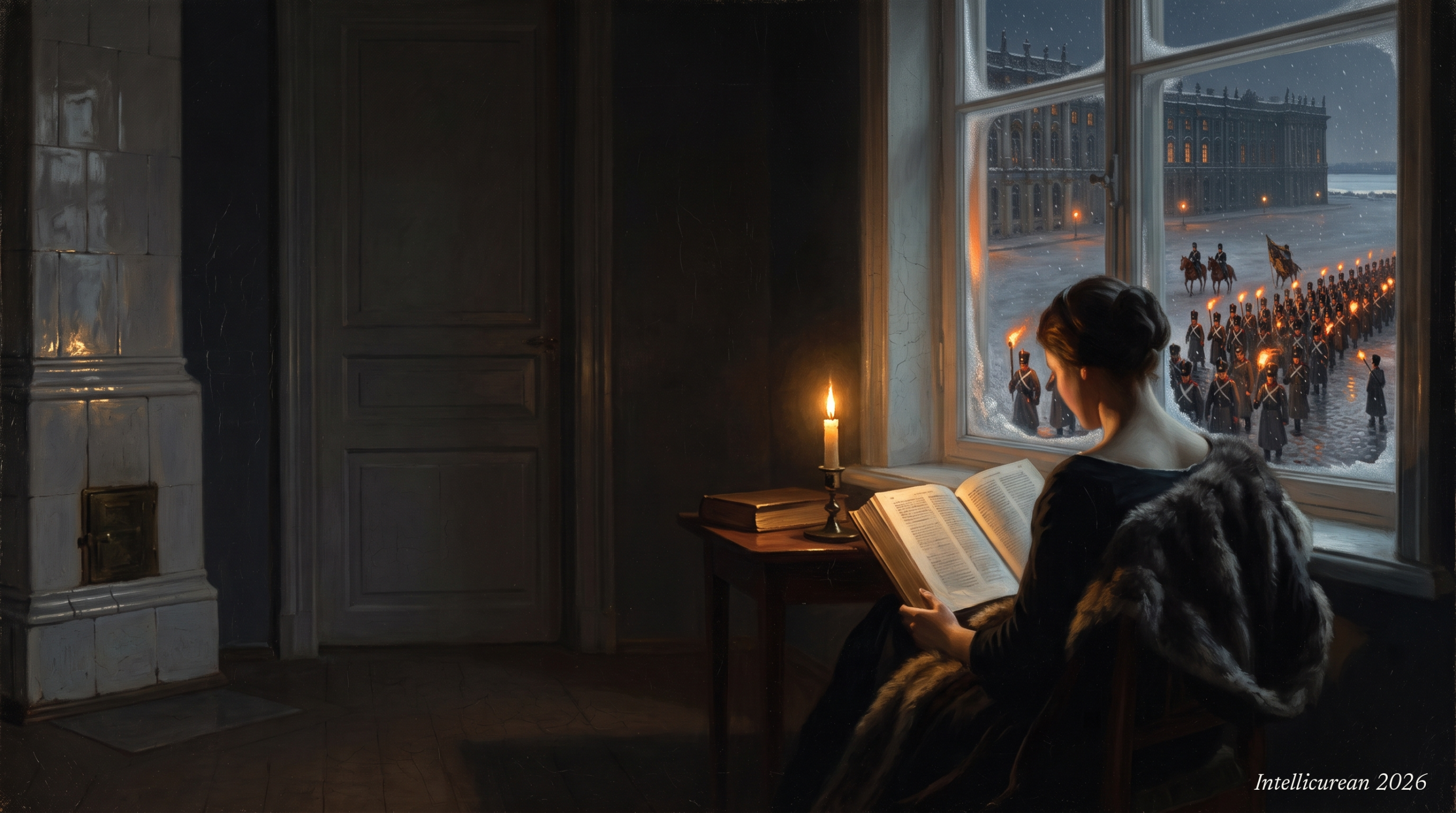
A young woman seen from behind, reading by candlelight at a winter window, while guardsmen with torches march through the snow below

In the winter after her son was taken from her, the grand duchess who would become Catherine the Great read the Annals of Tacitus and wrote later that it caused “a singular revolution in my brain.” Seven years later she took a throne. What she learned from Tacitus was not how to seize one. It was who writes the record afterward.

In the winter after her son was taken from her, a grand duchess of twenty-five read the Annals and wrote later that it caused “a singular revolution in my brain.” Seven years later she took a throne. What she learned from Tacitus was not how to seize one. It was who writes the record afterward.

Catherine managed three documents about the coup of 1762: a manifesto that said she was compelled, a second that said her husband died of colic, and a long letter to a lover in Warsaw that told him everything, hour by hour, and told him colic too. A fourth document was found in her cabinet thirty-four years later: a note from Alexei Orlov confessing a drunken accident at Ropsha, which clears her of ordering the death, which survives only in a copy made in a quarter of an hour by a courtier of her son’s, and which the archive, when asked directly, cannot find.

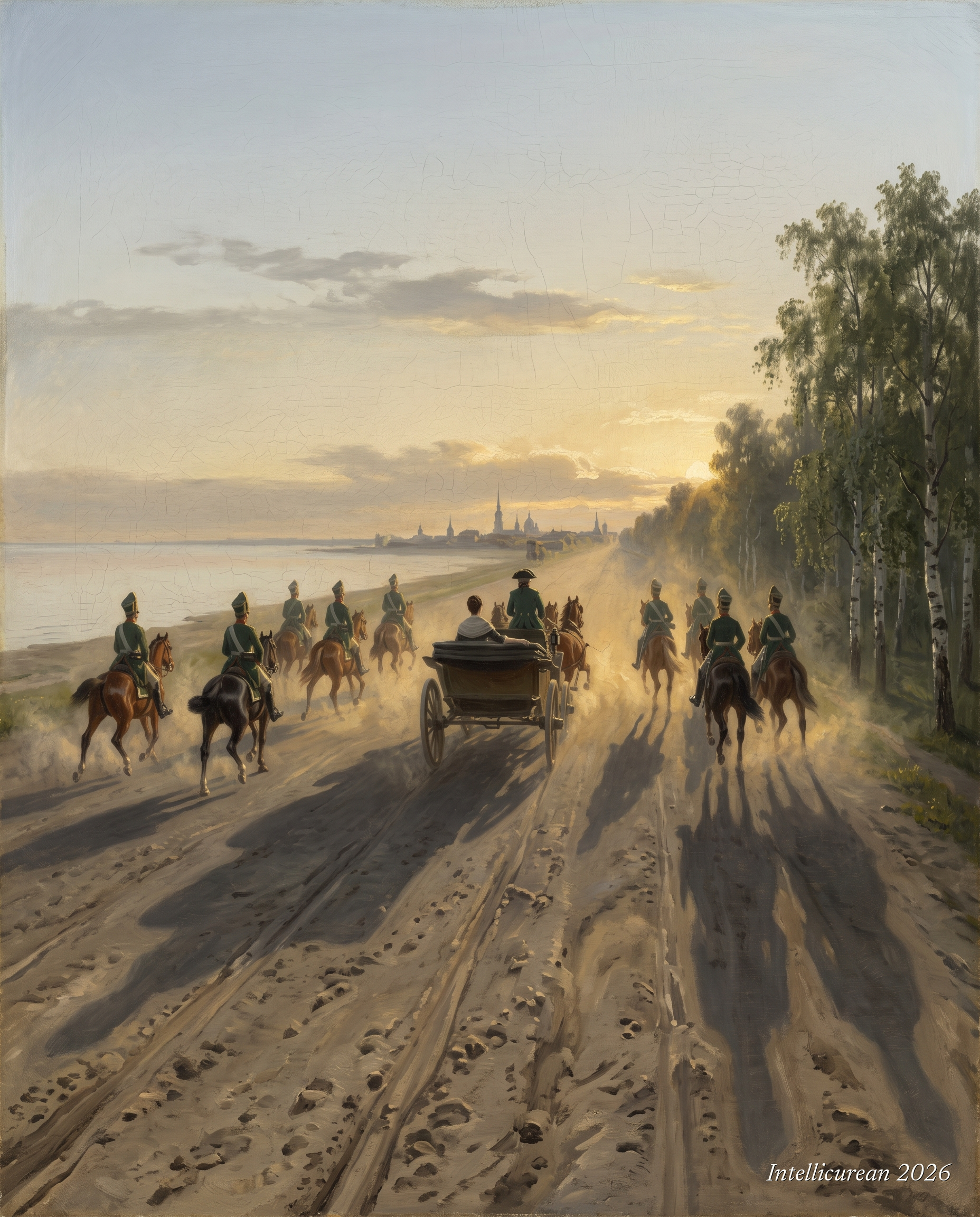
A carriage at a gallop on a dawn road along the sea, guardsmen closing round

The Peterhof road, six in the morning, 28 June 1762, as the essay imagines it. A generated image, not a record.

Why we’re pointing you there

Michael Cummins reads the four documents the way Tacitus taught Catherine to read everything: as records made by parties with reasons. Herzen in 1858, Bain in 1902, a Russian archivist who counted the letters in the folder and found two, and a confession that got drunker with each printing. One guess, graded, about why she wrote her own account first; two readings of the forgery, if it is one; and an ending in a drawer that held either the proof of her innocence or nothing at all.

The reader of Tacitus was read, at the end, by Tacitus’s method. The method cannot tell which.

Read the essay at Intellicurean →

Intellicurious points to the best of what we read and make. The full essay, with its sources and colophon, lives at intellicurean.com.

ANOTHER MAN’S ELOQUENCE

Intellicurean Essays

New on Intellicurean

Another Man’s Eloquence

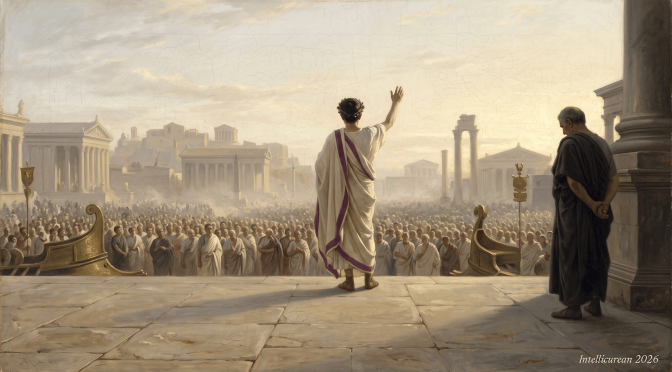
In the autumn of 54 a boy emperor praised a dead man, and the crowd smiled at the wrong moment. The sentences were Seneca’s. What happens to a philosopher who spends eight years as someone else’s voice?

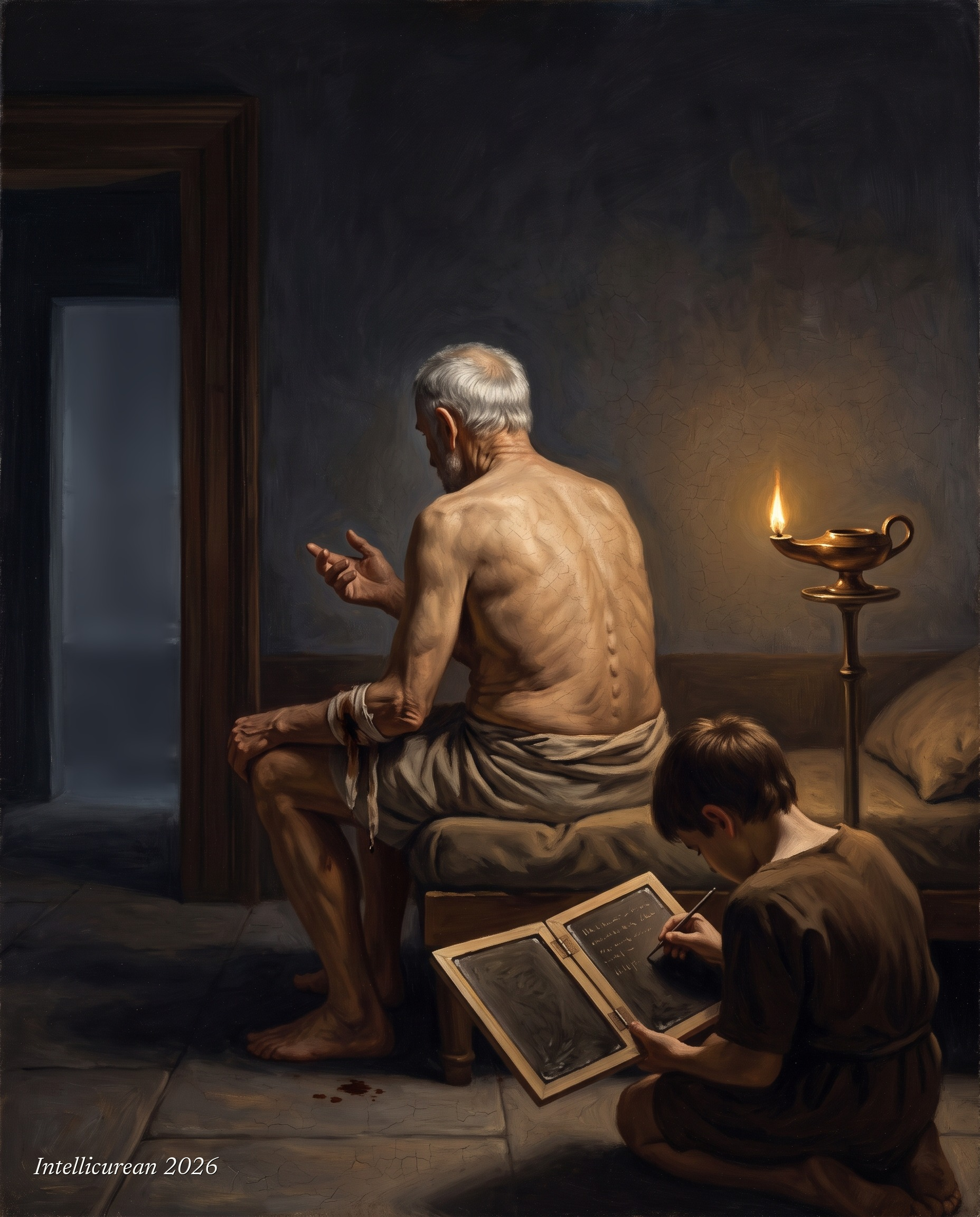
Seneca, seen from behind by lamplight, dictating to a single scribe

The dictation, AD 65, as the essay imagines it. A generated image, not a record.

Tacitus says the old men in the Forum noticed something new that day: Nero was the first ruler of Rome to need another man’s eloquence. Five years later the same man wrote the letter that explained a mother’s murder to the Senate, and the city blamed the ghost, not the emperor. Three years after that, the charge that ended his career was that he had claimed the credit. And in the first year he owned his own mouth, he wrote the most famous opening in Roman philosophy: set yourself free for your own sake.

Why we’re pointing you there

Michael Cummins follows the voice through four dates, 54, 59, 62 and 65, and finds one word doing the work: aliena, “another’s,” the word Tacitus used for Nero’s borrowed speech and the word Seneca used, in his own letters, for everything a man does not own. The essay makes one guess about what the throne cost him, grades it, and prints the two hostile witnesses who say it cost him nothing. It ends with the one text Seneca dictated as unmistakably his own, on the night he died, and why we don’t have it.

Every speechwriter since is Seneca, and the letter after the crime still gets written.

Read the essay at Intellicurean →

Intellicurious points to the best of what we read and make. The full essay, with its sources and colophon, lives at intellicurean.com.

HATS AND CLOAKS

Intellicurean Essays on Intellicurious

Prague, February 1948. A photograph of the new Communist leader on a balcony, a fur hat on his head, a comrade at his shoulder. Four years later the comrade is hanged and painted out of the picture. Milan Kundera built the most famous opening in Czech literature on what was left: the hat. A scholar has since checked the print, and the story is not quite what the photograph shows.

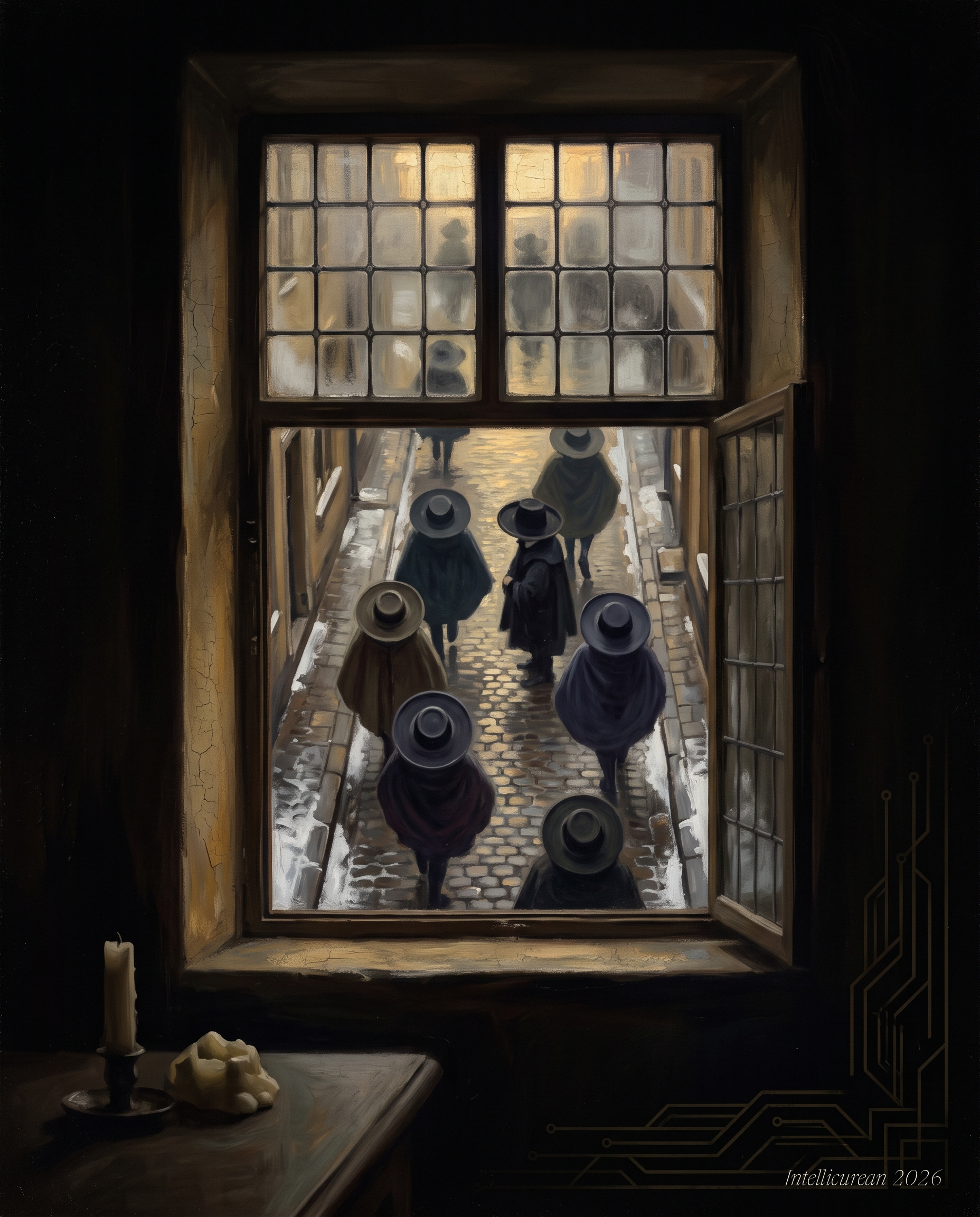
A painting of a dark study looking down through a leaded window at a snowy street, where walkers are seen from above as hats and cloaks only
Descartes’s window, painted for the essay: hats and cloaks in the street, and the men supplied by judgment.

Why we’re pointing you there

Everyone quotes Kundera’s line about memory and forgetting. Michael Cummins reads the page it’s on, and finds that Kundera gave the line to a character who is busy trying to erase his own past, and knew exactly what he was doing. From there the essay follows one fur hat through four sets of hands: the state’s, the novelist’s, Kundera’s own on his early work, and Nietzsche’s sister’s on her brother’s notebooks. Descartes supplies the frame, from a window in 1641: we see hats and cloaks in the street, and the men beneath them are something we judge, not something we see.

The hardest section concerns a half-page police report from 1950 that surfaced in 2008 with Kundera’s name on it. The essay lays out what the document says, what is contested, who the witnesses are related to, and decides nothing, which is the only honest thing to do with it. It makes exactly one guess about Kundera, labels it as a guess, and gives its grade. Read it for the ending, where the record does something the novel never mentions.

Read the full essay at Intellicurean →

Essays & Reviews for the Intellectually Curious

I THINK, BUT AM NOT CERTAIN

Intellicurean Essays on Intellicurious

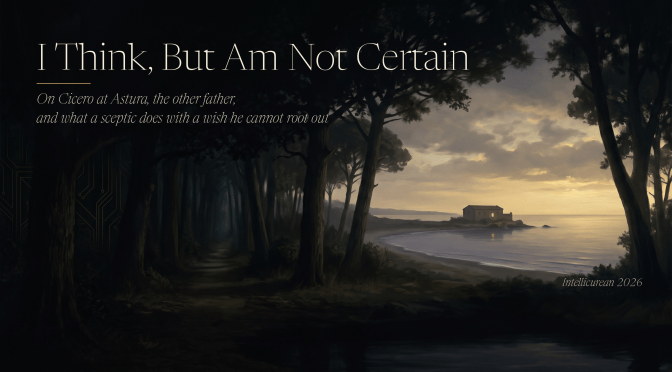
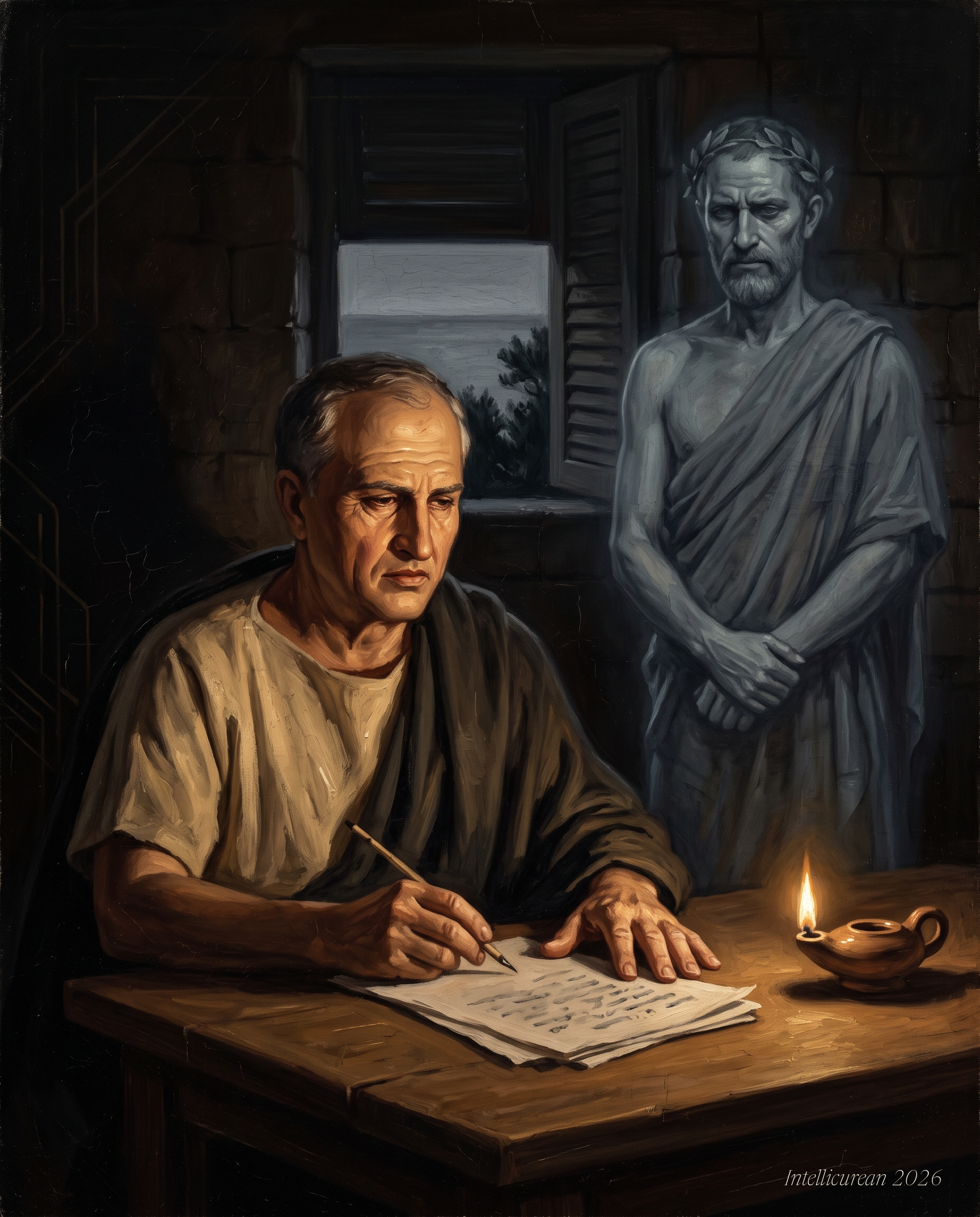
In the spring of 45 BCE Cicero hid in a wood all day, wrote every night that nothing can be known for certain, and spent the same nights trying to buy land on which to make his dead daughter a god. What was in his mind? The essay guesses twice, and grades both guesses by his own rules.

A painting of Cicero writing by lamplight at Astura, with a translucent figure of Demosthenes, wreathed, standing unseen behind his shoulder
Cicero at Astura and the ghost of Demosthenes, painted for the essay. An invention, and captioned as one there.

Why we’re pointing you there

Most writing about Cicero’s grief for Tullia quotes the letters and moves on. Michael Cummins reads them as a working file: the philosopher checking the dates of other parents’ bereavements before he dares cite them, refusing a visit from his teenage wife, ordering columns from Chios for a shrine he never built. Then he notices who else is in the room. Demosthenes, the orator Cicero spent his life measuring himself against, had also lost an only daughter, and had been attacked in an Athenian court for grieving her too little. Cicero cited the attack, months after his own loss, in a book about grief.

What we liked most is how the two men are made to meet. Not in an invented dialogue, but in a cento: every sentence its speaker’s own, from public-domain translations named on the page, and only the arrangement the essay’s. Demosthenes never speaks of his daughter, because he never did. The essay ends fourteen centuries later in a library in Verona, with the first reader we know of who found these letters and wrote back. It is the second essay in a row with no machine in it, and the one we would hand to a sceptic.

Read the full essay at Intellicurean →

Essays & Reviews for the Intellectually Curious
WHO PAID FOR VENUS?

Intellicurean Essays on Intellicurious

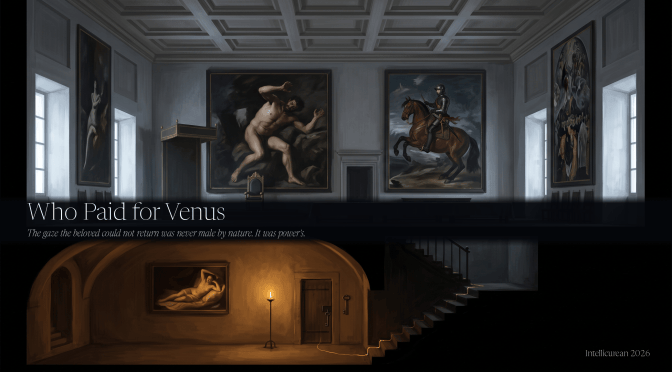
Two rooms, one painter, two very different buyers. In 1549 a queen hung Titian’s tormented giants to greet the future king of Spain. A few years later that king hung Titian’s nudes for himself. The essay asks who was doing the looking, and finds it was never simply the men.

Why we’re pointing you there

Everyone who took an art-history survey met John Berger’s line about men looking and women being looked at. Michael Cummins takes that line to the Prado, where the museum’s new volumes on women and the Spanish collections show something the slogan can’t hold: Mary of Hungary commissioning, Christina of Sweden collecting, Isabella Farnese marking her paintings with a lily like a brand on cattle. Power looked, and power was often a woman. The essay does not overturn Berger. It finds the room he left out.

What we liked most is the discipline. Every claim about who owned what rests on an inventory, and where the record gives only a later opinion rather than a fact, the essay says so and moves on. It is also the first piece in the series with no artificial intelligence in it at all, which is the point: Intellicurean was always a project about judgment, and here the judgment is a queen’s. Read it for Binche in 1549, and for a Sisyphus who turns out to have been a political statement.

Read the full essay at Intellicurean →

Essays & Reviews for the Intellectually Curious
CHARLATANS AND BORES

Every age invents its know-it-all — the Renaissance humanist drowning in citations, the “well, actually” of the comment thread. What, exactly, is the pedant missing? He has the facts. He is not lying. And yet he is unbearable.

Why we’re pointing you there

Intellicurean sets the poet-scholar A.E. Housman — who spent thirty years on a bad Latin poem and knew precisely how tedious it looked — against the philosopher H.P. Grice, who worked out the unwritten rules that make conversation bearable. The pedant, it turns out, obeys the rule of truth and tramples every rule of mercy. He tells you true things you never needed, and mistakes the telling for a gift.

Then the essay springs its trap. The AI chatbot is the perfect pedant — infinite recall, immaculate manners, and no judgment at all about which of its thousand true sentences you actually wanted. In lacking the one faculty, it shows us what that faculty always was: not knowledge, but the taste to know what, of all you could say, is worth another person’s finite time.

Read the full essay at Intellicurean → Essays & Reviews for the Intellectually Curious