

New on Intellicurean
Another Man’s Eloquence
In the autumn of 54 a boy emperor praised a dead man, and the crowd smiled at the wrong moment. The sentences were Seneca’s. What happens to a philosopher who spends eight years as someone else’s voice?

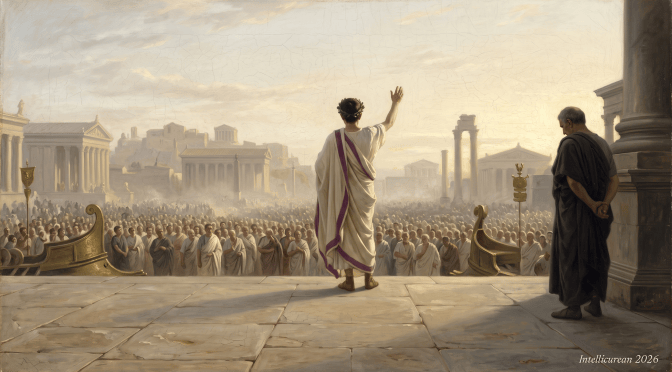
The dictation, AD 65, as the essay imagines it. A generated image, not a record.
Tacitus says the old men in the Forum noticed something new that day: Nero was the first ruler of Rome to need another man’s eloquence. Five years later the same man wrote the letter that explained a mother’s murder to the Senate, and the city blamed the ghost, not the emperor. Three years after that, the charge that ended his career was that he had claimed the credit. And in the first year he owned his own mouth, he wrote the most famous opening in Roman philosophy: set yourself free for your own sake.
Why we’re pointing you there
Michael Cummins follows the voice through four dates, 54, 59, 62 and 65, and finds one word doing the work: aliena, “another’s,” the word Tacitus used for Nero’s borrowed speech and the word Seneca used, in his own letters, for everything a man does not own. The essay makes one guess about what the throne cost him, grades it, and prints the two hostile witnesses who say it cost him nothing. It ends with the one text Seneca dictated as unmistakably his own, on the night he died, and why we don’t have it.
Every speechwriter since is Seneca, and the letter after the crime still gets written.
Read the essay at Intellicurean →
Intellicurious points to the best of what we read and make. The full essay, with its sources and colophon, lives at intellicurean.com.

